| Name | Marrella splendens. The genus name honors John Marr, a Cambridge paleontologist and friend of Walcott; the species name is Latin for “shining” or “splendid” |
| Classification | Phylum Arthropoda, order Marrellida (marrellomorphs). Its higher placement is undetermined |
| Age | Middle Cambrian (Wuliuan), about 508 million years ago |
| Found in | The Burgess Shale (Walcott Quarry and others), British Columbia, Canada. Fossils assigned to the same genus have also been reported from Guizhou and Hunan Provinces in China |
| Length | 2.4 to 24.5 mm (excluding antennae). About 25 mm at most |
| Body segments | 17 in small individuals, 26 or more in large ones (increasing with growth) |
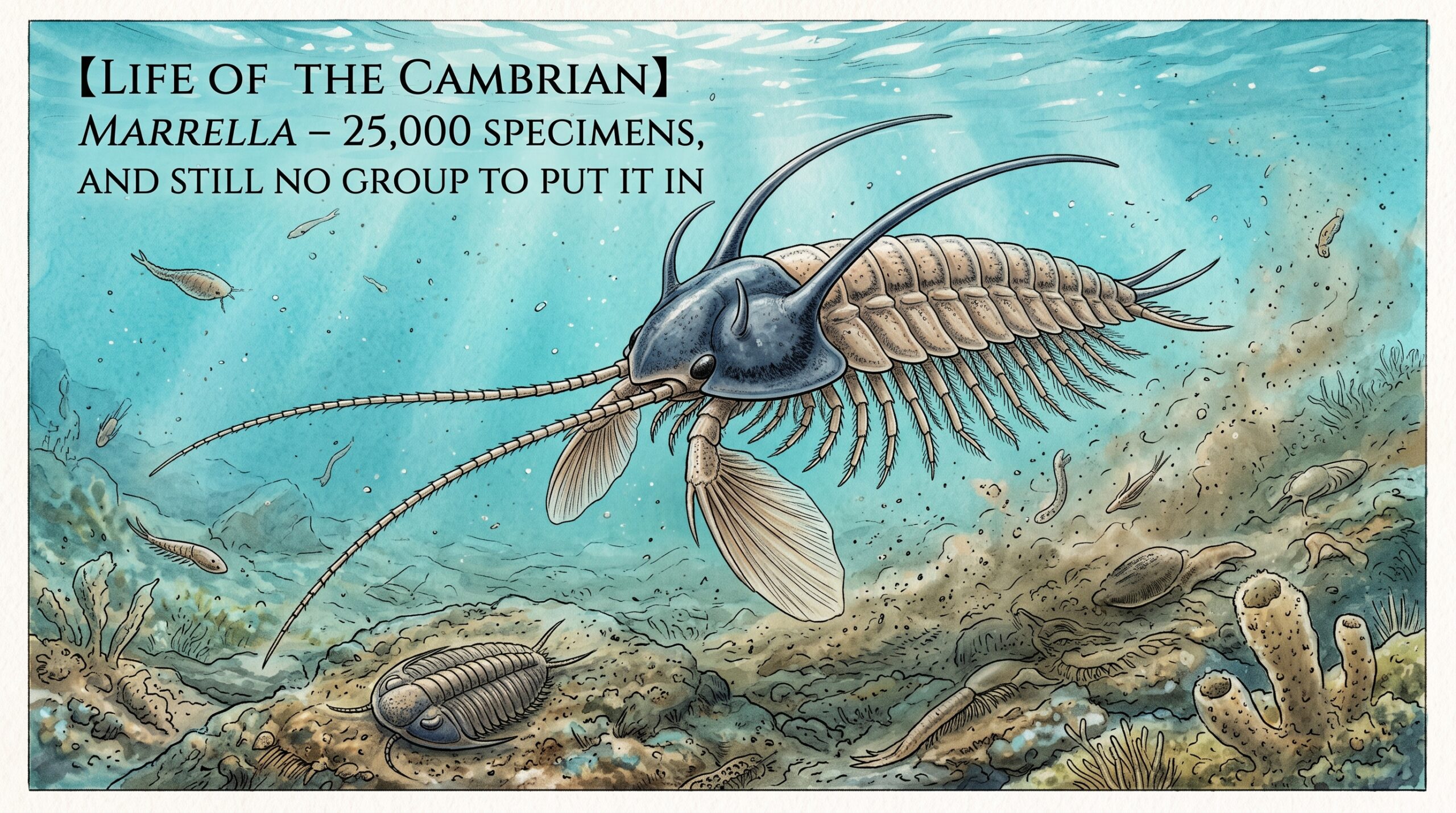
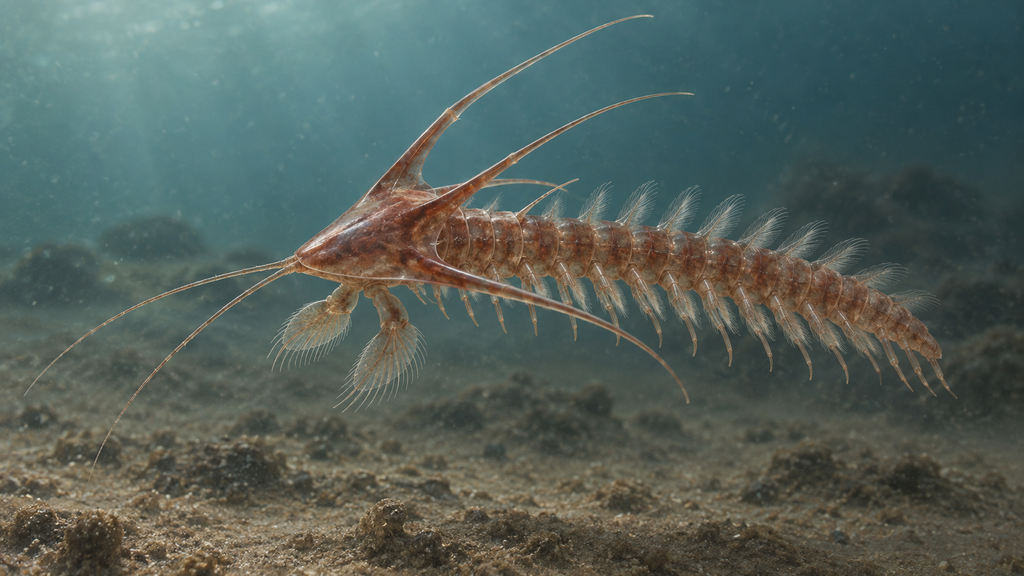
Marrella was a small arthropod that swam in the Cambrian sea. It is distinguished by two pairs of long spines extending backward from a head shield and by legs packed along the underside of the body, and Walcott, its discoverer, was calling it the lace crab before it had a formal name. It is one of the most abundant fossils in the Burgess Shale, with more than 25,000 specimens collected. Despite that wealth of material, which group of arthropods it belongs to remains undecided more than a century after its description.
Form and way of life
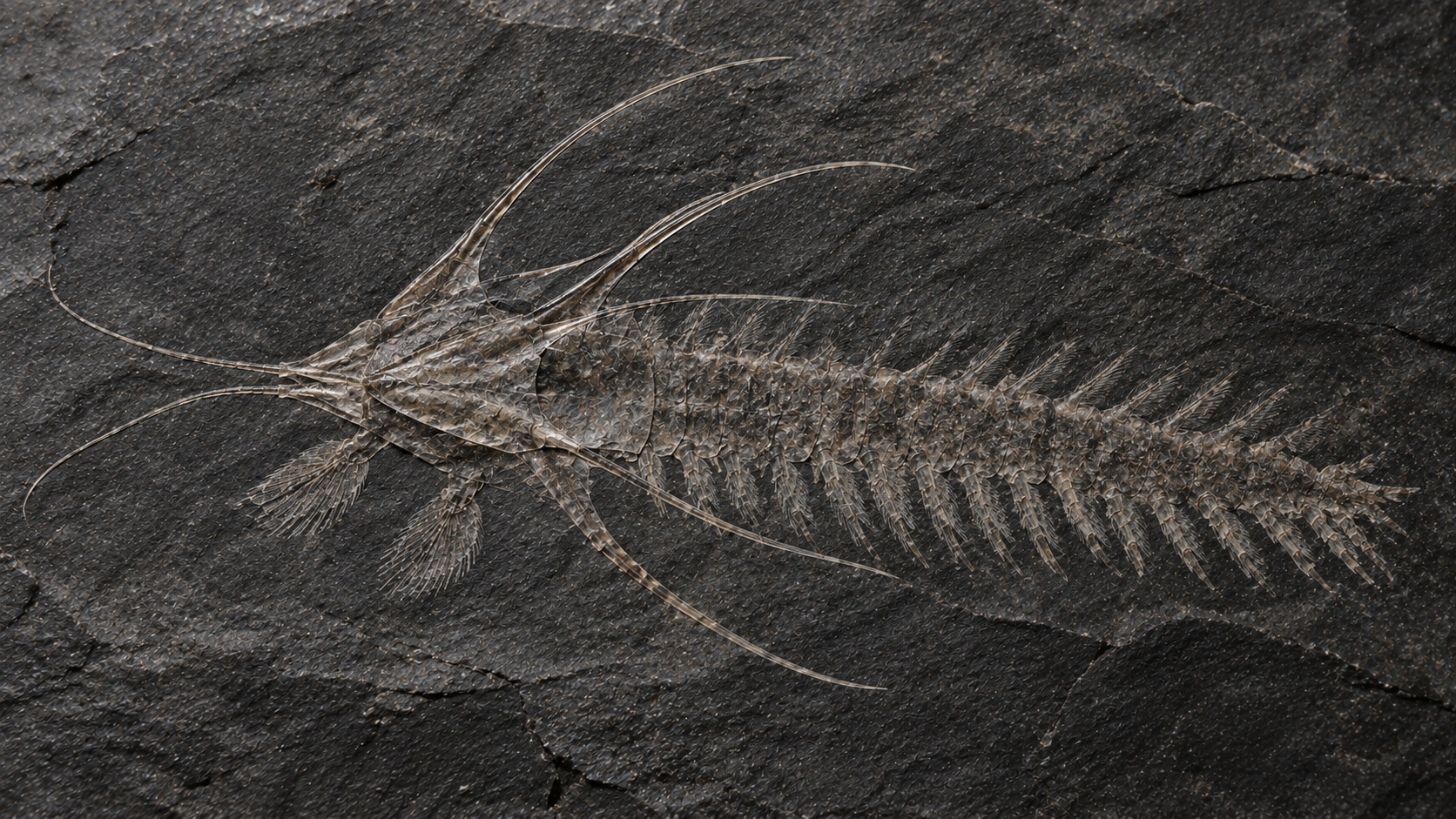
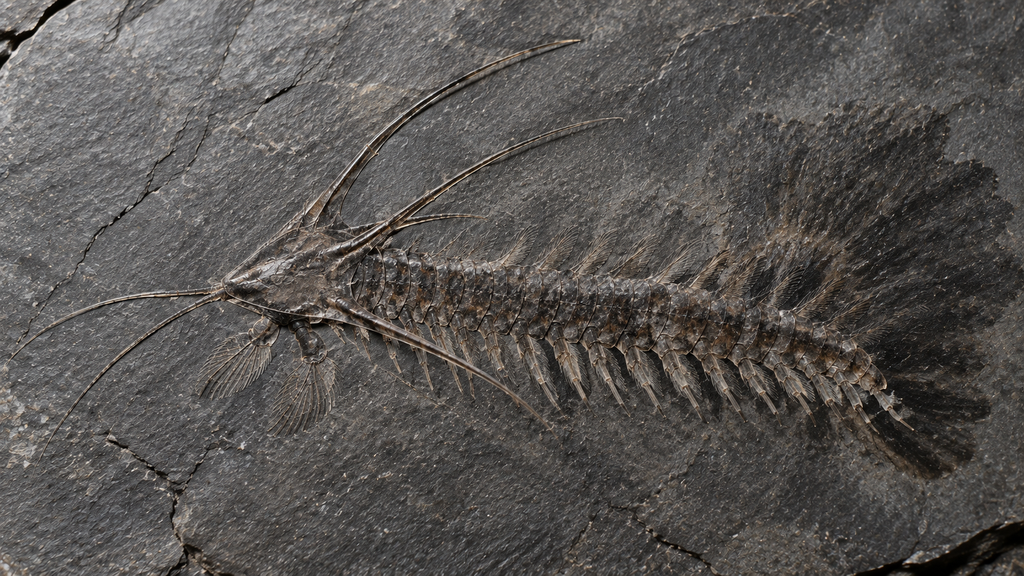
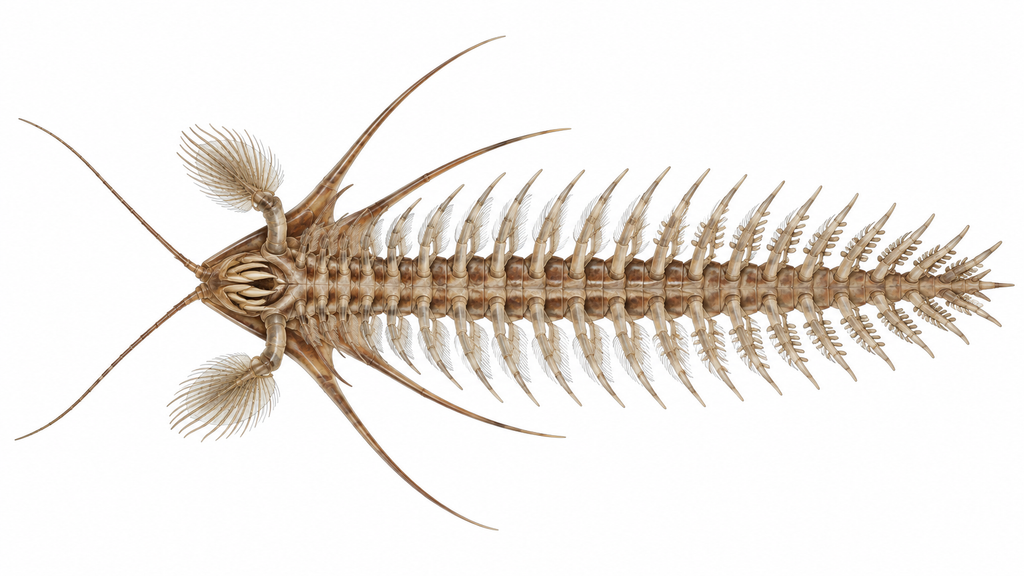
The head is covered by a shield tapering to a wedge at the front, from which two pairs of spines extend backward. One pair projects laterally and the other dorsally, both reaching most of the length of the trunk. A smaller pair sits at the lower rear of the shield, making three pairs in all. There are no compound eyes. The head bears two pairs of appendages: the front pair long, slender antennae of up to thirty segments, and the rear pair six-segmented and fan-like, with dense setae along the margins.
Behind the head follow 26 small ring-like body segments, each carrying a pair of biramous legs. The inner branch is a six-segmented walking limb; the outer branch is a fine filamentous gill. The rear twelve pairs of legs carry rounded projections along their inner edges, forming a net-like structure beneath the body. The tail is barely developed, and the body ends in small segments. The stomach lies within the head, near the mouth, with the gut running from there to near the rear end of the body.
These details are known because of the sheer number of specimens. In 2006, Diego García-Bellido and Desmond Collins re-examined just over a thousand of the more than 9,000 specimens the Royal Ontario Museum had collected since 1975, and assembled an almost unbroken growth series running from 2.4 mm juveniles to 24.5 mm adults. That series also showed body segment counts rising from 17 to 26 or more with growth.
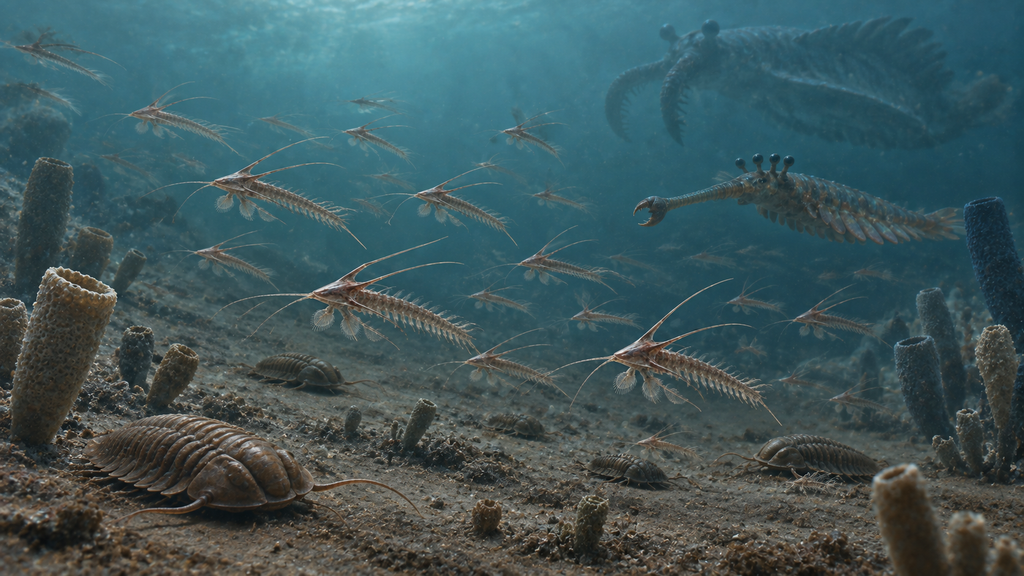
Its way of life is taken to be swimming just above the seafloor. Propulsion came from the second pair of head appendages, once interpreted as a second set of antennae; because their distal five segments are flattened, fringed with setae and carry traces of blood vessels inside, they were reread as paddles for pushing water. The antennae are sensory. Its food was particles of organic matter in the water and on the seafloor surface, and it is reconstructed as catching particles in the net formed by the rear legs and passing them forward to the mouth with the tips of the front legs. The same sea held trilobites, Ottoia, Opabinia and Anomalocaris.
Many Marrella fossils preserve a dark stain around the body, interpreted as the trace of gut contents squeezed out as the animal was flattened by sediment. In 2014, because the stain contains copper-bearing minerals, it was suggested to be a remnant of hemocyanin, the arthropod blood protein; a 2019 re-examination concluded that the mineral formed through metamorphism long after fossilization.
There is also one Marrella specimen fossilized in the middle of moulting. Reported in 2004, it preserves the animal partway through squeezing a still-soft new head shield and spines out of a split at the front of the old exoskeleton. The antennae have already emerged, while the tips of the spines and most of the trunk remain inside the old shell. That Cambrian arthropods moulted as modern arthropods do had previously been shown only indirectly. Such a fossil requires death during the very brief window of moulting to coincide with conditions preserving soft tissue, and it is a single specimen among more than 25,000.
The fossil that announced the Burgess Shale
Marrella is one of the first fossils found in the Burgess Shale. Charles Walcott of the Smithsonian Institution left a sketch of it in his field notebook on 31 August 1909, alongside other soft-bodied fossils. What he found then, though, was float lying on a mountain trail. On 9 August 1910, Walcott and his son Stuart traced the “lace crab bed” into the bedrock, and that became the discovery of the fossil-bearing layer later called the Walcott Quarry. In 1912, Walcott gave the lace crab the name Marrella splendens.
Marrella also stands out in sheer abundance. It makes up 7.3 percent of the specimens counted at the Walcott Quarry, the second most abundant arthropod species. It is also common at Marble Canyon, which includes the same beds as the Burgess Shale, yet is absent from the Tulip Beds at Mount Stephen, so its occurrence varies by locality. Outside the Burgess Shale, fossils assigned to the same genus have been reported from the Kaili Formation in Guizhou and the Balang Formation in Hunan, China, but not from the older Chengjiang biota.
25,000 specimens, and nowhere to put it
Walcott’s 1912 paper describing Marrella treated branchiopods, malacostracans, trilobites and merostomes together, and placed Marrella as close to the trilobites. The first reconstruction, drawn by Percy Raymond in 1920, was likewise made on the premise that it was a trilobite relative.
The turning point came in 1971. Harry Whittington of the University of Cambridge chose Marrella as the first subject in his thorough re-examination of Burgess Shale fossils by modern methods, working through the composition of the head appendages and the construction of the body segments one by one. He concluded that Marrella fits neither the trilobites nor the crustaceans nor the chelicerates — an arthropod belonging to no known group. The word “Trilobitoidea” survives in the paper’s title, but its content rejected that framework. This conclusion became the starting point for the view that Burgess Shale animals do not fit neatly into modern classification, leading on to the re-examinations of Opabinia and Anomalocaris.
Subsequent work has not settled where Marrella goes. Phylogenetic analyses since 1989 have alternately proposed placing it near the base of the arthropod tree, within the arachnomorphs including trilobites and chelicerates, and on the mandibulate side with insects, crustaceans and myriapods. In 2022, a new marrellomorph was described from Ordovician strata in Ontario, and that analysis returned sea spiders as the closest relatives — on the grounds of the loss of compound eyes and the similarity of the head appendages, though with only weak support. In 2025, the internal structure of Primicaris, the oldest marrellomorph, from the Chengjiang biota in China, was examined by micro-CT, and the Marrella lineage was placed on the mandibulate stem.
What researchers currently agree on is that Marrella forms its own grouping, the Marrellida; that its relatives continued through Furca and Tomlinsonus in the Ordovician, Xylokorys in the Silurian and Mimetaster in the Devonian; and that this grouping branched early from somewhere among the major arthropod lineages. Where it branched from shifts with the characters and methods used in the analysis. That the body of Marrella is known in fine detail and yet cannot be fitted into modern classification shows that this is not a problem the number of specimens can solve.
Sources
Marrella splendens – The Burgess Shale (Royal Ontario Museum)
García-Bellido & Collins (2004) Moulting arthropod caught in the act. Nature
Moysiuk et al. (2022) A new marrellomorph arthropod from southern Ontario. Journal of Paleontology
コメント