
| Name | Kimberella quadrata, after the Australian fossil collector John Kimber |
| Classification | Bilaterian. The leading view places it close to the mollusks, but this is not settled |
| Age | Late Ediacaran, Proterozoic (mainly about 558 to 555 million years ago; there are also reports from younger strata) |
| Found in | The Ediacara Hills of South Australia, the White Sea coast of Russia, central Iran, China and elsewhere |
| Length | Up to about 15 cm |
| Width and height | 5 to 7 cm wide, 3 to 4 cm high. Fossils are impressions only, so no weight estimate exists |
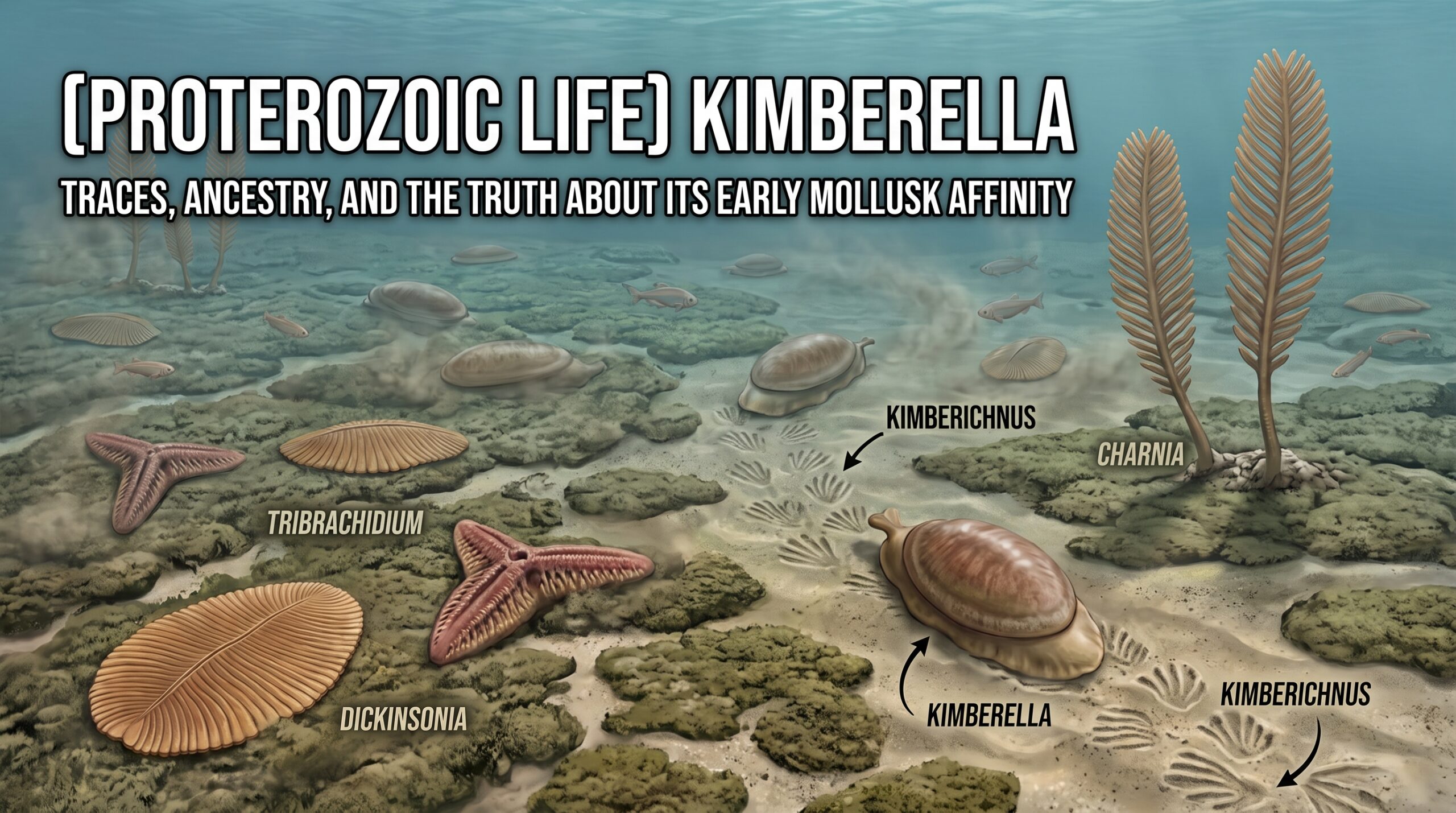
Kimberella was a slug-like animal that crawled across the shallow Ediacaran seafloor. A soft shell covered the back of its oval body, and it moved along the bottom on a muscular foot on the underside, scraping up and eating microbial mats. Described as a jellyfish in 1966, its interpretation was overturned thirty years later by Russian specimens, and it is now treated as a candidate for an organism close to the ancestry of mollusks — a name that comes up whenever pre-Cambrian animal evolution is discussed.
Form and way of life
Seen from above the body is oval, with large individuals reaching 15 cm in length. The dorsal side was covered by a single unmineralized shell, thought to have been firm but flexible enough to bend. A membranous frill ran around the shell margin, and on the underside was a flat, muscular foot corresponding to the foot of a living snail. A 2007 study of more than 800 specimens collected from the White Sea coast of Russia read off not only the shell and foot but also an extensible proboscis and the arrangement of the musculature. For an organism with no hard skeleton at all, its body construction is exceptionally well understood.
Its way of life is reconstructed from marks preserved around the body fossils. The seafloor of the time was covered in mats layered with bacteria and algae, and beside Kimberella fossils one often finds fan-shaped patterns of paired thin scrape marks. These are interpreted as traces left by pulling the mat toward itself with two hard tooth-like organs at the tip of the proboscis, then backing up and eating its way along — a feeding motion close to the way an excavator arm scrapes ground toward itself. These scrape marks carry their own trace-fossil name, Kimberichnus, and on some bedding surfaces the traces are far more numerous than the body fossils.
What it ate has become clearer too. In 2022, a study extracted molecules derived from its diet from Kimberella fossils about 558 million years old from the White Sea coast. The composition of sterols preserved in the fossils indicated a diet of green algae and bacteria, and further concluded that it had gut function comparable to living invertebrates, taking up only particular molecules selectively. Dickinsonia, examined by the same method, showed no evidence of a gut and appears to have absorbed nutrition directly through its body surface — which means that animals eating with a mouth and gut and organisms absorbing through the body surface lived side by side on the same seafloor. Around Kimberella were also the triradial Tribrachidium and frond-shaped relatives of Charnia.
From jellyfish to candidate mollusk ancestor
The first fossils were found in 1959 in the Ediacara Hills of South Australia. They were few and poorly preserved, so the 1966 description treated the animal as a jellyfish, and in 1972 it was interpreted as a box jellyfish. The genus name was originally Kimberia, but that name turned out to be already in use for a snail, and it was renamed Kimberella in 1972. The name honors John Kimber, a fossil collector who died on an expedition in central Australia in 1964. Ironically, an organism renamed because of a clash with a snail’s scientific name would later be reinterpreted as sitting on the mollusk side, the group that includes snails.
The turning point came in the 1990s, when well-preserved specimens emerged one after another from cliffs on the White Sea coast of Russia. In 1997, a study of more than 35 new specimens published in Nature concluded that Kimberella was not a radially symmetrical organism like a jellyfish but a bilaterian with front-to-back and left-right distinctions, equipped with a shell and a foot and resembling a mollusk. A transformation from a drifting jellyfish into a slug crawling on the seafloor. In 2014, a study systematically examining the fan-shaped scrape marks preserved in both Australia and Russia identified their maker as Kimberella and argued that the feeding style was molluscan, not explicable by arthropods. What supports the interpretation of this organism is that the record of behavior — what it was doing — survives on the same bedding surfaces as the body fossils.
This reversal carries significance beyond a single fossil. If bilaterians with shells, feet and guts were already moving about before the explosive diversification of the Cambrian, then the time when the major animal lineages began to diverge must reach back further still. Kimberella is treated as the strongest physical evidence for this, and in molecular clock studies calculating divergence dates from rates of DNA change, it has been used as a calibration point setting the minimum age for the divergence of bilaterians and others. The age of the White Sea strata has been determined at roughly 555 million years by radiometric dating of interbedded volcanic ash, providing the yardstick for the time in which Kimberella lived.
Whether it can be called a mollusk outright, however, remains unsettled. The radula — the grater-like organ of teeth that characterizes living mollusks — has not been found in the fossils, and the two teeth inferred from the scrape marks are not enough to distinguish whether it falls within the mollusk lineage or on a related branch that split off before it. Researchers range from those treating it as an early member of the mollusks to those leaving it as a bilaterian of undetermined affinity. Meanwhile, reports from new localities continue: in 2026, specimens were described from limestone about 550 to 543 million years old in the Yangtze Gorges of China, indicating that Kimberella may have survived longer than previously thought, close to the end of the Ediacaran.


Sources
Fedonkin & Waggoner (1997) Nature, “The Late Precambrian fossil Kimberella is a mollusc-like bilaterian organism”
https://doi.org/10.1038/42242
Fedonkin, Simonetta & Ivantsov (2007) Geological Society, London, Special Publications, “New data on Kimberella, the Vendian mollusc-like organism (White Sea region, Russia)”
https://doi.org/10.1144/SP286.12
Gehling, Runnegar & Droser (2014) Journal of Paleontology, “Scratch Traces of Large Ediacara Bilaterian Animals”
https://doi.org/10.1666/13-054
Bobrovskiy et al. (2022) Current Biology, “Guts, gut contents, and feeding strategies of Ediacaran animals”
https://doi.org/10.1016/j.cub.2022.10.051
Wu et al. (2026) Precambrian Research, “Kimberella from the terminal Ediacaran Shibantan limestone, South China”
https://doi.org/10.1016/j.precamres.2026.108164
Australian National University press release (2022, via ScienceDaily)
https://www.sciencedaily.com/releases/2022/11/221122111515.htm
コメント