
| Name | Charniodiscus (“the disc of Charnwood”) |
| Classification | Petalonamae, Arboreomorpha (thought to be an early animal lineage; its precise position is undetermined) |
| Age | Ediacaran (about 565 to 555 million years ago) |
| Found in | The United Kingdom (Charnwood Forest), Canada (Newfoundland) and elsewhere |
| Length | About 20 to 50 cm (from disc to frond tip; varies by species and specimen) |
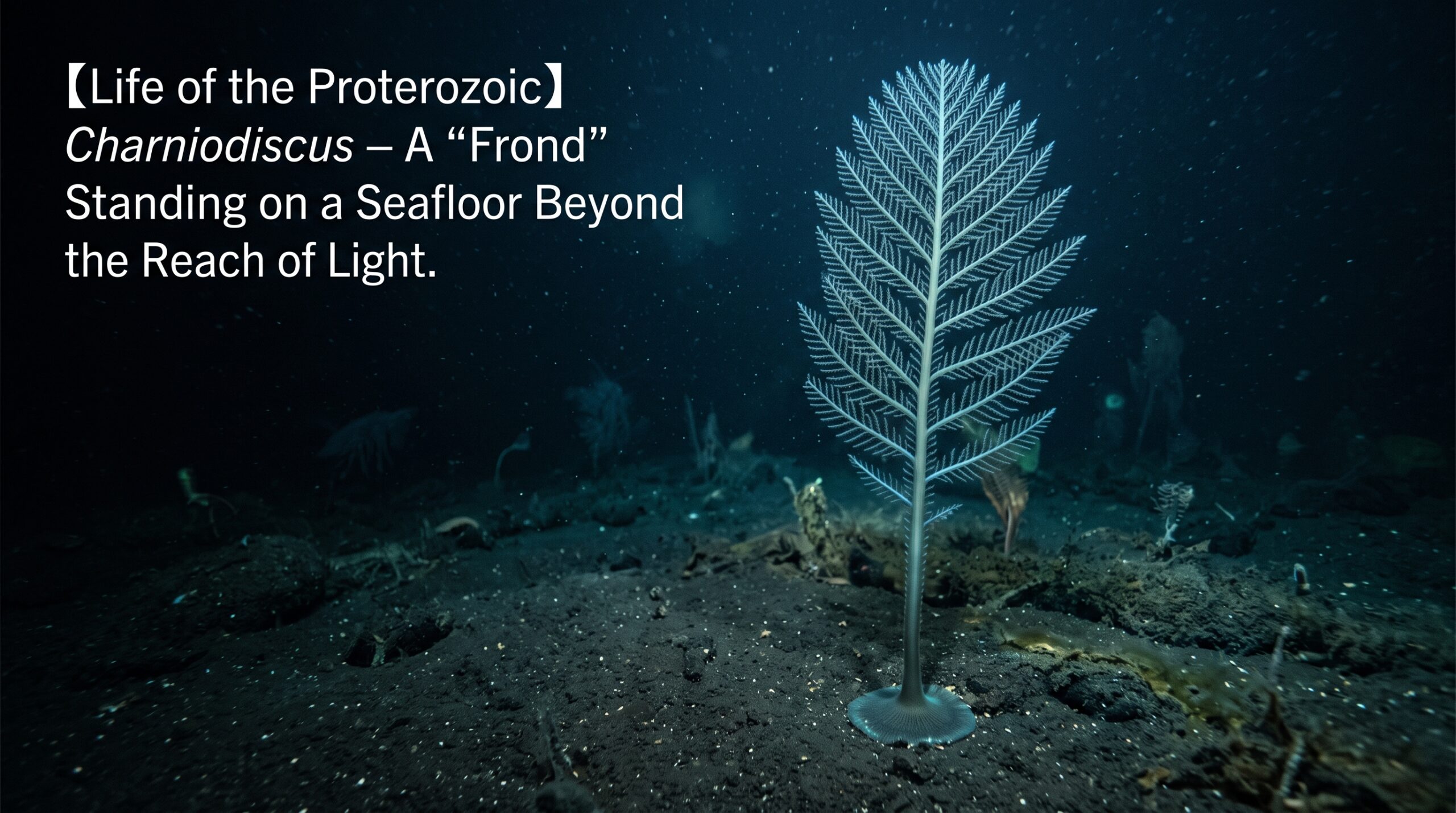
Charniodiscus was a frond-shaped organism anchored to the Ediacaran seafloor. A bulb-like disc buried in the sediment held the body in place, and a frond on the end of a stalk stood up into the water. It looks like a seaweed, but it stood on a deep seafloor beyond the reach of light, so it did not live by photosynthesis. And the name “the disc of Charnwood” was given not to the frond or the stalk, but to the disc at its base.
A “frond” standing on a lightless seafloor
The body is made of three parts: the disc holding it to the seafloor, the stalk rising from it, and the frond spreading into the water. Fine branches are arranged regularly along the frond, which tapers to a point. The British type specimen runs about 20 cm from the center of the disc to the tip, and specimens from Newfoundland include a species that appears to have raised its frond about 50 cm off the seafloor on a long stalk.
With a soft body lacking bones or shell, every fossil is an impression left on a seafloor surface. At Mistaken Point in Newfoundland, the seafloor of the time survives intact, buried at once by volcanic ash, and the frond fossils on a single surface all lie toppled in the same direction. The interpretation is that a population streaming like weathervanes in the bottom current fell and was buried in the orientation in which it had stood.
That seafloor lay far deeper than the depth at which photosynthesis is possible. There was no living by light as plants and algae do, and the organism is thought to have taken in nutrition by straining or absorbing particles of organic matter carried by the water and organic matter dissolved in it. The frond-like form, then, was not for catching light but for gaining surface area in contact with water. Around it stood other frond-shaped organisms including Charnia, with almost no swimming animals in sight and no organisms with eyes or mouths yet — a quiet seafloor.
It closely resembles the sea pens (relatives of corals) living in today’s oceans, but sea pens appear much later, and their mode of growth differs. The leading view is that the resemblance is coincidental, with no direct connection. Charniodiscus itself is most often placed within an early animal lineage, but which living group it leads to has not been settled.
The face of the field guide, moved to another genus
The description of this organism began from one part of the body alone. In 1958, on the basis of fossils found in Charnwood Forest in England, Trevor Ford published two names at once: Charnia for the frond fossils, and Charniodiscus for the concentric disc fossils. At that point the disc was thought to be the basal part of Charnia, and the genus name Charniodiscus was born referring, in effect, to the anchor alone. It was redescribed as a single organism with the frond attached to the disc only in 1963.
Well-preserved specimens were then found one after another at sites such as the Ediacara Hills in Australia, and were described as species of this genus. Most reconstructions showing a neat frond spread at the end of a stalk are based on those specimens, and for a long time they carried the image of Charniodiscus that appeared in field guides and textbooks.
Then in 2018, a study re-examining three-dimensionally preserved Australian specimens separated them from Charniodiscus, reviving the genus name Arborea, which had been merged away, and transferring them to it. In 2022, the type specimens from Charnwood Forest, the starting point, were themselves re-examined: the frond of this genus was shown to spread conically rather than flat, and to lack the dorsal sheet-like structure present in the arboreans. As a result, what remained in Charniodiscus was a very small number of species including the type species. Much of the form that long served as the face of the field guide belongs, under the current division, to Arborea.
A genus, then, that was born as a name for a disc alone, acquired a body, multiplied its species around the world, and gave most of them up. For Ediacaran organisms, which leave nothing but impressions of soft bodies, deciding which fossil belongs with which is itself difficult, and the sixty-odd years of Charniodiscus are that difficulty given a history.


Sources
The paper first describing the Charnwood Forest fossils and naming Charnia and Charniodiscus: Ford, “Pre-Cambrian fossils from Charnwood Forest” (Proceedings of the Yorkshire Geological Society, 1958)
Measuring the Mistaken Point specimens and revising the species of this genus: Laflamme, Narbonne & Anderson, “Morphometric analysis of the Ediacaran frond Charniodiscus from the Mistaken Point Formation, Newfoundland” (Journal of Paleontology, 2004)
Reviving the genus Arborea on the basis of three-dimensional Australian specimens: Laflamme, Gehling & Droser, “Deconstructing an Ediacaran frond: three-dimensional preservation of Arborea from Ediacara, South Australia” (Journal of Paleontology, 2018)
Re-examining the type specimens and concluding that Charniodiscus and Arborea are separate genera: Pérez-Pinedo et al., “Charniodiscus and Arborea Are Separate Genera Within the Arboreomorpha” (Frontiers in Earth Science, 2022)
コメント