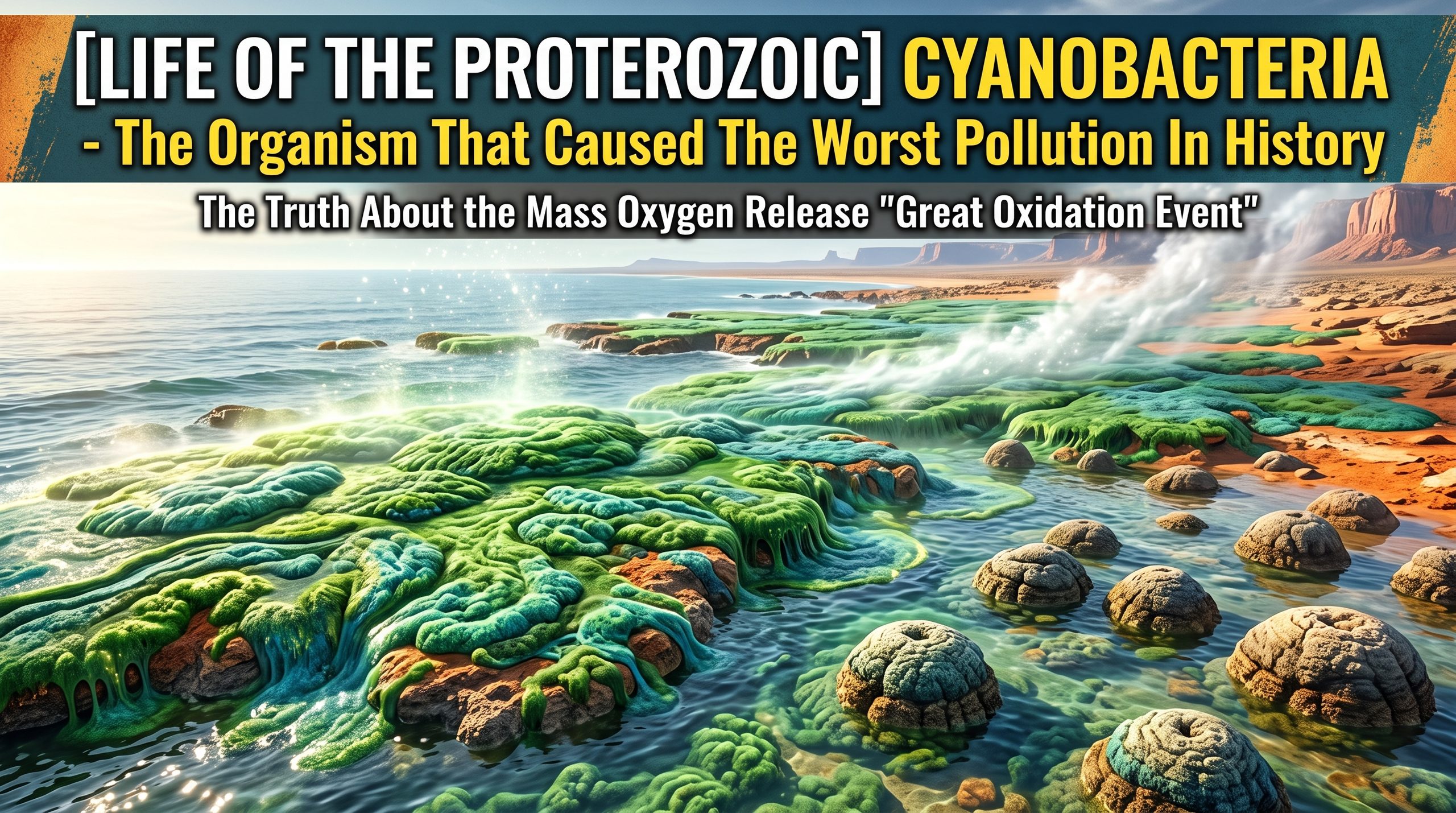

| Name | Cyanobacteria. The name comes from the Greek kyanos, meaning dark blue |
| Classification | Domain Bacteria, phylum Cyanobacteria |
| Age | About 2 billion years ago (the record of confirmed fossils) to the present. Their origin itself is thought to be older still |
| Found in | Worldwide. The oldest confirmed fossils come from the Belcher Islands, Canada |
| Size | Cell diameter generally 1 to 10 micrometers — an order of magnitude thinner than a human hair. When cells link into filaments or stack into mats, they become visible to the naked eye |
Cyanobacteria are bacteria that perform photosynthesis and release oxygen. Confirmed fossils reach back about two billion years, and they still live today in seas and rivers, rice paddies and hot springs. On the early Earth they kept producing oxygen in bulk and rebuilt the composition of the atmosphere itself.
A bacterium that photosynthesizes like a plant
Cyanobacteria were once called blue-green algae in older textbooks. Despite the word “algae,” they are neither plants nor algae but bacteria, cells without a nucleus. A single cell is a few micrometers across. Some float alone, some link like beads into filaments, and some build layered mats while trapping grains of sand.
What makes these bacteria special is oxygenic photosynthesis: producing nutrients from water, carbon dioxide and sunlight while releasing oxygen. It is the same mechanism plants use, but the order is the reverse — cyanobacteria invented it first. The chloroplast that handles photosynthesis inside a plant cell is thought to be a descendant of a cyanobacterium taken up into another cell long ago. Which means the trees in a forest and the grass at the roadside all live by putting the descendants of cyanobacteria to work inside their cells.
Their performance on today’s Earth is unchanged. Drifting through tropical seas is Prochlorococcus, a minute cyanobacterium about 0.6 micrometers across. Regarded as the most numerous photosynthetic organism on the planet, its total number runs to 10^27, and some estimates credit this group with producing roughly 20 percent of Earth’s oxygen. Others settle in hot spring pools, rice paddies and even the surfaces of dry rock — almost anywhere light reaches. The blooms that turn summer lake surfaces green are cyanobacteria multiplying in mass.
Preserved in rock, two billion years on
Cyanobacteria have soft bodies with neither bone nor shell, so they fossilize poorly. Given the right conditions, though, they do survive. The key is the stromatolite, a structure formed as bacterial mats stack into layers while trapping grains of sand and carbonate.
The oldest fossil widely accepted as definitely cyanobacterial is Eoentophysalis belcherensis, found in the Belcher Islands of Canada. It was preserved down to the shape of the cells inside stromatolites about 2.018 to 1.854 billion years old. And its form closely resembles cyanobacteria living in shallow seas today. Two billion years ago, in other words, a form essentially indistinguishable from the present one was already in place.
Stromatolites themselves are still being built. At Shark Bay in Western Australia, rocky masses stacked up by cyanobacterial mats stand in rows across the shallows, showing the scenery of an ancient sea as it was.
The worst pollution event in history
For cyanobacteria, oxygen is not the objective. It is simply waste, left over after photosynthesis produces nutrients. And that waste bent the course of Earth’s history. Around 2.43 billion years ago, oxygen began to appear in an atmosphere that had been essentially oxygen-free — the turning point known as the Great Oxidation Event.
The problem was that nearly every organism of the time lived on the premise of a world without oxygen. Oxygen is a highly reactive molecule, and to an unprotected cell it is a poison that sets about wrecking the components. The oxygen released by cyanobacteria transformed, root and branch, the environment of microbes with no means of handling it. That is why the event carries the alarming alternative name of the oxygen catastrophe, and as an example of organisms transforming the planetary environment with their own waste, nothing exceeds it.
What died, and how much, is in fact not clearly known. Microbes leave almost no fossils, so direct evidence of the scene of extinction is hard to obtain. What is certain is that oxygen-averse microbes are still alive, and that their habitats are confined to places oxygen cannot reach: the mud of swamps, seafloor sediments, the guts of animals. A way of life that once extended across the whole planet has been driven into the places without oxygen.
The effects of oxygen may not have stopped with living things. The atmosphere of the time contained a good deal of methane, a strong greenhouse gas, and oxygen destroys methane. With less methane the Earth cooled, and the strata record a major ice age beginning around the same time as the Great Oxidation Event. The scenario that destruction of methane by oxygen was the trigger is favored, though this too is not settled.
Afterward, the mechanism of aerobic respiration — extracting energy using oxygen — spread, and the poison turned into the most efficient fuel available. That we can live by breathing is a continuation of that switch. The oxygen that caused the pollution became, unchanged, the resource sustaining the living world, and cyanobacteria are still producing it.


Sources
On the discovery of thylakoids in fossil cells about 1.75 billion years old: Demoulin et al., “Oldest thylakoids in fossil cells directly evidence oxygenic photosynthesis” (Nature, 2024). The age of the oldest confirmed cyanobacterial fossil (Eoentophysalis) also follows the account in this paper.
On the onset date of the Great Oxidation Event and its correspondence with the early glaciations: Gumsley et al., “Timing and tempo of the Great Oxidation Event” (PNAS, 2017)
On how atmospheric oxygen came to be established: Poulton et al., “A 200-million-year delay in permanent atmospheric oxygenation” (Nature, 2021)
On Prochlorococcus: the explainer at the Smithsonian Institution’s Ocean Portal
コメント