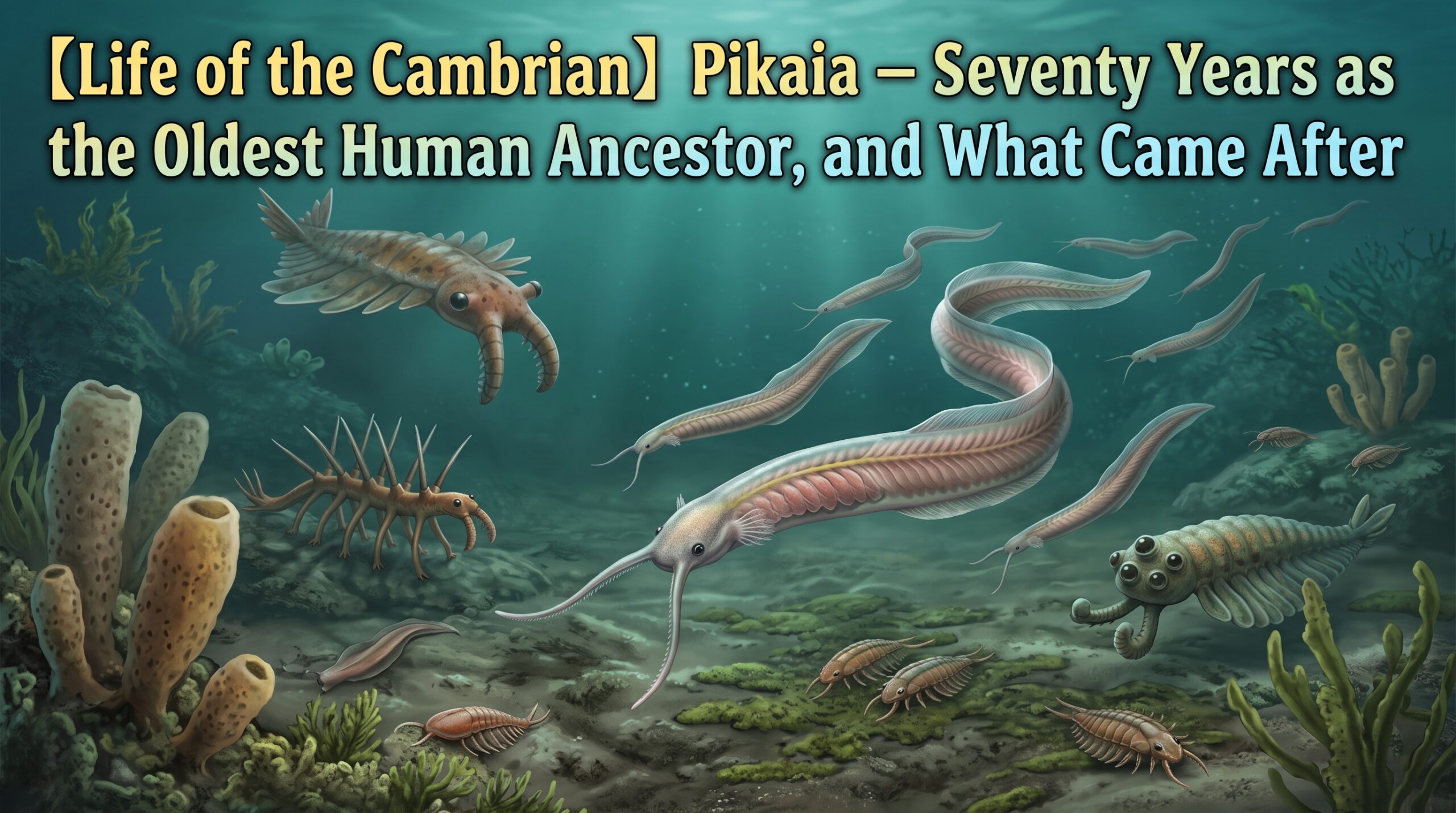
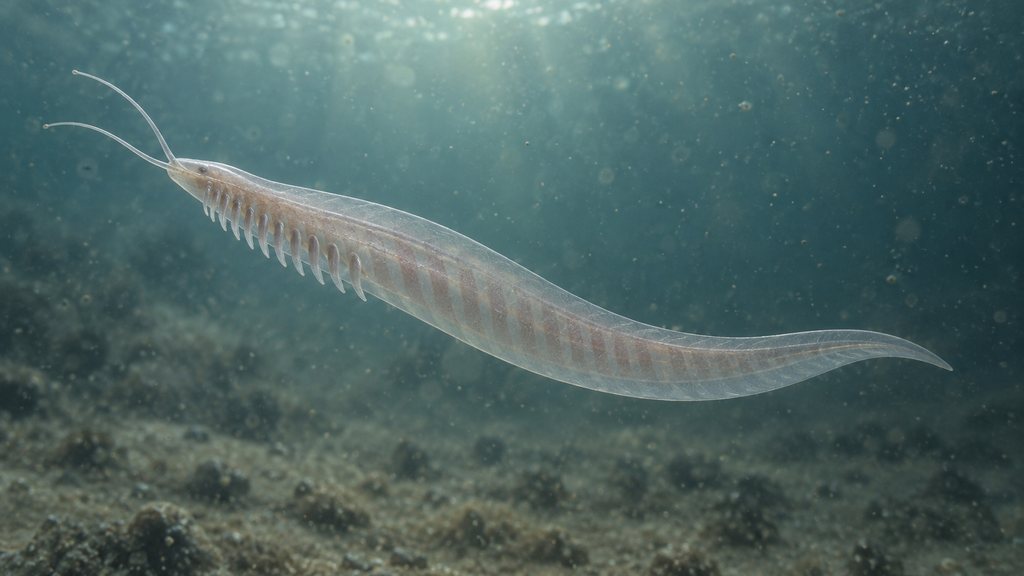
| Name | Pikaia gracilens. The genus name comes from Pika Peak near the fossil locality; the species name means “slender” |
| Classification | Chordate (an early lineage belonging to no living group) |
| Age | Middle Cambrian (about 508 million years ago) |
| Found in | The Burgess Shale, British Columbia, Canada |
| Length | 1.5 to 6 cm (averaging just under 4 cm) |
| Weight | Around 1 gram (approximated from living lancelets of the same size) |
Pikaia was a small chordate that swam in the Cambrian sea. It had a nerve cord running down the center of the body with muscle blocks flanking it on either side, and its construction is close to that of the living lancelet. After being recognized as a chordate in 1979, it appeared in field guides and popular books as the oldest ancestor leading to humans — a title it lost in 1999, when older fish fossils were found in China.
Form and way of life
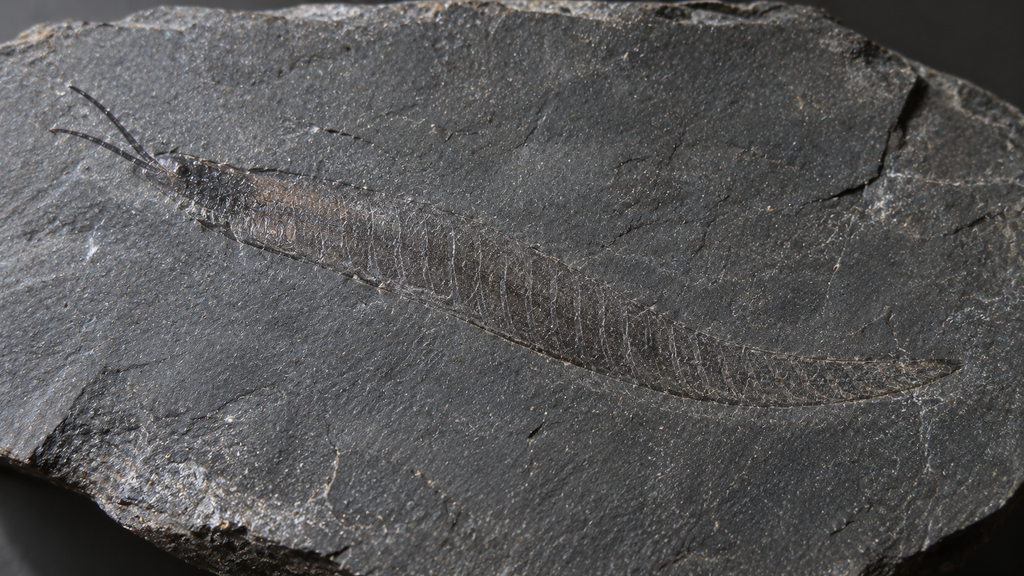
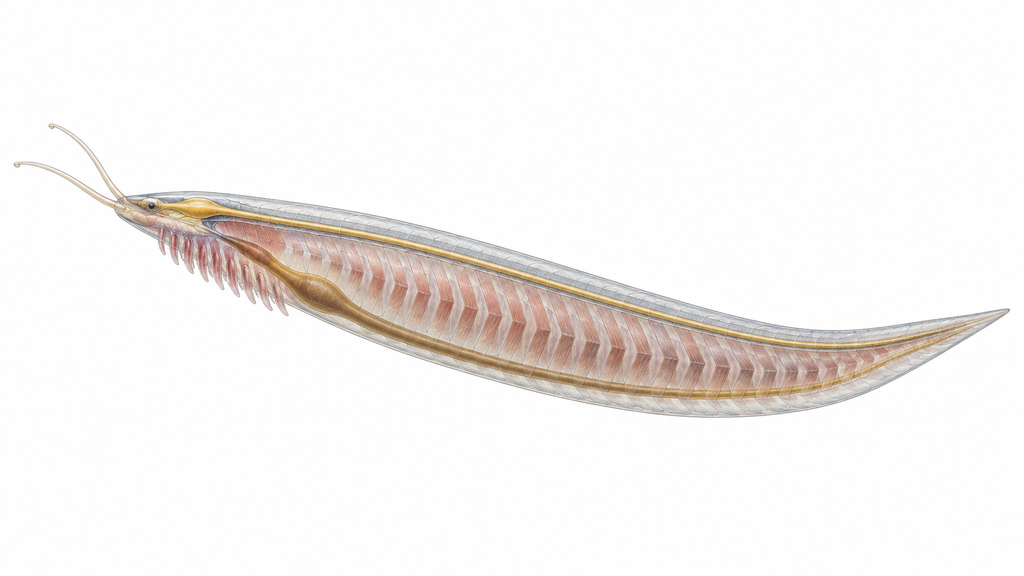
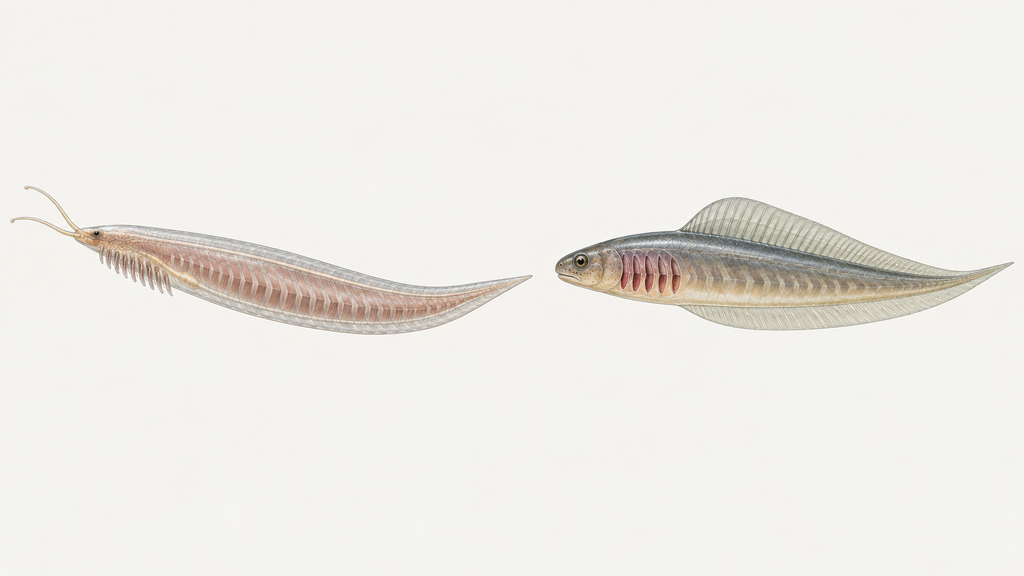
The body is leaf-shaped, compressed from side to side, taller than it is wide, and tapering gently toward the tail. A pair of slender tentacles extends from the front of the head, with short projections arranged along the sides of the body behind them. These projections are thought to have been external gills for taking oxygen from the water. There are no paired fins.
The most conspicuous internal feature is a series of vertical stripes running regularly from head to tail. These are the boundaries between muscle blocks (myomeres), and about a hundred can be counted. As in living fish, the animal is reconstructed as swimming eel-like, contracting these blocks alternately left and right to throw the body into an S. The musculature lacks fibers for fast movement, however, so its motion appears to have been slow. It is thought to have drifted near the seafloor, filtering small particles from the water.
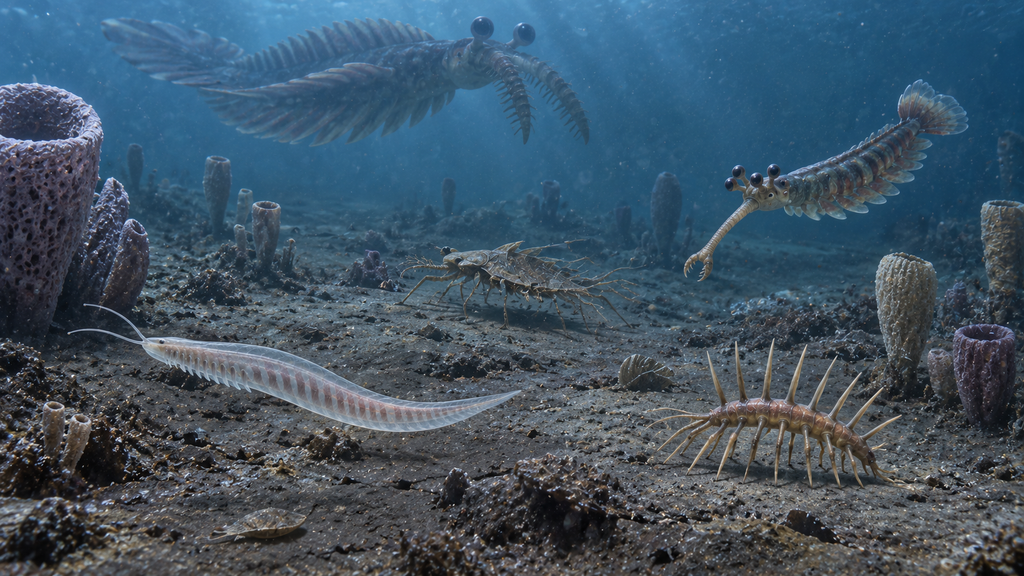
The basis for the reconstruction is 114 specimens from the Burgess Shale. That the bodies of animals with neither shell nor bone survive in this number is peculiar to the Burgess Shale, where they were buried rapidly in fine mud, and traces of soft tissue — muscle blocks, gut, nerve cord — remain on the rock surface as thin carbon films. The same strata yield the Cambrian cast of Anomalocaris, Hallucigenia, Opabinia and Marrella, among which Pikaia was an inconspicuous, unremarkable swimmer.
This reconstruction underwent a major correction in 2024. The surface long taken for the underside turned out to be the back: for more than a century the animal had been viewed upside down. The single tube running along the dorsal side is not a blood vessel but the nerve cord, which swells near the head and branches into the two tentacles. Once the orientation is corrected, the curvature of the muscle blocks and the direction of the external gills stop conflicting with living chordates, and Pikaia‘s position as an early branch of the chordates became clear. Whether the notochord itself, the precursor of the backbone, is preserved in the fossils remains a matter on which researchers differ.
The years as “our ancestor”
Pikaia was first described by Charles Walcott, who discovered the Burgess Shale. In 1911, Walcott read the vertical stripes along the body as body segments and reported Pikaia as a polychaete worm. For roughly seventy years afterward, it was treated as one of the many worm-like animals of the Burgess Shale.
That assessment changed in 1979. Simon Conway Morris of the University of Cambridge, working through the Burgess Shale fossils comprehensively, reinterpreted the stripes as muscle blocks rather than segments, read a rod-like structure along the body axis as a notochord, and moved Pikaia to the chordates. It was the oldest chordate fossil then known, and from there Pikaia took up the position of the animal that fish, dinosaurs and humans all trace back to. What spread this view was Wonderful Life, published in 1989 by the paleontologist Stephen Jay Gould. The book closes with a thought experiment: had Pikaia not survived in the Cambrian sea, vertebrates would not exist. Pikaia became one of the most famous Cambrian animals in popular science writing, and headlines calling it the oldest human ancestor became standard in Japanese field guides and general books as well.
That title collapsed in 1999, when two animals, Myllokunmingia and Haikouichthys, were reported from Chengjiang in Yunnan Province, China. Both are about 3 cm long, with gill pouches, a dorsal fin and a clearly differentiated head — unmistakably fish. The Chengjiang strata date to about 518 million years ago, roughly 10 million years older than the Burgess Shale. Which means that when Pikaia was swimming, vertebrates with bodies far more advanced than its own were already in the sea. Pikaia can be neither the oldest chordate nor a direct ancestor of vertebrates. Its current position is as a distant relative that branched off the ancestral line and survived with a form of its own.
In 2012, Conway Morris, together with Jean-Bernard Caron of the Royal Ontario Museum, published a detailed description re-examining all 114 specimens under the electron microscope. With evidence of muscle blocks, a nerve cord and blood vessels assembled, Pikaia‘s status as a chordate was secured at that point. Caron, however, stated plainly that Pikaia is not our direct ancestor but a very distant relative. The 2024 reinterpretation reversing its orientation does not change that placement either; it made clearer that Pikaia is a branch diverging near the base of the chordates, belonging to neither the lancelets nor the vertebrates.
Having given up the ancestral seat, Pikaia has not lost its importance. Because the Chengjiang fish had already completed the vertebrate body, those fossils cannot tell us what form chordates started from. With muscle blocks and a nerve cord but neither vertebrae nor a skull, Pikaia is one of the few fossils preserving the stage before that, and it remains a starting point for thinking about the origin of chordates.
Sources
Conway Morris, S. & Caron, J.-B. (2012). Pikaia gracilens Walcott, a stem-group chordate from the Middle Cambrian of British Columbia. Biological Reviews.
https://doi.org/10.1111/j.1469-185X.2012.00220.x
Mussini, G. et al. (2024). A new interpretation of Pikaia reveals the origins of the chordate body plan. Current Biology.
https://doi.org/10.1016/j.cub.2024.05.026
Shu, D.-G. et al. (1999). Lower Cambrian vertebrates from south China. Nature 402, 42–46.
https://doi.org/10.1038/46965
University of Cambridge (2012). Humans’ oldest ancestor found (press release for the 2012 description)
https://www.cam.ac.uk/research/news/humans-oldest-ancestor-found
Royal Ontario Museum (2012). Press release for the 2012 description (on the study of the 114 specimens)
https://www.rom.on.ca/en/node/1840
コメント