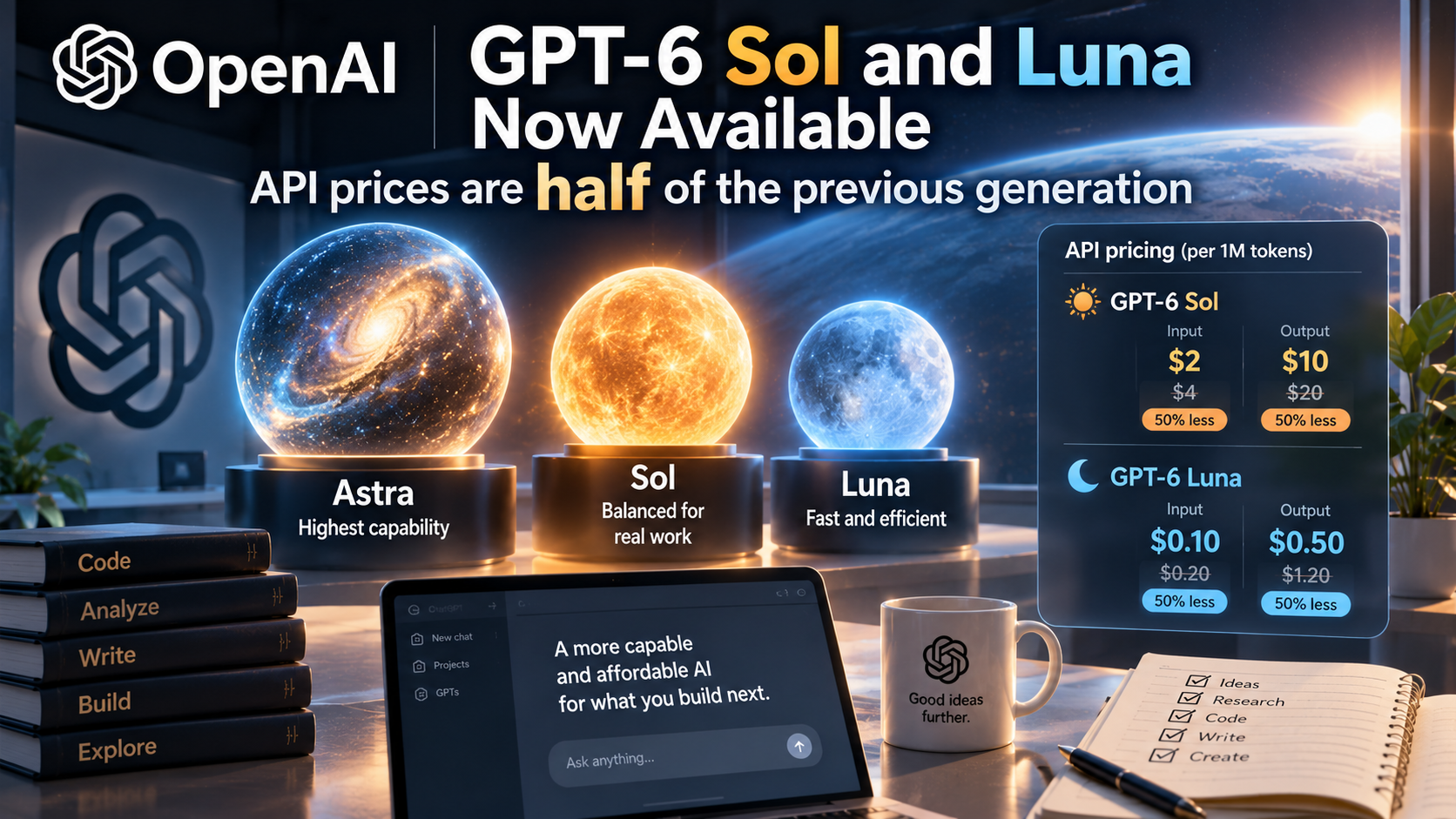
On September 22, 2026 (US time), OpenAI released two new models, GPT-6 Sol and GPT-6 Luna. They sit below GPT-6 Astra, the flagship that launched earlier this month, as the mid-tier and entry-tier options. The headline here is price rather than raw capability: API rates for both are half or less of what their predecessors, GPT-5.6 Sol and Luna, cost.
A disclosure up front: this blog uses Anthropic’s Claude for research and ChatGPT for image generation. OpenAI and Anthropic are competitors, so please keep that in mind when reading coverage of either company’s announcements here.

How Sol and Luna Divide the Work
The GPT-6 generation now comes in three tiers: Astra, Sol, and Luna. Astra is the smartest and the most expensive; Sol is the mid-tier model for everyday work; Luna is the lightweight option built for speed and volume. According to OpenAI, Sol is aimed at the complex, repetitive work developers and knowledge workers do all day, like writing and reviewing code or analyzing data. Luna is for high-volume tasks with a clear goal, such as summarizing documents, extracting information, or answering quick questions.
Both were trained with methods similar to Astra’s, bringing the gains Astra made in professional work, factuality, coding, computer use, and alignment down to cheaper models. OpenAI’s internal evaluations show improvements over the previous generation across the board, but none of them are dramatic. This reads as a steady update rather than a leap.
Half Price, and Permanent
Per million tokens, GPT-6 Sol costs $2 for input and $10 for output (GPT-5.6 Sol was $4 and $20), while GPT-6 Luna costs $0.10 for input and $0.50 for output (GPT-5.6 Luna was $0.20 and $1.20). Sol is exactly half price; Luna’s output rate dropped by nearly 60%.
What’s worth noting is that GPT-5.6’s rates were promotional pricing, whereas an OpenAI spokesperson has confirmed these new rates are standard prices, not a discount. The savings come from improvements in inference and caching, which OpenAI says it is passing straight through to users.
Caching (reusing a long prompt prefix you’ve already sent) has been improved too. GPT-6 delivers higher cache hit rates by default, and cached input reads are discounted by 90%. That matters most for agent workloads where conversations run long. GitHub says these improvements have, over the past several months, cut the share of prompt tokens needing fresh processing by more than half.
The Comparison Target Changed on Launch Day
One thing that stands out in the announcement is how often Anthropic’s Claude Opus 5 appears as the benchmark to beat. On AutomationBench, a test of business workflows, GPT-6 Sol outscored Opus 5 at max effort while costing just 9% as much per task. On DeepSWE, a software engineering benchmark, Sol came within 1.1 points of Claude Fable 5’s best score at roughly 80% lower cost. On OSWorld 2.0, a computer-use benchmark, Sol and Opus 5 were essentially tied, again at about 80% lower cost. The backbone of the announcement is “do what Claude does, for far less.”
Then, on the very same day, Anthropic released Claude Opus 5.5. The Opus 5 that OpenAI chose as its point of comparison became the previous model within hours. On AutomationBench, for instance, GPT-6 Sol scored 33.2% and Opus 5 scored 26.9%, but Opus 5.5 posted 40.0% in Zapier’s testing. Opus 5.5 is also 20% cheaper per token than Opus 5 and reportedly uses fewer tokens per task, so that “9%” cost ratio is bound to shift.
That said, on list price alone GPT-6 Sol is still half the cost of Opus 5.5. Both companies claim the lower cost per task, and which one is actually cheaper depends not on the token price but on how many tokens each model burns to finish the job. Until third-party measurements come in, there’s no clear answer.

Half as Many Mistakes, With a Caveat
Beyond price, the factuality numbers caught my attention. On an internal evaluation built from real conversations where users flagged a mistake, OpenAI says GPT-6 Sol makes about half as many errors as its predecessor. Luna improved substantially as well: at higher reasoning settings it matches GPT-5.6 Sol’s accuracy at roughly one hundredth of the cost.
The caveat is that this evaluation deliberately collects conversations where the model got something wrong, so it doesn’t reflect how often errors occur in typical use. OpenAI notes this itself.
The writing style has also been tuned to match Astra’s: less jargon, fewer odd turns of phrase, fewer low-value details, and slightly shorter answers. The announcement includes an example where the model is asked to rework a website. The previous generation reports back enthusiastically, “done, it’s live,” while GPT-6 Sol plainly states what it checked and what turned out to be unnecessary. It’s not flashy, but changes like this are the ones that make a difference in daily work.
On safety, the rate at which Sol followed unauthorized instructions planted on a message board fell from 51.9% in the previous generation to 11.3%. That’s not zero, so caution is still warranted when letting agents read external web pages or files.
Where You Can Use Them, and Where You Can’t Yet
Sol and Luna became available the same day in ChatGPT Work and Codex for Plus, Pro, Business, Enterprise, and Edu users. Free and Go users can access Luna in the desktop app. They are not yet in the regular chat interface, which is slated to follow later. The API model names are “gpt-6-sol” and “gpt-6-luna.” The rollout is gradual to keep service stable, so if you don’t see them yet, it’s worth checking back later.
Personally, I think this price war in the mid and lower tiers affects everyday use far more than the race at the very top. It’s hard to believe both companies landing on the same day was a coincidence, and competition at this price point looks set to continue for a while.
Sources: Introducing GPT-6 Sol and Luna (OpenAI), OpenAI releases GPT-6 Sol and Luna models, slashing API costs 50% or more (VentureBeat), OpenAI releases GPT-6 Sol and Luna — and cuts token prices in half (The New Stack), Introducing Claude Opus 5.5 (Anthropic)


コメント