| Name | Charnia masoni (the genus name after Charnwood Forest, where it was found; the species name after Roger Mason, the boy who reported the discovery) |
| Classification | Rangeomorpha (Ediacaran biota) |
| Age | Ediacaran (about 570 to 550 million years ago; the English fossils date to about 562 million years) |
| Found in | The United Kingdom (Charnwood Forest), plus Canada, Russia, Australia and China |
| Length | About 1 to 66 cm |
Charnia was an organism shaped like a fern frond, anchored to the Ediacaran seafloor. It was the first fossil from Precambrian strata to be formally recognized as such — a landmark that overturned the standing assumption in the history of life that fossils only occur from the Cambrian onward. And yet that same assumption very nearly buried the discovery.
Form and way of life
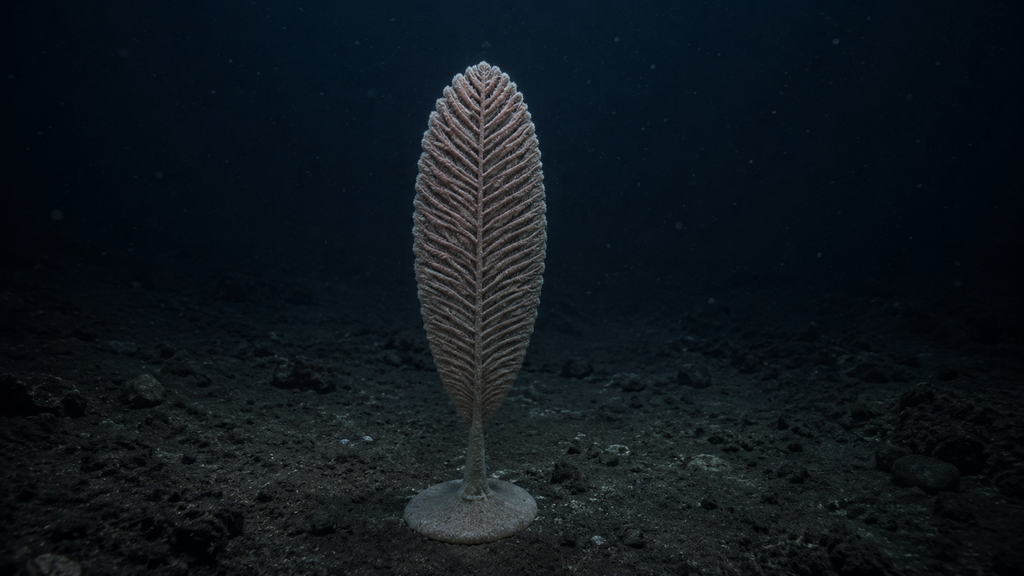
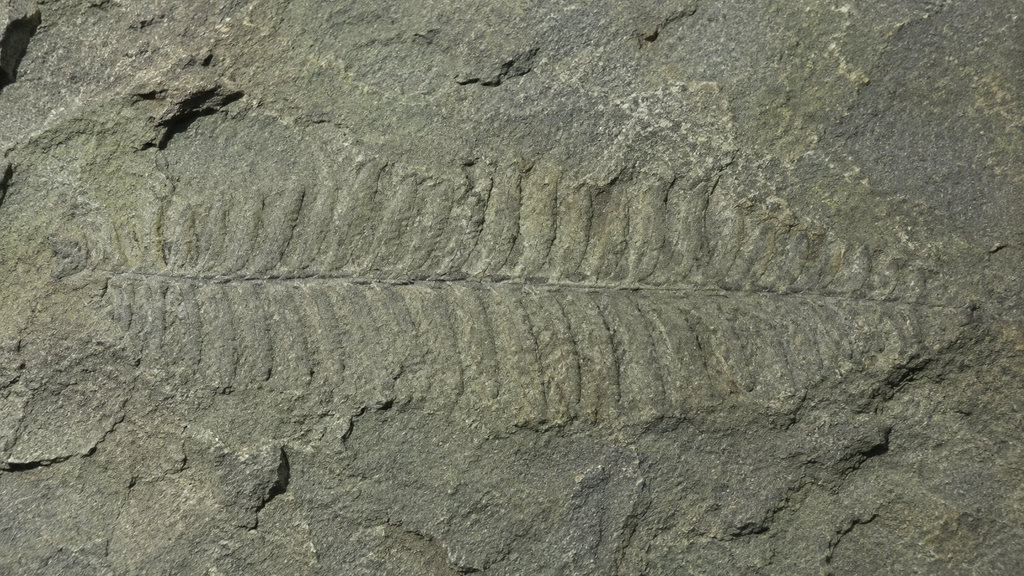
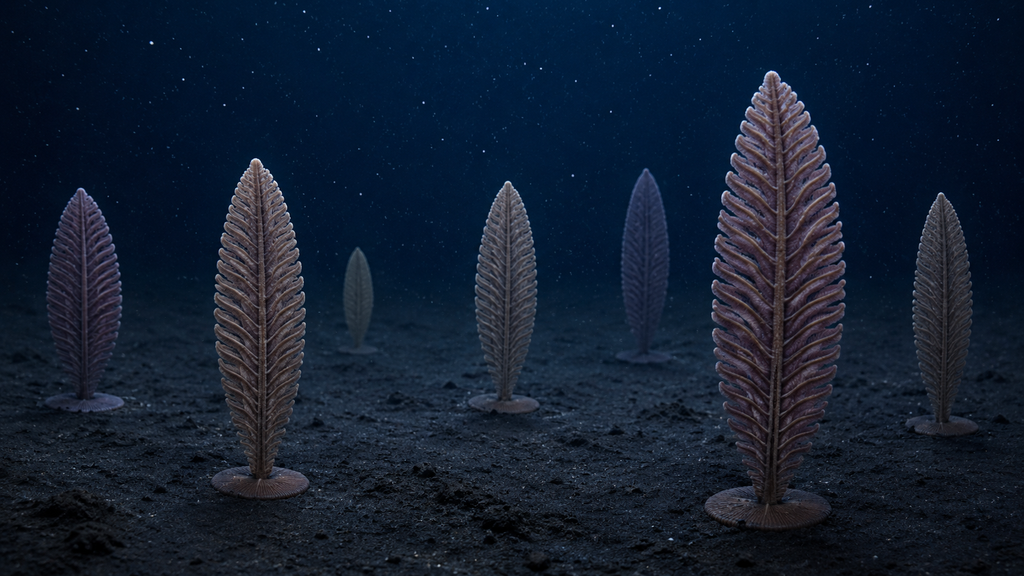
The body is a long, narrow frond, with branches extending alternately left and right from a zigzag seam running down the center. Each branch divides into finer branches, and those finer branches divide again in the same pattern — a fractal-like repeating structure that is the defining feature. The group of organisms with this construction is called the rangeomorphs, and Charnia is its emblem. The lower end of the body was fixed to the seafloor by a disc-shaped organ, and the animal stood up into the water. It is thought not to have moved of its own accord.
It looks entirely like a plant, and is not one. Most strata containing Charnia fossils are sediments deposited on a deep seafloor beyond the reach of light. Growing where photosynthesis is impossible, it cannot have been an alga or a seaweed. But no mouth or gut is visible either, so even as an animal it is unclear how it obtained nourishment. The leading view is that it absorbed organic matter directly from seawater through its body surface. It was once compared to living sea pens (relatives of corals), but that view was rejected once its mode of growth was found to differ. In 2021, a study analyzing growth patterns in British and Russian specimens placed Charnia within an early lineage of the eumetazoans, the group running from jellyfish through insects to humans. On that reading, Charnia was a genuine animal built to a body plan now entirely lost.
“There are no fossils in rocks that old”
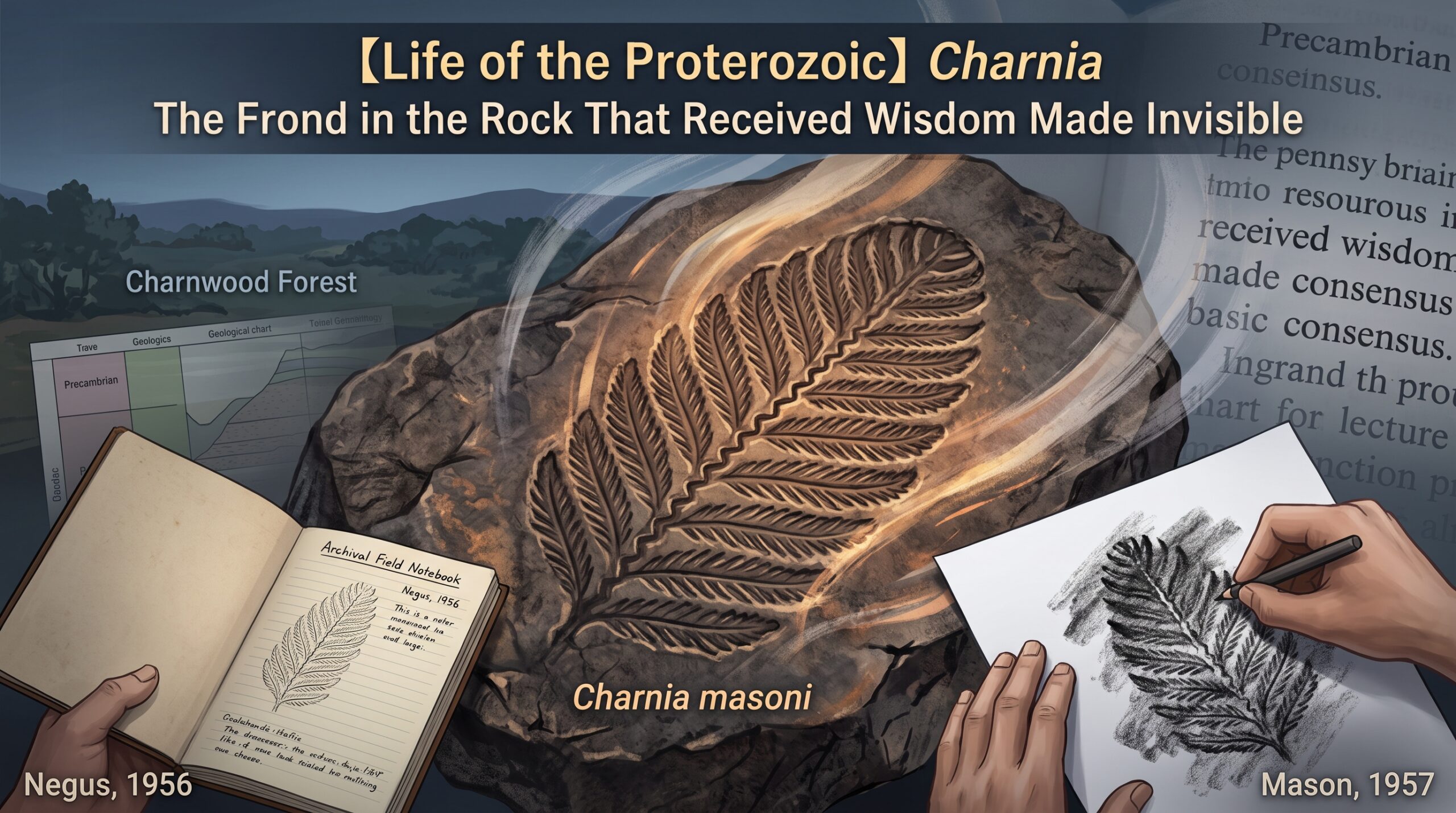
The Charnia fossil was exposed on a rock face in Charnwood Forest in the English Midlands, in plain view of anyone. The first person to recognize it as a fossil was Tina Negus, then fifteen, in 1956. She told her school geography teacher about the find and was not taken seriously. It was already known that the rocks of this area were Precambrian, and the textbook-level consensus was that strata of that age contain no fossils. What was believed was the consensus, not the person who had seen the fossil.
In the spring of 1957, three boys from a local school came upon the same fossil on the same rock face while rock climbing. It was their friend Richard Blachford who noticed it first, but fifteen-year-old Roger Mason, who hurried over, made a rubbing of the rock and, through his father, who taught at a university, showed it to the geologist Trevor Ford. Ford was himself skeptical about Precambrian fossils, but changed his mind after examining the specimen in the field. The fossil was excavated, and in 1958 Ford described it as a new genus and species, Charnia masoni, the species name honoring Mason as the reporter. The existence of Precambrian organisms entered the formal scientific record for the first time.
Another well-known figure turns out to have walked this area too. David Attenborough, known for his nature programs, attended the same school as Mason and had gone fossil hunting in the same Charnwood Forest a few years earlier. He later said that, following the received view that those rocks were too old to yield fossils, he never searched in this particular area. The fossil had been there the whole time, passing before any number of eyes.
Two discoverers, named side by side fifty years on
After its description, Charnia became a symbol of Precambrian research, and fossils were found in Australia, Canada, Russia and China as well. The process leading to the formal establishment of the Ediacaran as a geological division follows on from the way this discovery energized Precambrian research. The name of the first discoverer, Tina Negus, meanwhile, stayed out of the record for a long time. She went on into biology, and later took up ceramics, painting and poetry, watching the fossil she had found become famous through a television screen.
The turning point came in 2004, when she saw Mason appear as a geologist in a documentary. Negus contacted him and told him she had seen the same fossil in the same quarry the year before his find. Mason accepted this and wrote publicly that Tina Negus had seen the fossil before he did, and that nobody had taken her seriously. In 2007, at events marking the fiftieth anniversary of the discovery, Negus was formally honored as the first discoverer. The display at the Leicester museum that holds the type specimen now carries both names.
Sources
Ford, T. D. (1958). Pre-Cambrian fossils from Charnwood Forest. Proceedings of the Yorkshire Geological Society.
https://doi.org/10.1144/pygs.31.3.211
Dunn, F. S. et al. (2019). Anatomy of the Ediacaran rangeomorph Charnia masoni. Papers in Palaeontology.
https://doi.org/10.1002/spp2.1234
Dunn, F. S. et al. (2021). The developmental biology of Charnia and the eumetazoan affinity of the Ediacaran rangeomorphs. Science Advances.
https://doi.org/10.1126/sciadv.abe0291
Charnwood Forest Geopark: Discovering Charnia
https://www.charnwoodforest.org/discovering-charnia/
コメント