This article contains affiliate links. As an Amazon Associate I earn from qualifying purchases.
| Name | Tanystropheus (“long vertebra”). The species at Monte San Giorgio are the small Tanystropheus longobardicus and the large T. hydroides |
| Classification | Reptile, archosauromorph (an early member of the line leading to dinosaurs and crocodiles, but not a dinosaur) |
| Age | Middle Triassic (about 242 million years ago) |
| Where found | Monte San Giorgio, on the border between Switzerland and Italy. Bones have also been found in Germany and elsewhere in Europe |
| Length | The large T. hydroides reached 5–6 m. Adults of the small T. longobardicus were about 1.5 m |
| Neck length | About three times the length of the trunk, made of only 13 vertebrae, each one extremely long |
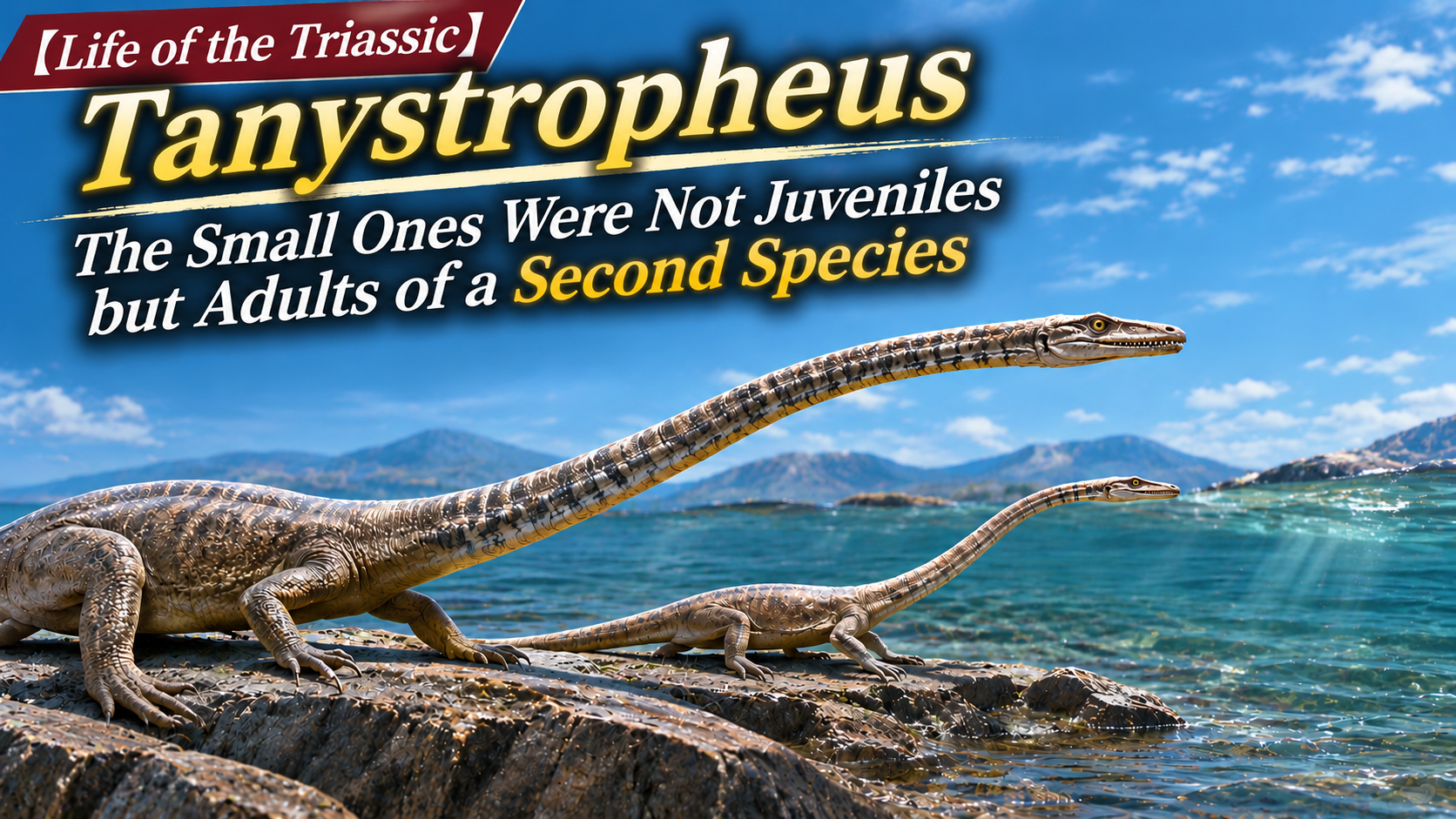
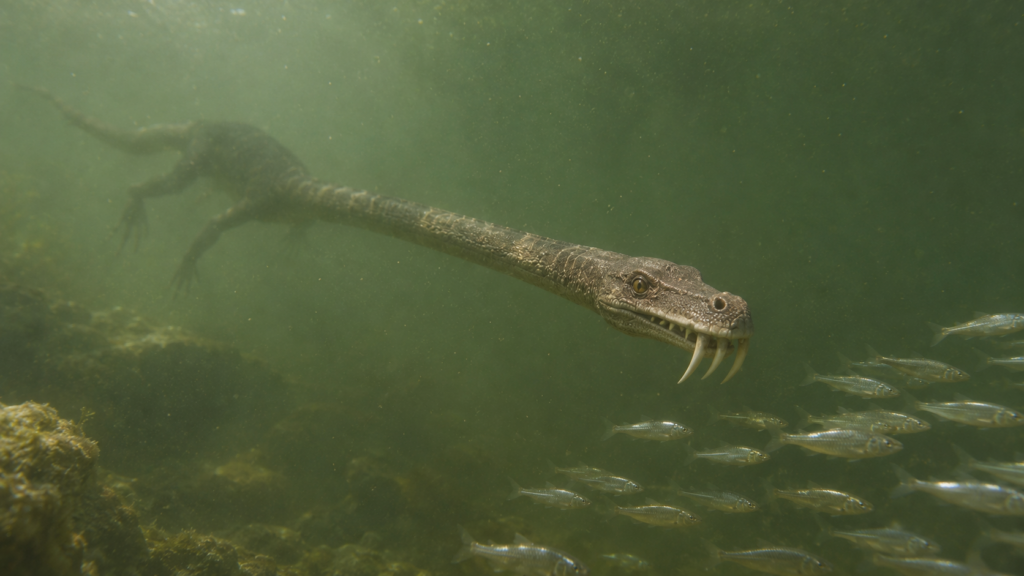
Tanystropheus was a reptile that lived along the shores of the Middle Triassic sea. It had a straight, stiff neck about three times as long as its trunk. Large and small individuals were long thought to be adults and juveniles of one species, but a 2020 study showed that they belonged to two separate species.
Body and way of life
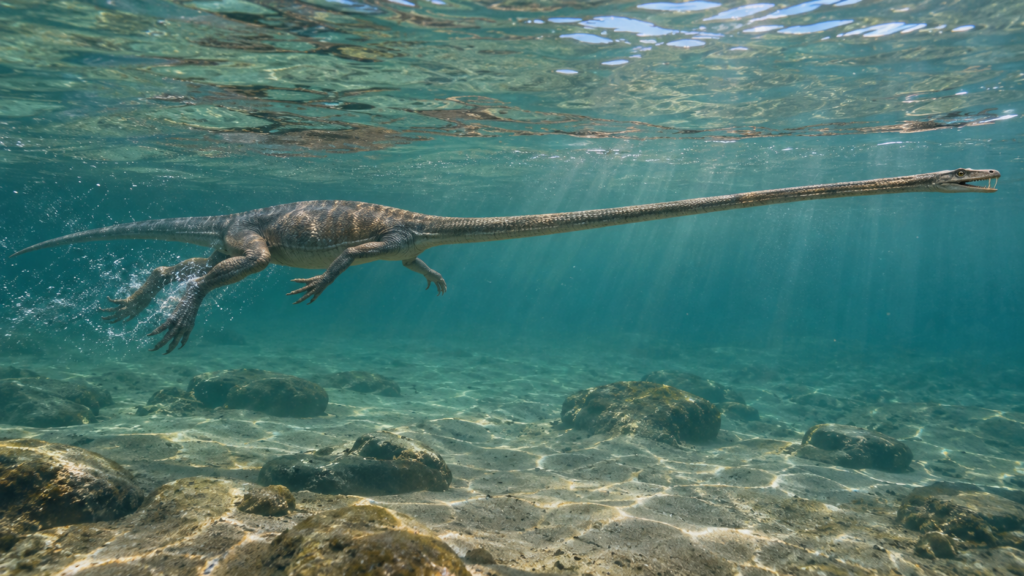
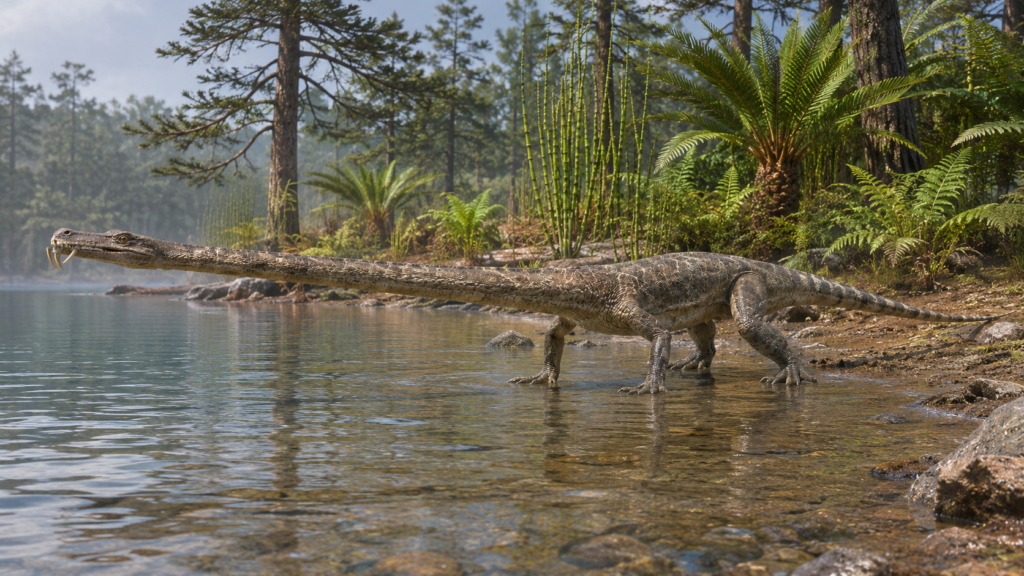
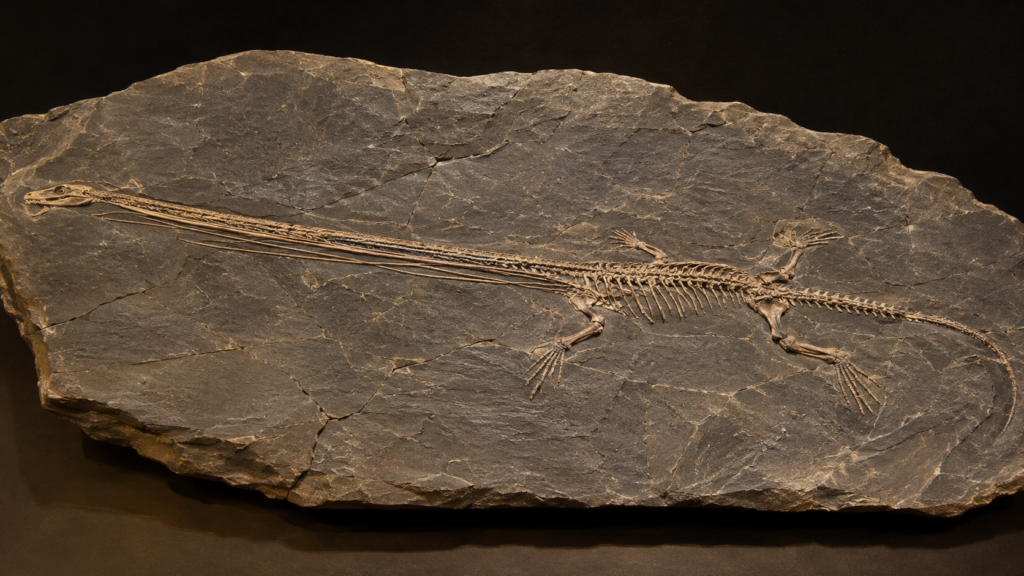
Most of the animal was neck. The neck had only 13 vertebrae, each drawn out into a long, thin bone. Along both sides lay several overlapping rod-like ribs nearly as long as the vertebrae themselves, turning the neck into a stiff pole that could hardly bend. The trunk was short, with four legs and a long tail, and the hind legs and the muscles at their base were sturdy. The head was very small for such a long neck, with teeth lining a narrow mouth.
Monte San Giorgio, where its fossils are most often found, preserves the rocks of a shallow Middle Triassic marine basin. The same beds have yielded ichthyosaurs, relatives of Nothosaurus and other marine reptiles, along with many fish. Tanystropheus is thought to have hunted in these waters by bringing the small head at the end of its long neck close to its prey.
The long neck could also be a weak point. In 2023, researchers described two fossils whose necks had been cleanly severed partway along. They think the animals were attacked at the neck by large predators.
The small ones were not juveniles
At first, no one recognized the neck as a neck. In 1886, an Italian researcher studying fossils from the Monte San Giorgio area took the long bones for the wing bones of a pterosaur and described them as a pterosaur under a different name. In the 20th century, the University of Zurich excavated at Monte San Giorgio and found nearly complete, articulated skeletons, which showed that the long bones were neck vertebrae.
Even after that, opinion stayed divided on whether the animal lived on land or in water. Could it walk on land with such a long, stiff neck? How did it hold up its neck in water? Each view had its evidence and its problems. The Monte San Giorgio fossils also came in two very different sizes. The small type had teeth with three points at the back of the jaw, while the large type had single-pointed, fang-like teeth. This difference was thought to be a change in the teeth as the animals grew from juveniles to adults.
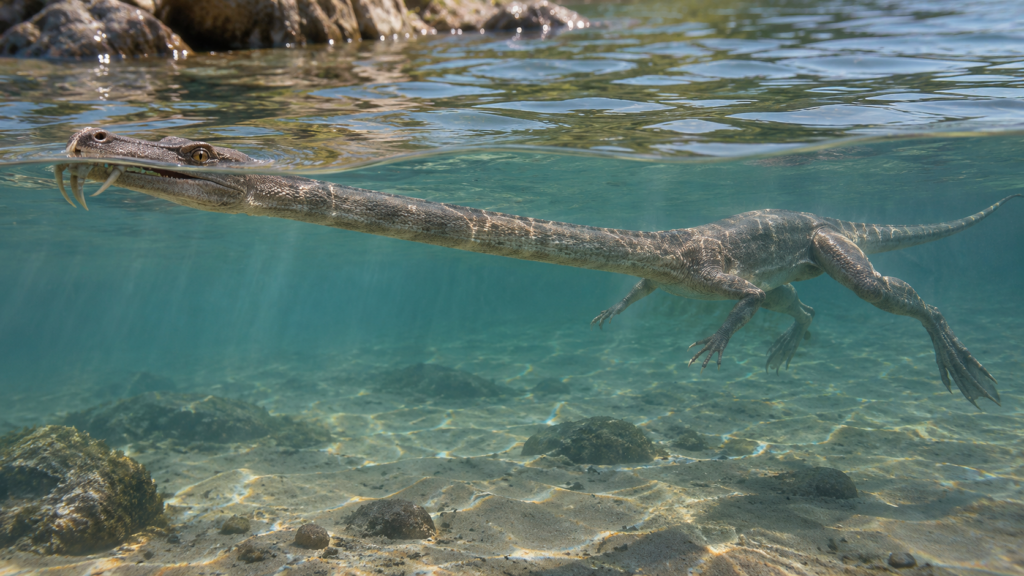
In 2020, Stephan Spiekman of the University of Zurich and colleagues examined a skull of the large type with high-resolution synchrotron CT scanning. The skull had been crushed and broken apart, but by reassembling the bones one by one in three dimensions, they recovered an almost complete head. The nostrils sat not on the sides of the snout but on top of it, as in a crocodile, a position that let the animal breathe with only the tip of its snout above water. The long, curved teeth interlocked top and bottom in a “fish-trap” arrangement that would hold slippery prey. The team concluded that Tanystropheus lived in water and hunted by approaching prey unseen in murky water, using its small head and very long neck.
At the same time, the team cut thin sections from limb bones of the small type. The bones showed many growth rings, and their growth had already stopped. The individual, about 1.5 m long, was an adult, not a juvenile. The difference in size was a difference of species, not of age. The small type kept the original name T. longobardicus, and the large type was described as a new species, T. hydroides.
The two species are thought to have shared the same shores while eating different food. The large T. hydroides caught fish and squid with its fang-like teeth, while the small T. longobardicus used its pointed, multi-cusped teeth to eat small shelled animals such as shrimp. With almost the same body plan, the two species lived side by side by differing in size and teeth.
Related products
You can find books and products related to this article on Amazon.
If you buy through the links above, this blog may earn a commission.
About the images
The images in this article are illustrations created with AI (ChatGPT), and you are welcome to use them. If you do, we would appreciate a link back to this article as the source.
Sources
Spiekman, S. N. F. et al. (2020). Aquatic Habits and Niche Partitioning in the Extraordinarily Long-Necked Triassic Reptile Tanystropheus. Current Biology 30, 3889–3895. https://doi.org/10.1016/j.cub.2020.07.025
University of Zurich, Long Neck Helped Reptile Hunt Underwater (6 August 2020) https://news.uzh.ch/en/articles/2020/Tanystropheus.html
Spiekman, S. N. F. & Mujal, E. (2023). Decapitation in the long-necked Triassic marine reptile Tanystropheus. Current Biology 33, R708–R709. https://doi.org/10.1016/j.cub.2023.04.027

コメント