This article contains affiliate links. As an Amazon Associate I earn from qualifying purchases.
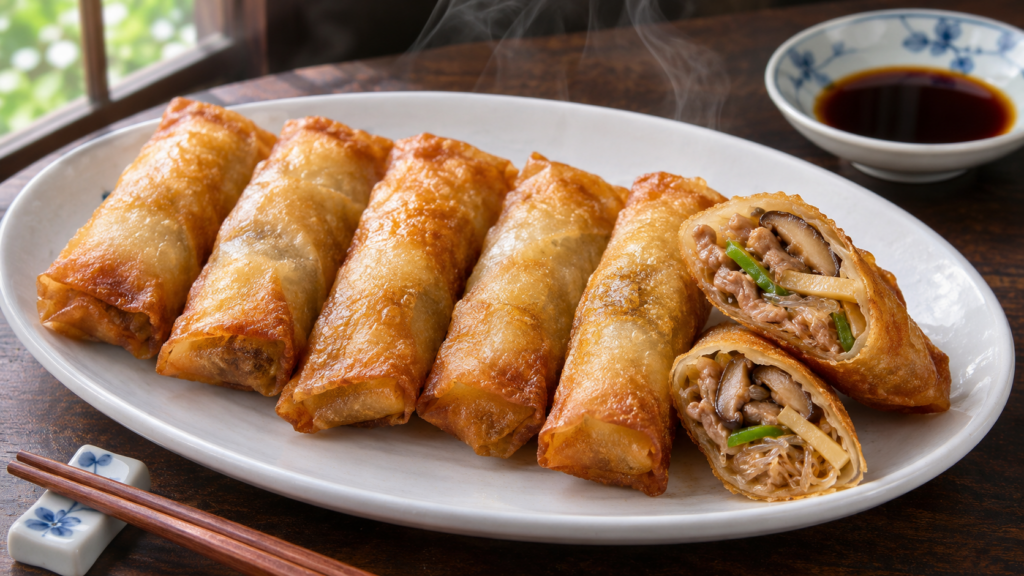
Japanese-style spring rolls, called harumaki, are made by stir-frying and simmering a filling, binding it with a starch slurry, wrapping it in spring roll wrappers and deep-frying. Two things decide how they turn out: cooling the filling completely before wrapping, and the frying temperature. Wrap a hot filling and the wrapper goes soft and tears in the oil; finish the frying at too low a temperature and the wrapper soaks up oil and turns limp.
Ingredients (makes 10)
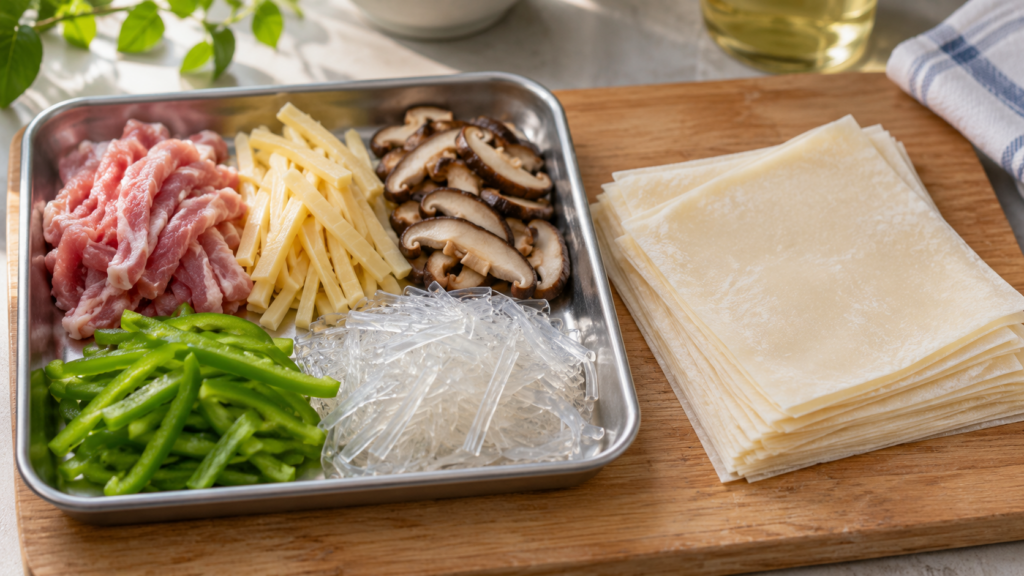
- Spring roll wrappers: 10 sheets
- Thinly sliced pork (lean cut such as leg): 150 g
- Boiled bamboo shoots: 80 g
- Dried shiitake mushrooms: 3 (fresh shiitake also work)
- Green bell pepper: 1
- Dried glass noodles (harusame): 30 g
- To season the pork: 1/2 tbsp sake, 1/2 tsp soy sauce
- Sauce: 150 ml chicken stock, 1 tbsp soy sauce, 1/2 tbsp oyster sauce, 1/2 tbsp sugar, a pinch of pepper
- Starch slurry: 1 tbsp katakuriko (potato starch), 1 tbsp water
- Sesame oil: 1/2 tbsp
- Sealing paste: 1 tbsp flour, 1 tbsp water
- Vegetable oil: a little for stir-frying, plus oil for deep-frying
Harusame are thin, clear noodles made from starch; any thin glass noodles will do. Chicken stock made from granules dissolved in hot water as the label directs is fine. Sake is Japanese rice wine; dry sherry can stand in. If you have no oyster sauce, you can leave it out. Cornstarch can replace the potato starch.
Method
1. Prepare the ingredients
Soak the dried shiitake in water until soft, remove the stems and slice thinly. Cut the pork into thin strips and rub in the sake and soy sauce. Cut the bamboo shoots and bell pepper into thin strips. Boil the glass noodles for about 1 minute, cool them in cold water, drain and cut into 2–3 cm lengths. Mix the sauce ingredients.
2. Stir-fry and simmer the filling
Heat a little vegetable oil in a frying pan and stir-fry the pork over medium heat. When it changes colour, add the bamboo shoots, shiitake and bell pepper and stir-fry together. Add the sauce, simmer for 1–2 minutes, then stir in the glass noodles.
3. Thicken
Turn off the heat, stir the starch slurry well and pour it in. Return to medium heat and keep stirring with a spatula until the filling is thick enough that you can see the bottom of the pan as you stir. Turn off the heat and drizzle with the sesame oil.
4. Cool the filling
Spread the filling in a tray and let it cool completely. To speed this up, set the tray in iced water. Once cold, divide it into 10 portions.
5. Wrap
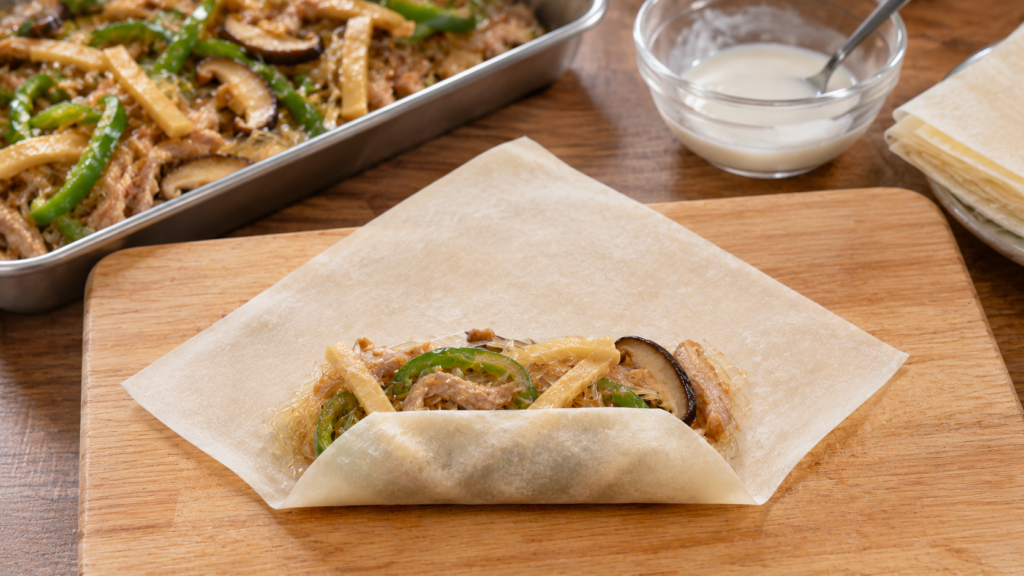
Mix the flour and water into a paste. Lay a wrapper smooth side down, with a corner pointing toward you. Place a portion of filling just in front of the centre, fold the near corner over it and roll once, tightly, pressing out the air. Fold in both sides, roll up the rest loosely, brush the last corner with paste and seal. Set the rolls seam side down. Wrap them just before frying.
6. Fry at 170°C
Pour oil into a pot to a depth of about 3–4 cm and heat it to 170°C (340°F). Add the rolls, as many as fit comfortably; two batches are fine. Leave them alone at first and spoon oil over the tops as they fry for 3–4 minutes.
7. Finish at a higher temperature
Raise the oil to 180–190°C (355–375°F) and fry for about 1 minute, until the wrappers are golden brown. Lift them out and stand them upright to drain.
Tips for good spring rolls
Cool the filling completely before wrapping
A warm filling steams the wrapper from the inside, so it softens and is likely to tear while frying. Oil and moisture from the filling also soak in more easily. Spreading the filling thinly in a tray cools it faster, and once cold it firms up and is easier to wrap.
Make the filling thick
After adding the starch slurry, keep stirring until you can see the bottom of the pan, cooking off the moisture. A runny filling wets the wrapper from the inside and makes it tear or leak in the oil.
Roll the first turn tight and the rest loose
A tight first turn pushes out the air inside, so there is no air pocket to swell and burst the roll in the oil. Rolling the outer layers loosely makes the wrapper fry up crisp.
Fry soon after wrapping
If wrapped rolls sit for a while, moisture from the filling moves into the wrapper and it tears more easily. Have the filling cooled and ready, and wrap right before frying.
Raise the temperature at the end
The filling is already cooked, so after the wrapper has cooked through at 170°C, a short fry at a higher temperature is enough. Finishing hot lets the oil drain well from the wrapper, so the rolls stay less greasy even after they sit for a while.
Troubleshooting
The wrapper tore while frying
The filling was still warm when you wrapped it, or the rolls sat too long before frying. Next time, cool the filling completely and wrap just before frying. Also make sure the first turn is tight enough to press out the air.
Filling or sauce leaked out
The filling was too runny, or the rolls were overfilled. Next time, cook the filling until you can see the bottom of the pan before cooling it, and leave some room in the wrapper. Seal the last corner with paste and put the rolls into the oil seam side down.
The wrappers aren’t crisp
Too many rolls went in at once and the oil cooled down, or the temperature wasn’t raised at the end. Next time, fry in two batches and finish at 180–190°C for about 1 minute. Stand the rolls upright to drain.
Related products
You can find books and products related to this article on Amazon.
If you buy through the links above, this blog may earn a commission.
About the images
The images in this article are illustrations created with AI (ChatGPT), and you are welcome to use them. If you do, we would appreciate a link back to this article as the source.
Sources
NHK Minna no Kyo no Ryori, “Gomoku harumaki” (Kentaro Chin) https://www.kyounoryouri.jp/recipe/601596_五目春巻.html
NHK Minna no Kyo no Ryori, “Harumaki” (Kazuo Yamanaka) https://www.kyounoryouri.jp/recipe/2629_春巻.html
Ajinomoto Park, “Gomoku harumaki” https://park.ajinomoto.co.jp/recipe/card/701166/
Ajinomoto Park, “Komi gomoku harumaki” https://park.ajinomoto.co.jp/recipe/card/707100/
Orange Page, “Kihon no harumaki” (Naoya Higuchi) https://www.orangepage.net/recipes/303782

コメント