This article contains affiliate links. As an Amazon Associate I earn from qualifying purchases.
| Name | Pakicetus, meaning “whale from Pakistan”. Described in 1981 |
| Classification | Mammalia, Cetartiodactyla, Pakicetidae (among the earliest cetaceans) |
| Age | Paleogene, early to early middle Eocene. About 50–48 million years ago (estimates of the age of the rocks vary) |
| Found in | Northern Pakistan (Kuldana Formation) |
| Length | About 1–2 m (estimated from skull size and from skeletons assembled from the bones of several individuals) |
| Weight | One estimate gives about 45 kg, roughly that of a wolf or a large dog |
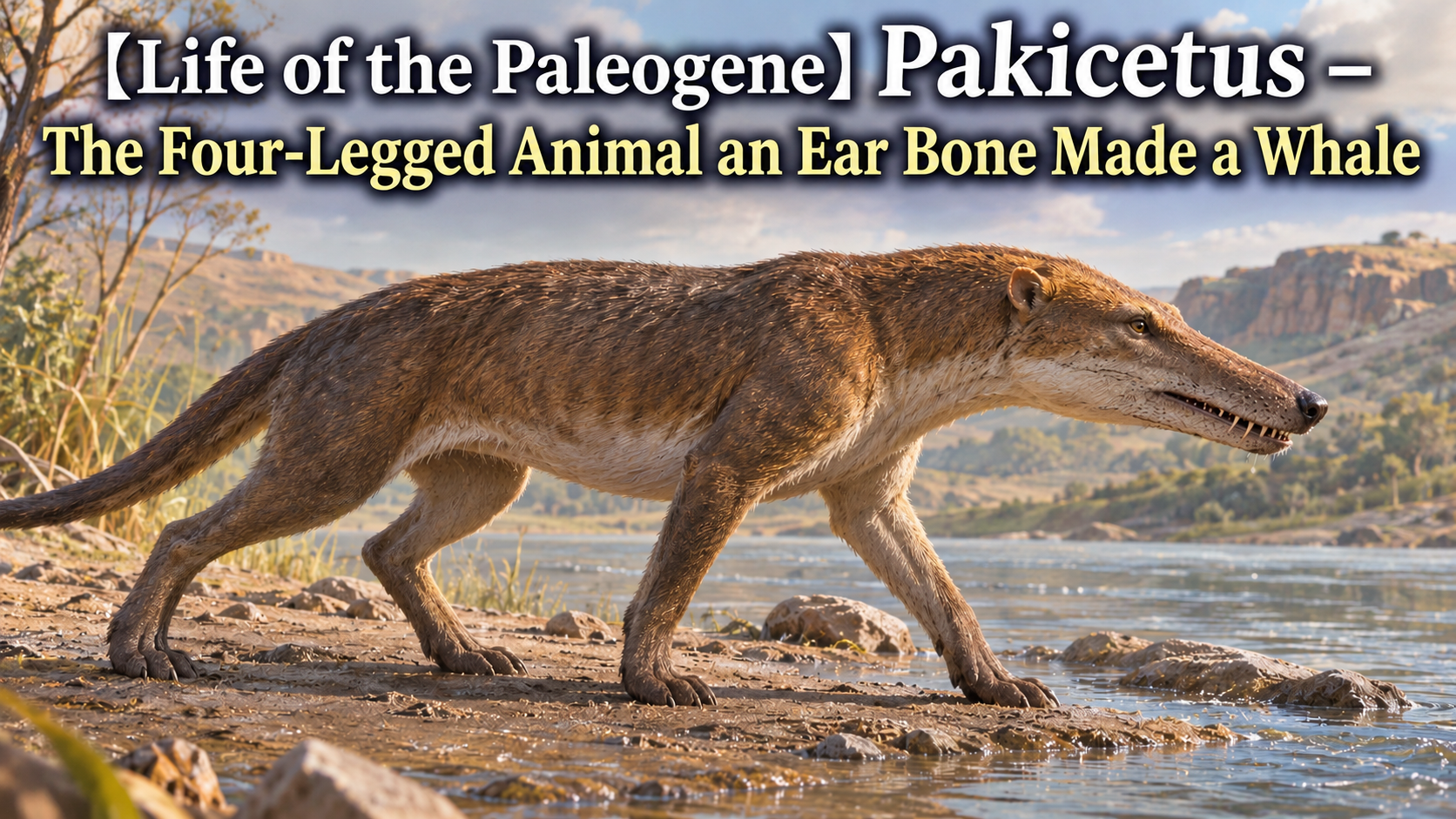
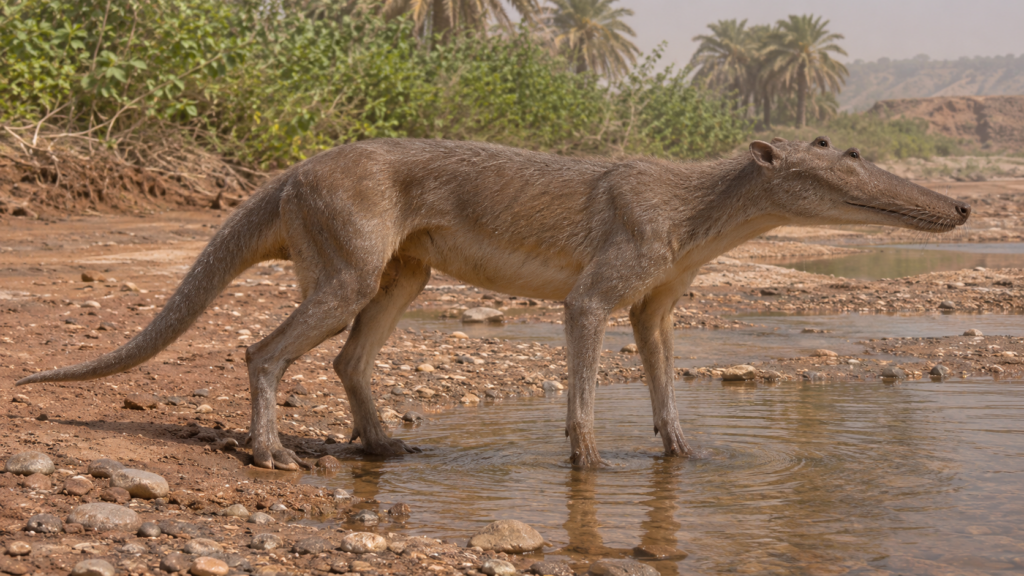
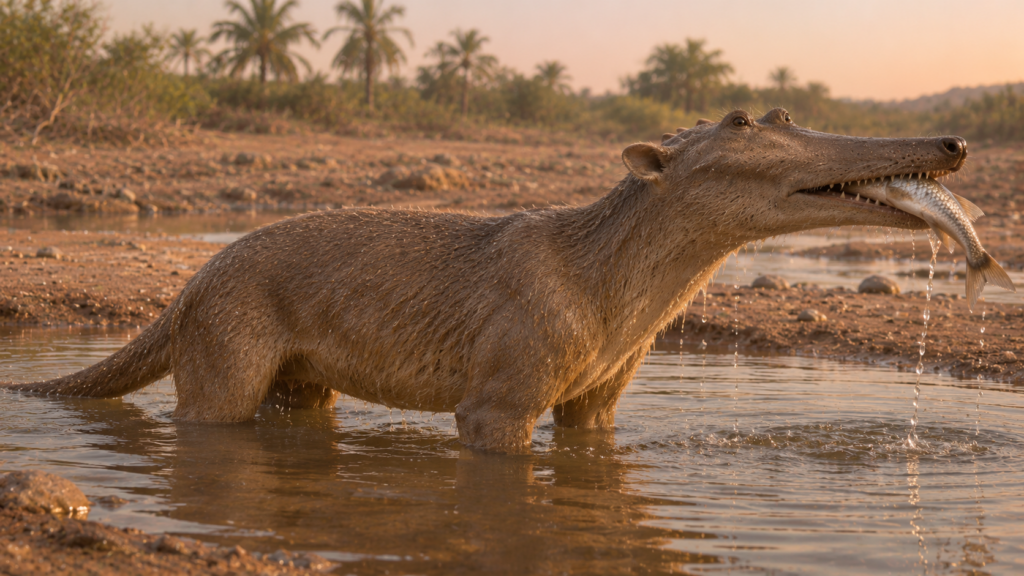
Pakicetus was one of the earliest whales, and it lived in what is now Pakistan about 50 million years ago. It was about the size of a wolf, walked on four legs, and had a long snout and a long tail. This animal had no flippers. It was classified as a whale because the ear bone on the first skull to be found has a feature that only whales have.
Appearance and Way of Life
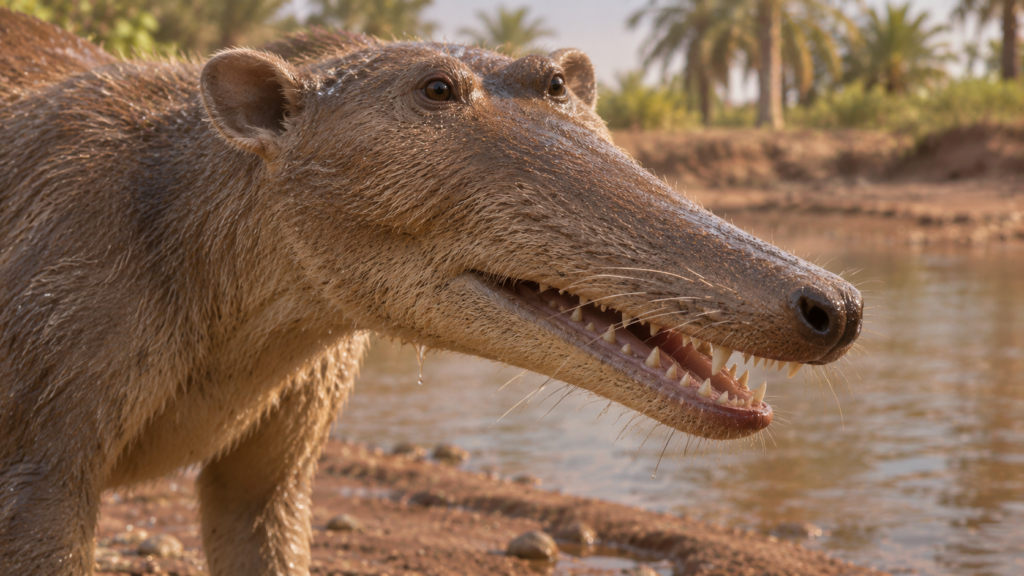
Pakicetus looked nothing like a modern whale. The researchers who described its skeleton compare it to a wolf with a long nose and a long tail. The nostrils were at the tip of the snout, and the jaws held a full set of teeth, from incisors to molars. The eye sockets sit close together near the top of the skull, an arrangement common in animals that keep their bodies under water while watching what is above the surface. The molars have tall, pointed cusps, and they carry broad, polished surfaces worn by tooth grinding against tooth. This kind of wear has been linked to eating fish.
The whole body became known in 2001. At a site in the Kala Chitta Hills of northern Pakistan, the bones of many different animals lie jumbled together, and more than 60% of them belong to pakicetids. Because the bones are mixed, no single individual can be pieced together. The reconstructed skeletons are composites, built from the bones of several individuals that were matched by size, by the chemistry of the bone and by other clues. The site has yielded skulls of three pakicetid genera, including Pakicetus and the fox-sized Ichthyolestes.
The rocks that hold the fossils were laid down in a shallow stream. The climate was hot and dry, and rain came only a few times a year, in heavy bursts. Water flowed in the stream only during the rains. For the rest of the year the stream bed is thought to have broken up into shallow pools.
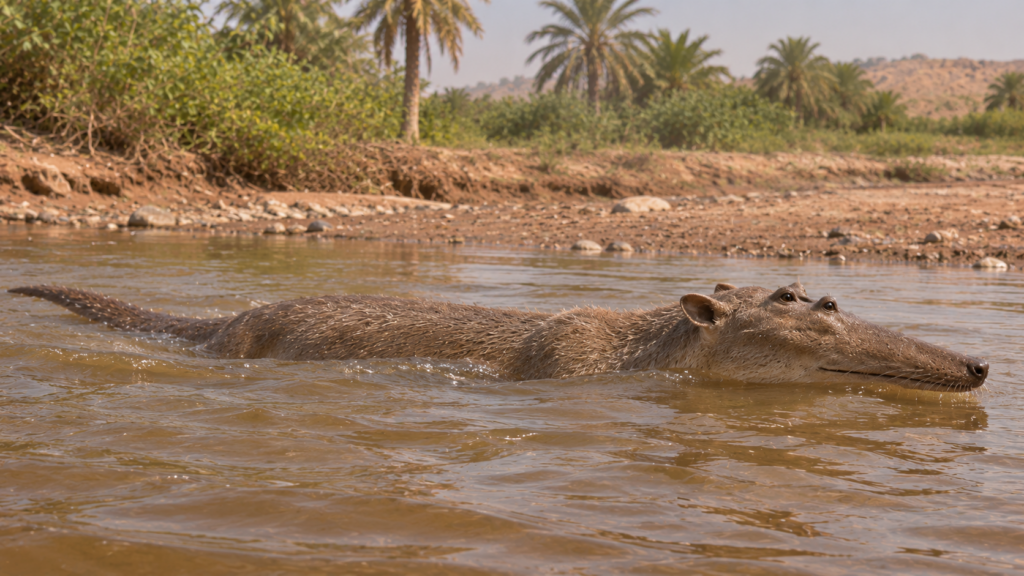
The shape of the limb bones is close to that of animals that run on land. The elbow and ankle bent only forwards and backwards, the lower back was long, and the tail was thick and sturdy. The 2001 paper reported pakicetids as land animals. Later work showed that the limb bones have a narrow inner cavity and thick walls of bone. Heavy bones act as ballast in water and are found in animals such as hippos, which walk along river beds. The oxygen isotopes in the tooth enamel also match those of an animal that spent much of its time in fresh water. The prevailing view today is that Pakicetus waded in shallow fresh water. Its skeleton shows no features for fast swimming.
The Paleogene is the period in which whales moved from land to sea. The overall story is covered in the Earth Timeline article on the Paleogene, and a whale that lived entirely in the sea is covered in the article on Basilosaurus.
The Ear Bone That Made It a Whale
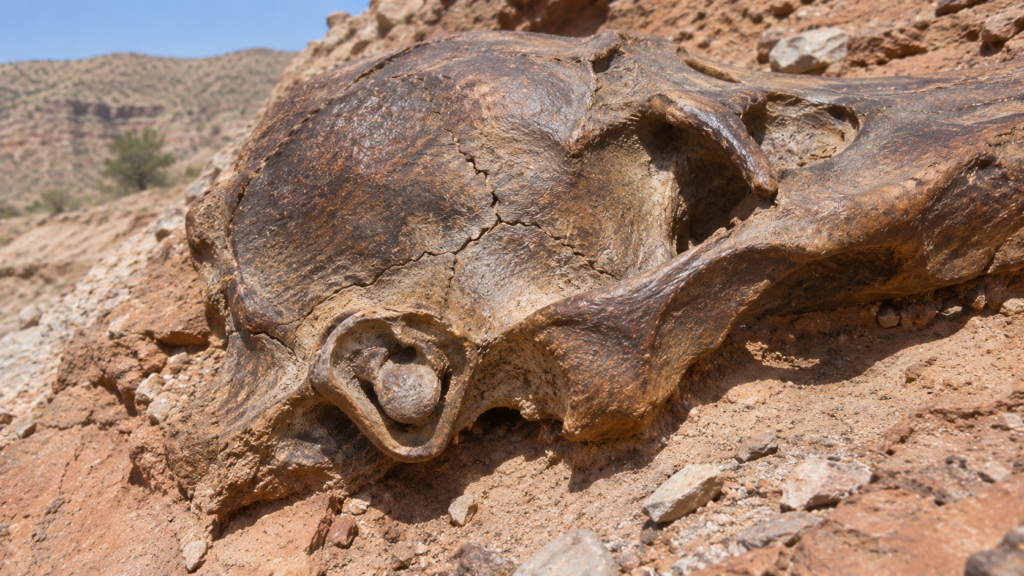
Pakicetus was described in 1981 by Philip Gingerich of the University of Michigan and a colleague. All that had been found at the time was the back of a skull, along with jaw fragments and teeth. There was not a single bone from the body. It was placed among the whales anyway, because of the shape of the ear bone preserved on the underside of the skull.
The middle ear of a mammal is an air-filled cavity. In many mammals a bone called the ectotympanic encloses this cavity, shaped like half a walnut shell. The wall of the shell is usually about the same thickness all the way round. In whales, the inner wall, the one nearer the midline of the head, is much thicker than the outer wall. This thickened rim is called the involucrum. Every whale has one, fossil or living. The skull of Pakicetus had one too.
In 1983 Gingerich and his colleagues reported the fossil in more detail in Science. The teeth resembled those of mesonychids, a group of meat-eating land mammals. The ear did not yet have the specializations that whales use to tell the direction of a sound under water. The fossils came from river sediments, together with land mammals. The authors placed Pakicetus partway through the move from land to sea. With no body bones known, popular reconstructions of the period showed it as a short-legged, seal-like animal.
That picture changed in 2001, when Hans Thewissen and his colleagues reported pakicetid skeletons in Nature. The skeleton was that of a long-legged, four-footed animal about the size of a wolf. The ankle held another important feature. The astragalus, the ankle bone that sits above the heel, has a pulley-shaped joint in all mammals, where it meets the shin bone. The astragalus of Pakicetus has a second pulley at the opposite end. Only artiodactyls, the even-toed hoofed mammals such as cattle, deer, pigs and hippos, have an astragalus with two pulleys. An analysis of relationships based on the features of the bones also placed whales closer to artiodactyls than to mesonychids. Genetic studies had already pointed to a close link between whales and artiodactyls, and the fossils now confirmed it.
Later studies looked at how the ear worked. Pakicetids had the same kind of ear as land mammals, with an ear canal and middle ear bones for hearing sound in air. Under water they are thought to have heard sound conducted through the bones of the head, helped by the heavy, thick ear bone. The system closer to that of modern toothed whales, in which sound reaches the ear through the lower jaw, appears only in whales later than the pakicetids. A 2004 study describes the pakicetid ear as a transitional stage that worked poorly both in air and in water.
In 2007 an involucrum was reported in the skull of Indohyus, a cat-sized artiodactyl found in India. The limb bones of Indohyus are also thick, and the oxygen isotopes in its teeth point to a life around water. The involucrum, then, was already present in small artiodactyls living by the water, before whales appeared. For a long time, having an involucrum was the main reason for including an animal in Cetacea, the order of whales. Some researchers therefore argue that Indohyus should be included as well. Thewissen and his colleagues keep it in the artiodactyl family Raoellidae, on the grounds that changing the classification would cause confusion.
Related products
You can find books and products related to this article on Amazon.
If you buy through the links above, this blog may earn a commission.
About the images
The images in this article are illustrations created with AI (ChatGPT), and you are welcome to use them. If you do, we would appreciate a link back to this article as the source.
Sources
Gingerich, P. D. & Russell, D. E. (1981). Pakicetus inachus, a new archaeocete (Mammalia, Cetacea) from the early-middle Eocene Kuldana Formation of Kohat (Pakistan). Contributions from the Museum of Paleontology, The University of Michigan 25(11), 235–246. https://hdl.handle.net/2027.42/48501
Gingerich, P. D., Wells, N. A., Russell, D. E. & Shah, S. M. I. (1983). Origin of whales in epicontinental remnant seas: new evidence from the early Eocene of Pakistan. Science 220(4595), 403–406. https://doi.org/10.1126/science.220.4595.403
Thewissen, J. G. M., Williams, E. M., Roe, L. J. & Hussain, S. T. (2001). Skeletons of terrestrial cetaceans and the relationship of whales to artiodactyls. Nature 413, 277–281. https://doi.org/10.1038/35095005
Thewissen, J. G. M., Cooper, L. N., George, J. C. & Bajpai, S. (2009). From land to water: the origin of whales, dolphins, and porpoises. Evolution: Education and Outreach 2, 272–288. https://doi.org/10.1007/s12052-009-0135-2
Nummela, S., Thewissen, J. G. M., Bajpai, S., Hussain, S. T. & Kumar, K. (2004). Eocene evolution of whale hearing. Nature 430, 776–778. https://doi.org/10.1038/nature02720
Nummela, S., Thewissen, J. G. M., Bajpai, S., Hussain, T. & Kumar, K. (2007). Sound transmission in archaic and modern whales: anatomical adaptations for underwater hearing. The Anatomical Record 290(6), 716–733. https://doi.org/10.1002/ar.20528
Thewissen, J. G. M., Cooper, L. N., Clementz, M. T., Bajpai, S. & Tiwari, B. N. (2007). Whales originated from aquatic artiodactyls in the Eocene epoch of India. Nature 450, 1190–1194. https://doi.org/10.1038/nature06343
Madar, S. I. (2007). The postcranial skeleton of early Eocene pakicetid cetaceans. Journal of Paleontology 81(1), 176–200. https://www.cambridge.org/core/journals/journal-of-paleontology/article/abs/postcranial-skeleton-of-early-eocene-pakicetid-cetaceans/2F73873CD7F8BF869689BE463469B939
Clementz, M. T., Goswami, A., Gingerich, P. D. & Koch, P. L. (2006). Isotopic records from early whales and sea cows: contrasting patterns of ecological transition. Journal of Vertebrate Paleontology 26(2), 355–370. https://www.goswamilab.com/_files/ugd/6b49fb_9e5c3a8a58f24a80869e074b22ed47fc.pdf
Bajpai, S. & Gingerich, P. D. (1998). A new Eocene archaeocete (Mammalia, Cetacea) from India and the time of origin of whales. PNAS 95(26), 15464–15468. https://doi.org/10.1073/pnas.95.26.15464
New York Institute of Technology, Cetacean Family Tree: Pakicetus spp. https://www.nyit.edu/?p=4471
Encyclopaedia Britannica, Pakicetus https://www.britannica.com/animal/Pakicetus
Black, R. (2010). How Did Whales Evolve? Smithsonian Magazine https://www.smithsonianmag.com/science-nature/how-did-whales-evolve-73276956/


コメント