This article contains affiliate links. As an Amazon Associate I earn from qualifying purchases.
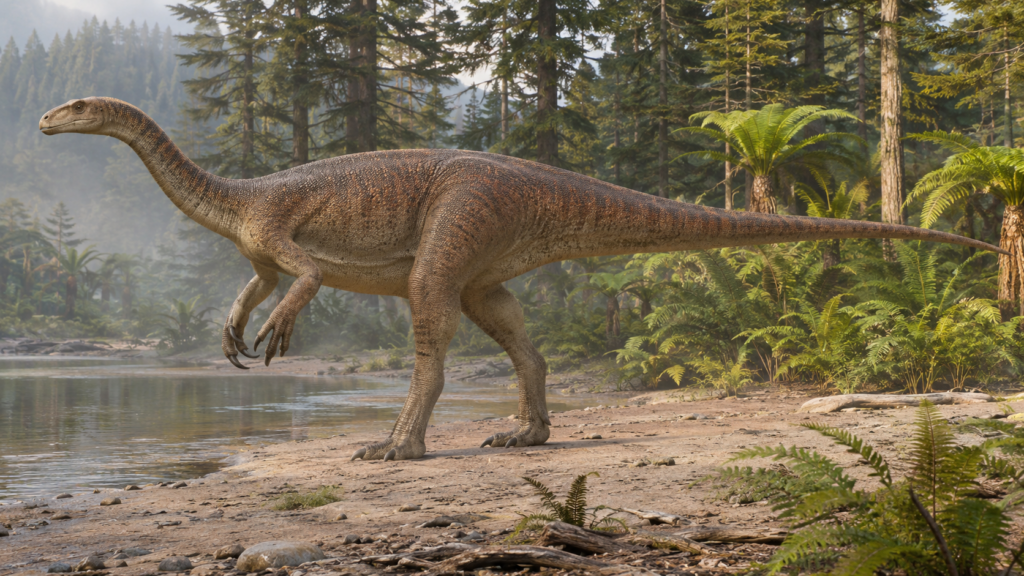
| Name | Plateosaurus. The original description gave no etymology; the name is thought to mean “broad lizard” |
| Classification | Dinosauria, Saurischia, Sauropodomorpha, Plateosauridae. An early sauropodomorph, often called a “prosauropod” |
| Age | Late Triassic (about 214 to 204 million years ago) |
| Found in | Germany, Switzerland and France, with many skeletons from Trossingen, Halberstadt and Frick |
| Length | 4.8–10 m as an adult |
| Weight | Estimated at 600–4,000 kg |
| Limb length | Hind limb about twice as long as the forelimb |
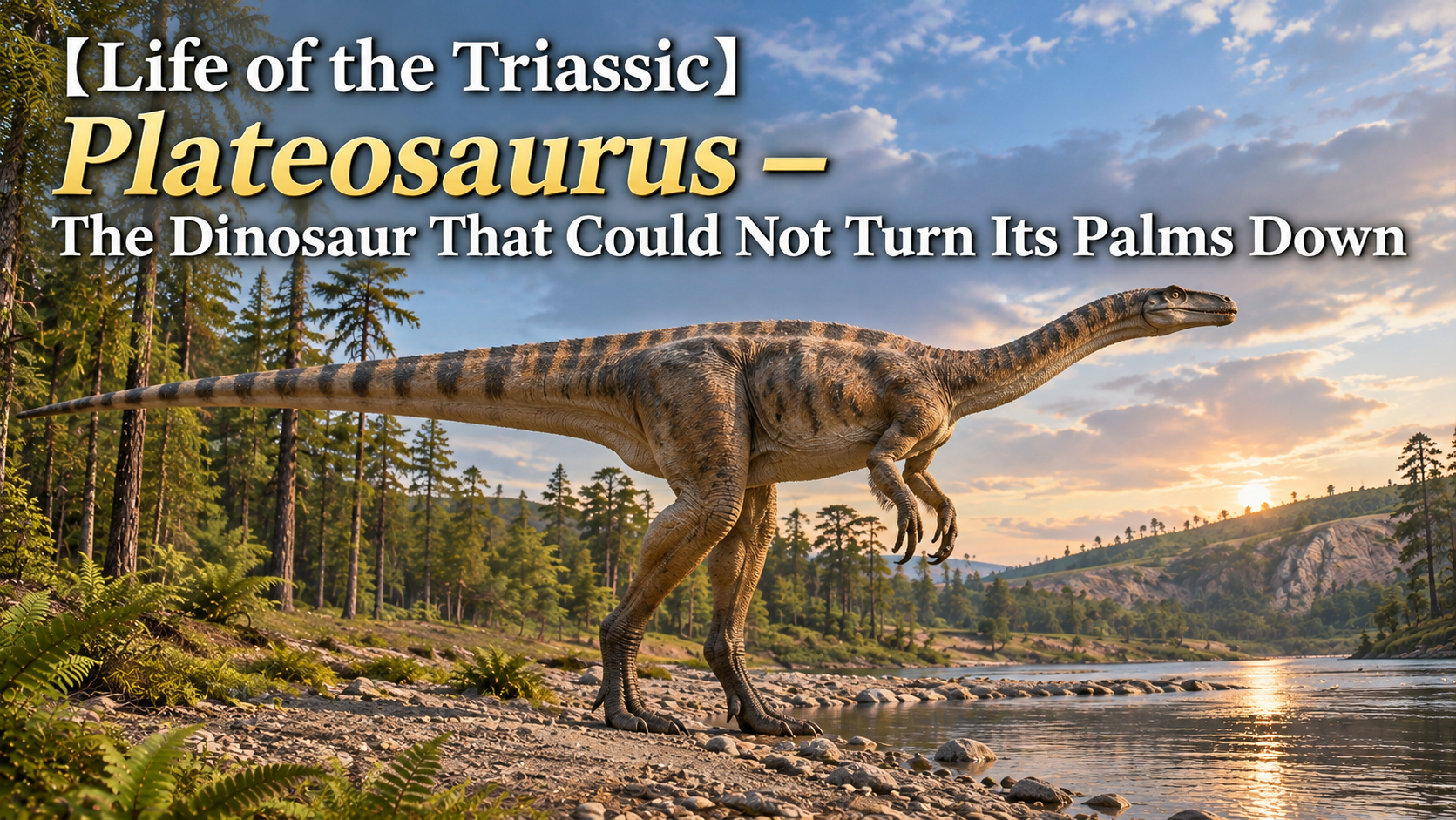
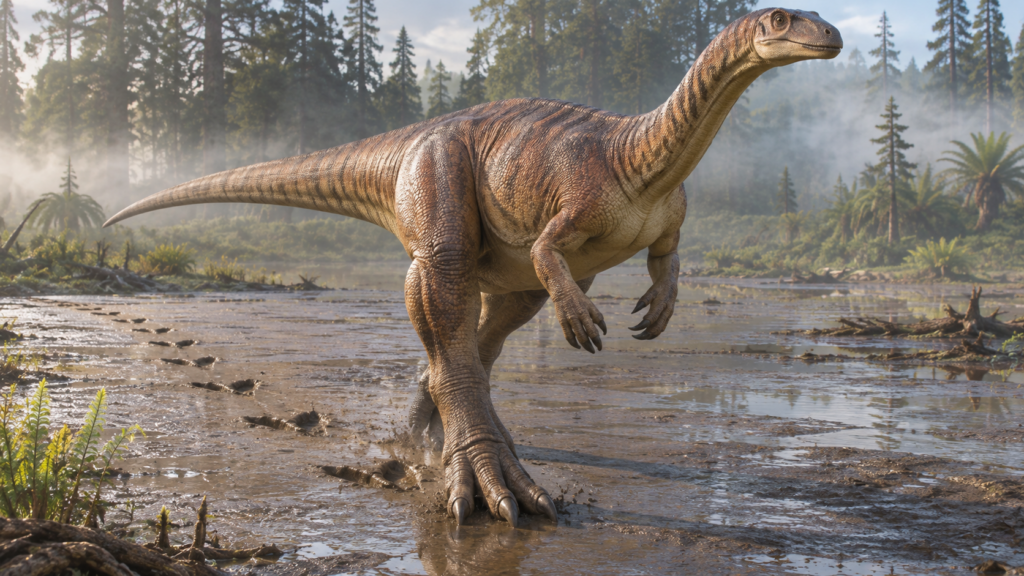
Plateosaurus was a plant-eating dinosaur of Late Triassic Europe. It was an early member of the lineage that later produced giant sauropods such as Brachiosaurus, with a small head and a long neck. Its way of walking was argued over for nearly a century, until a 2007 study of its forelimb bones showed that it could not have walked on all fours.
Body and way of life
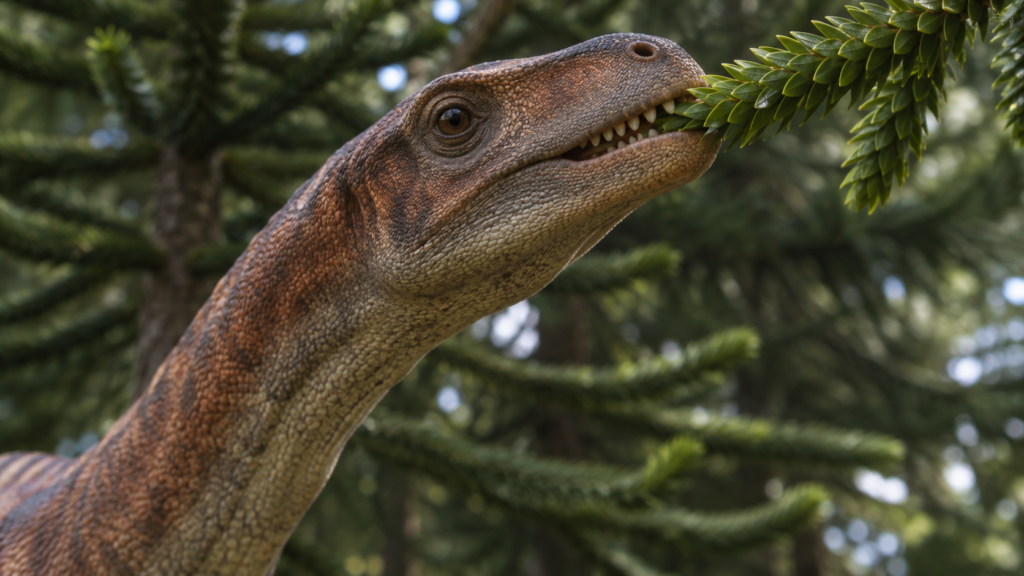
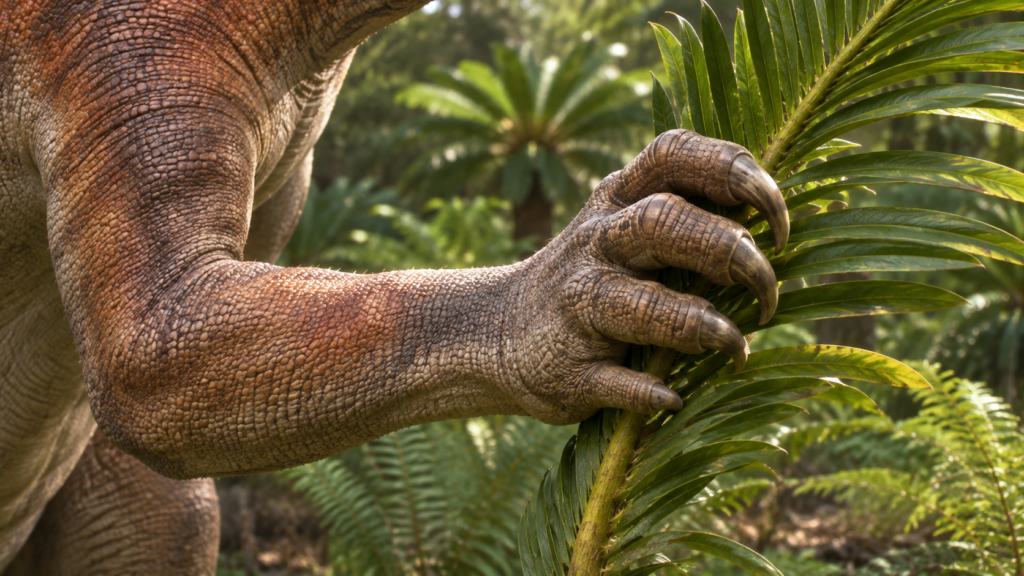
The small head sat on a long, flexible neck of 10 vertebrae. The body was stocky, and the tail had at least 40 vertebrae. The teeth were shaped for crushing plants. The arms were short but muscular, with large claws on three fingers, and the hand was built for grasping.
The first fossils were found in 1834 near Nuremberg, Germany, by the physician Johann Friedrich Engelhardt, and Hermann von Meyer named Plateosaurus three years later, in 1837. That was before Richard Owen coined the word Dinosauria in 1842. Well over 100 individuals have since been found, at more than 50 localities, most of them in Germany.
The type species was long P. engelhardti, but its original material was judged too poor to diagnose the species, and in 2019 the type was replaced by P. trossingensis, based on fossils from Trossingen. Three species are now widely accepted: P. trossingensis, P. longiceps and P. gracilis.
The skeletons at the three main sites belong almost entirely to this one dinosaur. Martin Sander explained that bias in a 1992 study. Heavy animals sank into mud, and their struggles to escape only liquefied it further. Juveniles and smaller plant-eaters were light enough not to sink, and the meat-eating dinosaurs that came to scavenge were light and large-footed enough to avoid being trapped. All three sites have produced teeth shed by those meat-eaters, along with remains of the early turtle Proganochelys.
Growth was unusual too. A 2005 study of bone cross-sections found that Plateosaurus grew at the fast rates typical of dinosaurs, yet size and age did not line up. Some individuals had stopped growing at 12 years old, while others were still growing at 20, which is why adults range from 4.8 m to 10 m long. The authors concluded that, as in modern reptiles, environmental conditions shaped each animal’s growth.
Forelimbs that could not walk
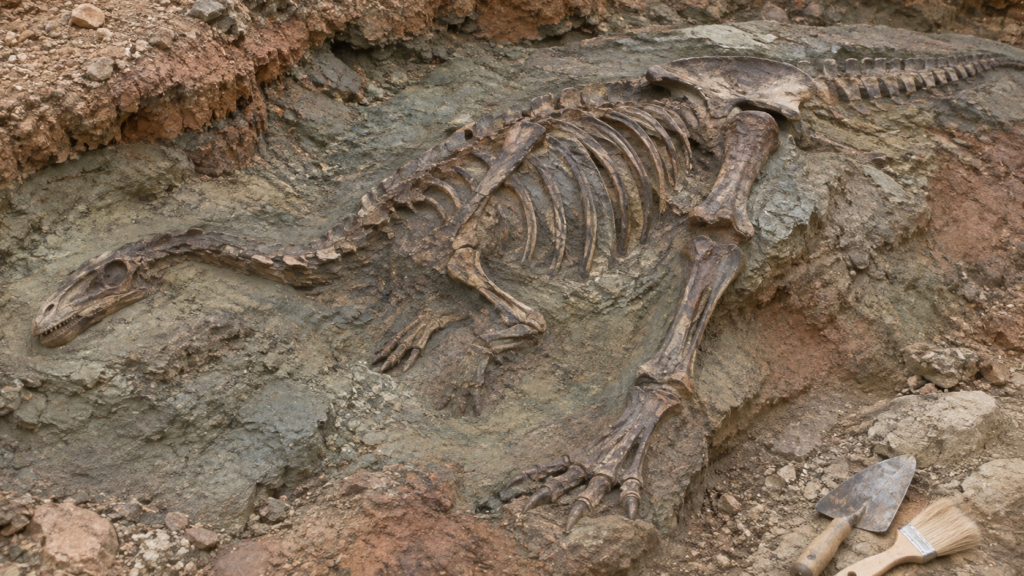
Nearly every conceivable posture has been proposed for Plateosaurus. Friedrich von Huene, who excavated at Trossingen, argued in 1907–08 that it walked upright on its toes on two legs, and he mounted the Tübingen skeletons that way. Otto Jaekel, who studied the Halberstadt material, proposed in 1910 that it walked on all fours like a lizard, with its soles flat on the ground. A year later he changed his mind and argued for a clumsy, kangaroo-like hop. Eberhard Fraas, who began the Trossingen digs, pointed to the flattened skeletons in the rock and argued for a sprawling four-legged gait.
From the 1980s on, researchers widely accepted a posture with the legs straight under the body and the back roughly level. The popular view became a compromise: four legs at slow speeds, two when running. A 1994 reconstruction gave the tail a strong downward curve that would have made standing on two legs impossible, but a 2003 study showed the tail was in fact straight.
The compromise fell apart in 2007, when Matthew Bonnan and Phil Senter examined the forelimb. A four-legged walker needs its palms facing the ground to take the weight. Humans can place their palms flat on the floor for a push-up because the two forearm bones cross, letting the wrist rotate. Bonnan and Senter found that the forearm bones of Plateosaurus could not rotate this way. Its palms faced inward and could not turn down. Some museum mounts did show the palms facing down, but only because the two forearm bones had been swapped at the elbow.
In 2010 Heinrich Mallison rebuilt a Tübingen skeleton as a 3D digital model and tested its posture and center of mass. With the back nearly level on two legs, the center of mass sat securely over the hind limbs, and both slow and rapid walking worked without difficulty. In four-legged poses, the forelimbs either carried very little weight or were put under heavy compression, and the movement of the hind limbs was cramped. The reach of the neck shrank, and looking around required an extreme neck posture. The study concluded that walking on four legs offered no advantage in either mobility or stability.
The current consensus is that Plateosaurus always walked on two legs. That brings the answer back to the bipedal walking Huene argued for a century ago, with one difference: Huene’s reconstruction tilted the backbone steeply, while today’s has the back held nearly level and balanced by the long tail. The forelimbs, unable to set a palm on the ground, were made for grasping rather than walking.
Related products
You can find books and products related to this article on Amazon.
If you buy through the links above, this blog may earn a commission.
About the images
The images in this article are illustrations created with AI (ChatGPT), and you are welcome to use them. If you do, we would appreciate a link back to this article as the source.
Sources
Mallison, H. (2010). The Digital Plateosaurus I: Body mass, mass distribution and posture assessed using CAD and CAE on a digitally mounted complete skeleton. Palaeontologia Electronica 13(2), 8A. https://palaeo-electronica.org/2010_2/198/index.html
Mallison, H. (2010). The Digital Plateosaurus II: An assessment of the range of motion of the limbs and vertebral column and of previous reconstructions using a digital skeletal mount. Acta Palaeontologica Polonica 55(3), 433–458. https://doi.org/10.4202/app.2009.0075
Bonnan, M. F. & Senter, P. (2007). Were the basal sauropodomorph dinosaurs Plateosaurus and Massospondylus habitual quadrupeds? Special Papers in Palaeontology 77, 139–155
Sander, P. M. & Klein, N. (2005). Developmental plasticity in the life history of a prosauropod dinosaur. Science 310(5755), 1800–1802. https://doi.org/10.1126/science.1120125
Sander, P. M. (1992). The Norian Plateosaurus bonebeds of central Europe and their taphonomy. Palaeogeography, Palaeoclimatology, Palaeoecology 93, 255–299
Wikipedia, Plateosaurus (age, body size, localities, discovery, species) https://en.wikipedia.org/wiki/Plateosaurus

コメント