This article contains affiliate links. As an Amazon Associate I earn from qualifying purchases.
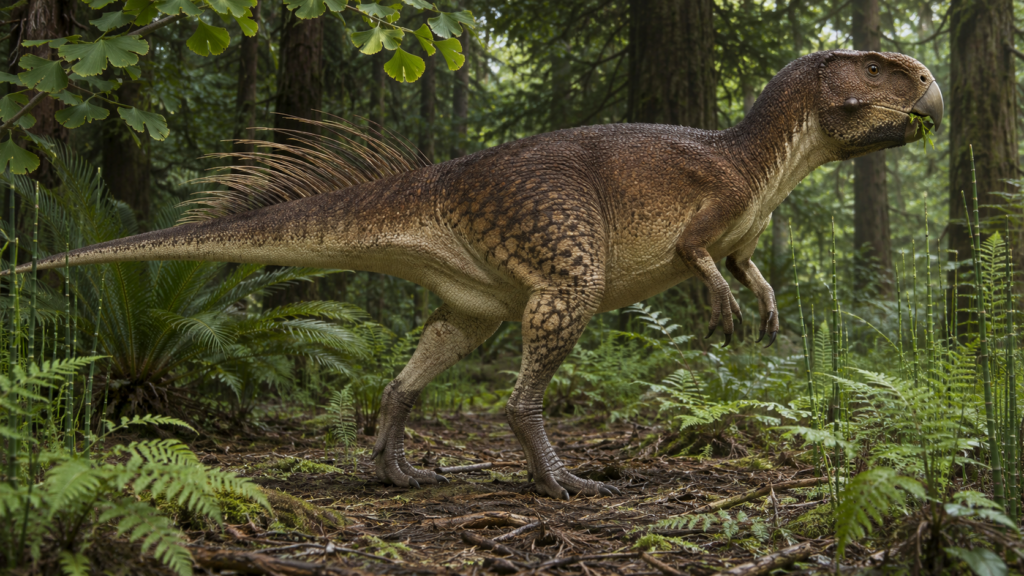
| Name | Psittacosaurus (“parrot lizard”). The first species named was Psittacosaurus mongoliensis |
| Classification | Dinosaur, ornithischian, ceratopsian |
| Age | Early Cretaceous (about 126 to 100 million years ago) |
| Where found | China, Mongolia, Russia (Siberia) |
| Length | About 2 m in the larger species |
| Weight | About 50 kg for the larger species by one estimate; adults of Psittacosaurus lujiatunensis from Liaoning, China, are estimated at about 23.5 kg |
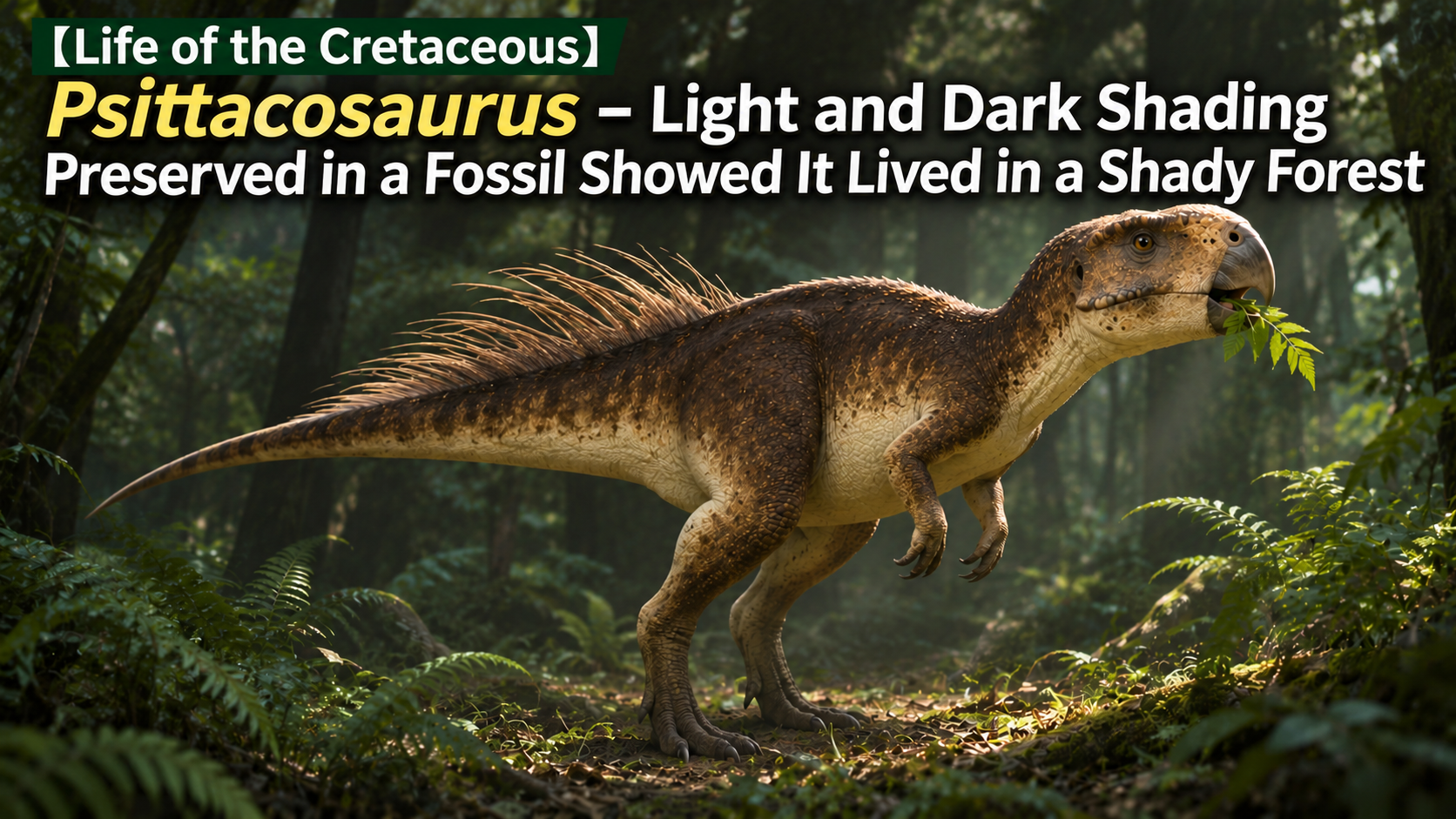
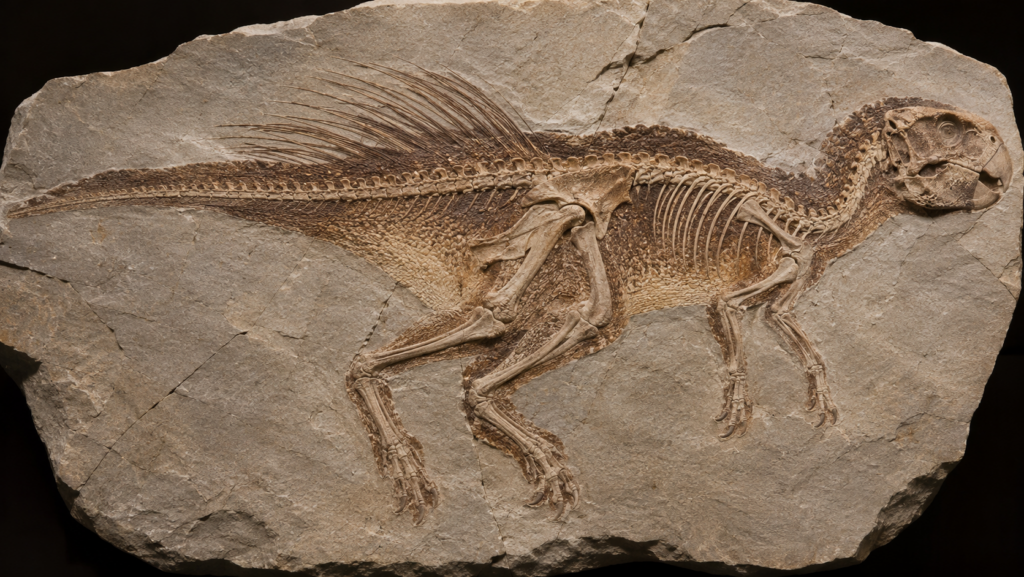
Psittacosaurus was a plant-eating dinosaur about the size of a large dog that lived in Asia in the Early Cretaceous. It was an early member of the ceratopsians, the group that includes Triceratops. Hundreds to thousands of specimens have been found, and one of them preserves the light and dark shading of the animal’s skin.
Appearance and Life
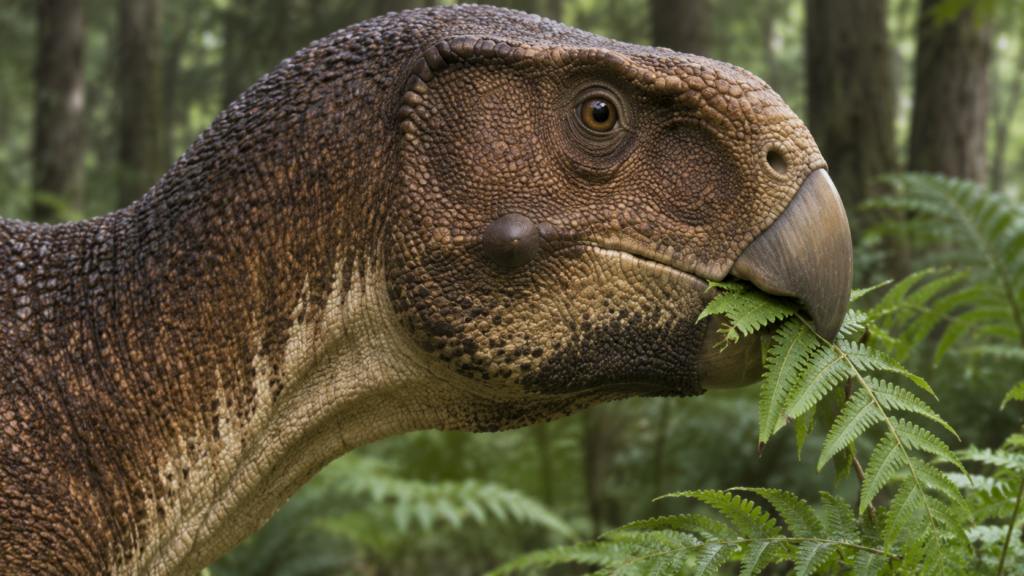
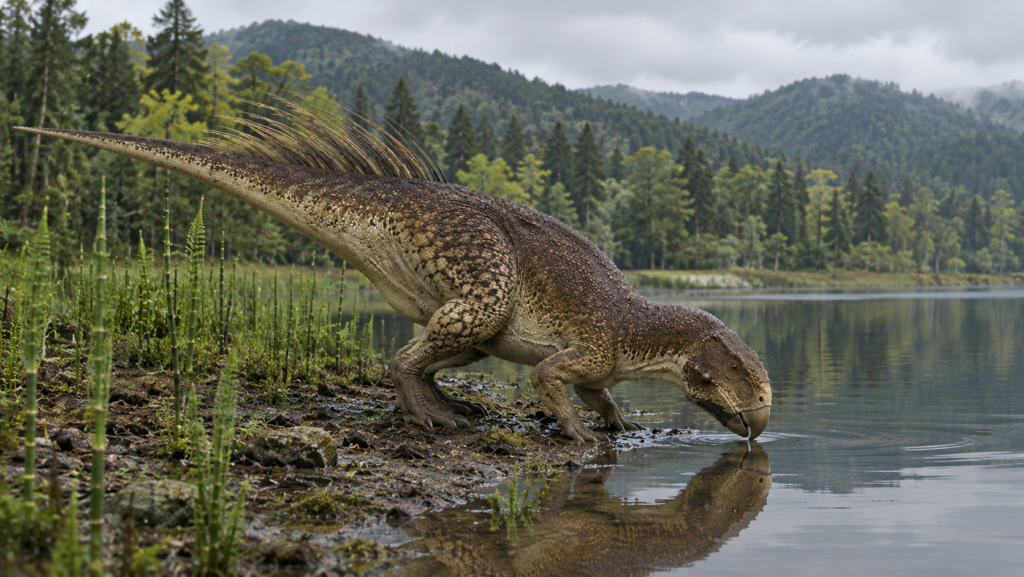
As its name suggests, the tip of its mouth is a hooked beak like a parrot’s. Its snout is one of the shortest of any dinosaur, and its head is deep and boxy. On each side of the face, at the cheek, sits a small bony knob. Skeletons with more than 40 small stones gathered where the stomach was are not unusual; the swallowed stones are thought to have ground up plant food in the stomach. In 2025, stomach stones were also reported from the skeletons of newly hatched young.
In 1923, Henry Fairfield Osborn of the American Museum of Natural History named the animal from fossils found in Mongolia. More fossils have since turned up in China and Russia, and more than ten species have been described. How many species it should be divided into is still debated.
A study of bone tissue and of limb proportions at different ages found that young animals in their first one to two years walked on all fours, and shifted to walking on their hind legs as they grew. One specimen, reported in 2002, has a row of long, bristle-like structures along the top of the base of its tail.
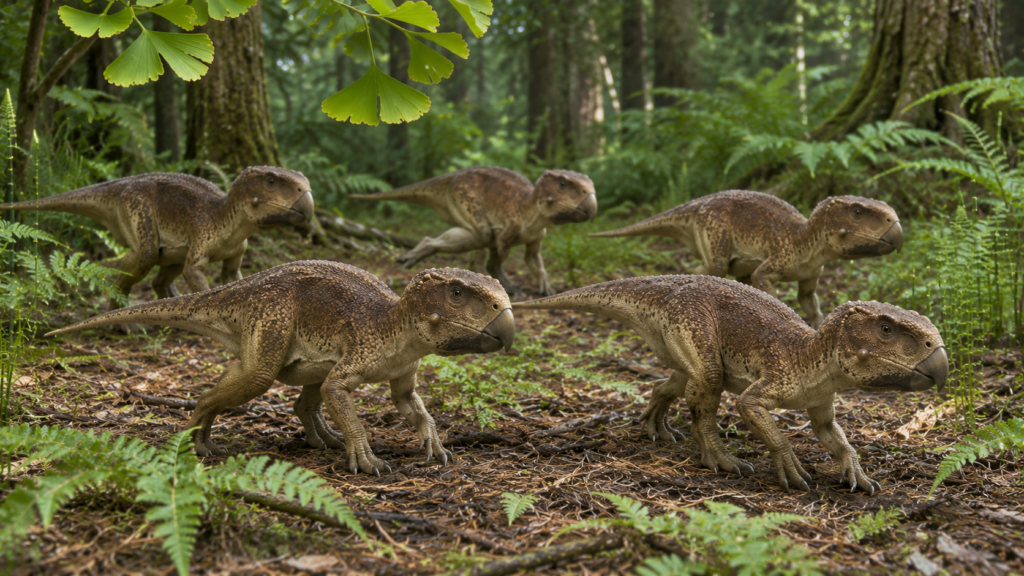
The Jehol Biota of Liaoning, China, has yielded several fossils of groups made up only of young animals, suggesting that juveniles lived together in groups. In 2004, a fossil of 34 young animals buried with one larger individual was reported as evidence of parental care. A re-examination in 2014 counted 24 young animals and found the larger one to be only four to five years old, too young to breed, suggesting a group of juveniles of different ages rather than a parent with its offspring.
In the Jehol Biota, Psittacosaurus was also prey. The bones of a young Psittacosaurus were found inside the belly of a fossil of the mammal Repenomamus robustus. In 2023, a fossil was reported in which a Repenomamus was buried by a volcanic mudflow while biting into the ribs of a Psittacosaurus.
Light and Dark Shading Preserved in the Fossil
The Senckenberg Museum in Frankfurt, Germany, holds a Psittacosaurus specimen from the Jehol Biota, SMF R 4970. Skin and scales are preserved along the outline of its body, and within them are traces of melanosomes, the tiny structures in cells that make pigment, preserved as darker and lighter areas.
In 2016, Jakob Vinther of the University of Bristol and colleagues studied how this pigment was distributed. The back was dark, and the belly and the underside of the tail were light. The chest was darker than the belly, the outer side of the hind legs had a net-like pattern and the inner side had stripes, the cheek knobs and chin were dark, and the end of the tail had fine spots. A dark back and light belly is called countershading, and many living animals have it. When light comes from above, the underside of the body falls into shadow; if the underside is lighter to begin with, the shadow is cancelled out, the body looks flat, and the animal is harder to spot.
The team painted this pattern onto a life-size model and compared how the body’s shadows looked under direct sunlight on a clear day and under scattered light, as on a cloudy day or inside a forest. The position of the light and dark areas on Psittacosaurus matched the pattern that best cancels shadows under scattered light. From this, the team concluded that Psittacosaurus lived in soft light, in a closed habitat such as a forest with a fairly dense canopy.
Dinosaur colours had previously been reconstructed from fossil melanosomes mainly in small feathered dinosaurs. This study went further, using the arrangement of light and dark shading to estimate how bright the animal’s surroundings were. In 2021, the same specimen was also used to describe the shape of the cloaca, the opening for waste and eggs.
Related products
You can find books and products related to this article on Amazon.
If you buy through the links above, this blog may earn a commission.
About the images
The images in this article are illustrations created with AI (ChatGPT), and you are welcome to use them. If you do, we would appreciate a link back to this article as the source.
Sources
Vinther, J. et al. (2016). 3D Camouflage in an Ornithischian Dinosaur. Current Biology 26, 2456–2462. https://doi.org/10.1016/j.cub.2016.06.065
Vinther, J. et al. (2021). A cloacal opening in a non-avian dinosaur. Current Biology 31, R182–R183. https://doi.org/10.1016/j.cub.2020.12.039
Meng, Q. et al. (2004). Parental care in an ornithischian dinosaur. Nature 431, 145–146. https://doi.org/10.1038/431145a
Hedrick, B. P. et al. (2014). The osteology and taphonomy of a Psittacosaurus bonebed assemblage of the Yixian Formation (Lower Cretaceous), Liaoning, China. Cretaceous Research 51, 321–340. https://doi.org/10.1016/j.cretres.2014.06.015
Zhao, Q. et al. (2013). Histology and postural change during the growth of the ceratopsian dinosaur Psittacosaurus lujiatunensis. Nature Communications 4, 2079. https://doi.org/10.1038/ncomms3079
Mayr, G. et al. (2002). Bristle-like integumentary structures at the tail of the horned dinosaur Psittacosaurus. Naturwissenschaften 89, 361–365. https://doi.org/10.1007/s00114-002-0339-6
Hu, Y. et al. (2005). Large Mesozoic mammals fed on young dinosaurs. Nature 433, 149–152. https://doi.org/10.1038/nature03102
Han, G. et al. (2023). An extraordinary fossil captures the struggle for existence during the Mesozoic. Scientific Reports 13, 11221. https://doi.org/10.1038/s41598-023-37545-8
Ishikawa, A. et al. (2025). Psittacosaurus houi, a longer snouted psittacosaurid from the Lower Cretaceous Lujiatun Unit of Yixian Formation, Liaoning, China. PeerJ 13, e19547. https://doi.org/10.7717/peerj.19547
Natural History Museum, Dino Directory: Psittacosaurus https://www.nhm.ac.uk/discover/dino-directory/psittacosaurus.html

コメント