This article contains affiliate links. As an Amazon Associate I earn from qualifying purchases.
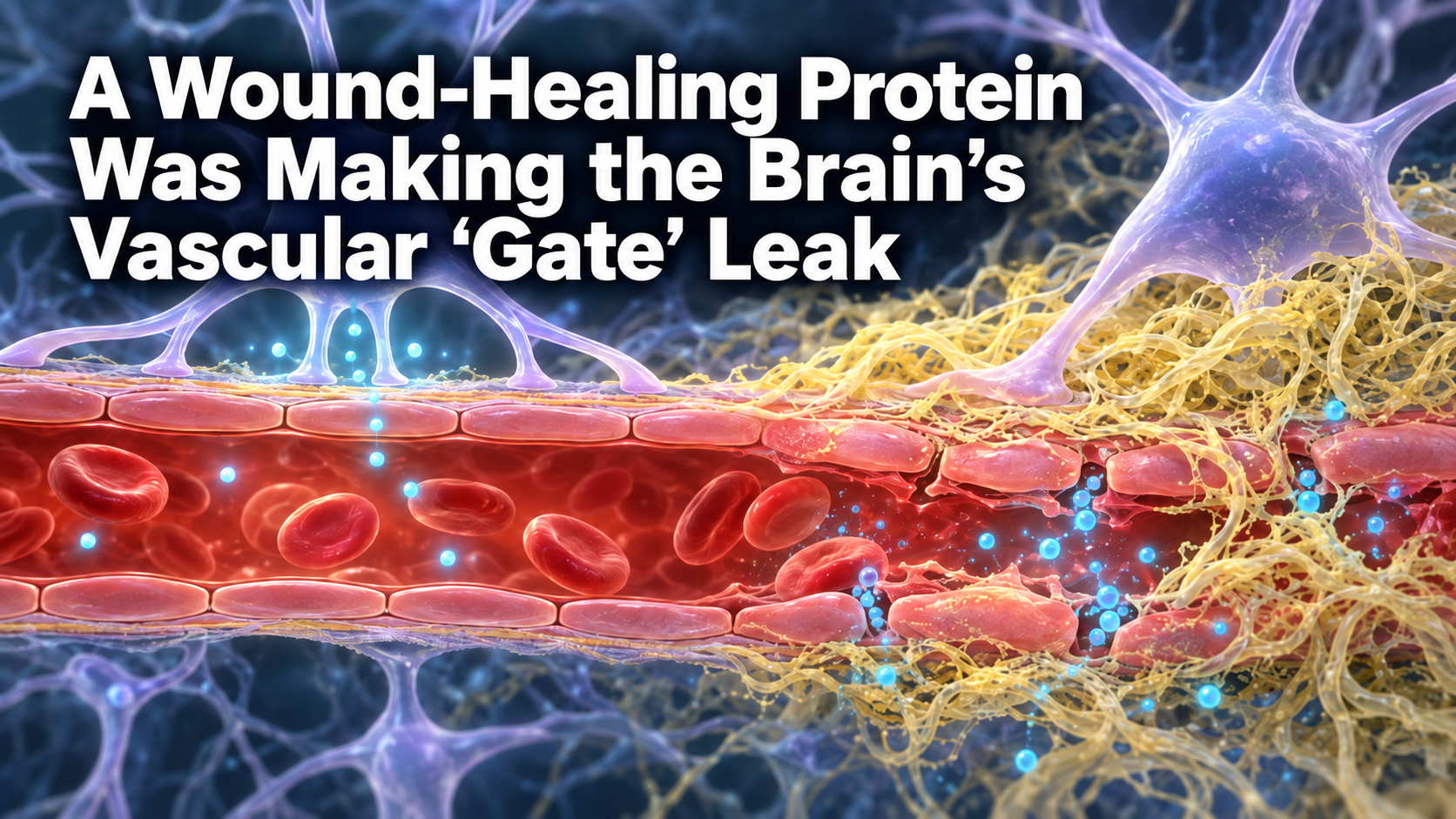
The blood vessels in the brain have something no other organ’s vessels have: a checkpoint. It is called the blood-brain barrier. The cells lining the inside of the vessels sit so tightly together that stray substances in the blood cannot slip into the brain, while waste that builds up in the brain gets handed back out to the bloodstream. In Alzheimer’s disease, this checkpoint starts to leak surprisingly early. The leak is most pronounced in people who carry APOE ε4, the strongest common genetic risk factor for the disease. What nobody could explain was the middle of the story: why does carrying APOE ε4 make the barrier leak?
A paper from Columbia University, published in Nature Aging in September 2026, fills in one piece of that middle. The culprit it names is an ordinary protein the body uses to heal wounds.
A Clue from Two Years Earlier: Carriers Who Never Got Sick
The story goes back to 2024. The same Columbia team had looked at people who carry two copies of APOE ε4 and yet remain cognitively healthy past 70. The idea was that some other gene might be protecting them. Reading their whole genomes, the team found a rare loss-of-function mutation in FN1, the gene for a protein called fibronectin.
Checked in a dataset of 7,185 people with two copies of APOE ε4, carriers of this mutation had 71% lower odds of developing Alzheimer’s disease, and those who did develop it did so about 3.4 years later on average. No obvious downside has been found in people who carry it.
Fibronectin builds the scaffold that fills the space between cells. When tissue is injured, it recruits cells to the site and drives the repair. Around the brain’s blood vessels, there is normally only a trace of it. In the brains of people with Alzheimer’s disease, however, it had piled up in large amounts around the vessels. The protective mutation reduces fibronectin. So by this point the direction was already visible: less fibronectin, more protection.
But that was only a genetic clue. What excess fibronectin actually does, whether it is truly a cause or just something that accumulates as a result of the disease, was still unknown.
Adding More Scaffold Was Enough to Make the Barrier Leak
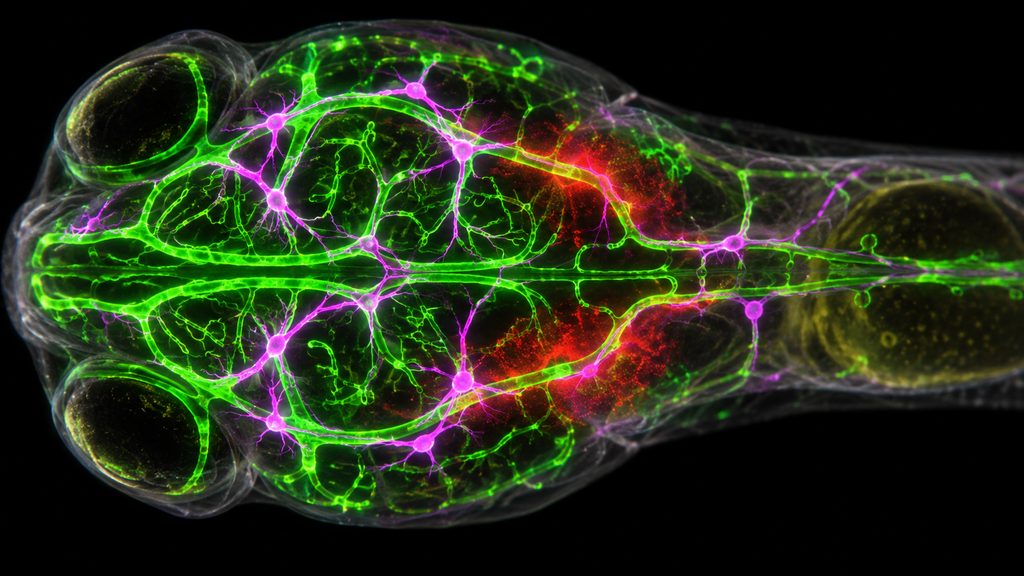
The decisive experiment in the new paper is almost disarmingly simple. In the brains of zebrafish, the team made astrocytes produce extra human fibronectin. Astrocytes are star-shaped support cells that wrap the outside of brain blood vessels and help maintain the checkpoint. No amyloid-beta was injected, and no inflammation was induced. The only change was more scaffold protein.
That alone made the barrier leak. Co-first author Prabesh Bhattarai explains that when the team raised fibronectin in astrocytes, the barrier became permeable, and when they lowered it, barrier function improved.
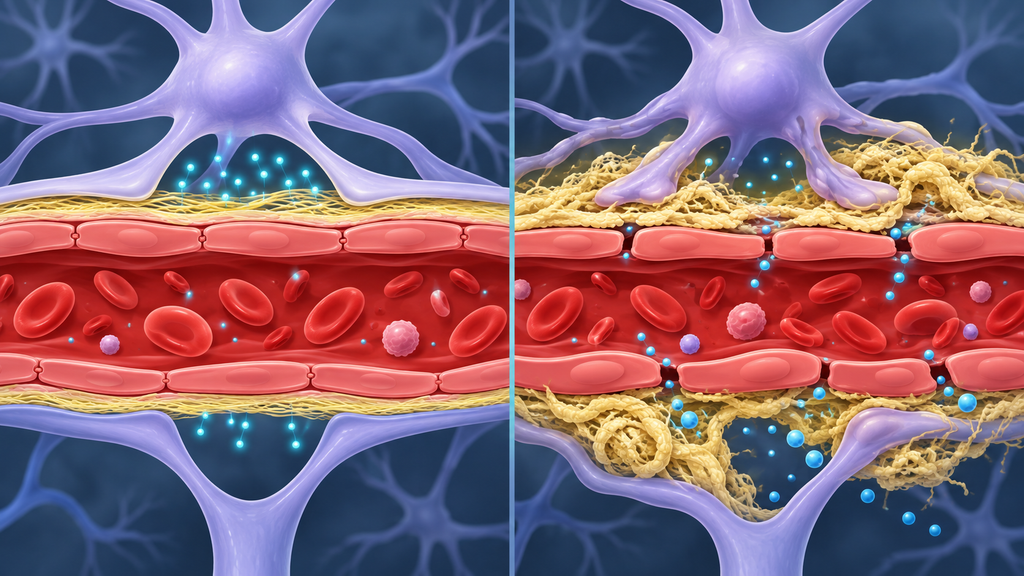
In mice carrying human APOE ε4, brain fibronectin was nearly twice the level seen in mice carrying APOE ε3, the standard version, and there was evidence of barrier leakage as well. In human postmortem brain tissue and cerebrospinal fluid, brains with high fibronectin stood out for their inflamed astrocytes. Put together, the team’s experiments trace one chain: APOE ε4, amyloid-beta and inflammatory signals each push astrocytes to make fibronectin, and the fibronectin settles around the vessels.
Piled-Up Scaffold Cuts Off the Conversation with the Vessel
So why does extra scaffold loosen the checkpoint? The mechanism the team worked out comes down to crossed signals.
Astrocytes and the cells lining the vessel keep their tight junctions, the seals between cells, by trading growth factors called VEGF, HB-EGF and IGF-1. When fibronectin accumulates in excess, it binds to receptors on the cell surface called integrins, which in turn keep an enzyme called focal adhesion kinase, or FAK, switched on. In that state, the exchange of growth factors breaks down, the seals come apart and the checkpoint develops gaps. Put another way, the “gather here and repair” signal meant for wounds is stuck ringing around the brain’s vessels, and it drowns out the everyday conversation that keeps the barrier intact.
According to co-first author Elanur Yilmaz, who led the single-cell gene analysis, the changes in this pathway pointed the same way in the experimental models and in brain tissue from people with Alzheimer’s disease.
Three Ways to Stop the Leak
Once the mechanism was clear, so were the ways to fix it. Using zebrafish and three-dimensional vessel models built from human cells, the team tried three approaches.
- Reduce fibronectin itself. In zebrafish exposed to amyloid-beta, leakage through the barrier went down.
- Block the FAK pathway. Shutting off the route by which fibronectin interrupts the growth-factor conversation brought the growth-factor signaling back.
- Replace the missing growth factors. In a model where VEGF signaling had been blocked to break the seals, adding HB-EGF and IGF-1 restored the levels of the proteins the seals are made of.
Corresponding author Caghan Kizil says the first option, reducing fibronectin, is the most direct and the easiest to carry into the clinic. The protective mutation found in 2024 is, after all, a case of nature doing exactly that. The lab is now looking for ways to do the same thing deliberately, whether with antibodies, small-molecule drugs or gene-based methods.
Still at the Stage of Fixing an Animal’s Barrier
One thing should be stated plainly: this study repaired the barrier’s leak, not memory or cognition. Kizil himself notes that the interventions have not yet been shown to preserve cognition even in animals, and that the human findings are correlational and need confirmation in larger groups. Before any human trial, the team would need to show an effect on cognition in animals, show that a drug reaches the brain, and show that it leaves fibronectin’s work elsewhere in the body alone.
Fibronectin is essential for wound healing and for maintaining blood vessels, so simply wiping it out is not an option. The goal, Kizil stresses, is to selectively curb the pathological build-up. The paper also discloses that Kizil and two co-authors hold patents on FN1-targeted treatments and are founders of a company set up to develop them.
Roughly one person in five carries at least one copy of APOE ε4. It is a common variant. With a concrete step now placed in the middle of the story of how it damages the brain’s vessels, namely an overabundance of a wound-healing protein, there is one more foundation on which to think about what could be done for the people who carry it.
Related products
You can find books and products related to this article on Amazon.
If you buy through the links above, this blog may earn a commission.
Sources
- Bhattarai P, Yilmaz E, et al. “Fibronectin mediates APOE4-driven blood–brain barrier dysfunction in Alzheimer’s disease.” Nature Aging (2026). https://doi.org/10.1038/s43587-026-01204-0
- Columbia University Irving Medical Center, via EurekAlert! (September 11, 2026). “The brain’s blood vessels may hold a key to Alzheimer’s and protection from it.” https://www.eurekalert.org/news-releases/1143638
- ScienceAlert (September 18, 2026). “Scientists Successfully Repair Leaky Blood-Brain Barrier in Alzheimer’s Models.” https://www.sciencealert.com/scientists-successfully-repair-leaky-blood-brain-barrier-in-alzheimers-models
- Earlier study: Bhattarai P, et al. “Rare genetic variation in fibronectin 1 (FN1) protects against APOEε4 in Alzheimer’s disease.” Acta Neuropathologica (2024). https://doi.org/10.1007/s00401-024-02721-1


コメント