
This article contains affiliate links. As an Amazon Associate I earn from qualifying purchases.
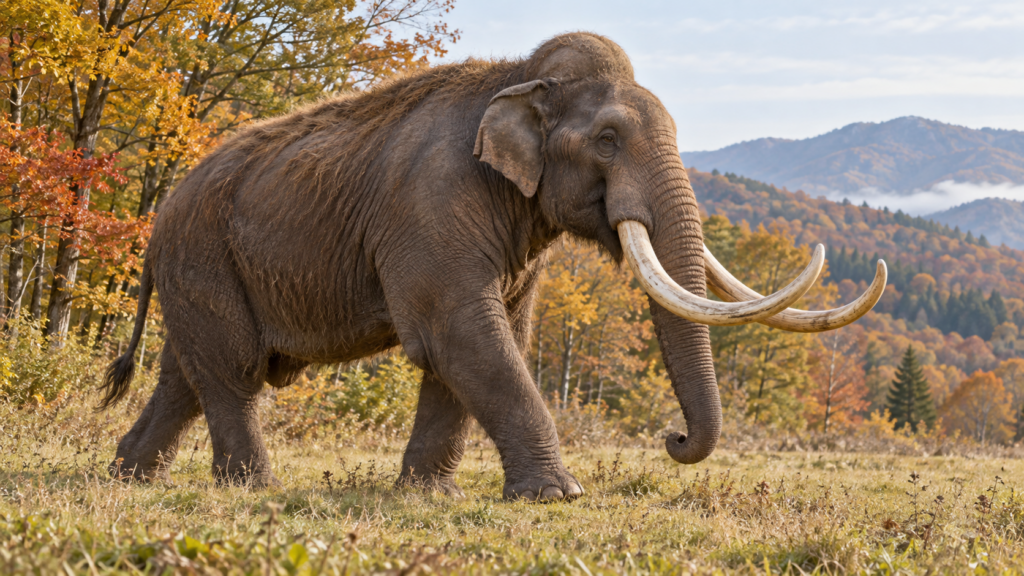
| Name | Naumann’s elephant (Palaeoloxodon naumanni). The species name honors Heinrich Edmund Naumann, a German geologist who came to Japan in the Meiji era and was the first to study Japan’s fossil elephants |
| Classification | Mammal, Proboscidea, Elephantidae, genus Palaeoloxodon |
| Age | Quaternary, middle to late Pleistocene (about 330,000 to about 35,000 years ago) |
| Where found | Across the Japanese archipelago, at hundreds of sites from Kyushu through Honshu to Hokkaido. The specimen on which the scientific name is based comes from Sahama-cho, Hamamatsu, Shizuoka Prefecture |
| Shoulder height | About 2.5 m in males. Females were clearly smaller |
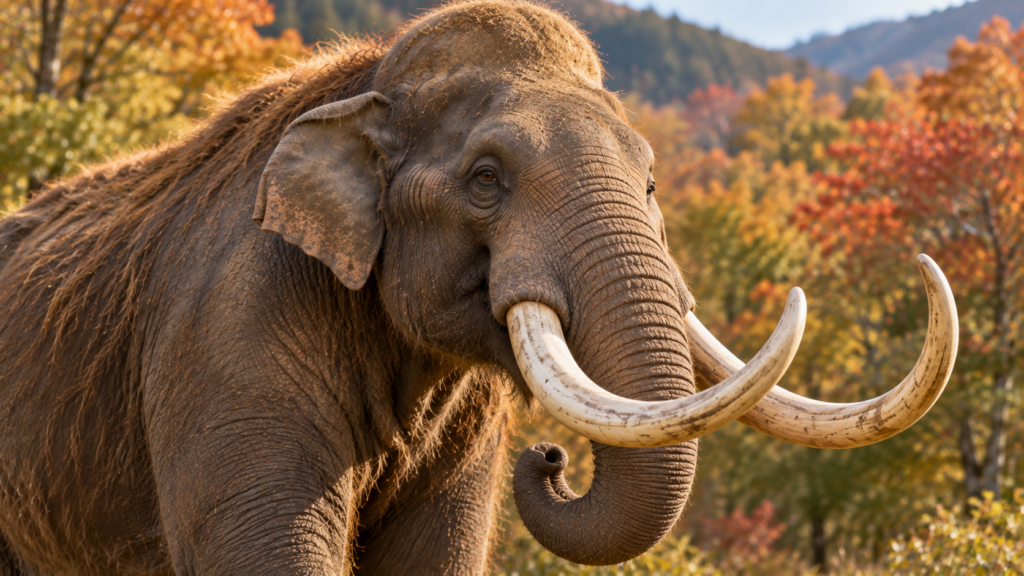
| Tusks | Males had thick tusks that curved upward and twisted slightly. Females had slender, nearly straight tusks |
Naumann’s elephant lived on the Japanese archipelago during the Pleistocene. It ranged from Kyushu through Honshu to Hokkaido, from coastal lowlands up into the mountains. It is the most commonly found fossil elephant in Japan, and its bones and teeth have turned up in central Tokyo, at housing construction sites in Kanagawa, and on the floor of the Seto Inland Sea.
Form and Life
Males and females of Naumann’s elephant differed greatly in size. Comparing a male skull found in Narita, Chiba Prefecture, with a female skull found at Nihonbashi-Hamacho in Chuo Ward, Tokyo, shows that the part of the male skull that held the tusk roots was much larger, and the body bones confirm that females were smaller than males. A male skeleton excavated in Fujisawa, Kanagawa Prefecture, has been reconstructed with a shoulder height of about 2.5 m.
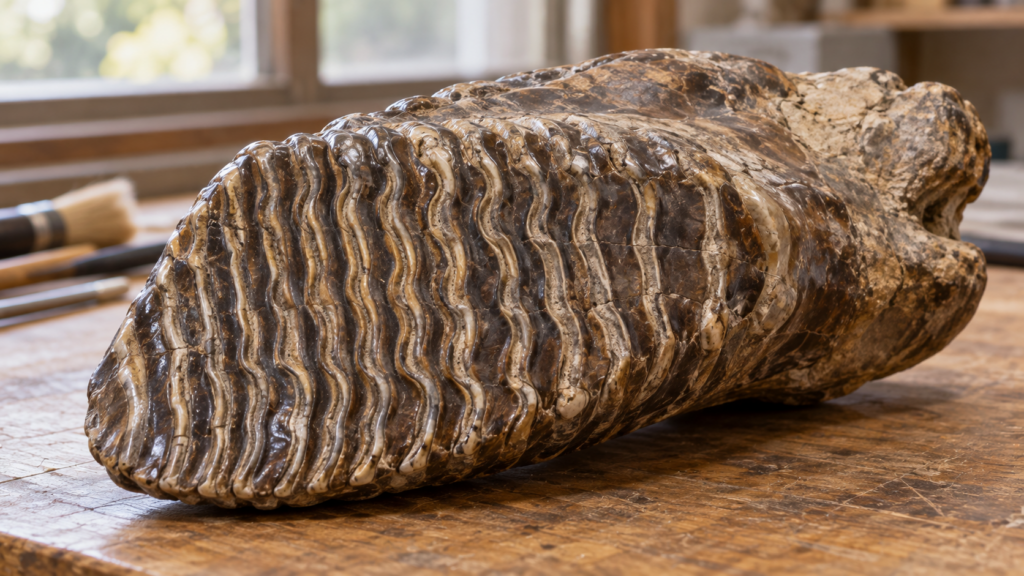
Its teeth were the typical molars of elephants, with many plates lined up across the worn grinding surface, used to grind plant food. The pattern on the chewing surface has a shape characteristic of Naumann’s elephant, so a single molar is enough to identify the species even when no skull survives.
It lived through a time of repeated glacial and interglacial periods. The Fujisawa male comes from strata about 130,000 years old, laid down during a warm period when sea level rose and the sea pushed inland, and the same layers held fossils of freshwater shellfish, turtles, monkeys and deer. In Hokkaido, it is thought to have been replaced by the woolly mammoth during cold periods.
Naumann, for whom the species is named, reported Japanese fossil elephants in an 1882 paper, but he assigned them to the same species as a fossil elephant from India (Elephas namadicus). In 1924 Jiro Makiyama of Kyoto Imperial University studied fossils from Sahama-cho in Hamamatsu and named them as a new subspecies of the Indian species, after Naumann. The Japanese elephant later came to be regarded as a separate species and is now called Palaeoloxodon naumanni.
Re-dating the Last Fossils Moved Its Extinction 10,000 Years Earlier
When Naumann’s elephant disappeared has been studied by radiocarbon dating the protein (collagen) preserved in its bones. In a 2012 study in which Akira Iwase and colleagues compiled dates for Naumann’s elephant from across Japan, the youngest date was about 24,000 years ago, and that was taken as the time of its extinction. Since humans are thought to have reached the Japanese archipelago about 38,000 years ago, people and elephants would have shared the islands for more than 10,000 years, and there was debate over whether human hunting had driven the elephants to extinction.
In 2026 Soichiro Kusaka of Tokai University and colleagues re-dated these fossils. In bones tens of thousands of years old, even a tiny admixture of carbon from the ground or from seawater makes the date come out younger than the true age. The team removed these contaminants with a method called ultrafiltration, which separates out only the long-chain molecules of collagen. When they re-selected and measured specimens from the 2012 compilation that had been dated younger than 38,000 years, every one came out older than before.
The preservation of the bones themselves was also a problem. Of the 57 specimens in the compilation, only four had well-preserved collagen, and these samples, from Shimane and Aomori Prefectures, gave dates of about 40,000 to 35,000 years ago. Of 21 specimens hauled up from the floor of the Seto Inland Sea off Hakata Island in Imabari, Ehime Prefecture, the six well-preserved ones were all older than 42,000 years. Among the new dates, the youngest fossil is about 36,400 to 35,700 years old.
The last fossil found is not necessarily from the last animal alive. Using the spread of the dates, the team estimated the time of extinction statistically at about 34,100 to 32,700 years ago, roughly 10,000 years earlier than the previously accepted date of about 24,000 years ago.
An earlier extinction changes how the relationship with humans looks. Judging from the ages of archaeological sites, the human population of the Japanese archipelago grew rapidly after about 39,000 years ago. Under the new estimate, humans and Naumann’s elephants overlapped for only 4,000 to 6,000 years, and the distribution of dates suggests that the times and places with many people did not overlap much with those yielding many elephant fossils. Records in stalagmites and in sediments from Lake Nojiri in Nagano Prefecture show that East Asia at this time swung between warm and cold phases at short intervals. The team concludes that the extinction of Naumann’s elephant was driven mainly by these climatic shifts, and that the effect of humans may have been limited.

Related products
You can find books and products related to this article on Amazon.
If you buy through the links above, this blog may earn a commission.
Sources
Kusaka, S., Nishioka, Y., Kimura, J., Iwase, A. & Morisaki, K. (2026). A refined chronology of the Naumann’s elephant (Palaeoloxodon naumanni) provides a new insight on factors of their extinction. Scientific Reports 16, 14657. https://doi.org/10.1038/s41598-026-50310-x
Iwase, A., Hashizume, J., Izuho, M., Takahashi, K. & Sato, H. (2012). Timing of megafaunal extinction in the late Late Pleistocene on the Japanese Archipelago. Quaternary International 255, 114–124. https://doi.org/10.1016/j.quaint.2011.03.029
Taru, H. (2007). Introducing the special exhibition “There Were Naumann’s Elephants! Kanagawa in a Warm Period.” Natural Science Gate 13(2), 12–13. Kanagawa Prefectural Museum of Natural History (in Japanese). https://nh.kanagawa-museum.jp/assets/icp/contents/1599806330492/simple/tobira49_3taru.pdf
Shizuoka University, Re-excavation at the type locality of Naumann’s elephant (in Japanese). https://doi.org/10.14945/00025047
Naumann, E. (1882). Ueber japanische Elephanten der Vorzeit. Palaeontographica 28, 1–39.
Makiyama, J. (1924). Notes on a fossil elephant from Sahamma, Tôtômi. Memoirs of the College of Science, Kyoto Imperial University, Series B 1.


コメント