This article contains affiliate links. As an Amazon Associate I earn from qualifying purchases.
| Name | Dimetrodon. The name combines the Greek words for “two,” “measure” and “teeth,” referring to its teeth of different sizes |
| Classification | Synapsida, Sphenacodontidae |
| Age | Early Permian (about 295 to 270 million years ago) |
| Where found | Mainly Texas and Oklahoma, USA. One small species comes from the Bromacker quarry in central Germany |
| Length | From about 1.7 m (Dimetrodon natalis) to about 4.6 m (Dimetrodon angelensis) among the North American species |
| Weight | About 38 to 250 kg among the North American species. The small German species was lighter still, with estimates ranging from about 6 to 24 kg depending on the study |
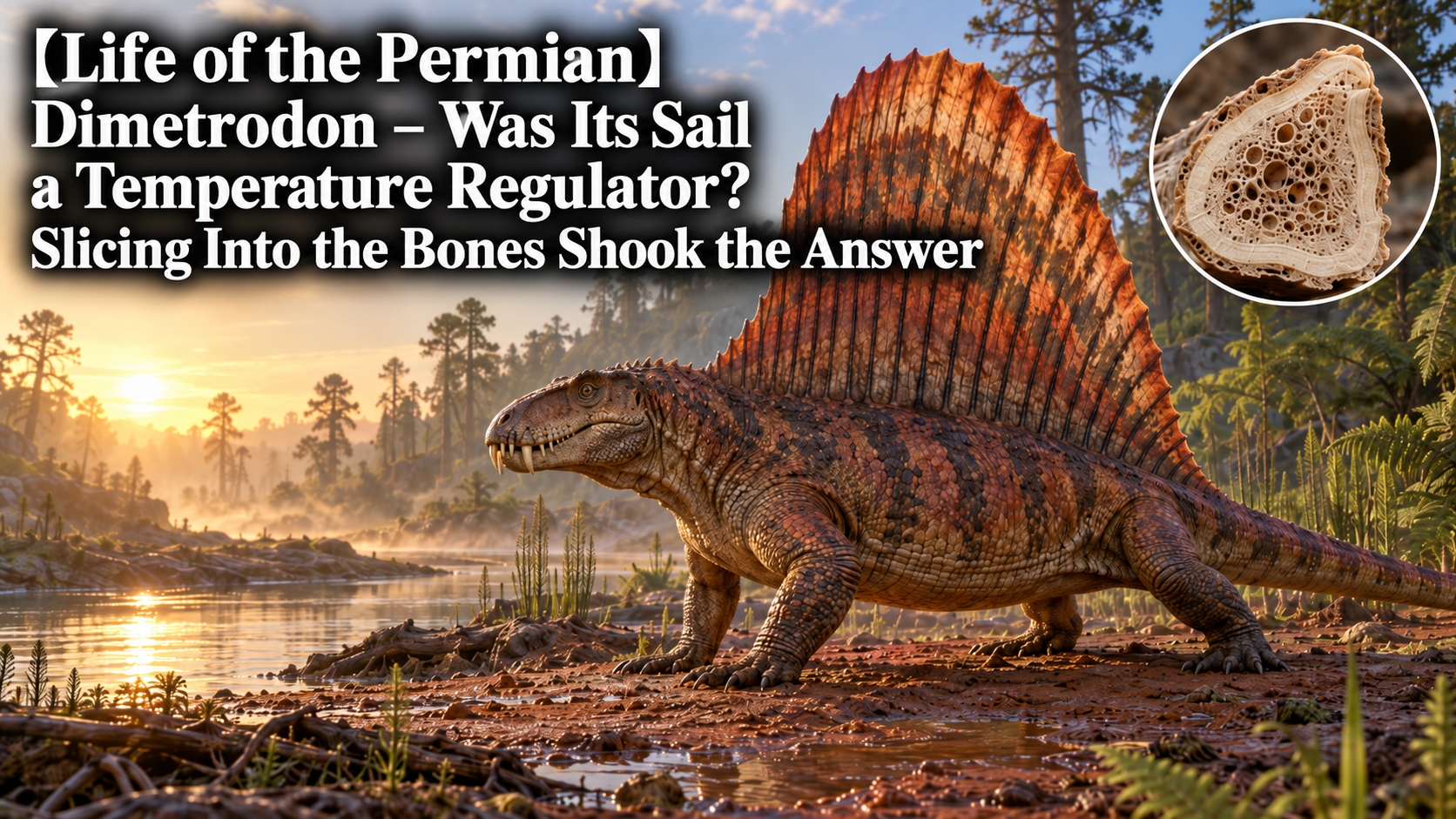
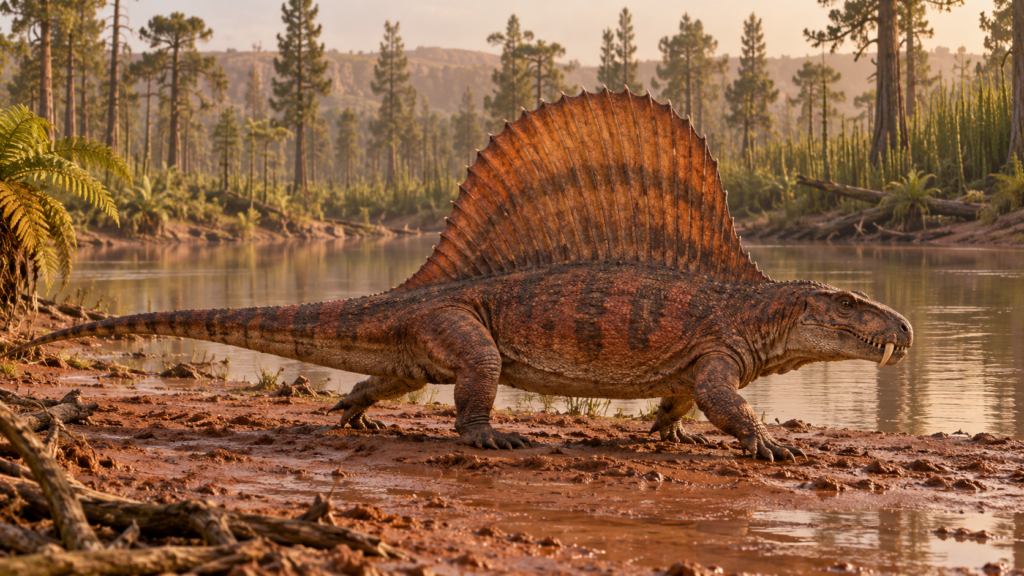
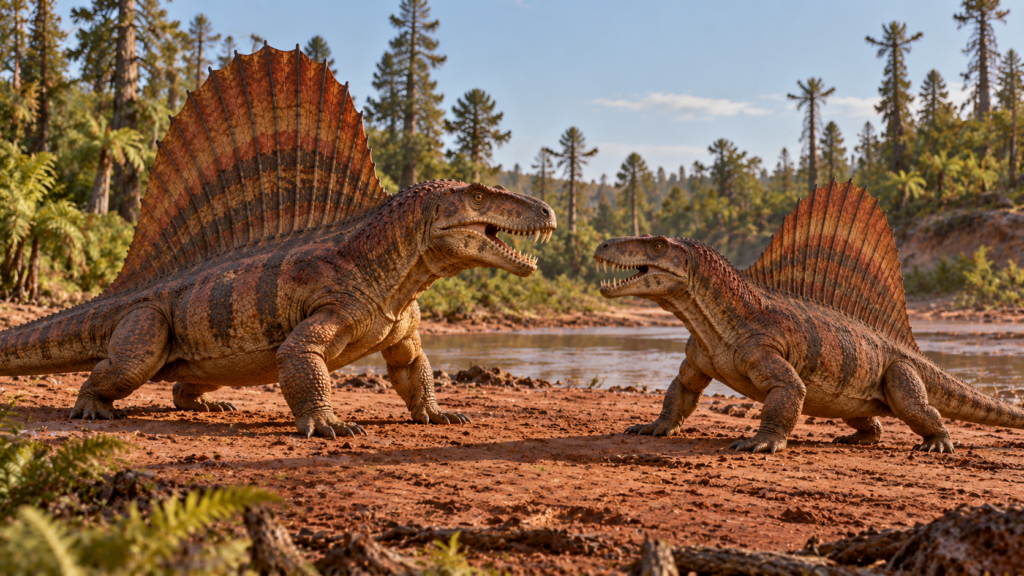
Dimetrodon was a meat-eating synapsid that lived on land in the Early Permian. On its back it carried a large sail made of long, slender bony spines joined by skin. It is a regular in dinosaur books and toy sets, but it was not a dinosaur: it disappeared roughly 40 million years before the first dinosaurs appeared. On the family tree, it is closer to mammals, including humans, than to any reptile.
Form and Life
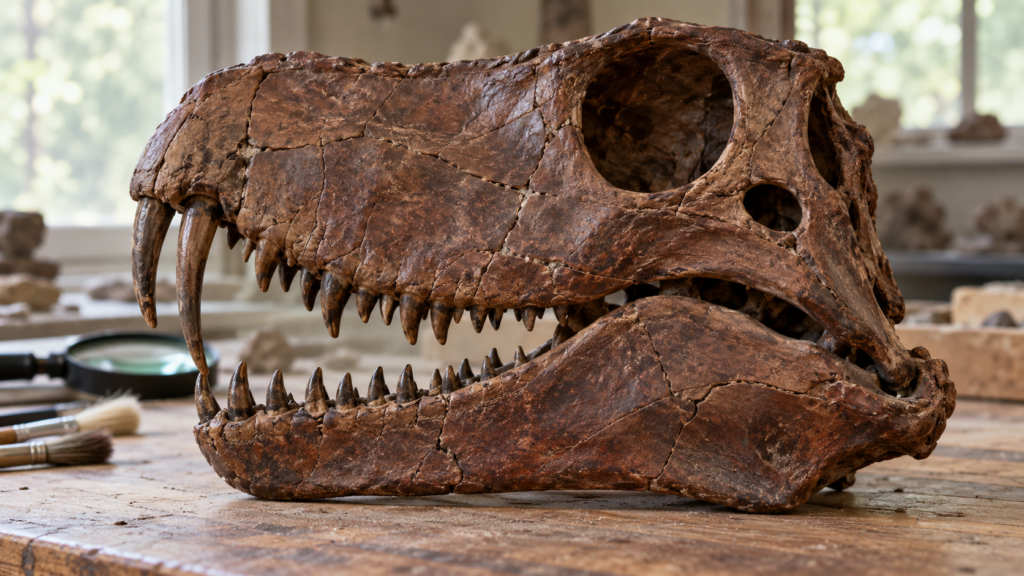
Dimetrodon was a long-tailed animal that walked with its four legs sprawled out to the sides. Its skull was tall and narrow, and behind each eye was a single opening where the jaw muscles attached. The number and position of this opening is the hallmark of synapsids, and it is still present, in modified form, in mammal skulls. The genus was named by the American paleontologist Edward Drinker Cope in 1878, when he described fossils from Texas.
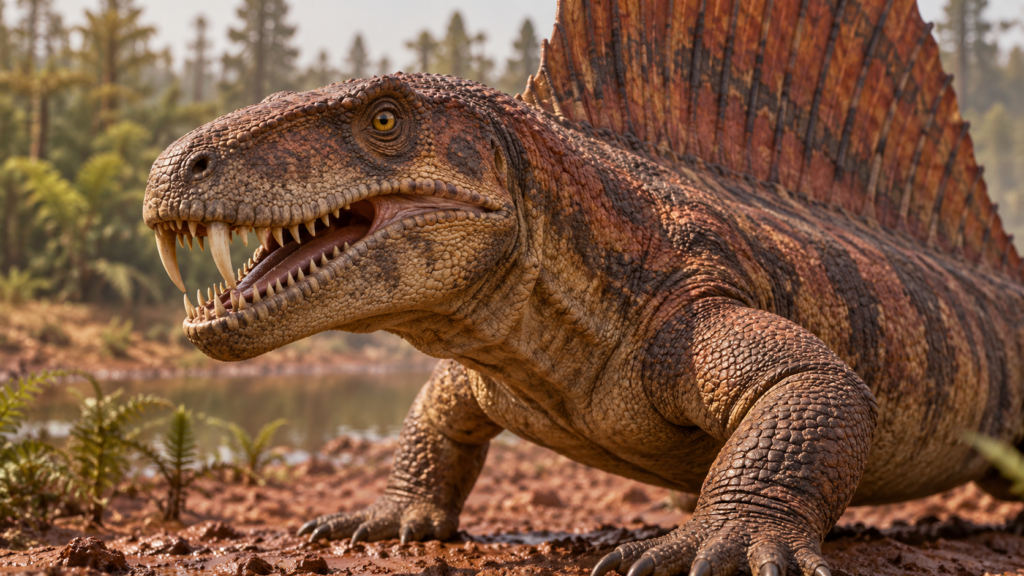
Its teeth differed in shape and size along the jaw. Near the front were one or two enlarged teeth in the upper jaw and one in the lower jaw, up to twice as long as the others, and all of the teeth curved backward with sharp cutting edges front and back. In 2014, Kirstin Brink and Robert Reisz of the University of Toronto compared the teeth of different Dimetrodon species and showed that the largest species had fine serrations, like a steak knife, along the edges of its teeth. This is the first appearance of such serrations in the fossil record of land animals, tens of millions of years before the meat-eating dinosaurs.
Dimetrodon was the top predator of its land ecosystems. At North American sites, it is thought to have sat at the top of food chains centered on the water’s edge. The red beds of Texas also contain the amphibian Eryops, the boomerang-headed Diplocaulus, and Edaphosaurus, a plant-eating synapsid that also had a sail. At a 2015 scientific meeting, researchers reported 88 dismembered Diplocaulus heads from a single Texas site, found together with shed Dimetrodon teeth. It was a meeting presentation rather than a published paper, but it hints that Dimetrodon hunted prey at the water’s edge.
About a dozen species are known, and they vary a great deal in size. North American species range from about 1.7 m to about 4.6 m long, and Dimetrodon teutonis, described in 2001 from the Bromacker quarry in Germany, is smaller than even the smallest North American species. It was the first Dimetrodon found outside North America.
Was the Sail a Temperature Regulator?
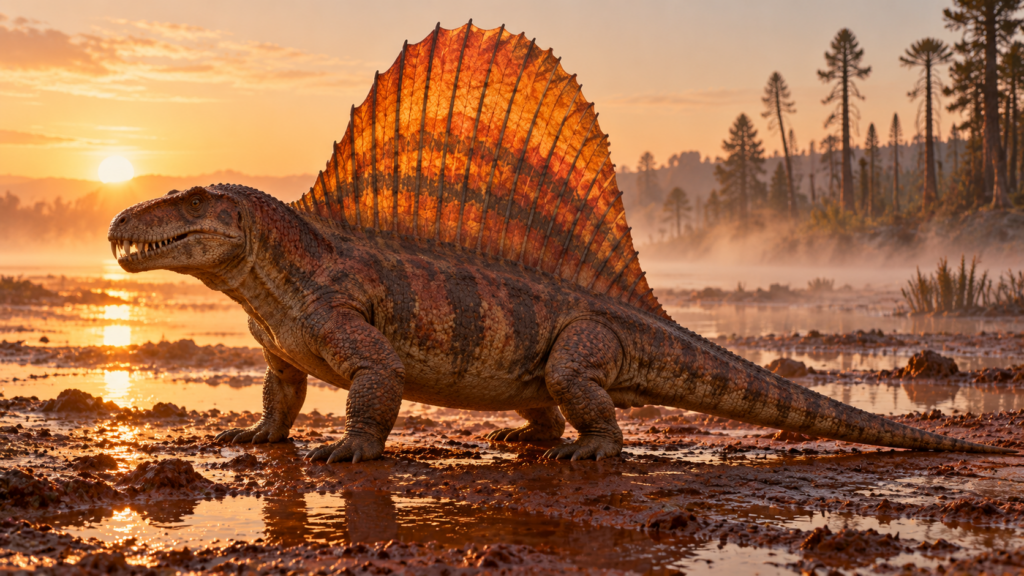
The sail of Dimetrodon is formed by extremely elongated projections on top of the backbone (neural spines), and the longest ones rose well above the height of the body. The best-known explanation for the sail has been temperature control. In 1973, British researchers Bramwell and Fellgett treated the sail as a surface for exchanging heat and calculated that, by catching the morning sun on its sail, the animal could warm up much faster than without one. The idea of blood flowing through the sail to pick up heat became a familiar part of how Dimetrodon was presented.
Doubts about this explanation came from inside the bones. In 2010, Adam Huttenlocker and colleagues cut thin sections of the neural spines of Dimetrodon and its relative Sphenacodon and examined them under the microscope. If the sail were a heat exchanger, the outer part of the sail might be expected to carry more blood vessels, but the bone at the tips of the spines had no more vascular channels than the bone at the base. Grooves that may have carried blood vessels ran along the surface of the spines, but the study concluded that how much the sail could actually regulate body temperature remains uncertain.
Also in 2010, Joseph Tomkins and colleagues looked at how sail size relates to body size. The sail of Dimetrodon grew larger at a faster rate than the body did, and sail size also varied within a species. This pattern of growth is typical of body parts used to attract mates or compete with rivals, such as deer antlers. The team also pointed out that the small ancestors of sail-backed synapsids were too small to need any special adaptations for regulating body temperature.
Dimetrodon was not the only sail-back. Edaphosaurus, from the same period, also carried a sail, but studies of their relationships suggest that the two sails evolved independently. There is no reason to assume that the sail did the same job in the meat-eating Dimetrodon and the plant-eating Edaphosaurus. The function of the sail has not been settled. It cannot be said that the sail had nothing to do with body temperature, but the view that it was mainly a structure for display has gained ground.
Related products
You can find books and products related to this article on Amazon.
If you buy through the links above, this blog may earn a commission.
Sources
Huttenlocker, A. K., Rega, E. & Sumida, S. S. (2010). Comparative anatomy and osteohistology of hyperelongate neural spines in the sphenacodontids Sphenacodon and Dimetrodon (Amniota: Synapsida). Journal of Morphology 271, 1407–1421. https://doi.org/10.1002/jmor.10876
Tomkins, J. L., LeBas, N. R., Witton, M. P., Martill, D. M. & Humphries, S. (2010). Positive allometry and the prehistory of sexual selection. The American Naturalist 176, 141–148. https://doi.org/10.1086/653001
Bramwell, C. D. & Fellgett, P. B. (1973). Thermal regulation in sail lizards. Nature 242, 203–205. https://doi.org/10.1038/242203a0
Brink, K. S. & Reisz, R. R. (2014). Hidden dental diversity in the oldest terrestrial apex predator Dimetrodon. Nature Communications 5, 3269. https://doi.org/10.1038/ncomms4269
Angielczyk, K. D. (2009). Dimetrodon is not a dinosaur: using tree thinking to understand the ancient relatives of mammals and their evolution. Evolution: Education and Outreach 2, 257–271. https://doi.org/10.1007/s12052-009-0117-4
Canoville, A., Knaus, P. L., Marchetti, L. & Fröbisch, J. (2026). Contrasting life history in the diminutive Dimetrodon species from North America and Germany. Scientific Reports 16, 16279. https://doi.org/10.1038/s41598-026-52199-y
Berman, D. S., Reisz, R. R., Martens, T. & Henrici, A. C. (2001). A new species of Dimetrodon (Synapsida: Sphenacodontidae) from the Lower Permian of Germany records first occurrence of genus outside of North America. Canadian Journal of Earth Sciences 38, 803–812. https://doi.org/10.1139/e00-106
Martínez, R. N. et al. (2011). A basal dinosaur from the dawn of the dinosaur era in southwestern Pangaea. Science 331, 206–210. https://doi.org/10.1126/science.1198467
Science News (2015). Dimetrodon‘s diet redetermined. https://www.sciencenews.org/article/dimetrodons-diet-redetermined
Cope, E. D. (1878). Descriptions of extinct Batrachia and Reptilia from the Permian formation of Texas. Proceedings of the American Philosophical Society 17, 505–530.

コメント