This article contains affiliate links. As an Amazon Associate I earn from qualifying purchases.
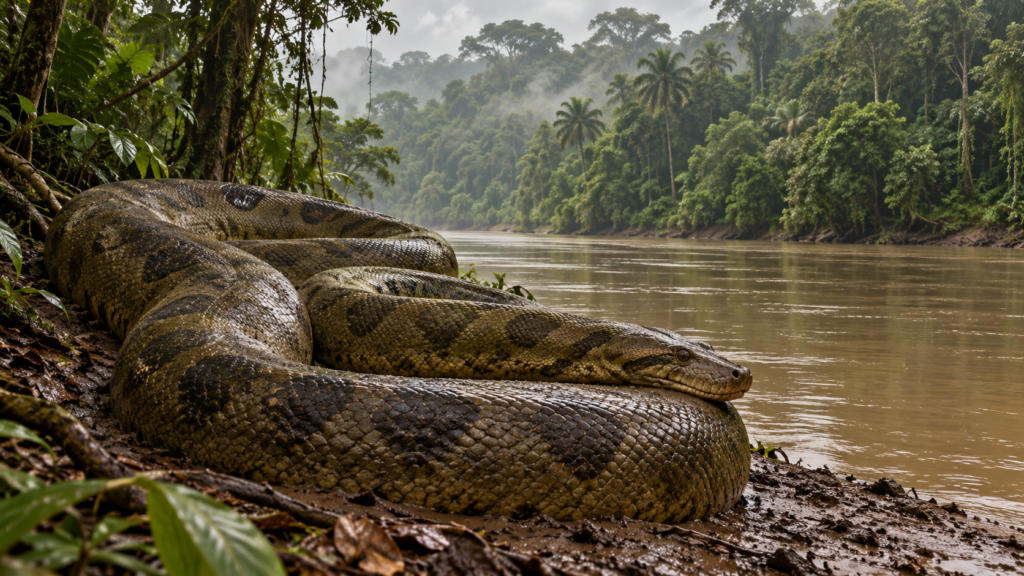
| Name | Titanoboa cerrejonensis. The genus name joins the Titans of Greek myth with “boa,” and the species name refers to Cerrejón, where it was found |
| Classification | Reptile, Squamata, Serpentes, Boidae, Boinae |
| Age | Paleogene, Paleocene (about 60 to 58 million years ago) |
| Where found | Cerrejón coal mine (Cerrejón Formation), northeastern Colombia |
| Length | About 13 m (estimated from fossil vertebrae) |
| Weight | About 1,100 kg (also an estimate) |
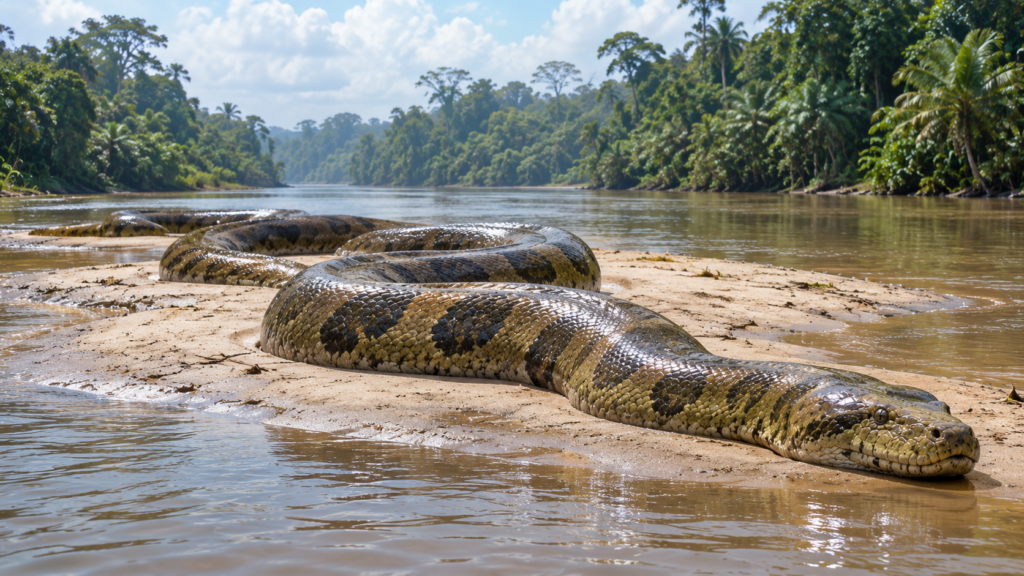
Titanoboa was a giant snake that lived in the tropical rainforests of South America during the Paleocene. It belongs to the Boinae, the same group as living boas and anacondas, and is estimated to have reached about 13 m in length and more than a tonne in weight, making it the largest snake known. The team that described it in 2009 argued that a snake this large needed a mean annual temperature of 30 to 34 °C to survive, and used it to estimate how hot the tropics were at the time.
Form and Life
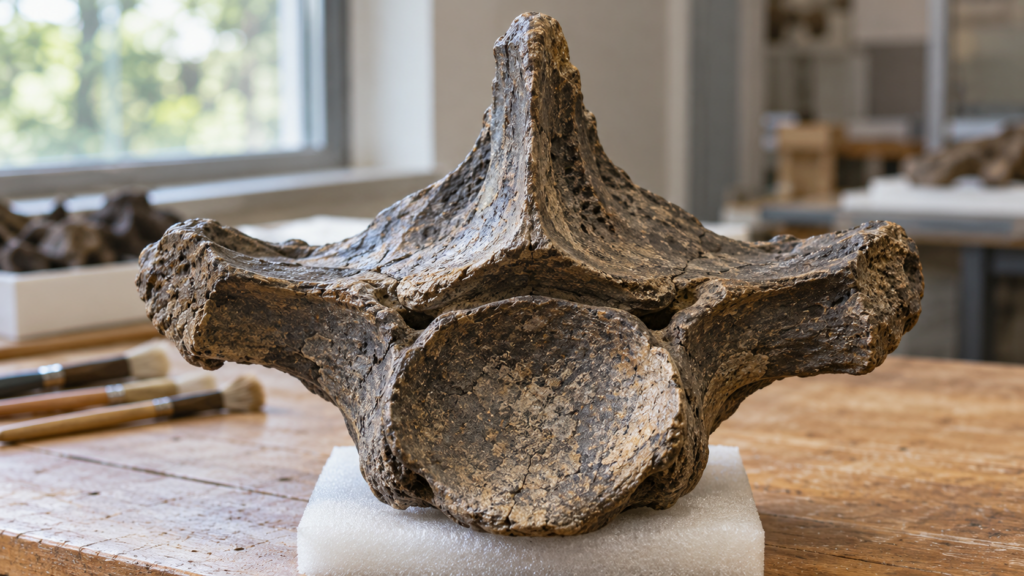
The fossils of Titanoboa came from grey claystone beneath a coal seam at the Cerrejón open-pit coal mine in northeastern Colombia. It was described in Nature in 2009 by Jason Head, then at the University of Toronto Mississauga, together with researchers from the Florida Museum of Natural History and the Smithsonian Tropical Research Institute. The description was based on fossils from 28 individuals, almost all of them individual vertebrae. The type specimen was a single vertebra.
Its length was estimated by comparing the shape of the vertebrae with the backbones of living boas, working out where along the spine each bone came from. The green anaconda, one of the largest living snakes, is said to reach up to about 9 m and about 250 kg. Titanoboa was nearly one and a half times as long and more than four times as heavy.
Titanoboa lived in a rainforest crossed by rivers and swamps. The Cerrejón Formation has yielded huge numbers of fossil leaves, the oldest well-documented record of a South American rainforest. The shapes of the leaves indicate more than 2,500 mm of rain a year and a mean annual temperature above 25 °C. The same rocks have produced turtles with shells more than 1.5 m long, several kinds of dyrosaurids (relatives of crocodiles), and large lungfish. The original paper inferred that Titanoboa lived much like an anaconda, at the water’s edge, and Head has suggested from its closely packed teeth that it may have specialized in eating fish.
The discovery took a roundabout path. Plant fossils were collected at Cerrejón in 2003 and vertebrate fossils in 2004, and large numbers of specimens were shipped to the Florida Museum of Natural History. In 2007, graduate student Alex Hastings noticed a giant vertebra in a batch of fossils labeled “crocodile,” and fellow graduate student Jason Bourque recognized it as a snake bone. The field team had at first taken these bones for crocodile relatives.
Can a Giant Snake Serve as an Ancient Thermometer?
Snakes are ectotherms that cannot make their own body heat, so their body temperature depends on their surroundings. The core of the original paper was to work backward from the snake’s size to the temperature of its time. In ectotherms, metabolism slows as temperatures drop, which limits how large the body can be. Based on the relationship between body size and temperature in living ectotherms, the team calculated that a snake as large as Titanoboa needed a mean annual temperature of at least 30 to 34 °C. That is several degrees warmer than the tropics today, and the team said it fit climate models for the high-carbon-dioxide Paleocene.
In July 2009, Nature published three challenges to this estimate. Sniderman, an Australian researcher, pointed out that applying the same method to a giant Pleistocene monitor lizard from Australia underestimates its actual size three- to fourfold, and suggested that the absence of giant reptiles today may reflect competition with mammals rather than temperature. Makarieva and colleagues recalculated the relationship between metabolism and body size using a value suited to boas rather than to ectotherms in general, and found that the warming above today’s temperatures was halved, from the paper’s 3.8 to 7.2 °C to 1.9 to 3.7 °C. Denny and colleagues argued that an animal as heavy as Titanoboa could keep its body temperature fairly stable just by moving between sun and shade, so it could not serve as an accurate thermometer.
In the same issue, Head and colleagues replied that their calculation does not assume body temperature always matches air temperature, and that it works for the living reticulated python, which reaches about 70 percent of Titanoboa‘s length. The debate has not been settled. However, the fossil leaves of the Cerrejón Formation independently point to temperatures above 25 °C, so the conclusion that the tropics were warm at the time does not rest on the snake alone.
Related products
You can find books and products related to this article on Amazon.
If you buy through the links above, this blog may earn a commission.
Sources
Head, J. J., Bloch, J. I., Hastings, A. K., Bourque, J. R., Cadena, E. A., Herrera, F. A., Polly, P. D. & Jaramillo, C. A. (2009). Giant boid snake from the Palaeocene neotropics reveals hotter past equatorial temperatures. Nature 457, 715–717. https://doi.org/10.1038/nature07671
Sniderman, J. M. K. (2009). Biased reptilian palaeothermometer? Nature 460, E1–E2. https://doi.org/10.1038/nature08222
Makarieva, A. M., Gorshkov, V. G. & Li, B.-L. (2009). Re-calibrating the snake palaeothermometer. Nature 460, E2–E3. https://doi.org/10.1038/nature08223
Denny, M. W., Lockwood, B. L. & Somero, G. N. (2009). Can the giant snake predict palaeoclimate? Nature 460, E3–E4. https://doi.org/10.1038/nature08224
Head, J. J. et al. (2009). Head et al. reply. Nature 460, E4–E5. https://doi.org/10.1038/nature08225
Wing, S. L., Herrera, F., Jaramillo, C. A., Gómez-Navarro, C., Wilf, P. & Labandeira, C. C. (2009). Late Paleocene fossils from the Cerrejón Formation, Colombia, are the earliest record of Neotropical rainforest. PNAS 106, 18627–18632. https://doi.org/10.1073/pnas.0905130106
Smithsonian Magazine (2012). How Titanoboa, the 40-foot-long snake, was found. https://www.smithsonianmag.com/science-nature/how-titanoboa-the-40-foot-long-snake-was-found-115791429/
Florida Museum of Natural History. Titanoboa. https://www.floridamuseum.ufl.edu/science/titanoboa/
Smithsonian’s National Zoo. Green anaconda. https://nationalzoo.si.edu/animals/green-anaconda
コメント