This article contains affiliate links. As an Amazon Associate I earn from qualifying purchases.
| Name | Ginkgo, maidenhair tree (Ginkgo biloba). The species name biloba means “two-lobed” and refers to the notch in the leaf |
| Classification | Gymnosperms, Ginkgoales, Ginkgoaceae, Ginkgo |
| Age | Ginkgoales date back to the Early Permian (about 290 million years ago). The earliest unquestioned fossils of the genus Ginkgo come from the Middle Jurassic of China. Still living today |
| Range | Wild populations survive only in parts of China. Planted trees grow around the world, including Japan |
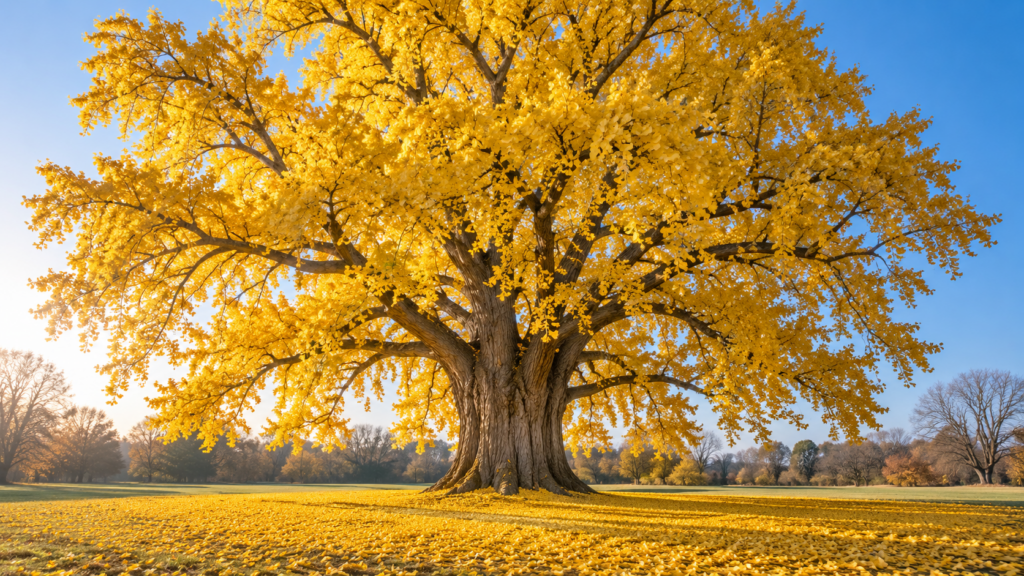
| Height | Large trees reach about 20–30 m. A tree at Koishikawa Botanical Garden in Tokyo, said to be about 300 years old, is about 22 m tall |
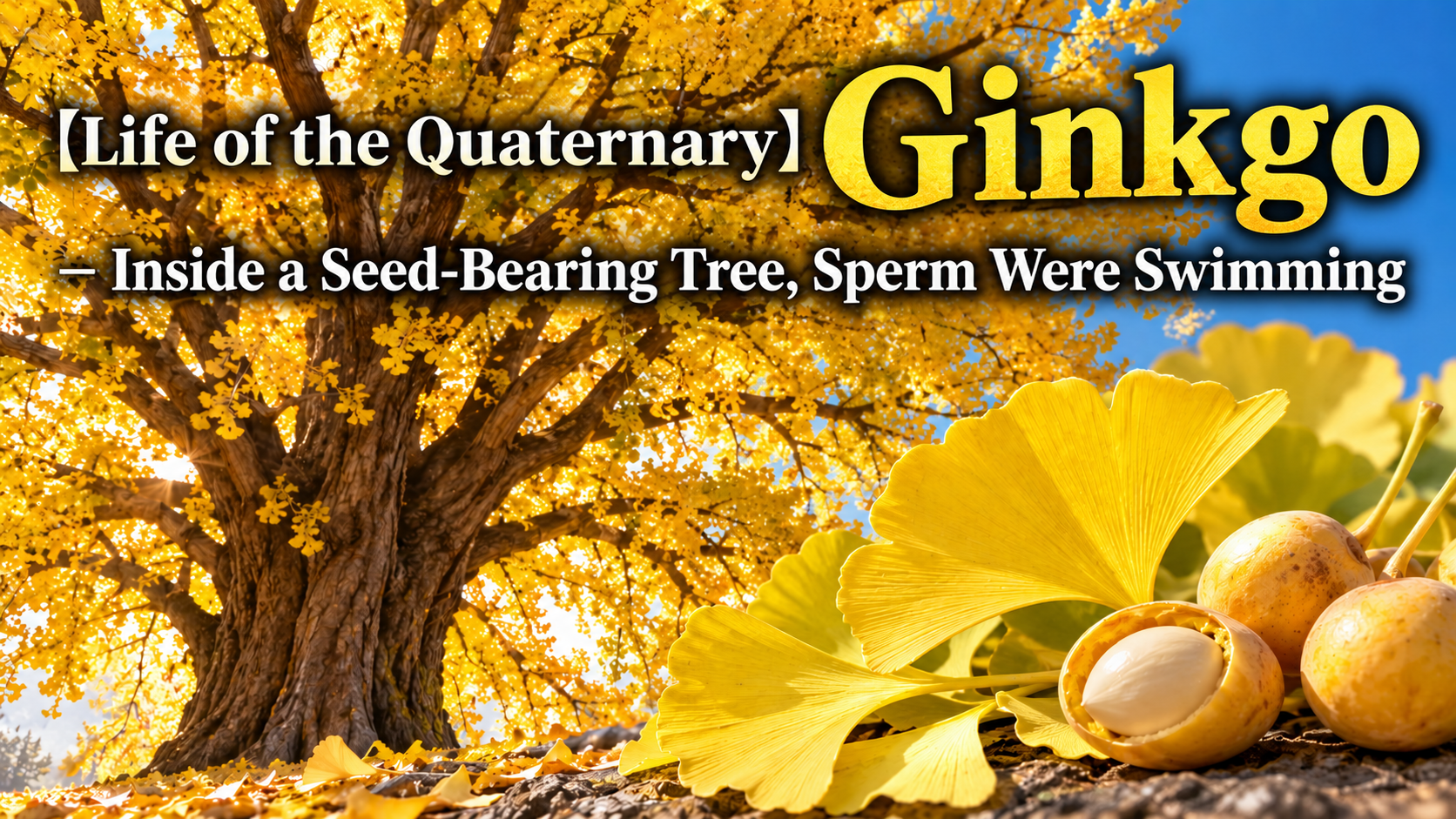
The ginkgo is a tall gymnosperm tree with fan-shaped leaves. It is the only surviving species of Ginkgoales, a group that once spread across the world, which is why it is called a “living fossil.” Although it is a seed plant, its sperm swim to reach the egg at fertilization.
Appearance and Way of Life
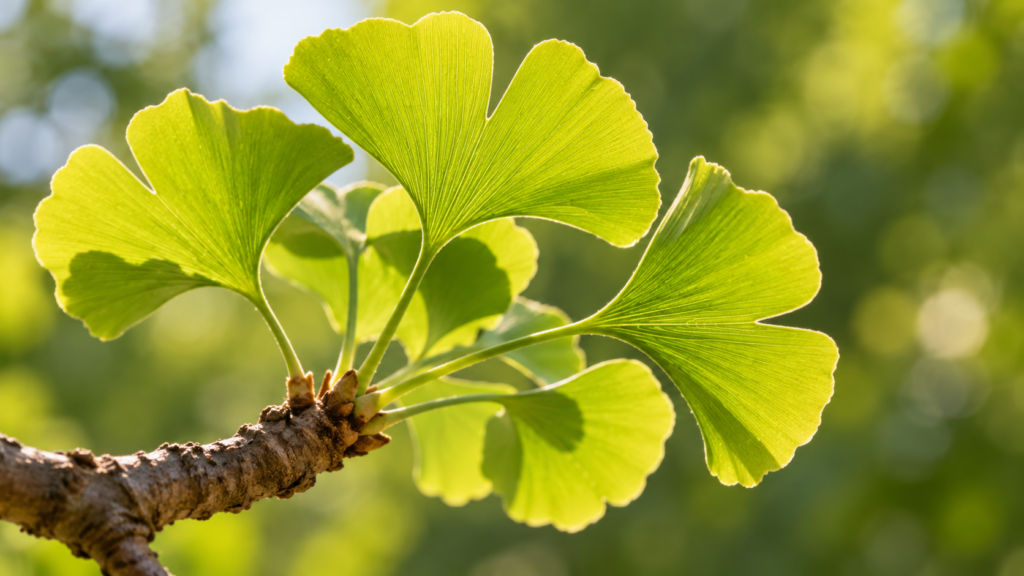
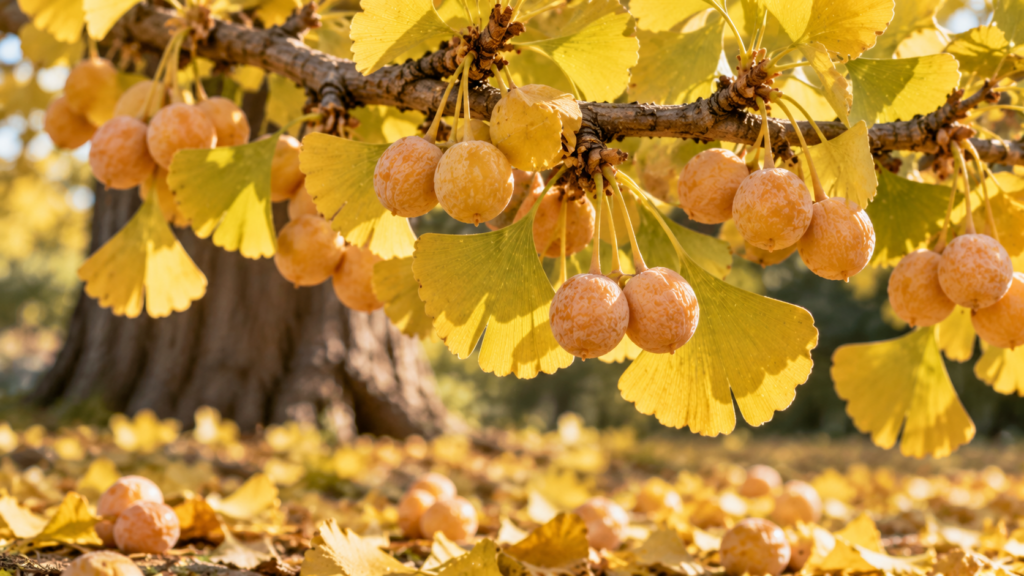
A ginkgo leaf opens like a fan at the end of a thin stalk, with veins that fork again and again from the base to the edge. Many leaves have a notch in the middle that splits them into two lobes, and the species name comes from this shape. In autumn the leaves turn yellow and drop almost all at once.
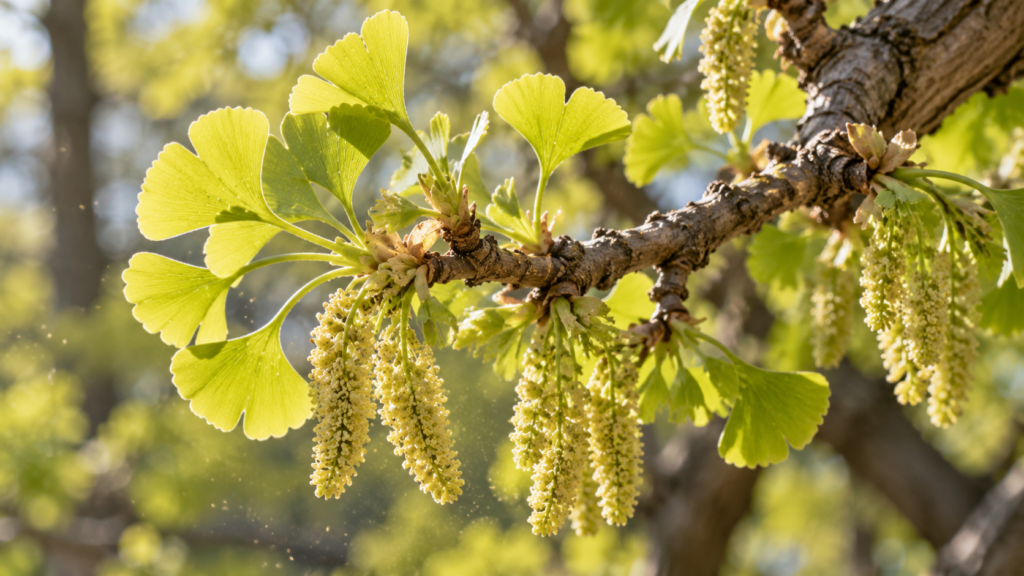
Ginkgo trees are either male or female. In spring, male trees produce small, catkin-like pollen organs and release pollen into the wind. On female trees, bare ovules sit in pairs at the tips of short stalks. Pollen is drawn into the ovule, sperm develop there over the summer, and fertilization takes place. By autumn the ovules have become yellow seeds whose fleshy outer layer gives off a strong smell. In Japan the kernel inside is eaten as ginnan.
The fossil record of Ginkgoales reaches back to Trichopitys from the Early Permian of southern France. The group diversified greatly from the Triassic into the Jurassic, when the variety of its leaves and reproductive organs reached its highest point in geological history. Middle Jurassic rocks in Henan Province, China, have yielded Ginkgo fossils preserved together with their ovule-bearing organs, described in 1989 as Ginkgo yimaensis. From the end of the Cretaceous, Ginkgoales declined quickly and disappeared from North America and later from Europe. The youngest fossils in East Asia come from Pliocene to Pleistocene rocks in Japan.
At one point the ginkgo was thought to be extinct in the wild. In 2019 a Chinese research team sequenced the genomes of 545 ginkgo trees from 51 populations in nine countries and showed that the species survived the ice ages in three refuges in southwestern, eastern and southern China. Ginkgo trees in Japan and Korea are estimated to have been brought from China by people earlier than those in Europe and North America, where the tree has been planted since the 18th century.
Sperm That Swim Inside a Seed Plant
In 19th-century botany, fertilization in seed plants was thought to work through a pollen tube that grows down to the egg, carrying sperm cells that do not move on their own. Swimming sperm belonged to mosses and ferns, and seed plants were regarded as having left fertilization by swimming behind.
In 1896 Sakugoro Hirase, an assistant in the botany department of the Imperial University’s College of Science (now the University of Tokyo’s Faculty of Science), found moving sperm emerging from pollen tubes inside the ovules of a ginkgo. Hirase came from Fukui and had been hired by the department in 1888 as an illustrator to draw botanical plates. Alongside his drawing work, he prepared his own microscope slides and kept up his observations. The ginkgo tree used for his study still stands at Koishikawa Botanical Garden in Tokyo.
In the same year, Seiichiro Ikeno of the Imperial University, who had advised Hirase, found swimming sperm in cycads. These two discoveries, showing that some seed plants have swimming sperm just like mosses and ferns, are regarded as the first contributions of modern Japanese biology to the wider world. Hirase and Ikeno received the Imperial Prize of the Imperial Academy together in 1912. Hirase left the university the year after his discovery and went on to teach at secondary schools in Shiga and Kyoto.
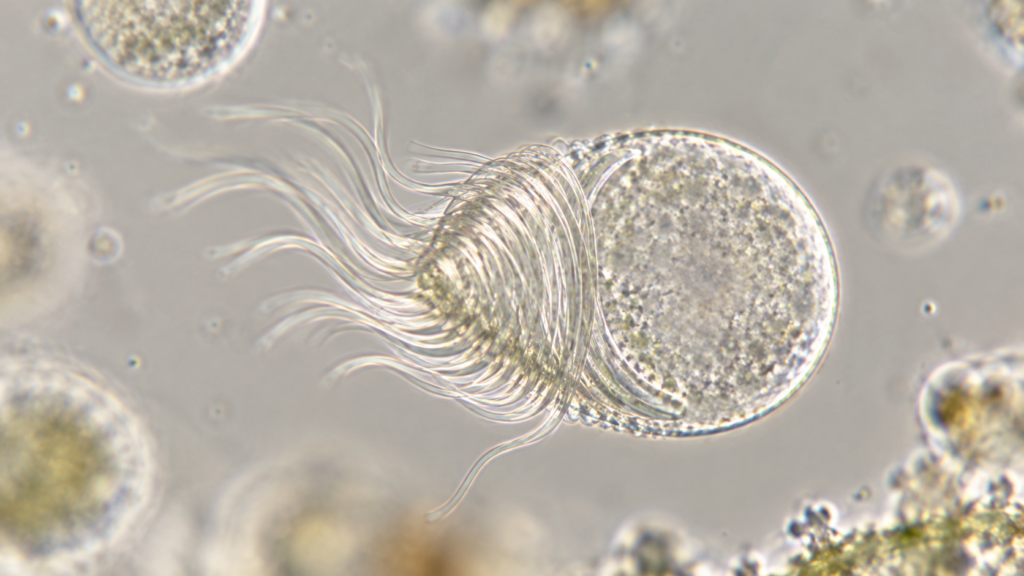
A ginkgo sperm is a large cell with roughly a thousand flagella arranged in a spiral. Pollen that enters the ovule in spring takes about four months to produce sperm inside the pollen tube. The sperm are then released into fluid inside the ovule and swim toward the egg, following chemical signals the egg gives off. All this happens inside small ovules high in a tree, yet the mechanism is thought to be a holdover from the time when the ancestors of land plants sent their sperm swimming through water. Today the only seed plants with swimming sperm are the ginkgo and the cycads.
Related products
You can find books and products related to this article on Amazon.
If you buy through the links above, this blog may earn a commission.
Sources
Zhao, Y.-P. et al. (2019). Resequencing 545 ginkgo genomes across the world reveals the evolutionary history of the living fossil. Nature Communications 10, 4201. https://doi.org/10.1038/s41467-019-12133-5
Zhou, Z.-Y. (2009). An overview of fossil Ginkgoales. Palaeoworld 18, 1–22. https://doi.org/10.1016/j.palwor.2009.01.001
International Organisation of Palaeobotany. Ginkgo biloba, its ancestors and allies (contribution by Z.-Y. Zhou). https://palaeobotany.org/index.php/living-fossils/gingko-biloba-its-ancestors-and-allies/
Nagata, T. (1997). Scientific contributions of Sakugoro Hirase. In Ginkgo Biloba A Global Treasure, 413–416. Springer. https://doi.org/10.1007/978-4-431-68416-9_30
Friedman, W. E. (2015). The swimming of the ginkgo sperm. Arnold Arboretum of Harvard University. https://arboretum.harvard.edu/stories/the-swimming-of-the-ginkgo-sperm/
Kotobank, “Hirase Sakugoro” (Nipponica, Heibonsha World Encyclopedia and others; in Japanese). https://kotobank.jp/word/%E5%B9%B3%E7%80%AC%E4%BD%9C%E4%BA%94%E9%83%8E-1103981
コメント