This article contains affiliate links. As an Amazon Associate I earn from qualifying purchases.
| Name | Iguanodon, meaning “iguana tooth.” The species name of the best-known species, Iguanodon bernissartensis, comes from the Belgian town of Bernissart |
| Classification | Ornithischia, Ornithopoda, Iguanodontia |
| Age | Early Cretaceous (about 126 to 122 million years ago for Iguanodon bernissartensis) |
| Where found | Belgium, England, Germany and Spain |
| Length | About 9 to 11 m as an adult |
| Weight | About 8 tonnes, according to an estimate from the Royal Belgian Institute of Natural Sciences. Estimates vary between studies |
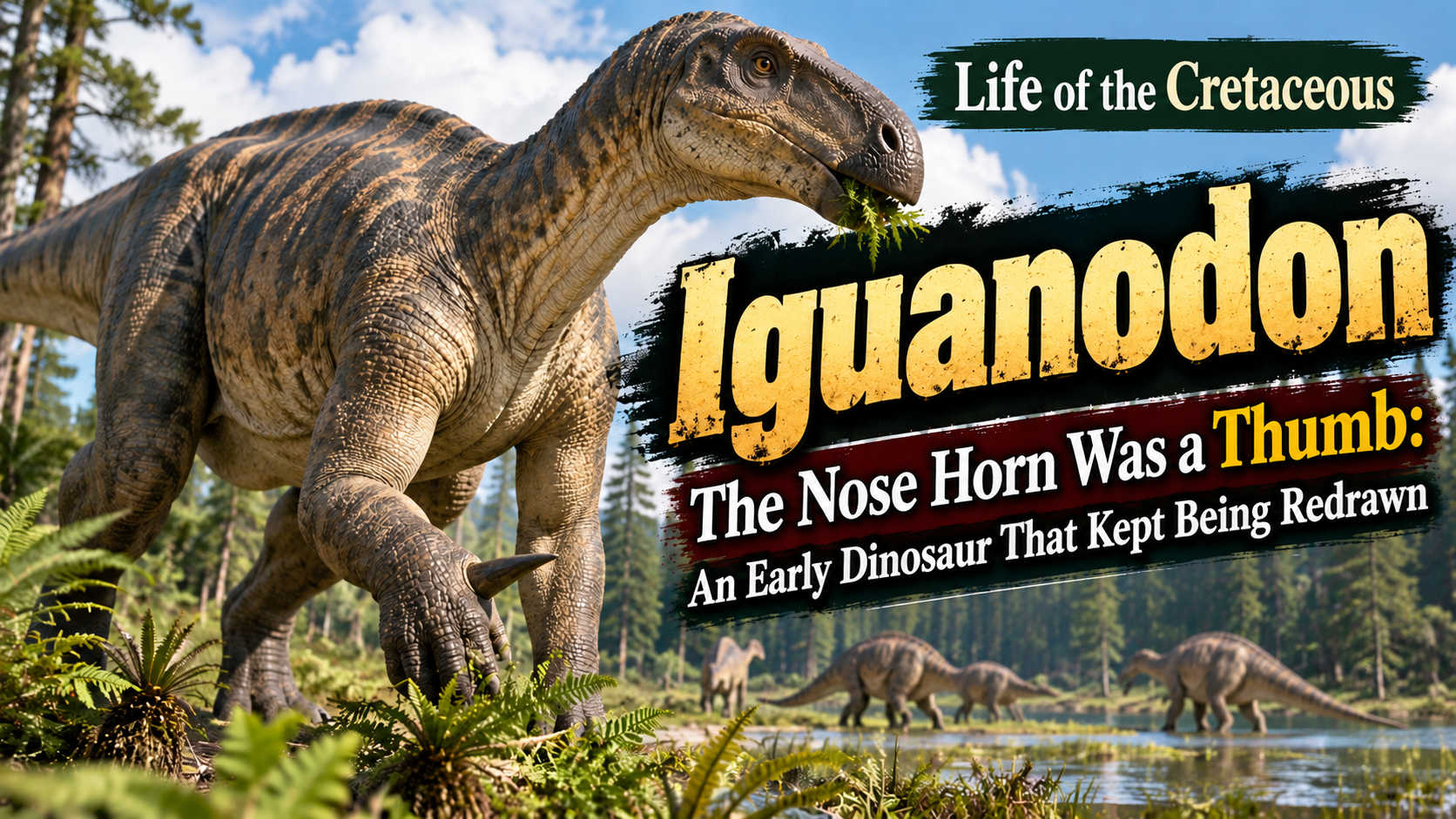
Iguanodon was a large plant-eating dinosaur that lived in Europe in the Early Cretaceous. It was named in 1825, making it the second dinosaur genus to receive a scientific name, after Megalosaurus. Its thumb was a large cone-shaped spike, and that bone was at first thought to be a horn on its nose.
Form and Life
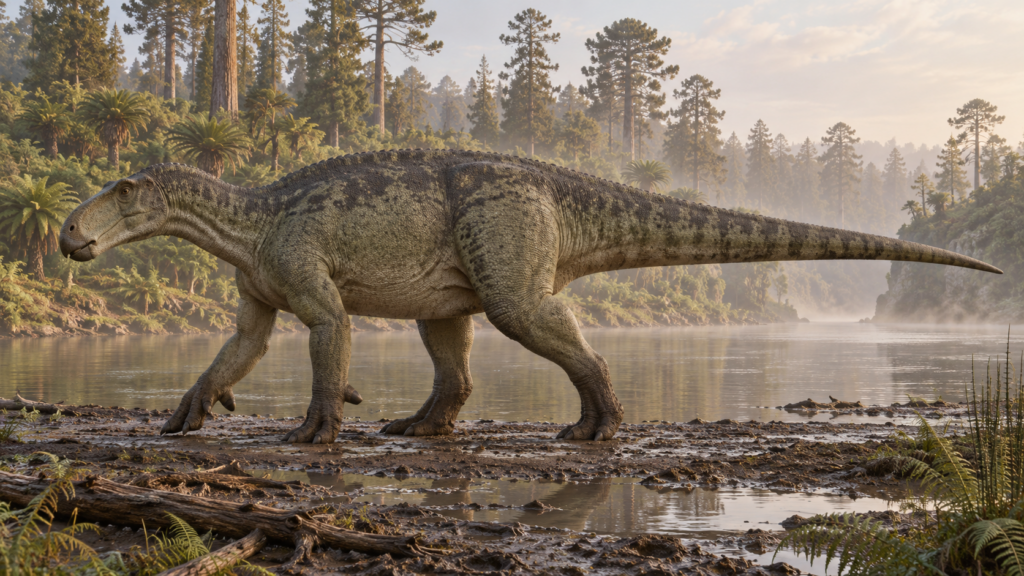
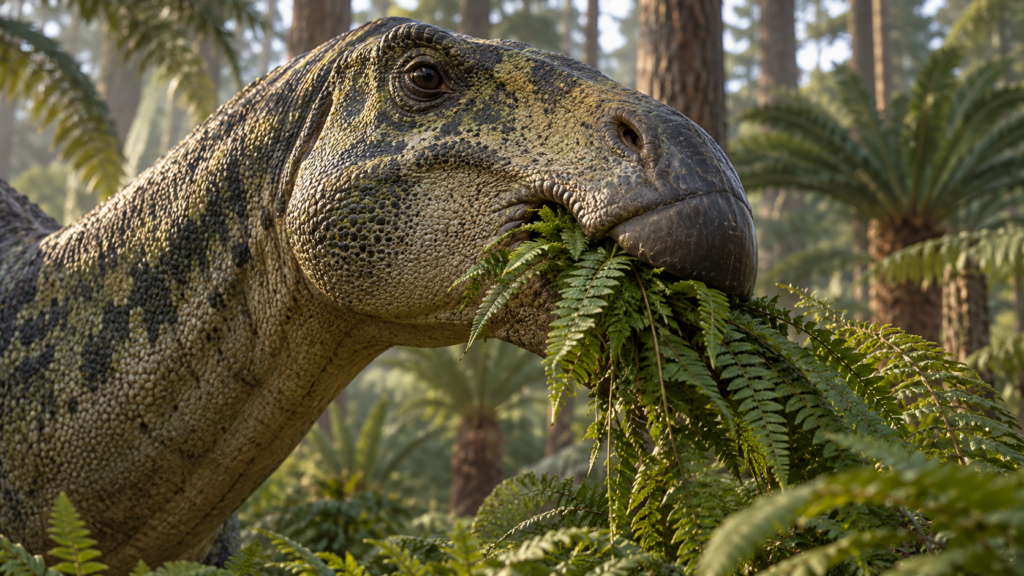
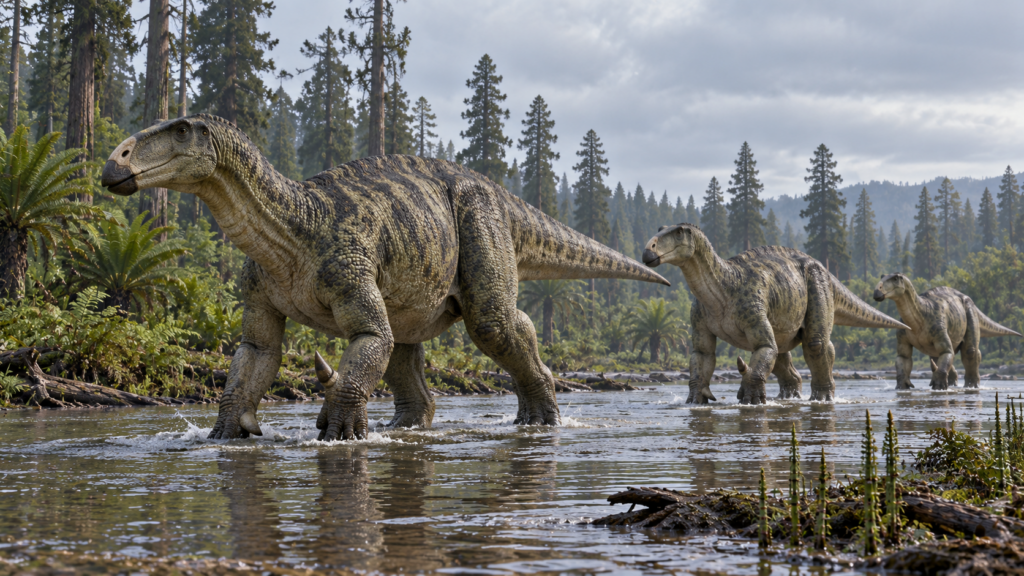
Iguanodon had thick hind legs and shorter but sturdy forelegs. Its head was long from front to back, and the front of the mouth was a toothless beak. Behind it, the cheeks were packed with teeth that wore down and were constantly replaced. It is thought to have torn off leaves and twigs with the beak and ground them up with the teeth further back. The first fossils ever found were these teeth, and the genus was named because they looked like enlarged versions of the teeth of a living iguana.
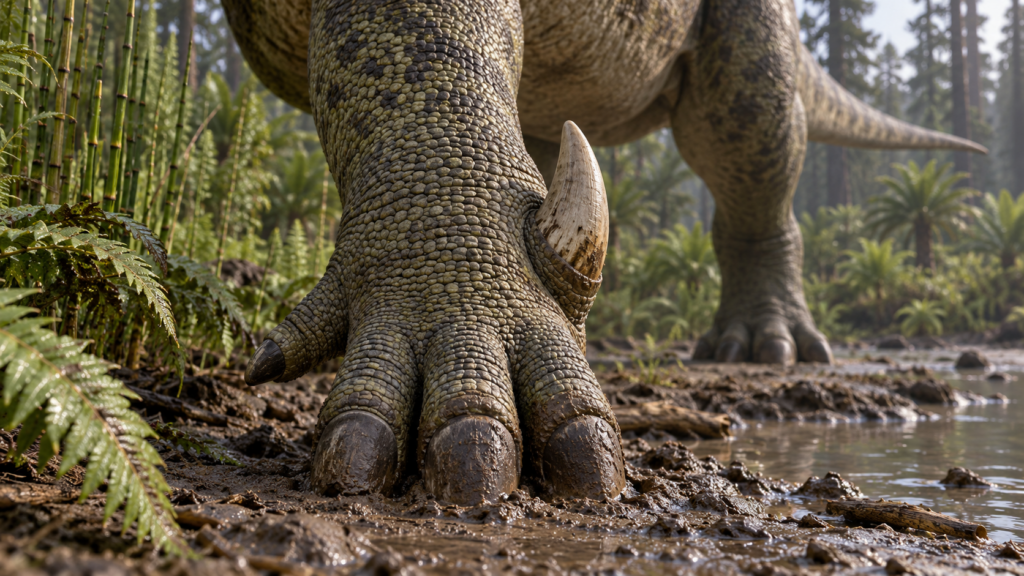
Each hand had five fingers, and each finger had a different shape. The middle three were thick and short, with hoof-like tips, and could be placed on the ground to carry the animal’s weight. The thumb was a cone-shaped spike covered in a horny sheath. The fifth finger pointed in a different direction from the others and is thought to have been able to grasp things. What the thumb spike was used for is still unsettled: one view is that it was a weapon against predators or rivals, and another is that it was a tool for stripping leaves or breaking open seeds.
The body of Iguanodon is known in detail because a Belgian coal mine produced a large number of complete skeletons. In March 1878, miners digging a gallery 322 m underground at the Bernissart colliery struck bones. Over about three years, roughly 30 skeletons were dug out of a clay-filled pocket in the rock, cut into about 600 blocks and taken to Brussels. These were the first complete, articulated skeletons of large dinosaurs ever found. The same site also yielded a smaller ornithopod of a different kind, Mantellisaurus. Iguanodon lived along waterways where ferns and conifers grew.
From Nose Horn to Thumb, and From Kangaroo Stance Back to Four Legs
The study of Iguanodon began with a few teeth found in England. In 1822, fossil teeth turned up in Sussex. The finder is traditionally said to have been Mary Ann Mantell, the wife of the doctor Gideon Mantell, although the details differ between accounts. The French anatomist Georges Cuvier first suspected the teeth came from a fish, and later, based on their internal structure, suggested they might belong to a new plant-eating reptile. In 1825, Mantell published the animal under the name Iguanodon. With only teeth to go on, it was estimated at the time to be more than 18 m long.
In 1834, a block of rock split by blasting at a limestone quarry near Maidstone in Kent turned out to contain a single animal’s bones together. The quarry owner, William Harding Bensted, pieced the fragments back together, and Mantell identified the bones as Iguanodon. Among them was a single cone-shaped bone. Mantell took it to be a horn on the nose and sketched the animal as a horned, four-legged beast. The idea is said to have been inspired by the living rhinoceros iguana, which has a horn on its snout.
That image carried over into the life-size dinosaur sculptures built in the grounds of the Crystal Palace in London in 1853. The Iguanodon, made under the guidance of the anatomist Richard Owen, was given a horn on its nose and shown as a heavy animal standing on four legs like a rhinoceros.
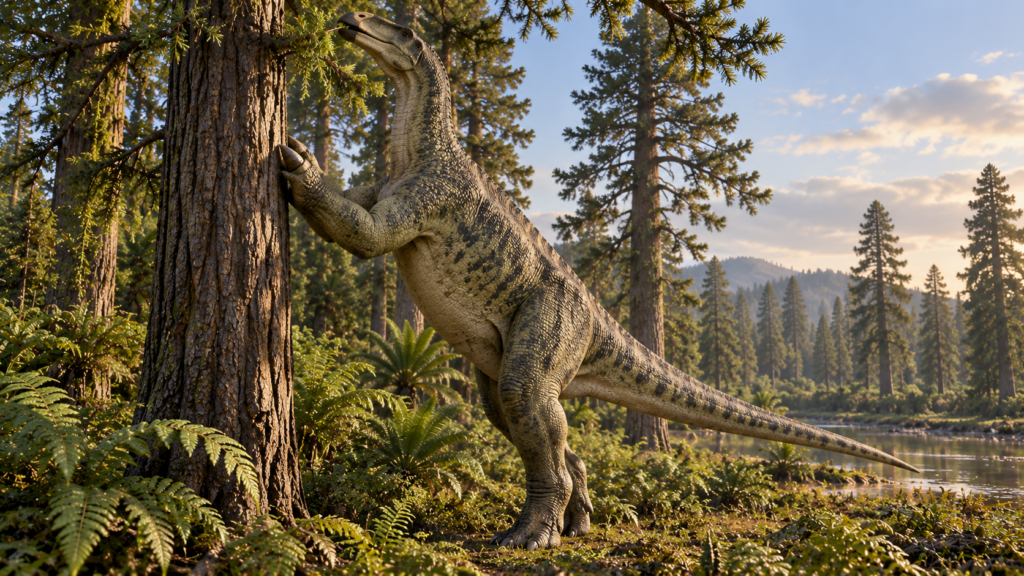
The horn was recognized as a thumb only after the Bernissart skeletons were excavated. In skeleton after skeleton, the cone-shaped bone sat at the end of the hand. At this point, however, the reconstruction swung in another direction. Louis Dollo, who directed the assembly of the skeletons in Brussels, argued that the backbone resembled that of a two-legged animal, and mounted the skeletons upright, like kangaroos, with the tail resting on the ground. The first mount was completed in 1882 and shown to the public in May 1883. For roughly the next hundred years, this upright pose was the standard image of Iguanodon in books and museums.
The revision came in 1980. The British paleontologist David Norman re-examined the Bernissart skeletons and concluded that Iguanodon held its backbone roughly horizontal when it moved. Today the usual view is that it walked mainly on all fours and may sometimes have run on its hind legs alone, although how much it moved on two legs is still debated. The skeletons in Brussels are too fragile to be remounted, so they are still displayed in Dollo’s upright pose.
Even the foundation of the name changed. The species Iguanodon anglicus, based on the teeth Mantell reported, was judged unusable as the reference for the name because teeth alone cannot tell species apart. In 2000, the International Commission on Zoological Nomenclature made Iguanodon bernissartensis, known from the complete Bernissart skeletons, the type species of the genus. The name Iguanodon now rests not on teeth from England but on skeletons from Belgium.
Related products
You can find books and products related to this article on Amazon.
If you buy through the links above, this blog may earn a commission.
Sources
Mantell, G. A. (1825). Notice on the Iguanodon, a newly discovered fossil reptile, from the sandstone of Tilgate forest, in Sussex. Philosophical Transactions of the Royal Society of London 115, 179–186. https://doi.org/10.1098/rstl.1825.0010
Natural History Museum. The discovery of Iguanodon. https://www.nhm.ac.uk/discover/the-discovery-of-iguanodon.html
Royal Belgian Institute of Natural Sciences. The Bernissart Iguanodons at a glance. https://www.naturalsciences.be/en/discover-join/discover/the-bernissart-iguanodons-at-a-glance
Royal Belgian Institute of Natural Sciences. Iguanodon bernissartensis (IRSNB R51). https://collections.naturalsciences.be/ssh-paleontology/masterpieces/bernissart
Norman, D. B. (1980). On the ornithischian dinosaur Iguanodon bernissartensis from the Lower Cretaceous of Bernissart (Belgium). Mémoires de l’Institut Royal des Sciences Naturelles de Belgique 178, 1–103. https://biblio.naturalsciences.be/rbins-publications/memoirs-of-the-royal-belgian-institute-of-natural-sciences-first-series/178-1980/vol-178-013074p-text.pdf/at_download/file
International Commission on Zoological Nomenclature (2000). Opinion 1947. Iguanodon Mantell, 1825 (Reptilia, Ornithischia): Iguanodon bernissartensis Boulenger in Beneden, 1881 designated as the type species, and a lectotype designated. Bulletin of Zoological Nomenclature 57, 61–62.


コメント