This article contains affiliate links. As an Amazon Associate I earn from qualifying purchases.
| Name | Elephant bird, genus Aepyornis (Greek for “lofty bird”) |
| Classification | Birds; Palaeognathae; Aepyornithidae |
| Period | Quaternary (until about 1,000 years ago) |
| Found in | Madagascar |
| Height | 2–3 m |
| Weight | About 330–540 kg (mean about 410 kg) estimated for Aepyornis maximus |
| Egg | The largest found is 39 cm long and 32.6 cm wide |
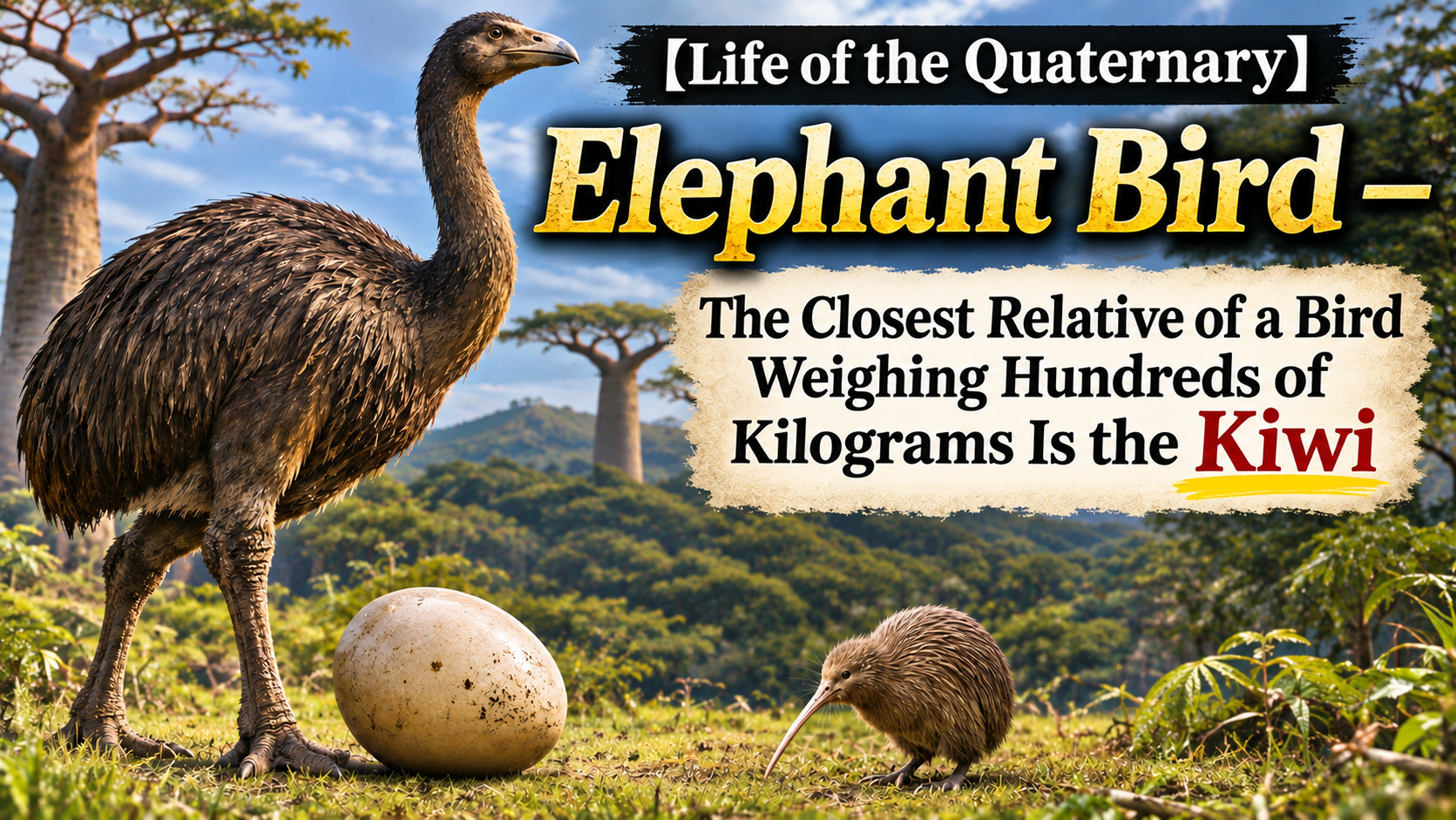
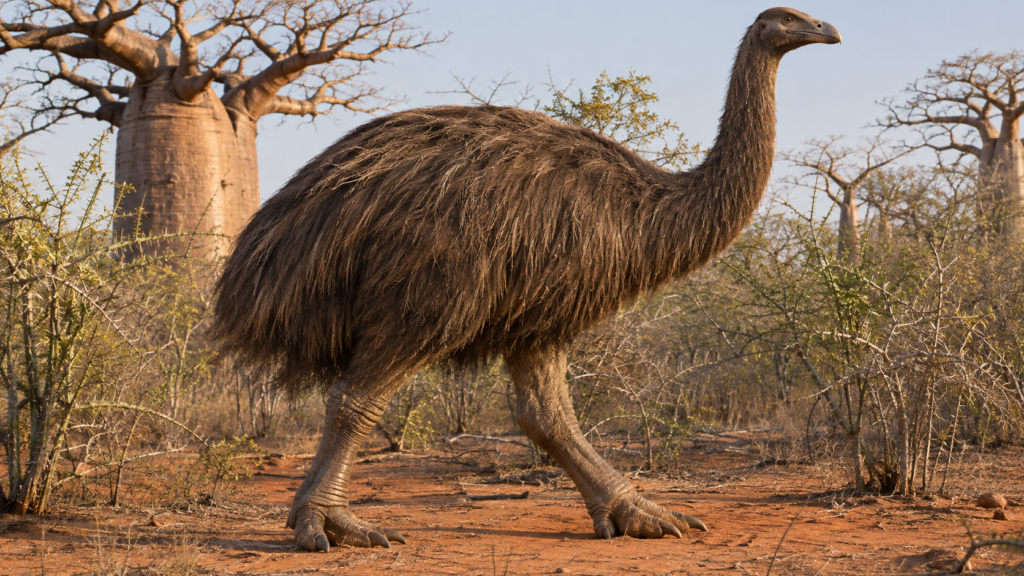
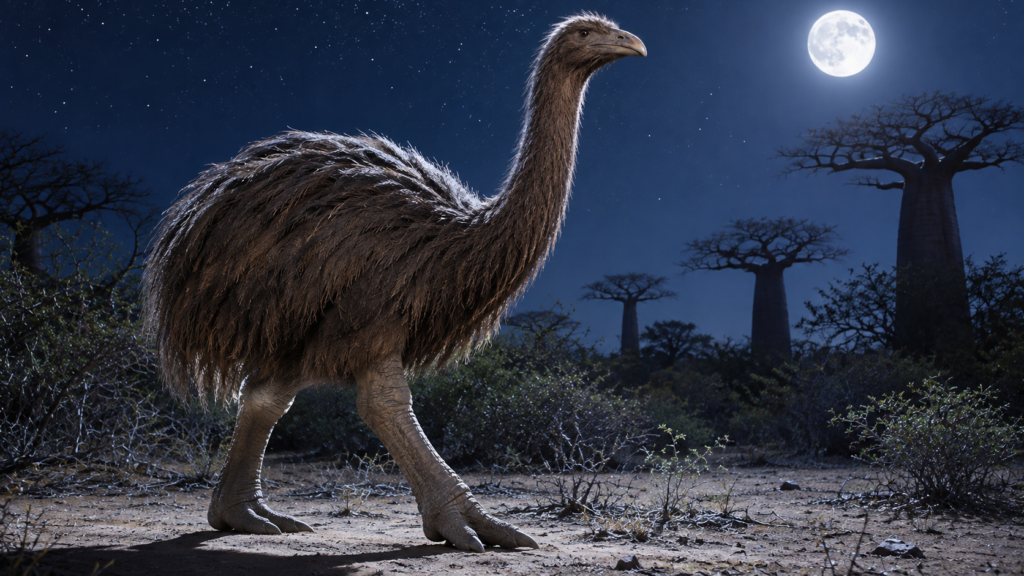
Aepyornis is a giant flightless bird from Madagascar. It belongs to the palaeognaths, the same group as ostriches and emus, and weighed several hundred kilograms. A 2014 study of ancient DNA showed that its closest living relative is not the African ostrich but the kiwi of New Zealand.
Appearance and Life
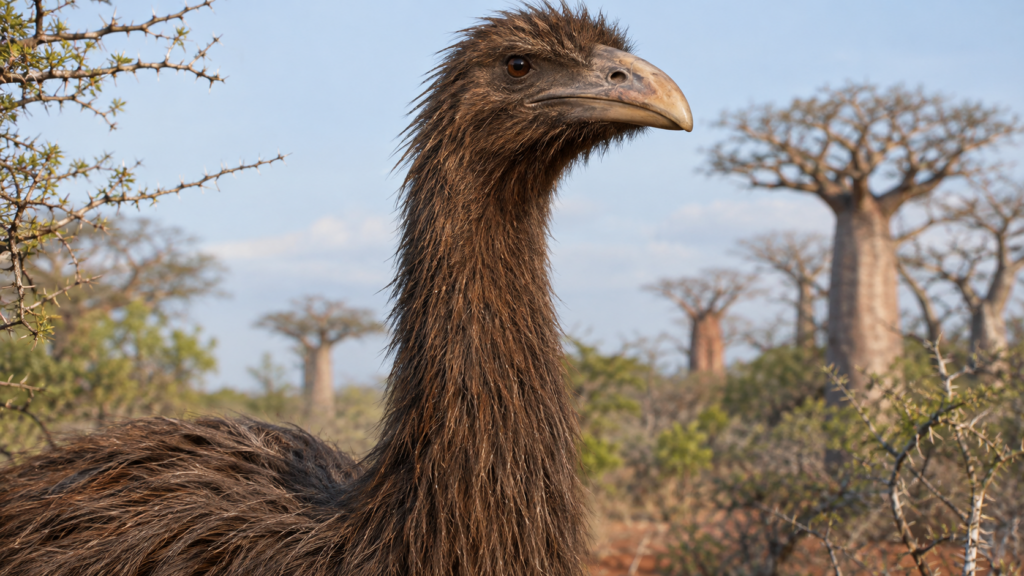
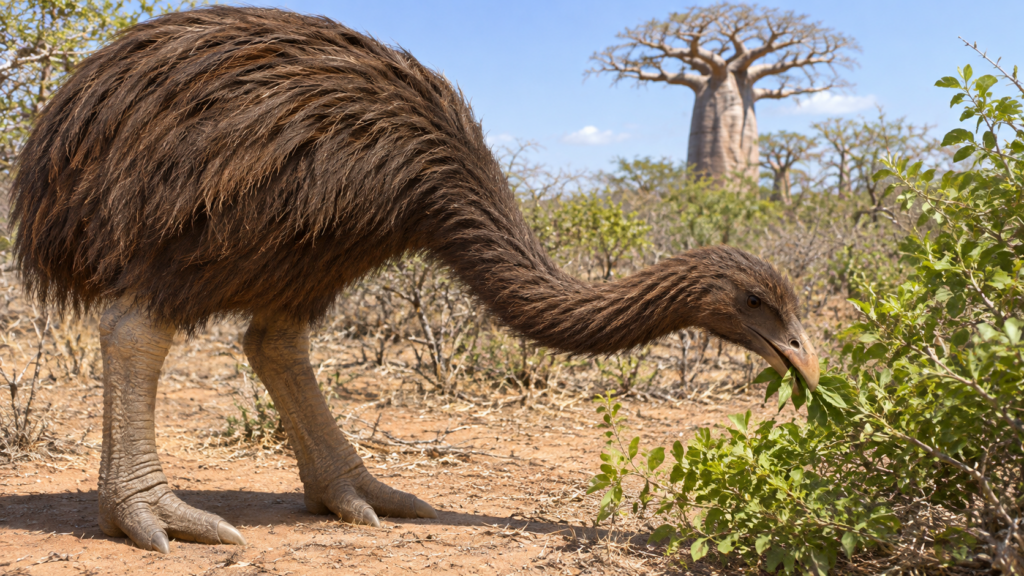
Aepyornis stood on thick, heavy legs, and its wings were small and reduced. The French zoologist Isidore Geoffroy Saint-Hilaire named the genus in 1851, based on eggs and bones sent from Madagascar. It is thought to have eaten plants.
In 2018, James Hansford and Samuel Turvey of the Zoological Society of London remeasured the bones and sorted the elephant birds into three genera and four species. Body masses estimated from the thickness of the leg bones put Aepyornis maximus at a mean of about 410 kg (about 330–540 kg). The same study named a new genus, Vorombe titan, with an estimated mean mass of almost 650 kg, and called it the world’s largest bird. However, a 2023 study of DNA from eggshell found only two genera in southern Madagascar during the Holocene, so whether Vorombe is a separate genus is still disputed.
The eggs are another reason the bird is famous. According to the Natural History Museum in London, the largest egg ever found is 39 cm long and 32.6 cm wide, and the thickest-shelled ones are estimated to have weighed about 10 kg. Its volume is said to equal about 160 chicken eggs.
People were long thought to have reached Madagascar around 2,500 years ago. In 2018, Hansford and colleagues reported elephant bird leg bones carrying cut marks and chop marks, dated to about 10,500 years ago. That pushed evidence of people butchering elephant birds back by more than 6,000 years. Aepyornis disappeared by about 1,000 years ago.
Its Closest Relative Is the Kiwi
The palaeognaths, including ostriches, rheas, emus, cassowaries, kiwi and the extinct moa, are spread across the continents of the Southern Hemisphere. That distribution was long explained by the breakup of the supercontinent Gondwana, which was thought to have carried flightless ancestors apart along with the land. Under that explanation, it seemed natural that Madagascar’s elephant birds, on an island that split from Africa, would be close relatives of the African ostrich.
In 2014, Kieren Mitchell and colleagues at the University of Adelaide in Australia read almost complete mitochondrial genomes from museum bones of Aepyornis hildebrandti and the smaller Mullerornis. Both grouped as the closest relatives of New Zealand’s kiwi. The ostrich turned out to be a distant lineage, the first to branch off among the palaeognaths. The nearest relative of a bird weighing hundreds of kilograms was a far smaller bird living in the forests of New Zealand.
Madagascar and New Zealand had already drifted far apart long before the two lineages are thought to have split. The team concluded that the common ancestor of elephant birds and kiwi could fly and spread across the sea. If so, the loss of flight happened independently at least six times among palaeognaths, and gigantism at least five times. The result flatly contradicts the idea that continental breakup alone explains where these birds live. An explainer published with the study puts the split between the two lineages at about 50 million years ago.
The link to the kiwi also showed up in the shape of the brain. In 2018, Christopher Torres and Julia Clarke of the University of Texas at Austin used CT scans to reconstruct the inside of the skulls of two elephant bird species. The optic lobes, which handle vision, were extremely small, the same trait seen in the nocturnal kiwi. The team interpreted this as evidence that elephant birds were active at night, and suggested that a way of life relying less on vision may have begun with the common ancestor of elephant birds and kiwi.

Related products
You can find books and products related to this article on Amazon.
If you buy through the links above, this blog may earn a commission.
About the images
The images in this article are illustrations created with AI (ChatGPT), and you are welcome to use them. If you do, we would appreciate a link back to this article as the source.
Sources
Mitchell, K. J. et al. (2014). Ancient DNA reveals elephant birds and kiwi are sister taxa and clarifies ratite bird evolution. Science 344, 898–900. https://doi.org/10.1126/science.1251981
Hansford, J. P. & Turvey, S. T. (2018). Unexpected diversity within the extinct elephant birds (Aves: Aepyornithidae) and a new identity for the world’s largest bird. Royal Society Open Science 5, 181295. https://doi.org/10.1098/rsos.181295
Hansford, J. et al. (2018). Early Holocene human presence in Madagascar evidenced by exploitation of avian megafauna. Science Advances 4, eaat6925. https://doi.org/10.1126/sciadv.aat6925
Torres, C. R. & Clarke, J. A. (2018). Nocturnal giants: evolution of the sensory ecology in elephant birds and other palaeognaths inferred from digital brain reconstructions. Proceedings of the Royal Society B 285, 20181540. https://doi.org/10.1098/rspb.2018.1540
Grealy, A. et al. (2023). Molecular exploration of fossil eggshell uncovers hidden lineage of giant extinct bird. Nature Communications 14, 914. https://doi.org/10.1038/s41467-023-36405-3
Natural History Museum, London, What is the biggest bird in the world? (egg size and weight, time of extinction) https://www.nhm.ac.uk/discover/what-is-the-biggest-bird-in-the-world.html
UCL Museums, Specimen of the Week 326: Elephant bird egg (egg volume) https://blogs.ucl.ac.uk/museums/2018/01/19/specimen-of-the-week-326-elephant-bird-egg/
ScienceDaily (2014), Ancient DNA reveals elephant birds and kiwi are sister taxa (University of Adelaide release) https://www.sciencedaily.com/releases/2014/05/140522141317.htm
Science in the Classroom, Do birds of a feather flock together? (date of the split) https://www.scienceintheclassroom.org/research-papers/do-birds-feather-flock-together

コメント