This article contains affiliate links. As an Amazon Associate I earn from qualifying purchases.
| Name | Belemnites (order Belemnitida). The name comes from the Greek belemnon, a dart or javelin |
| Classification | Mollusca, Cephalopoda, Coleoidea (the group that includes squid and octopuses) |
| Age | Jurassic to the end of the Cretaceous (about 201–66 million years ago) |
| Found in | Worldwide. Specimens that keep their arms and ink sacs come from places such as Holzmaden and Nusplingen in southern Germany |
| Guard length | From about 3 cm (Neohibolites minimus) to about 46 cm (a specimen from Indonesia) |
| Total length | About 30 cm including the arms in the Early Jurassic Passaloteuthis. The British Geological Survey writes that the owner of the largest guard was 4–5 m long |
| Weight | About 170–180 g for a 30 cm Passaloteuthis (calculated from a model of the body) |
| Arms | Ten, each carrying two rows of small hooks |
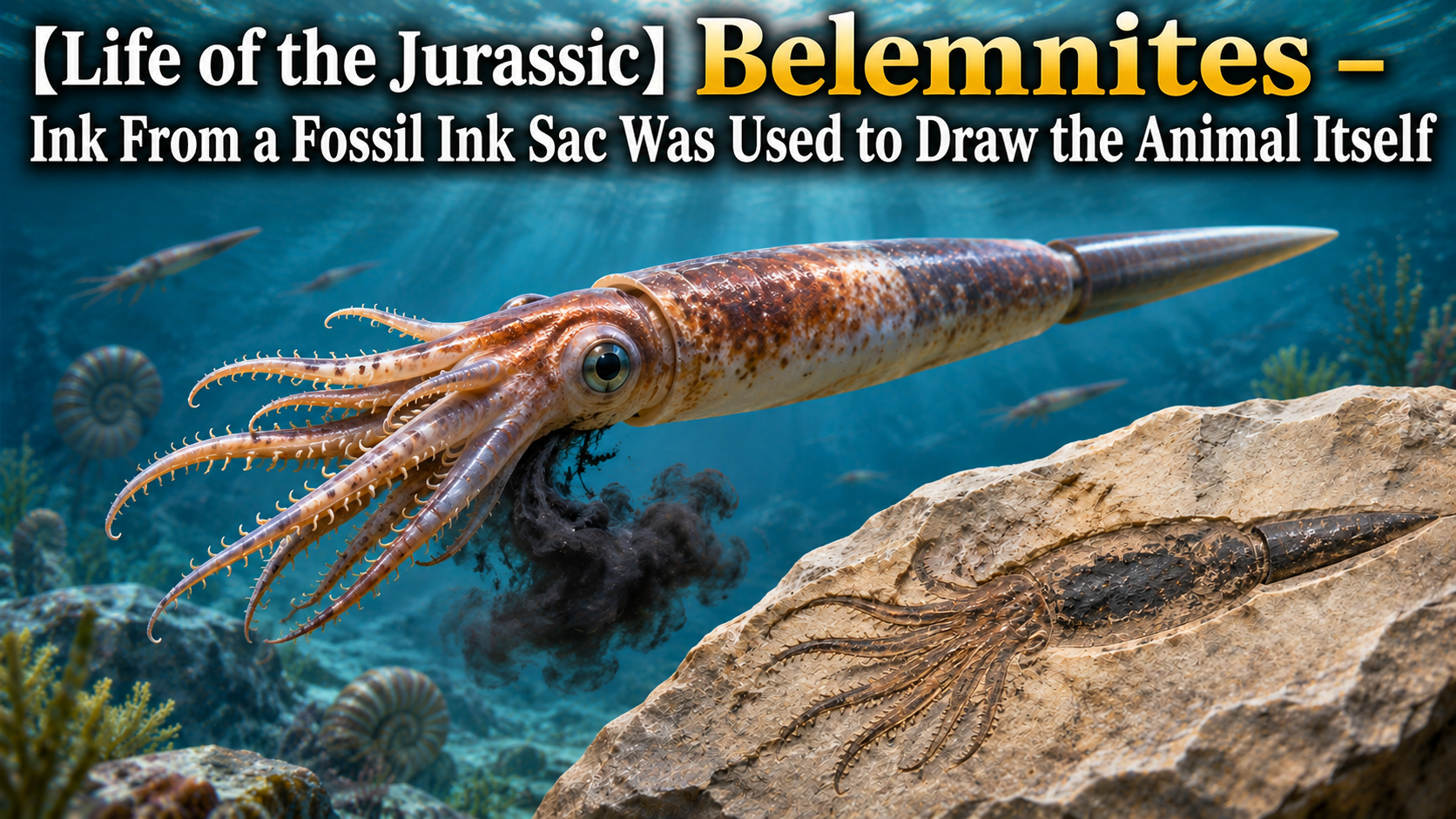
Belemnites were squid-like cephalopods that lived in the seas of the Jurassic and Cretaceous. At the rear end of the body they had a hard, bullet-shaped guard, and that guard is almost always the only part found as a fossil. A few fossils also keep the ink sac, and in Britain ink taken from a fossil ink sac was used to draw a picture of the animal.
Appearance and Way of Life
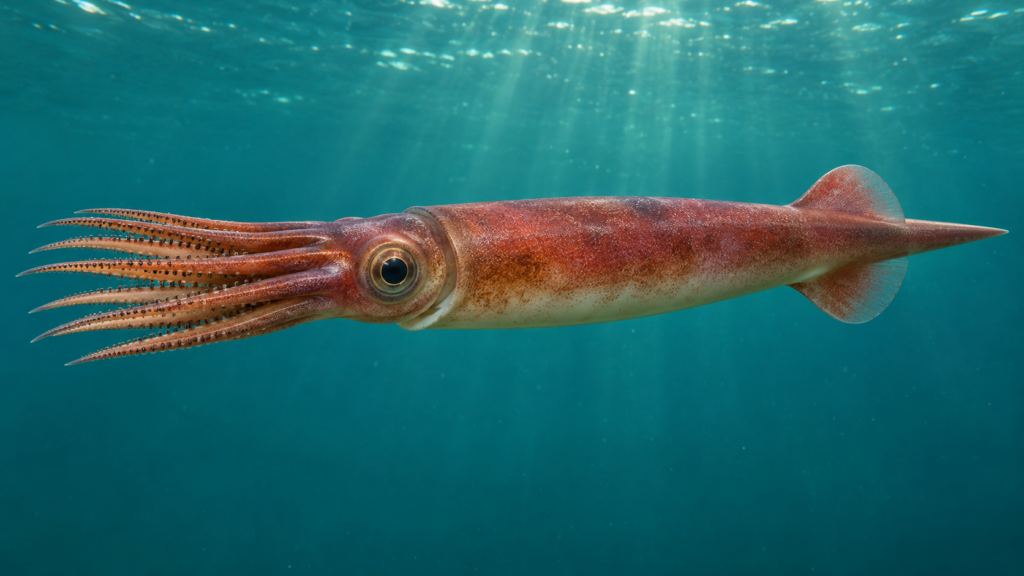
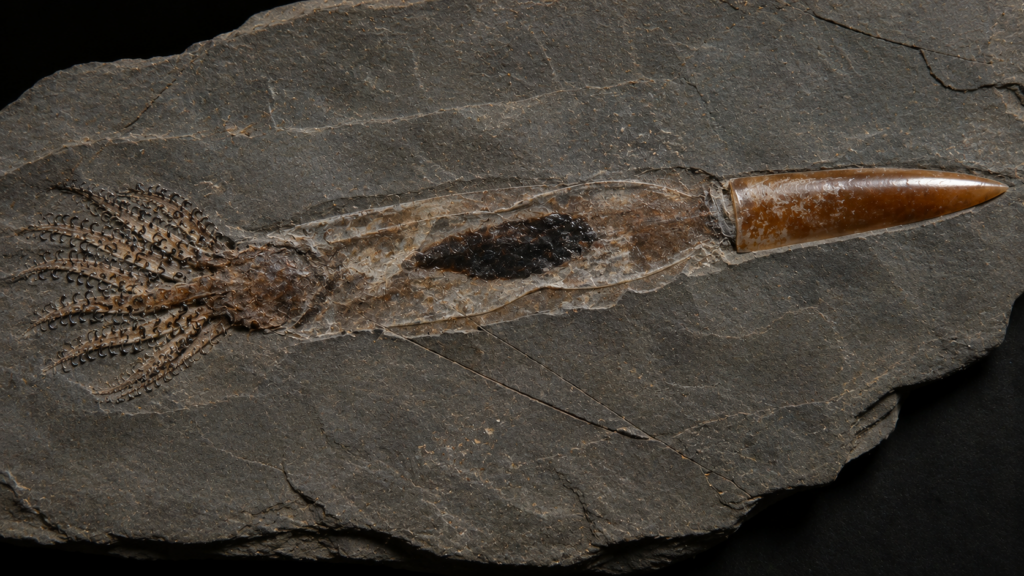
A belemnite’s shell lay inside its body, not outside. The bullet-shaped guard sat at the very back. A cone-shaped shell divided into many chambers fitted into a hollow at the front of the guard, and a thin plate ran forward from it along the back. The chambered shell held gas and worked as a float, and the heavy guard is thought to have balanced the weight of the head and arms. The closest living relatives of belemnites are squid and cuttlefish.
What the body looked like in front of the guard is known from a very small number of fossils that preserve soft parts. The black shale of Early Jurassic age (about 180 million years old) around Holzmaden in southern Germany has yielded specimens of the genus Passaloteuthis with their arms still in place. One on display at the museum in Holzmaden has the guard, the chambered shell, the dorsal plate, traces of muscle, arms lined with hooks, and an ink sac lying beside the guard. It is about 30 cm long including the arms. A 2019 study based on this specimen calculated the volume and mass of the body, put its weight at about 170–180 g, and concluded that the animal could hold itself level in the water with its fins.
Belemnites had ten arms. In another Passaloteuthis from the same rocks, the complete arms are 8–9 cm long and each carries 23 to 28 pairs of hooks. The hooks measure about 0.4 mm at the arm tips and about 4 mm in the middle of the arm. A pair of large hooks 39 mm long sits near the base of the arms, and the specimen has at least 406 hooks in all. Some specimens lack the large hooks, and the difference may be one between males and females.
The shell of a lobster-like crustacean lies among the arms of that specimen. It appears to be a moulted shell, and the research team thinks the belemnite was chewing on it right up to its death. Most of the belemnite’s own body is missing, and the fossil is interpreted as the leftovers of a meal dropped by a shark or another vertebrate. A fossil of the shark Hybodus from the same rocks has belemnite guards packed into its stomach region, about 200 of them by one estimate.
Guards vary greatly in size from species to species. Many are about 5–10 cm long, and a species with a guard about 6 cm thick was reported in 2026. People once believed that guards fell from the sky during thunderstorms, and in Britain finger-shaped guards were known as Devil’s Fingers and St Peter’s Fingers. Belemnites died out at the end of the Cretaceous.
A Picture Drawn in Fossil Ink
Soft bodies normally decay before they can fossilise, but an ink sac sometimes survives as a black lump. According to the British Geological Survey, fossil ink sacs have been found in Jurassic rocks in southern England and southern Germany. Besides the Passaloteuthis from Holzmaden, a belemnite with its beaks, arms and ink sac was reported from the limestone of Nusplingen in 2010.
Fossil ink has been known since the early nineteenth century. It was found by Mary Anning, who collected fossils at Lyme Regis on the south coast of England. In a report of 1829 the geologist William Buckland wrote that a hardened black substance, like the contents of a cuttlefish’s ink bag, occurs in the rocks at Lyme Regis. Anning took it to be the ink sac of a belemnite. Buckland held back, assigning it to an unknown cephalopod closely related to the belemnite animal. Ground to a powder it was brown, like the sepia used by painters, and it could be made into a drawing medium again. The Geological Society of London holds a drawing of an ichthyosaur skull made with this ink in about 1833–1834. It is thought to be the work of Elizabeth Philpot, a fossil collector and a friend of Anning.
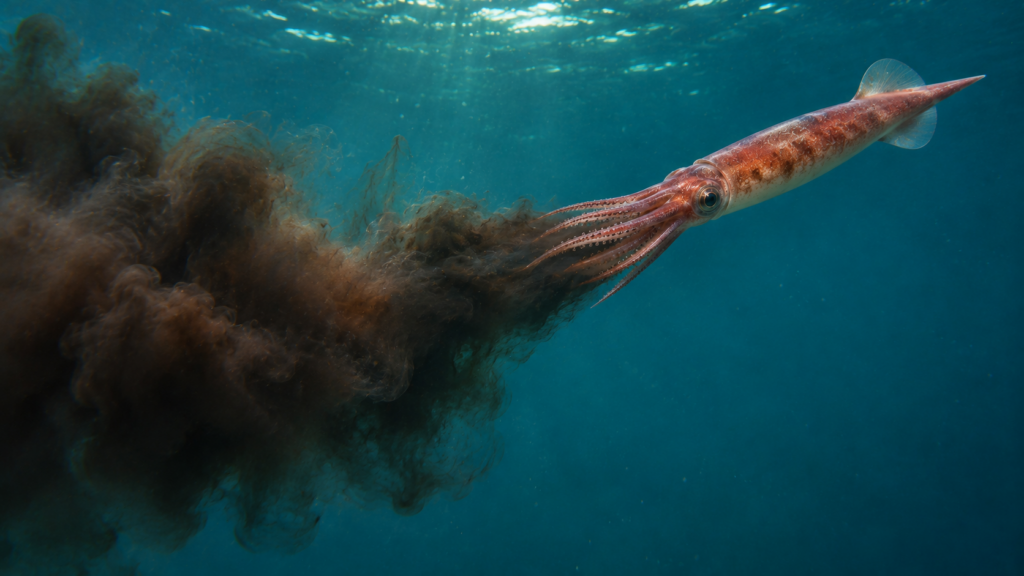
In 2009 Phil Wilby of the British Geological Survey found a fossil cephalopod ink sac near the village of Christian Malford in Wiltshire. Large numbers of fossils had come to light there during railway construction in the 1840s, and Wilby and his colleagues tracked down the lost fossil bed again and excavated it. The solidified black ink was mixed with ammonia to make a paint, and the paint was used to draw a picture of the animal.
News reports at the time named the animal as Belemnotheutis antiquus. The genus was named in 1842 from Christian Malford specimens. It had ten arms lined with hooks and an ink sac, and it was about 10–30 cm long. It lacked the thick guard of an ordinary belemnite, and it is usually placed in a closely related group separate from the order Belemnitida. In the nineteenth century the anatomist Richard Owen combined the body of this animal with the guard of an ordinary belemnite in his reconstruction of the belemnite animal, which was later recognised as a mistake.
One ink sac from Christian Malford and one from Lyme Regis have been analysed chemically. The results, published in 2012, showed that both still contained the black pigment melanin (eumelanin), and that it was chemically very similar to the ink of the living common cuttlefish. The granules of ink were also about the same size and shape as those of the cuttlefish. Both ink sacs are more than 160 million years old.

Related products
You can find books and products related to this article on Amazon.
If you buy through the links above, this blog may earn a commission.
About the images
The images in this article are illustrations created with AI (ChatGPT), and you are welcome to use them. If you do, we would appreciate a link back to this article as the source.
Sources
British Geological Survey, Belemnites https://www.bgs.ac.uk/discoveringGeology/time/fossilfocus/belemnite.html
The Geological Society of London, Fossil sepia, described 1829 https://www.geolsoc.org.uk/the-library/online-exhibitions/mary-anning-and-the-geological-society/pterosaurs-coprolites-and-sepia/fossil-sepia/
Glass, K. et al. (2012). Direct chemical evidence for eumelanin pigment from the Jurassic period. Proceedings of the National Academy of Sciences 109(26), 10218–10223. https://doi.org/10.1073/pnas.1118448109
Jenny, D. et al. (2019). Predatory behaviour and taphonomy of a Jurassic belemnoid coleoid (Diplobelida, Cephalopoda). Scientific Reports 9, 7944. https://doi.org/10.1038/s41598-019-44260-w
Klug, C. et al. (2021). Fossilized leftover falls as sources of palaeoecological data: a ‘pabulite’ comprising a crustacean, a belemnite and a vertebrate from the Early Jurassic Posidonia Shale. Swiss Journal of Palaeontology 140, 10. https://doi.org/10.1186/s13358-021-00225-z
Klug, C., Schweigert, G., Fuchs, D. & Dietl, G. (2010). First record of a belemnite preserved with beaks, arms and ink sac from the Nusplingen Lithographic Limestone (Kimmeridgian, SW Germany). Lethaia 43(4), 445–456. https://doi.org/10.1111/j.1502-3931.2009.00203.x
Donovan, D. T. & Crane, M. D. (1992). The type material of the Jurassic cephalopod Belemnotheutis. Palaeontology 35(2), 273–296. https://www.palass.org/publications/palaeontology-journal/archive/35/2/article_pp273-296
Phys.org (28 August 2009), report on the Christian Malford excavation and the ink https://phys.org/news/2009-08-scientists-squid-ink-jurassic-period.html


コメント