This article contains affiliate links. As an Amazon Associate I earn from qualifying purchases.
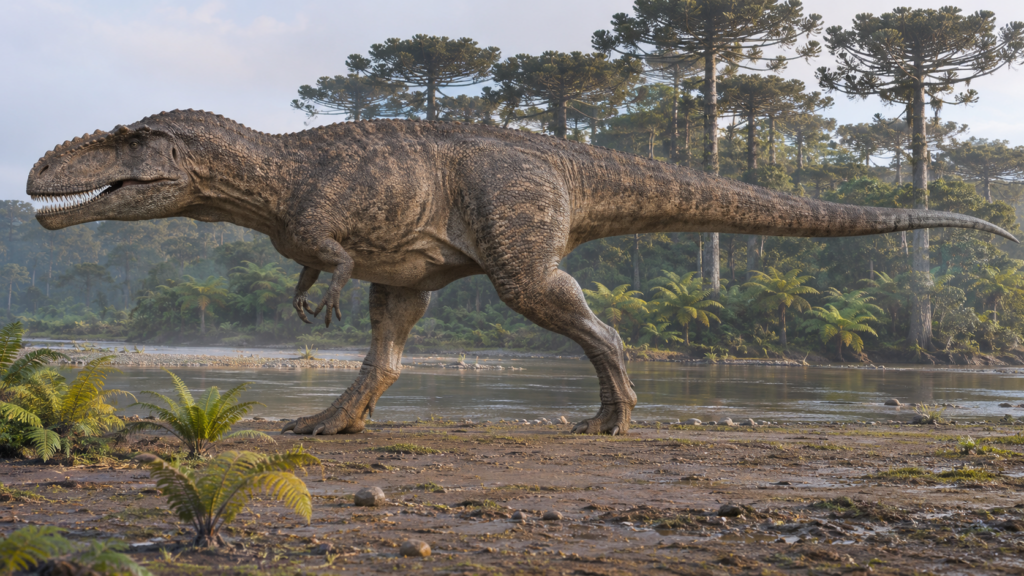
| Name | Giganotosaurus carolinii. The genus name means “giant southern lizard.” The species name honors Rubén Carolini, who found it |
| Classification | Reptilia, Dinosauria, Theropoda, Carcharodontosauridae |
| Age | Cretaceous (a 2026 study dated the rock layer to about 111 million years ago, in the Early Cretaceous) |
| Found in | Neuquén Province, Argentina (the Candeleros Formation near Villa El Chocón) |
| Length | About 12.5 m (original description); about 13 m in an estimate based on skull length |
| Weight | About 6 to 8 tonnes (original description); other estimates put a larger individual at over 8 tonnes, or close to 14 tonnes based on skull length |
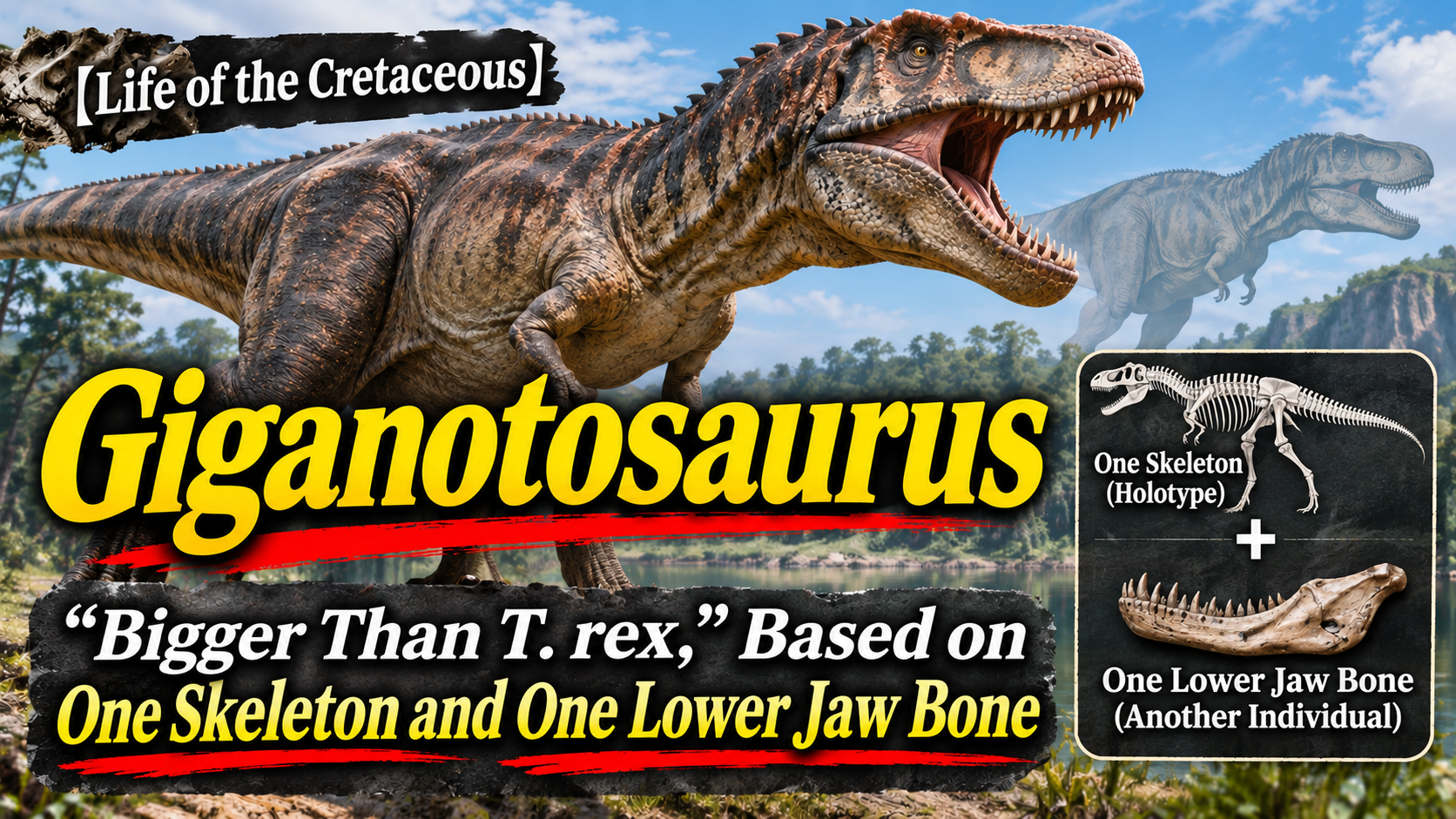
Giganotosaurus was a large meat-eating dinosaur that lived in South America during the Cretaceous. When it was described in 1995, it was called “probably the largest carnivorous dinosaur in the world,” and it became widely known as a dinosaur bigger than Tyrannosaurus. The bones behind that comparison are one partial skeleton and a single lower jaw bone from another individual.
Appearance and Life
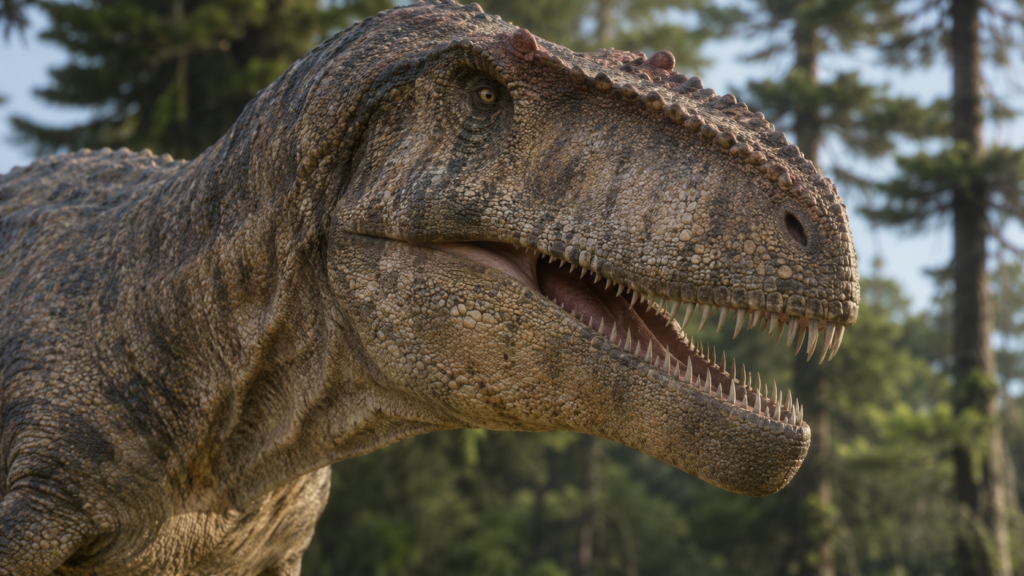
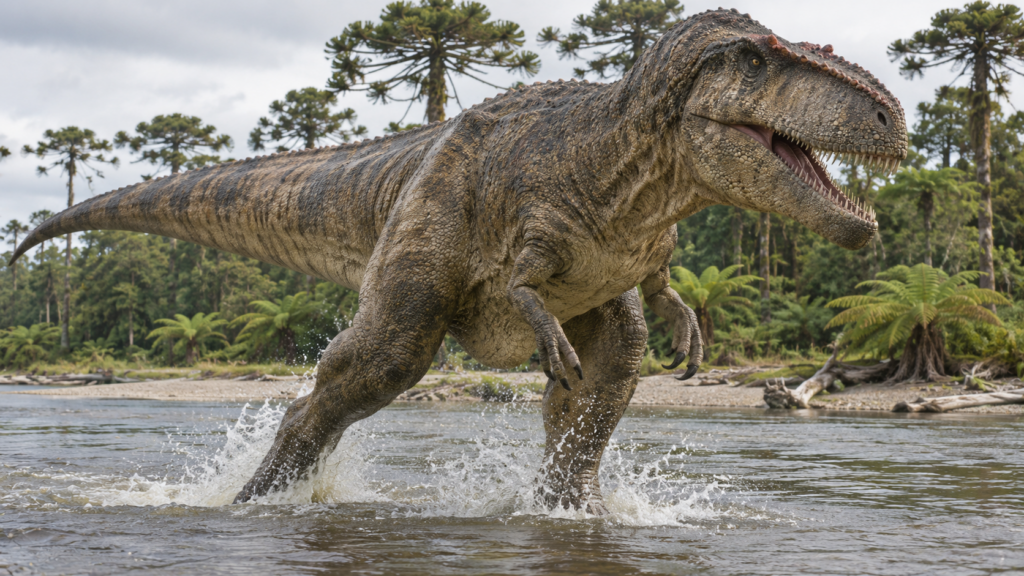
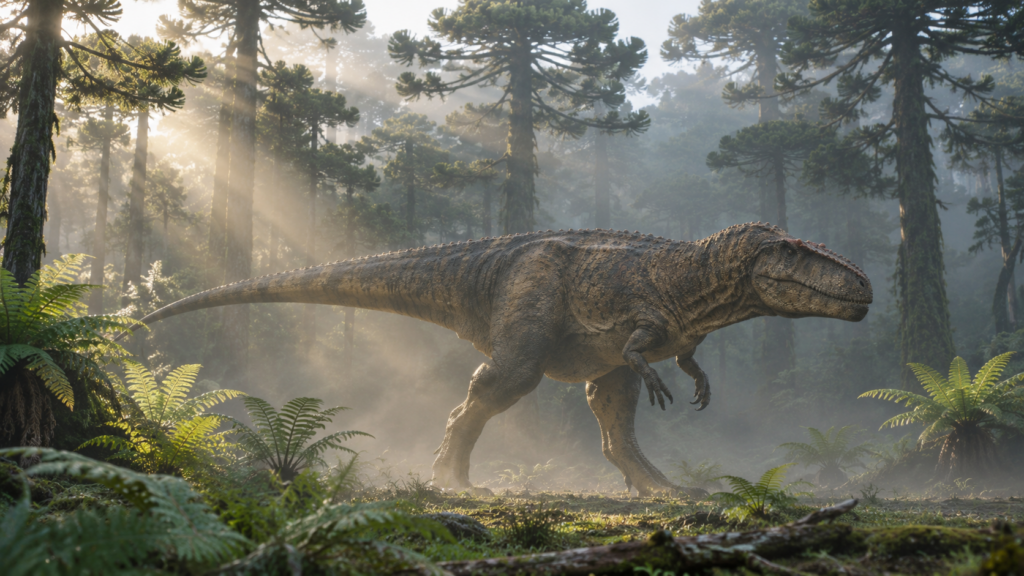
Giganotosaurus was a large theropod that walked on its hind legs. Its skull was long and narrow, and its mouth was lined with thin, blade-like teeth. Its arms were short, and a long tail balanced its body. The enamel on its teeth carried a wrinkled pattern. Thin, blade-like teeth with wrinkled enamel are regarded as a shared feature of the carcharodontosaurid family.
The first fossil was found in 1993 by Rubén Darío Carolini, an amateur fossil hunter, in Neuquén Province in northern Patagonia, Argentina. The Argentine paleontologists Rodolfo Coria and Leonardo Salgado described it in the journal Nature in 1995 and named the species after Carolini. This specimen, MUCPv-CH-1, is the type specimen of Giganotosaurus.
It is classified as a close relative of Carcharodontosaurus from North Africa. A study of the braincase, the part of the skull that holds the brain, published in 2002, supported the view that the two dinosaurs were each other’s closest relatives. In 2010, a cast of the brain was reconstructed from the inside of the braincase, showing that the layout of the brain resembled that of Carcharodontosaurus. A slightly higher rock layer in the same province has yielded Mapusaurus, a close relative of about the same size, with at least seven individuals found together.
The Candeleros Formation, where the fossil was found, had long been treated as Late Cretaceous. In 2026, a study that dated zircon crystals from volcanic ash beds within the rocks placed the Candeleros Formation at about 111.4 million years ago and the layer above it at about 106.8 million years ago, both in the Albian stage of the Early Cretaceous. That makes the rocks some 10 to 15 million years older than previously thought.
The Evidence for “Bigger Than T. rex”
The original 1995 description estimated Giganotosaurus at about 12.5 m long and 6 to 8 tonnes, calling it the largest theropod in the Southern Hemisphere and probably the largest carnivorous dinosaur in the world. The type specimen is a skeleton with a substantial share of its bones, but it is a single individual.
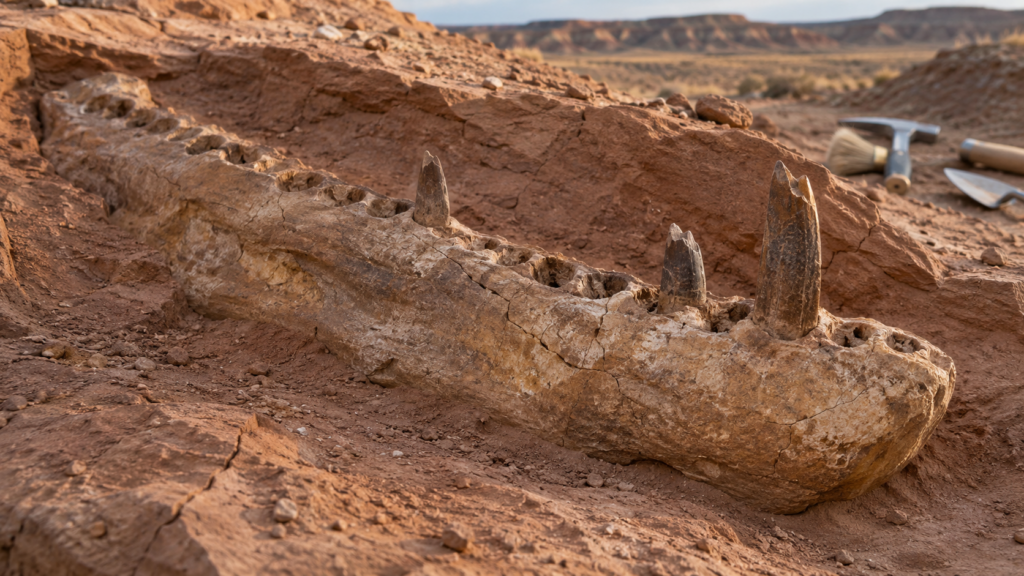
In 2004, a team studying South American fossils re-examined the body size of large dinosaurs from the continent. They found that the type specimen was about the same size as an average Tyrannosaurus and slightly smaller than “Sue,” one of the largest Tyrannosaurus specimens. A lower jaw bone (dentary) from another individual, MUCPv-95, however, was 8 percent longer than the type specimen’s. The study concluded that if the body grew in the same proportions, this individual would have weighed more than 8 tonnes and been the largest known theropod. Only part of its lower jaw has been found.
In 2007, a study that estimated body size from skull length appeared under the title “My theropod is bigger than yours … or not.” It found that Giganotosaurus and Carcharodontosaurus reached close to 13 m and 14 tonnes and may have surpassed Tyrannosaurus. Because the skull of Giganotosaurus has not been found complete, its length is itself an estimate. In 2022, the skull length of Giganotosaurus was recalculated using the skull of Meraxes, a newly described relative.
Large Tyrannosaurus specimens are also being re-examined. In 2019, a team at the University of Alberta in Canada estimated that “Scotty” (RSM P2523.8), a specimen from Saskatchewan, weighed more than 8.8 tonnes, heavier than any other known Tyrannosaurus and any other giant theropod.
Which of the two dinosaurs comes out larger depends on which specimens are compared and how their size is estimated. For Giganotosaurus, the comparison rests on the type specimen and one lower jaw bone; for Tyrannosaurus, on individual large specimens such as Sue and Scotty. Which one was bigger has not been settled. In 2014, a study also argued that Spinosaurus had a larger body than Tyrannosaurus.
Related products
You can find books and products related to this article on Amazon.
If you buy through the links above, this blog may earn a commission.
About the images
The images in this article are illustrations created with AI (ChatGPT), and you are welcome to use them. If you do, we would appreciate a link back to this article as the source.
Sources
Coria, R. A. & Salgado, L. (1995). A new giant carnivorous dinosaur from the Cretaceous of Patagonia. Nature 377, 224–226. https://doi.org/10.1038/377224a0
Mazzetta, G. V. et al. (2004). Giants and bizarres: body size of some southern South American Cretaceous dinosaurs. Historical Biology 16, 71–83. https://doi.org/10.1080/08912960410001715132
Therrien, F. & Henderson, D. M. (2007). My theropod is bigger than yours … or not: estimating body size from skull length in theropods. Journal of Vertebrate Paleontology 27, 108–115. https://doi.org/10.1671/0272-4634(2007)27[108:MTIBTY]2.0.CO;2
Persons, W. S. et al. (2019). An older and exceptionally large adult specimen of Tyrannosaurus rex. The Anatomical Record 303, 656–672. https://doi.org/10.1002/ar.24118
Coria, R. A. & Currie, P. J. (2002). The braincase of Giganotosaurus carolinii (Dinosauria: Theropoda) from the Upper Cretaceous of Argentina. Journal of Vertebrate Paleontology 22, 802–811. https://doi.org/10.1671/0272-4634(2002)022[0802:TBOGCD]2.0.CO;2
Paulina Carabajal, A. & Canale, J. I. (2010). Cranial endocast of the carcharodontosaurid theropod Giganotosaurus carolinii. Neues Jahrbuch für Geologie und Paläontologie, Abhandlungen 258, 249–256. https://doi.org/10.1127/0077-7749/2010/0104
Canale, J. I. et al. (2022). New giant carnivorous dinosaur reveals convergent evolutionary trends in theropod arm reduction. Current Biology 32, 3195–3202. https://doi.org/10.1016/j.cub.2022.05.057
Maniel, I. J. et al. (2026). Albian zircon U-Pb crystallization ages from tuff beds in the Candeleros and Huincul formations, Neuquén Basin, Argentina. Gondwana Research 159, 193–204. https://doi.org/10.1016/j.gr.2026.06.020
Ibrahim, N. et al. (2014). Semiaquatic adaptations in a giant predatory dinosaur. Science 345, 1613–1616. https://doi.org/10.1126/science.1258750
Wikipedia, Giganotosaurus (discovery and meaning of the name) https://en.wikipedia.org/wiki/Giganotosaurus

コメント