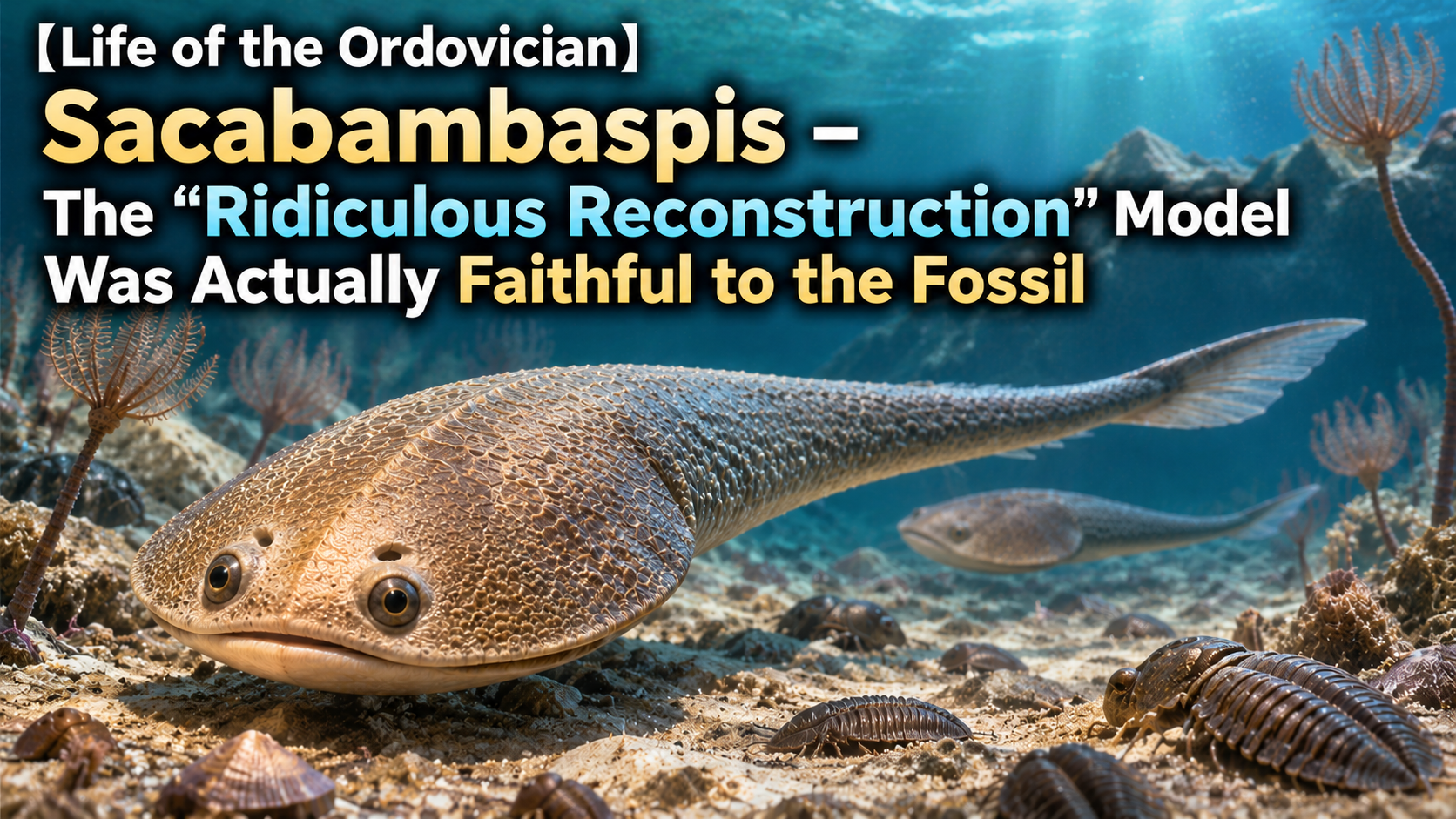
| Name | Sacabambaspis. From Sacabamba, a village in Bolivia, plus the Greek aspis, “shield” |
| Classification | Agnatha, Pteraspidomorphi, Arandaspidiformes |
| Age | Middle to Late Ordovician (about 470 to 458 million years ago) |
| Found in | Cochabamba Department, Bolivia (Anzaldo Formation); also Argentina, Australia, and Oman |
| Length | About 35 cm (head shield about 10 cm long and 8 cm wide) |
| Weight | No published estimate; judging from its build, a few hundred grams (rough figure) |
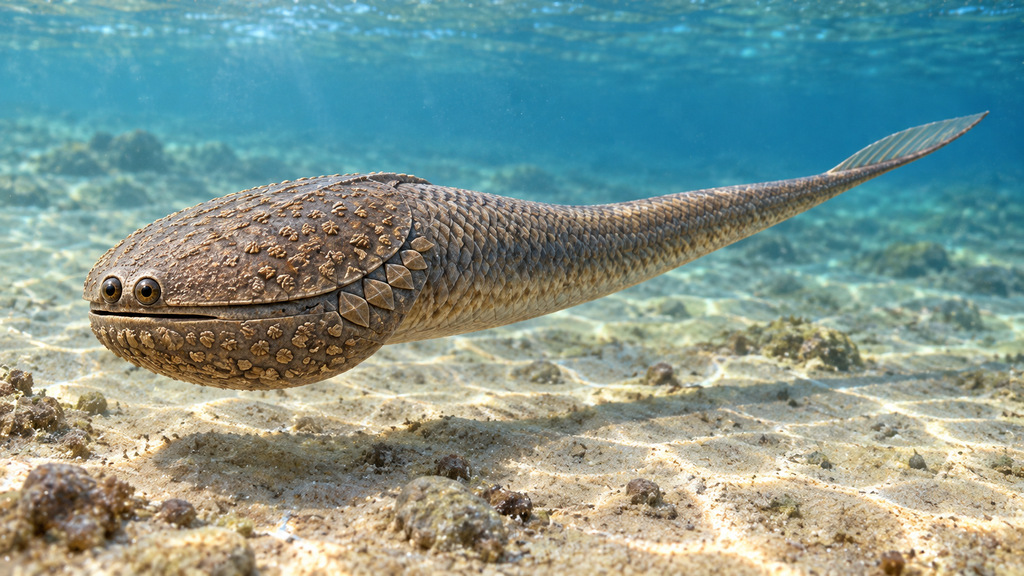
Sacabambaspis is one of the earliest fishes, and it had no jaws. Large bony plates covered its head and the front half of its body, it had neither pectoral nor pelvic fins, and the only thing attached to the rear of the body was a thin tail. More than thirty fossils have been found with the whole body still articulated, making it the best-studied fish of the Ordovician. In 2023, a photograph of a reconstruction model kept in a museum in Finland spread widely in Japan, and the name of this fish became known well outside paleontology.
Appearance and Way of Life
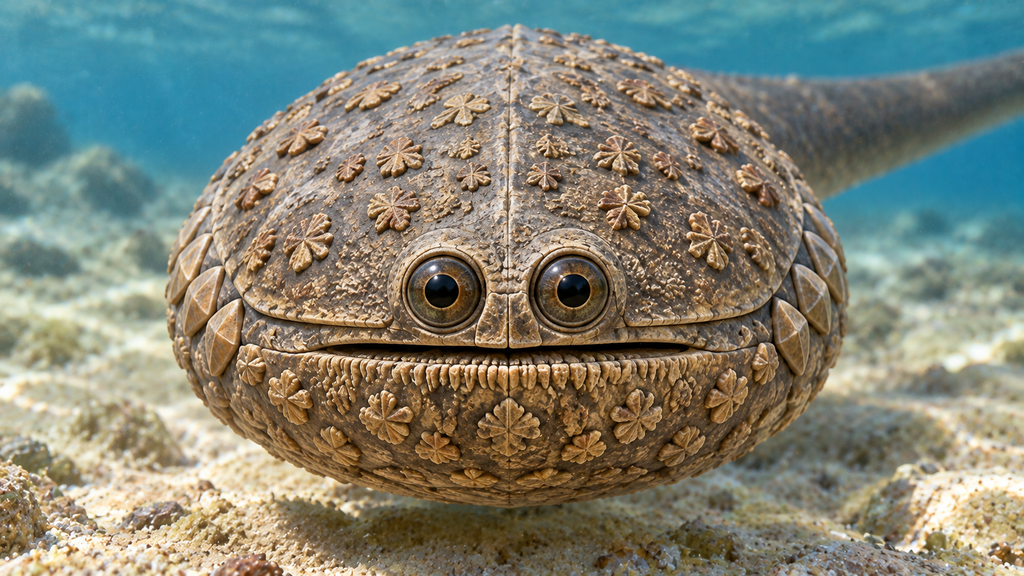
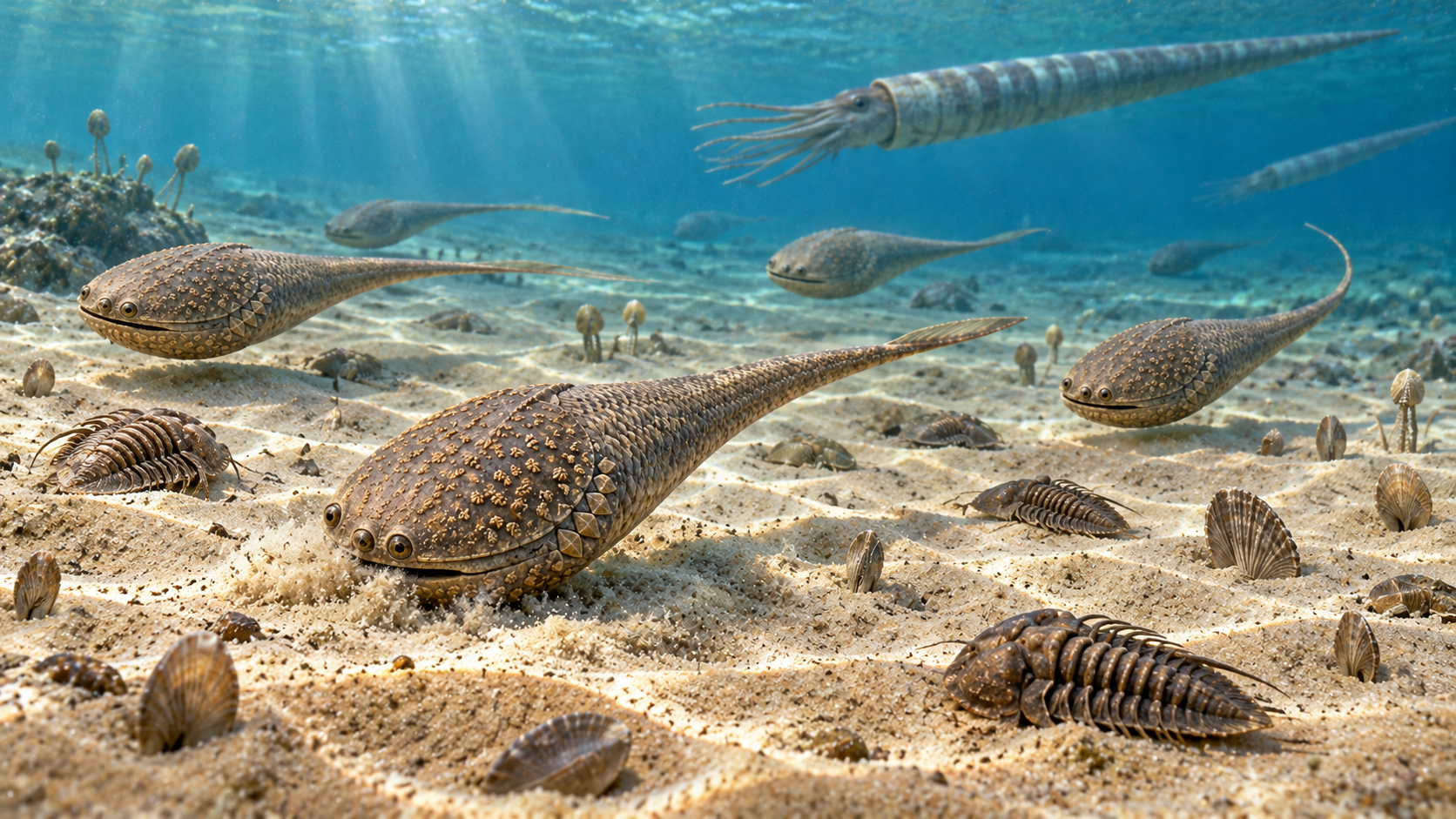
The body was flattened as if pressed from above, with a large head and a thin tail. The overall outline is close to that of a tadpole. The head shield was made of two large plates, one on the back and one on the belly. The dorsal plate was almost flat, while the ventral plate bulged deeply toward the front. Along the boundary between the two, on the sides of the head, small diamond-shaped plates ran in an arc, and the gill openings are thought to have lined up beneath them. The surface of the plates was densely covered with tiny tubercles shaped like oak leaves.
The eyes sat side by side at the very front of the head. Their position is clear in the fossils, where a ring of bone called the scleral ring remains around each eye. This arrangement is often compared to the headlights of a car, and it shows that the brain lay toward the back of the head rather than the front. The mouth was a thin horizontal slit just below the eyes, and along its lower edge ran close to sixty rows of narrow bony strips. Although it had no jaws, the prevailing interpretation is that it moved these strips to expand and contract the mouth cavity, sucking in mud from the seafloor and small organic particles from the water. Near the front of the dorsal plate is a pair of small pits, which may mark two light-sensing pineal organs sitting side by side. Lateral line grooves are also carved into the head plates, showing that it sensed movement in the water.
Cut through the armor and view it under a microscope, and three layers appear. The lowest is plate-like bone, the middle is thick spongy bone, and the top is tissue close to the dentine and enamel that make up the teeth and scales of sharks. In other words, tooth-like tissue covered the surface of the body rather than the mouth. This layered structure closely resembles the armor of the heterostracans, which flourished in the Silurian and Devonian, and is one of the reasons the two groups are considered close relatives.
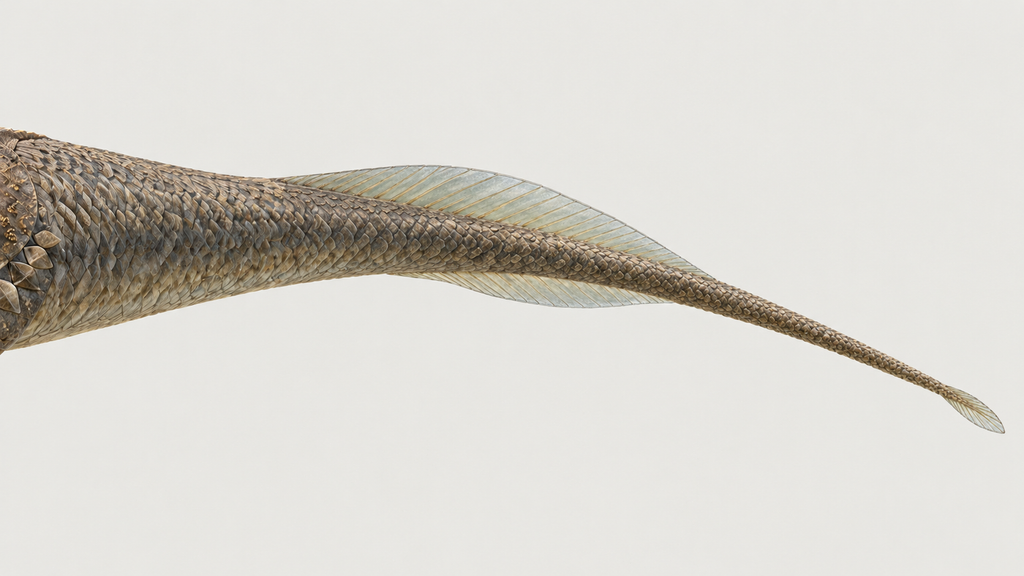
Behind the head, the trunk was covered with long narrow scales that converged from both sides into a V-shaped pattern, with a single ridge of scales running along the edge of the back and another along the belly. The tail was extremely thin, like a rod wrapped in scales, with a thin fin membrane at the end. Most of the fin lay on the upper side of the tail, and the axis of the tail bent downward. The shape of this tail was disputed for a long time.
It lived in the shallow seas along the margin of Gondwana, the giant continent of the Southern Hemisphere. The rocks that yield its fossils are alternating sandstones and mudstones, representing environments from the wave-washed nearshore to muddy bottoms a little farther out. The same beds contain trilobite crawling traces and the shells of lingulid brachiopods. With no fins, it was probably not a fast swimmer, and it is thought to have been a slow fish that moved just above the bottom using only its tail. The seas of that time held cephalopods with shells several meters long and arthropods ancestral to the large sea scorpions, and the armor of Sacabambaspis is believed to have served as protection against such predators.
Discovery, and What the Fossils Say About How They Died
The first fossils were found in the 1980s near a village called Sacabamba, about 50 km east of Cochabamba, Bolivia. In 1986, Pierre-Yves Gagnier and colleagues described it as a new genus and species on the basis of a few fragments of armor. The species name, janvieri, honors the French paleontologist Philippe Janvier. Subsequent fieldwork turned up one articulated specimen after another, and in 1989 it was presented in National Geographic’s research journal as “the oldest vertebrate, 470 million years old.” Older fish fossils have since been reported from Cambrian rocks in China, so it no longer holds the title of oldest. Even so, as an Ordovician vertebrate with a complete skeleton, it remains the best material available.
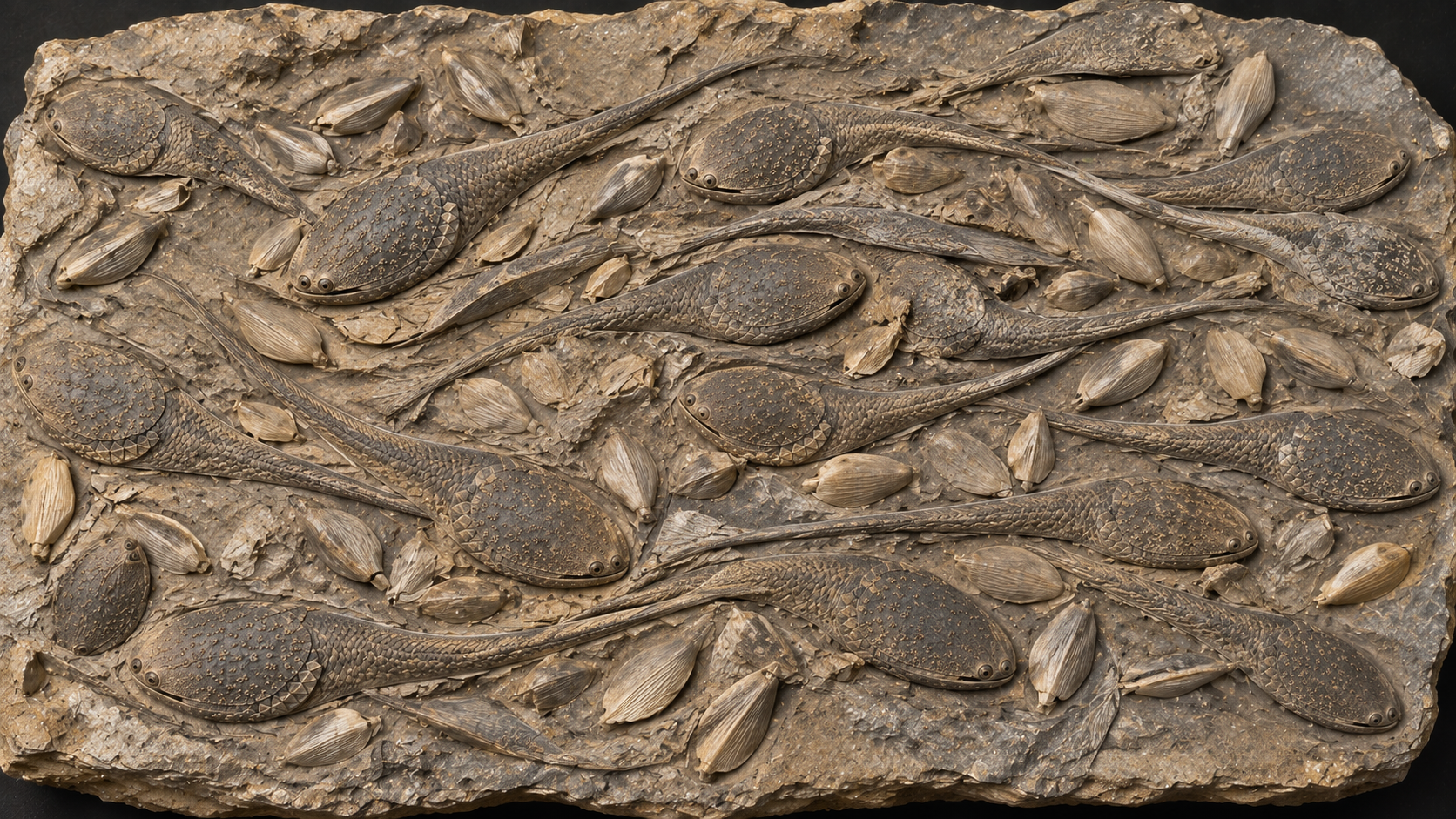
The Bolivian specimens came out packed tightly together in a small area. More than thirty fish lay piled on the same surface, surrounded by large numbers of lingulid brachiopods that had died at the same time. One interpretation is that a storm sent a large volume of fresh water and mud down the rivers all at once, and the sudden change in salinity killed the entire school. The “Sacabambaspis slab,” a single block of rock with many fish lined up on it, has become the signature specimen of this fish.
The shape of the tail went unresolved for nearly twenty years. In 1989, Gagnier reconstructed a long tail formed of a thin tube of scales, based on the best-preserved specimen. Because no other jawless fish had anything like it, many researchers doubted the reconstruction, arguing that the long tail was displaced armor from a neighboring individual and that the real tail was short and leaf-shaped. A 2006 study that re-prepared the same specimen confirmed that the thin, long tail did belong to that individual, vindicating Gagnier’s original reconstruction. The same study also revealed the structure in which the tail axis bends downward while the fin membrane spreads above it.
How a Museum Model Went Viral
In August 2022, a researcher visiting the Finnish Museum of Natural History in Helsinki posted a photograph of the Sacabambaspis reconstruction model on display there. With its round, forward-facing eyes set apart, two pits that looked like nostrils, and a mouth turned up at both corners, the model first drew attention in the English-speaking world, then was rediscovered on Japanese message boards and social media from the spring of 2023 and spread rapidly in June. When a website introducing living things wrote an article about it on June 8, the accompanying post drew more than 300,000 likes, and the official account of the game Among Us joined in on June 15. LINE stickers, figures, felt plush toys, and even nail art followed, along with a diagram for memorizing the name as “saka, van, bus, peace.” Its treatment as something like a yuru-chara mascot has been cited as the reason it spread so widely in Japan in particular.
The model was made by the Estonian paleontologist Elga Mark-Kurik (1928–2016). A specialist in Devonian fishes, she was asked to produce the models when the museum built its fossil fish exhibit in the mid-1990s. She was not a professional sculptor; in an interview given during her lifetime, she described carving the original in foam, casting it in silicone, and attaching doll eyes bought at a nearby craft store.
The model’s expression drew laughter, but the body itself does not depart from the fossils. Two eyes side by side at the very front of the head, a mouth that is a thin slit below the eyes, no pectoral or pelvic fins, a large head and a thin tail: every one of these is a feature described above under “Appearance and Way of Life.” The headlight eyes are read from the position of the scleral rings in the fossils, and the slit mouth from the bony strips of the lower lip. The model that spread as a “terrible reconstruction” was, in fact, a shape a researcher had built faithfully from the fossils, and it happened to be an arrangement that looks like a human face. Since it became a sensation, plush toys and figures supervised by paleontologists have also been produced in Japan.
References
Gagnier, P.-Y., Blieck, A. & Rodrigo, G. (1986) First Ordovician vertebrate from South America. Geobios 19: 629–634. https://doi.org/10.1016/S0016-6995(86)80058-4
Gagnier, P.-Y. & Blieck, A. (1992) On Sacabambaspis janvieri and the vertebrate diversity in Ordovician seas. In: Mark-Kurik, E. (ed.) Fossil fishes as living animals. https://hal.science/hal-03029368v1
Gagnier, P.-Y. et al. (1996) New paleontological and geological data on the Ordovician and Silurian of Bolivia. Journal of South American Earth Sciences 9: 329–347. https://doi.org/10.1016/S0895-9811(96)00018-1
Sansom, I. J., Donoghue, P. C. J. & Albanesi, G. (2005) Histology and affinity of the earliest armoured vertebrate. Biology Letters 1: 446–449. https://doi.org/10.1098/rsbl.2005.0349
Pradel, A. et al. (2006) The tail of the Ordovician fish Sacabambaspis. Biology Letters 3: 72–75. https://doi.org/10.1098/rsbl.2006.0557
Davies, N. S. et al. (2007) Ichnology, palaeoecology and taphonomy of a Gondwanan early vertebrate habitat: Insights from the Ordovician Anzaldo Formation, Bolivia. Palaeogeography, Palaeoclimatology, Palaeoecology 249: 18–35. https://doi.org/10.1016/j.palaeo.2007.01.003
Sansom, I. J. et al. (2009) Ordovician fish from the Arabian Peninsula. Palaeontology 52: 337–342. https://doi.org/10.1111/j.1475-4983.2009.00846.x
AUTOMATON WEST (June 16, 2023) 470-million-year-old fish Sacabambaspis goes viral in Japan. https://automaton-media.com/en/news/20230616-19550/
Know Your Meme: Sacabambaspis. https://knowyourmeme.com/memes/sacabambaspis

コメント