This article contains affiliate links. As an Amazon Associate I earn from qualifying purchases.
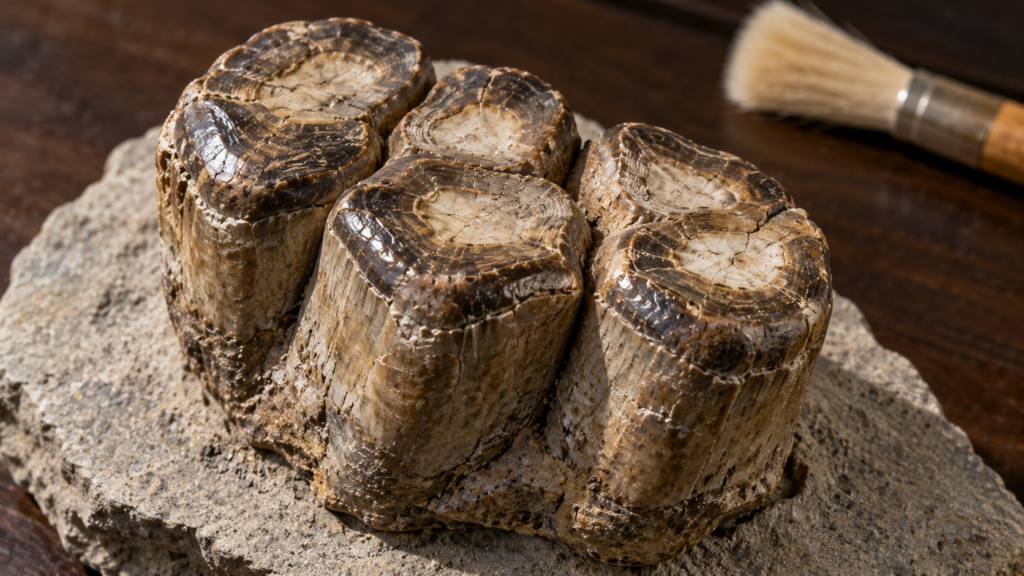
| Name | Desmostylus, from the Greek for “bundle” and “pillar,” after its molars, which look like slender columns bound together |
| Classification | Mammalia, Desmostylia, Desmostylidae |
| Age | Neogene, Miocene (oldest record about 23 to 22 million years ago) |
| Found in | Coasts of the North Pacific: California and Oregon in the United States, Japan, and Sakhalin |
| Length | Estimated at about 2.7 m for an adult |
| Weight | Estimated at about 1.3 tonnes for an adult |
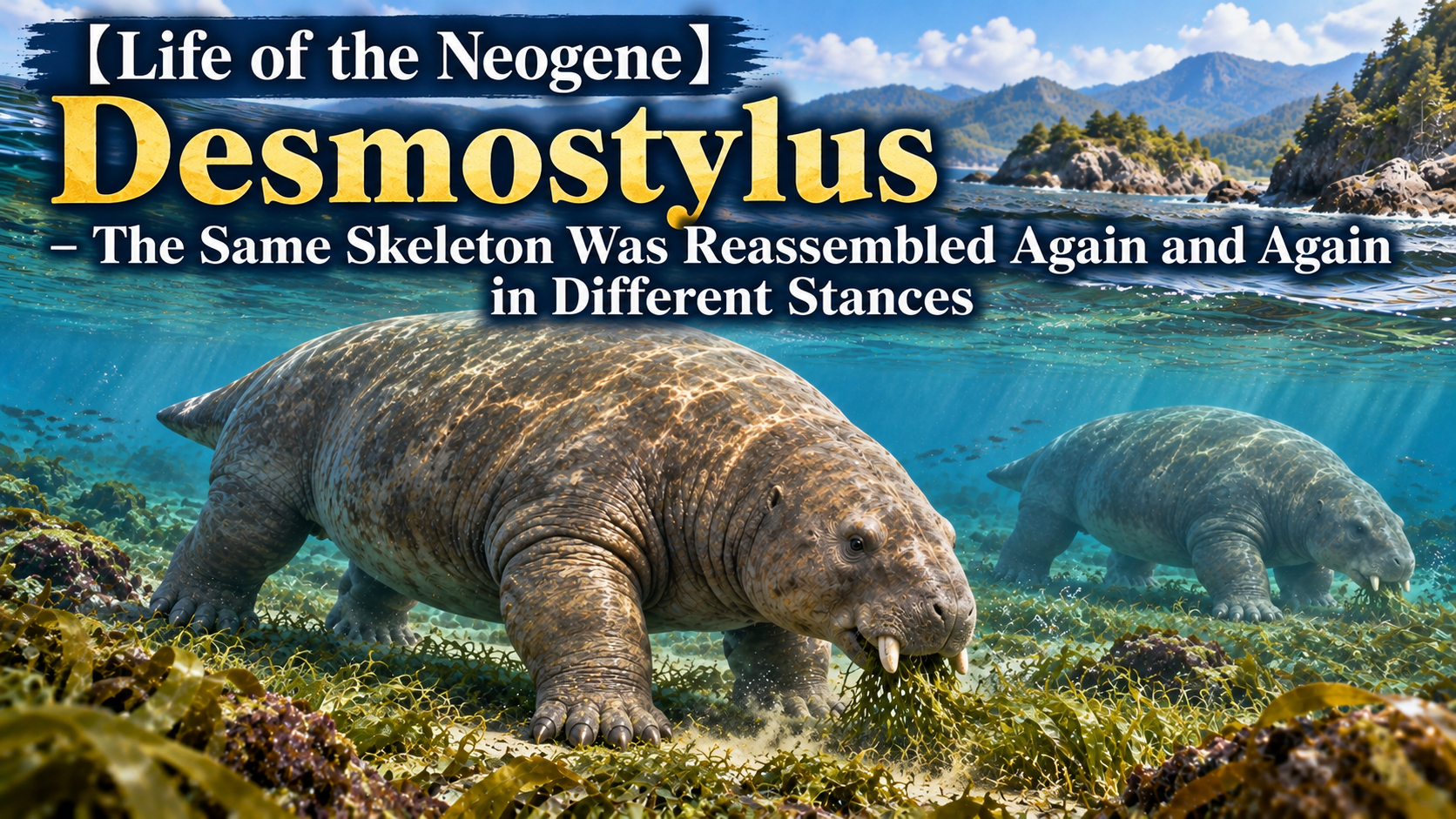
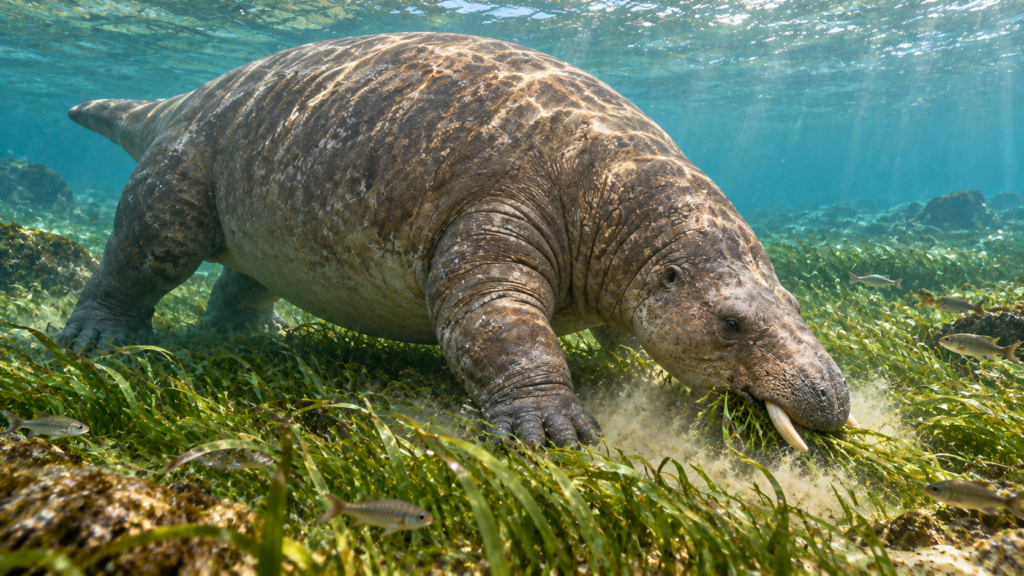
Desmostylus was a large, four-legged mammal that lived along the coasts of the North Pacific in the Miocene. It spent its life in shallow coastal water and had peculiar molars that look like bundles of slender pillars. Complete skeletons have been found in Japan and Sakhalin, but researchers have mounted them standing in different ways, and the same specimen has been taken apart and reassembled several times.
Appearance and Way of Life
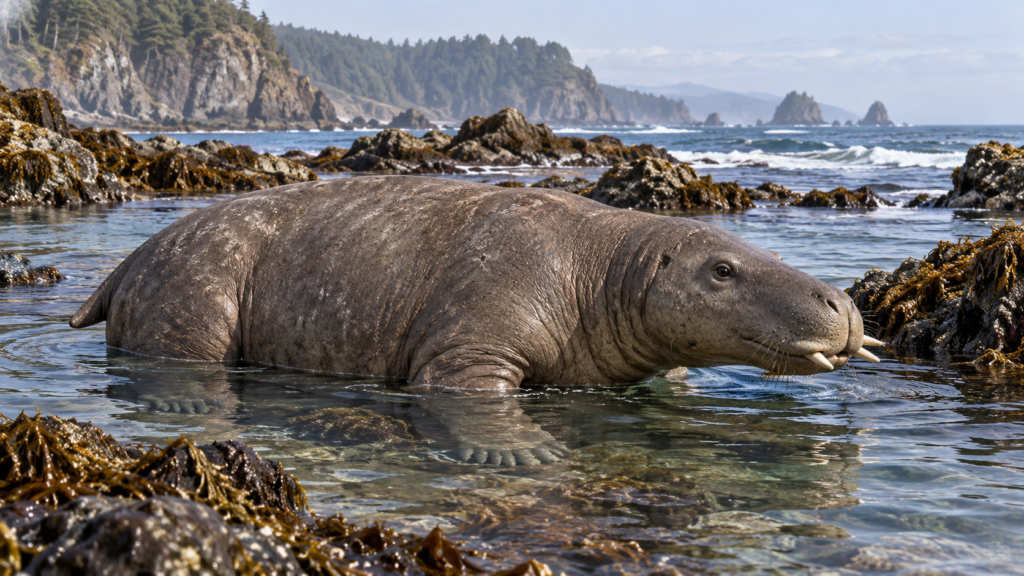
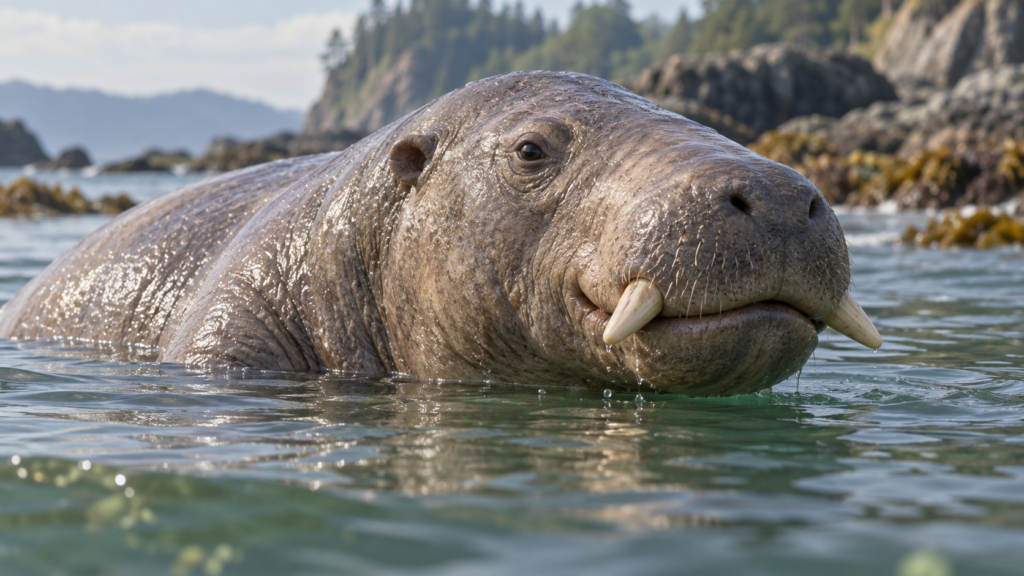
Desmostylus had a thick body, a short neck and four legs. Its head was long, and tusks projected forward from the tips of both the upper and lower jaws. Its most distinctive feature was its cheek teeth, each shaped like a cluster of cylinders bundled together. Because these teeth resemble those of no other mammal, Desmostylus and its relatives are placed in a group of their own, the order Desmostylia.
The genus was named in 1888 by the American paleontologist Othniel Marsh, based on only a few teeth and a single lower-back vertebra found in California. Marsh placed it among the sea cows (sirenians), the group of dugongs and manatees. Its relationship to other mammals is still unsettled: one view links it to elephants and sea cows, another to horses and rhinoceroses.
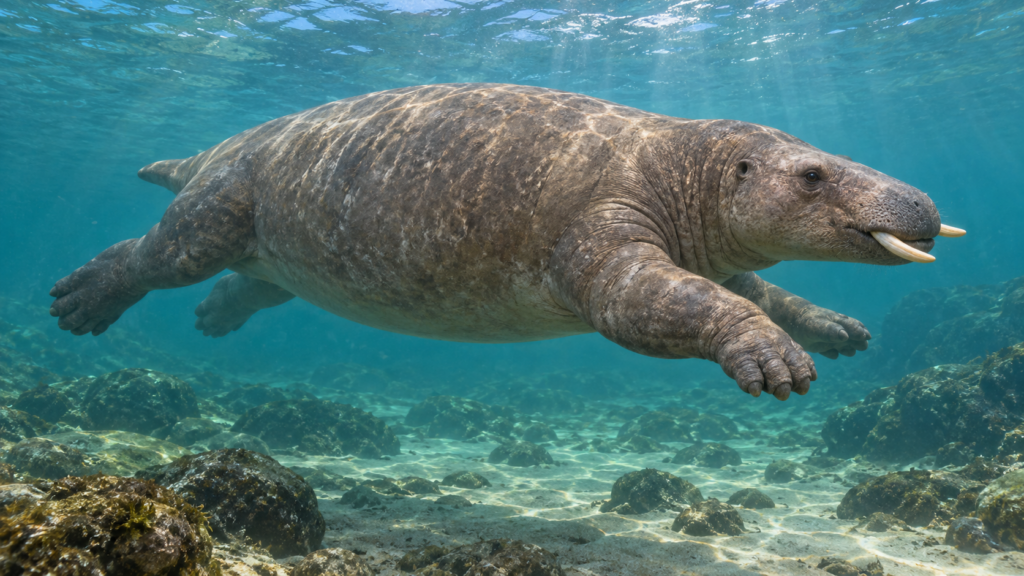
Its way of life has been reconstructed from chemical analyses of its bones and teeth. A 2003 study of tooth enamel from Middle Miocene Desmostylus in California found, from carbon isotope ratios, that it ate aquatic plants such as water plants and seaweed, and from the small variation in oxygen isotope ratios, that it spent much of its time in water. In 2013, a study comparing the internal structure of desmostylian bones found that while other desmostylians had heavy, dense bones, Desmostylus had light, spongy bone, and interpreted it as an active swimmer rather than an animal that walked slowly along the bottom. A 2015 study inferred from the shape of the jaws and teeth that it fed by clenching its teeth while sucking in coastal plants.
There are size estimates based on complete skeletons. The adult skeleton from Sakhalin at Hokkaido University is estimated to have been about 2.75 m long in life, about 1 m tall at the shoulder, and about 1.3 tonnes. Marsh had imagined an animal about 5 m long from a single vertebra; once whole skeletons were found, it turned out to be much smaller.
The Same Skeleton, Reassembled Again and Again in Different Stances
The first complete skeleton of Desmostylus was found in the 1930s in southern Sakhalin, then Japanese territory under the name Karafuto. Found along the Keton River near Shisuka (now Poronaysk), it was excavated by Takumi Nagao of Hokkaido Imperial University (now Hokkaido University), who described it as a new species in 1935. This “Keton specimen” was the first Desmostylus ever reconstructed as a full skeleton, and it is still held by Hokkaido University.
The problem was how to attach the four legs to the body and make it stand. Should the legs go straight down under the body, as in a hippopotamus, or should the elbows and knees splay out to the sides with the body held low, as in a crocodile or lizard? With no living animal to serve as a guide, the answer depends on how one reads the shapes of the joints. After Nagao’s mount, the Keton specimen was reassembled by Setsuo Kamei of Kyoto.
In 1977, a second skeleton was found in a river in the town of Utanobori (now part of Esashi) in Hokkaido. This “Utanobori specimen” came from rocks about 13.7 million years old, with roughly 60 percent of one animal’s bones still connected at the joints. In 1984, Norihisa Inuzuka, who studied it, proposed a posture with the elbows and knees splayed out to the sides and the body held low. One of his reasons was that the earlier mount of the Keton specimen had its legs bent at right angles, and with the short neck that had since come to light, the animal’s snout could not have reached the ground. Following this proposal, the Keton and Utanobori skeletons and a specimen from Tsuyama in Okayama Prefecture were remounted in the splayed posture.
In 2002, the American paleontologist Daryl Domning argued otherwise. In a study that newly reassembled a skeleton of the related Paleoparadoxia, he concluded that desmostylians walked with their legs straight under the body, holding it high off the ground, with an arched back and the heels raised so that they stood on their toes. In water, he proposed, they swam by paddling with the front legs, like polar bears.
Which stance is correct is still not settled. Skeletons on display in museums stand differently depending on when they were mounted. Each time a new researcher took up the bones, the same fossil rose to its feet as a different-looking animal: that is the history of the reconstruction of Desmostylus. Even now that studies of its bone structure and teeth suggest it spent more time swimming than walking on land, how it looked when it came ashore still depends on who draws it.
Related products
You can find books and products related to this article on Amazon.
If you buy through the links above, this blog may earn a commission.
About the images
The images in this article are illustrations created with AI (ChatGPT), and you are welcome to use them. If you do, we would appreciate a link back to this article as the source.
Sources
Inuzuka, N. (1996). Body size and mass estimates of desmostylians (Mammalia). The Journal of the Geological Society of Japan 102, 816–819. https://doi.org/10.5575/geosoc.102.816
Inuzuka, N. (2009). The skeleton of Desmostylus from Utanobori, Hokkaido, Japan, II. Postcranial skeleton. Bulletin of the Geological Survey of Japan 60, 257–379. https://doi.org/10.9795/bullgsj.60.257
Domning, D. P. (2002). The terrestrial posture of desmostylians. Smithsonian Contributions to Paleobiology 93, 99–111. https://doi.org/10.5479/si.00810266.93.99
Hayashi, S. et al. (2013). Bone inner structure suggests increasing aquatic adaptations in Desmostylia (Mammalia, Afrotheria). PLOS ONE 8, e59146. https://doi.org/10.1371/journal.pone.0059146
Clementz, M. T., Hoppe, K. A. & Koch, P. L. (2003). A paleoecological paradox: the habitat and dietary preferences of the extinct tethythere Desmostylus, inferred from stable isotope analysis. Paleobiology 29, 506–519. https://doi.org/10.1666/0094-8373(2003)029<0506:APPTHA>2.0.CO;2
Chiba, K. et al. (2015). A new desmostylian mammal from Unalaska (USA) and the robust Sanjussen jaw from Hokkaido (Japan), with comments on feeding in derived desmostylids. Historical Biology 28, 289–303. https://doi.org/10.1080/08912963.2015.1046718
Nagao, T. (1935). Desmostylus mirabilis nov., from Saghalin. The Journal of the Geological Society of Japan 42, 822–824. https://doi.org/10.5575/geosoc.42.822
Matsui, K. & Pyenson, N. D. (2023). New evidence for the antiquity of Desmostylus (Desmostylia) from the Skooner Gulch Formation of California. Royal Society Open Science 10, 221648. https://doi.org/10.1098/rsos.221648


コメント