This article contains affiliate links. As an Amazon Associate I earn from qualifying purchases.
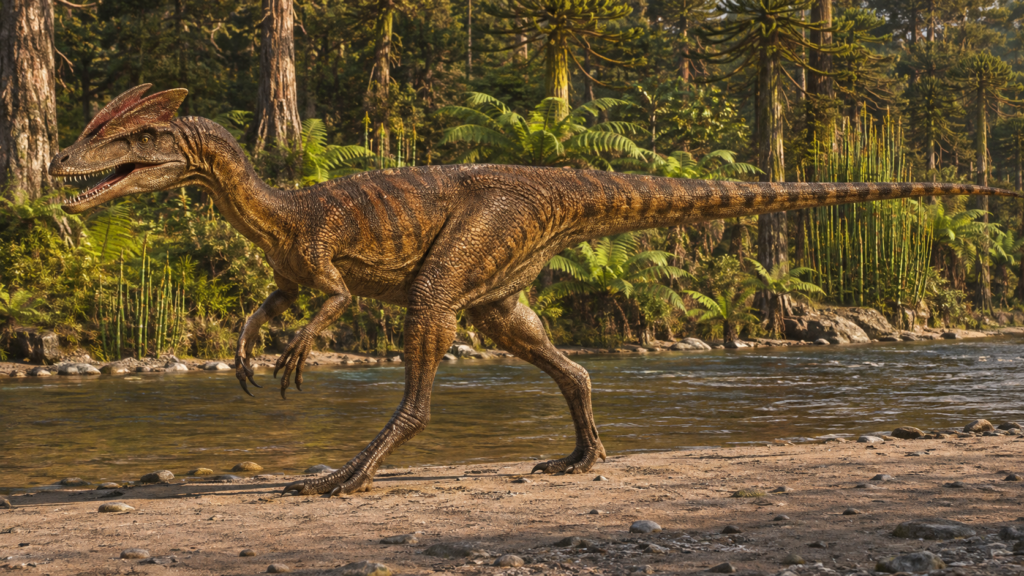
| Name | Dilophosaurus (“two-crested lizard”). Species: Dilophosaurus wetherilli |
| Classification | Dinosaur (saurischian, theropod). An early-branching member of the meat-eating theropods |
| Age | Early Jurassic (around 183 million years ago) |
| Where found | Navajo Nation lands in northern Arizona, USA (Kayenta Formation). The first bones were found in 1940 |
| Length | About 6–7 m |
| Weight | About 400 kg (Natural History Museum, London estimate) |
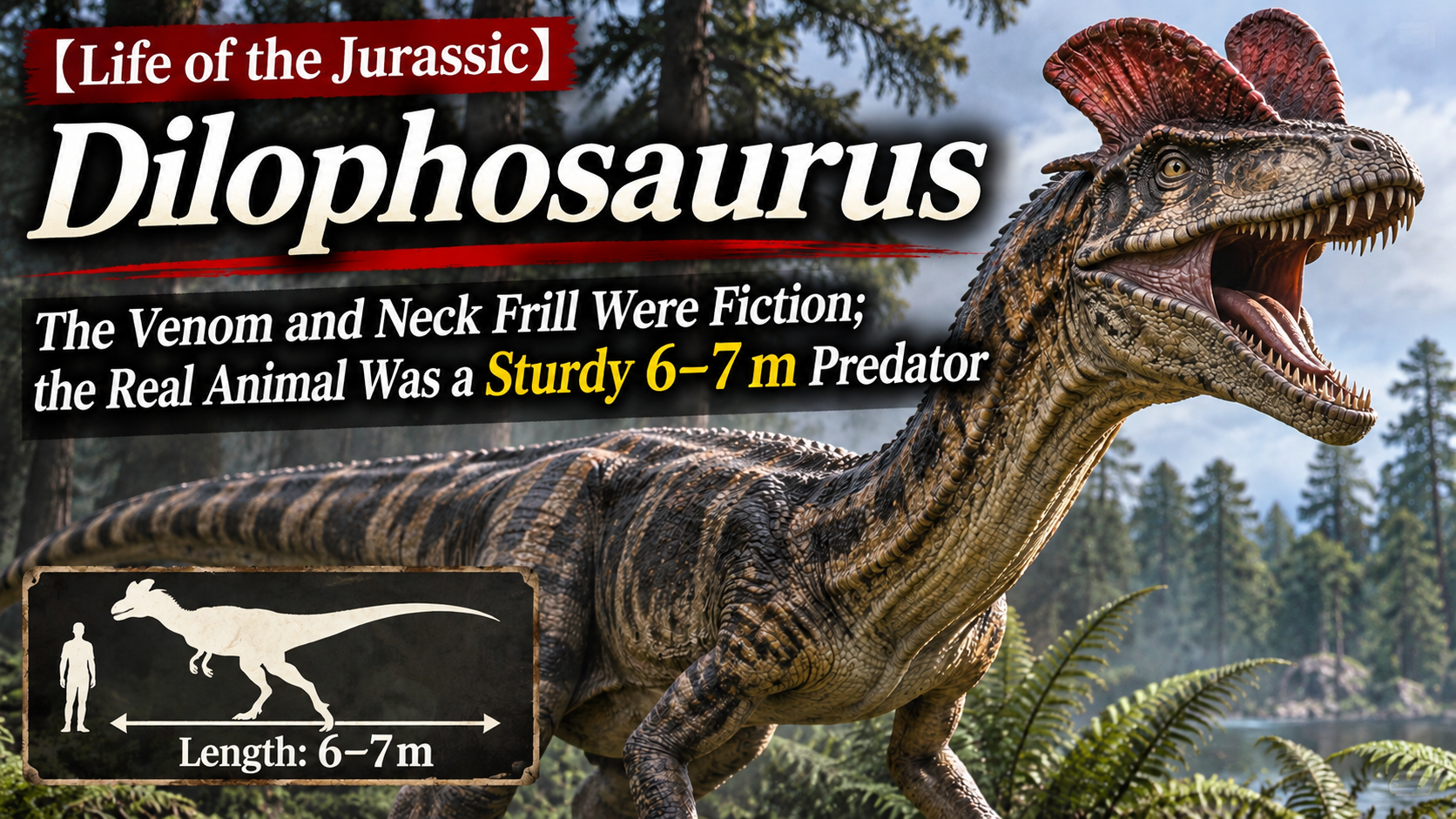
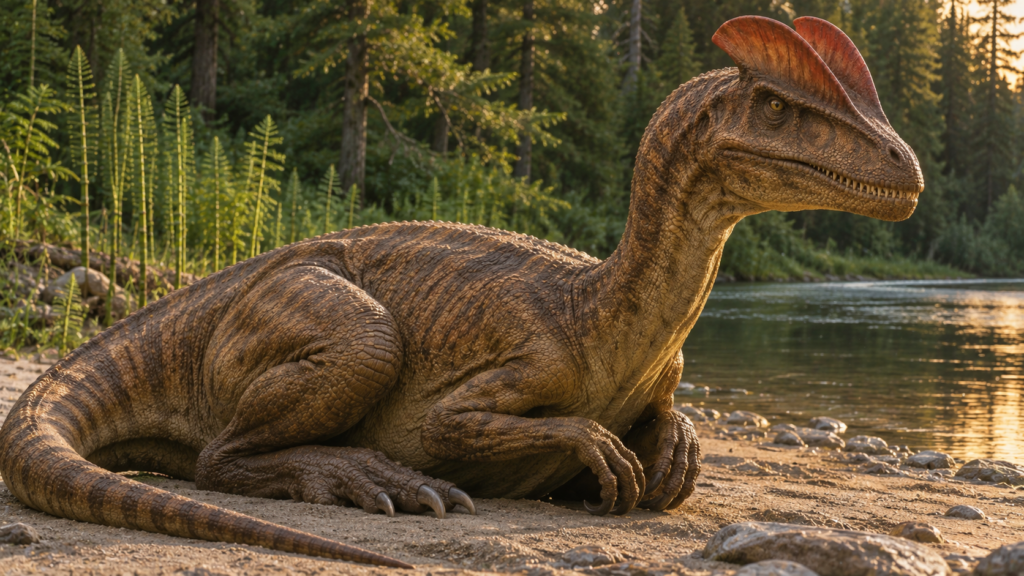
Dilophosaurus was a meat-eating dinosaur that lived in North America in the Early Jurassic. On top of its head stood two thin, plate-like crests running in parallel. At 6–7 m long, it was the largest animal known from the land of North America at that time. In the film Jurassic Park it appears as a small dinosaur that spits venom and spreads a frill around its neck, but that version was not reconstructed from fossils.
Appearance and way of life
Dilophosaurus was a theropod that walked on two hind legs. Its head was long and narrow, with a mouth full of sharp teeth. Its arms were powerful, with claws on the fingers, and a long tail balanced its body.
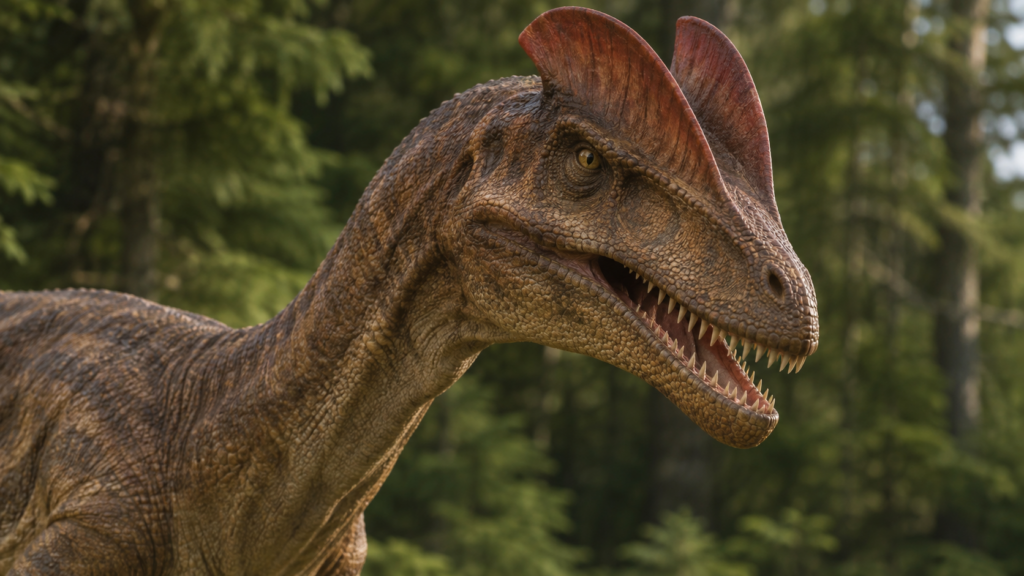
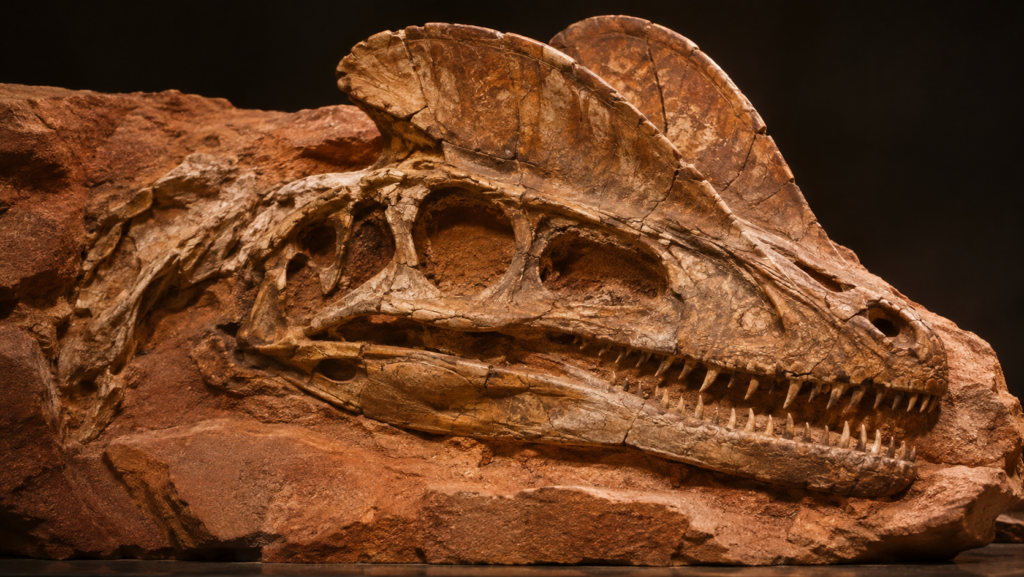
Its most striking feature is the pair of crests. In 2020, Adam Marsh and Timothy Rowe of the University of Texas at Austin re-examined all five known specimens and showed that the bones of the head, including the crests, were riddled with small air-filled chambers. These air spaces braced the thin crests from the inside. The crests were almost certainly covered in keratin or keratinized skin, and are thought to have been used for recognizing members of the same species or for display to mates. Whether the body was covered in feathers is not known.
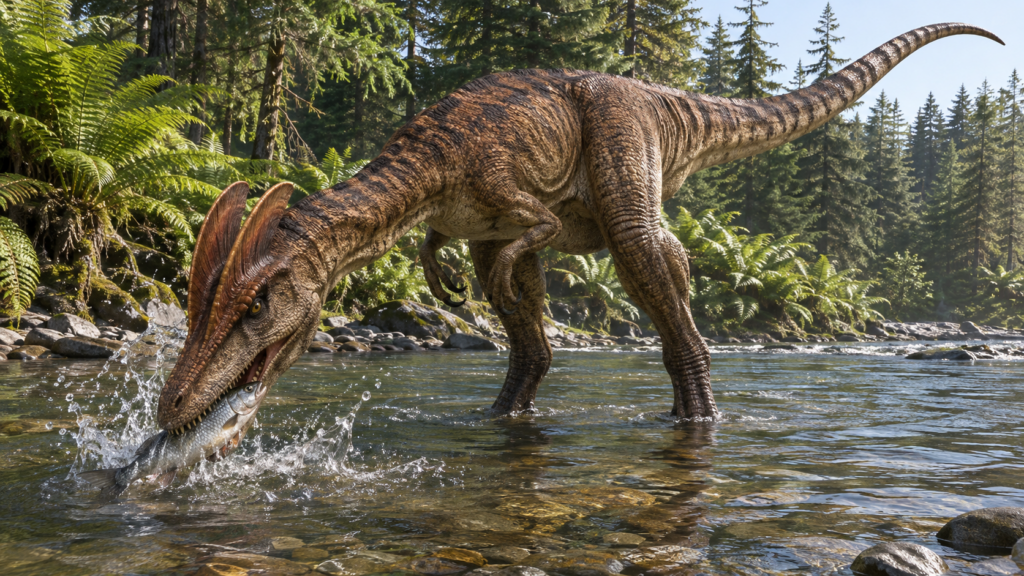
Dilophosaurus lived in a landscape crossed by rivers; the Kayenta Formation is made of the sand and mud those rivers laid down. The same rocks have also yielded Scutellosaurus, a small dinosaur with rows of little bony plates on its back; Sarahsaurus, a long-necked plant-eater; and the small meat-eater Megapnosaurus (Syntarsus). Sarahsaurus came from the same quarry as one of the Dilophosaurus specimens. Marsh and Rowe concluded that Dilophosaurus could grip and hold down large prey with its strong arms, and could also snatch fish and small prey from the rivers.
The individual behind the name-bearing specimen (the holotype) was injured many times during its life. A 2016 study found eight injuries or signs of disease in the bones of its shoulders and arms. The left shoulder blade and left forearm had healed fractures, and one forearm bone had healed with a bend of about 20 degrees. The left ulna showed signs of an infection that had entered through a puncture wound. The right upper arm bone was twisted about 35 degrees more than the left, and the third finger of the right hand was deformed so that it could not bend. Even so, this animal survived for months, and probably years, after its injuries.
Traces left by a dinosaur shaped much like Dilophosaurus have also been found. In rocks about 198 million years old at St. George, Utah, a theropod left the mark of where it crouched down to rest. Along with impressions of the feet, tail and the pad under the hips, the hand prints show the palms facing inward toward each other, revealing that theropods held their hands in the same orientation as birds. The researchers say Dilophosaurus is just the right size to have made the trace, but no bones of Dilophosaurus itself are known from rocks of that age.
Where the movie version came from
The first bones were found in 1940 by Jesse Williams, a Navajo man, on Navajo Nation lands in northern Arizona. In 1942, Sam Welles of the University of California Museum of Paleontology and his colleagues dug up the bones of two individuals there. In 1954, Welles described them as a new species of Megalosaurus. The crests came to light later: the skull of a larger individual that Welles collected in the same area in 1964 preserved both of them. In 1970 Welles renamed the animal as a new genus, Dilophosaurus.
The first skeleton was assembled with missing parts of the bones filled in with plaster. The 1954 description did not clearly distinguish which parts were real bone and which were plaster, and that ambiguity caused confusion for a long time. The joint between the bone at the tip of the upper jaw and the bone behind it was originally thought to be weak.
In 1990, the novelist Michael Crichton had Dilophosaurus spit venom in his novel Jurassic Park. It was an invention, meant to show that a resurrected dinosaur could be dangerous in unexpected ways. For the 1993 film, Steven Spielberg and his production team added a frill that spread around the neck, on top of the venom, and made the animal much smaller than the real thing. No fossil shows any trace of a venom organ or a frill.
Marsh and Rowe’s 2020 study went through the five specimens one by one and redescribed them, separating the plaster from the bone. The joint at the tip of the upper jaw turned out to be far sturdier than first assumed. The jaws bear traces of powerful muscles, and with its strong arms, this was an animal built to hunt large prey. The crests, too, were bone reinforced by air chambers.
Related products
You can find books and products related to this article on Amazon.
If you buy through the links above, this blog may earn a commission.
About the images
The images in this article are illustrations created with AI (ChatGPT), and you are welcome to use them. If you do, we would appreciate a link back to this article as the source.
Sources
Marsh, A. D. & Rowe, T. B. (2020). A comprehensive anatomical and phylogenetic evaluation of Dilophosaurus wetherilli (Dinosauria, Theropoda) with descriptions of new specimens from the Kayenta Formation of northern Arizona. Journal of Paleontology 94(S78), 1–103. https://doi.org/10.1017/jpa.2020.14
Senter, P. & Juengst, S. L. (2016). Record-Breaking Pain: The Largest Number and Variety of Forelimb Bone Maladies in a Theropod Dinosaur. PLoS ONE 11(2), e0149140. https://doi.org/10.1371/journal.pone.0149140
Milner, A. R. C. et al. (2009). Bird-Like Anatomy, Posture, and Behavior Revealed by an Early Jurassic Theropod Dinosaur Resting Trace. PLoS ONE 4(3), e4591. https://doi.org/10.1371/journal.pone.0004591
ScienceDaily (University of Texas at Austin news release, July 7, 2020) https://www.sciencedaily.com/releases/2020/07/200707183920.htm
National Geographic, Jurassic Park got almost everything wrong about this iconic dinosaur https://www.nationalgeographic.com/science/article/jurassic-park-got-almost-everything-wrong-about-iconic-dinosaur-dilophosaurus
Natural History Museum, Dino Directory: Dilophosaurus https://www.nhm.ac.uk/discover/dino-directory/dilophosaurus.html

コメント