
This article contains affiliate links. As an Amazon Associate I earn from qualifying purchases.
The summer of 2026 was a record-breaker for France. Between mid-June and mid-August, the country logged 52 “heatwave days,” the most since records began. Wildfires broke out across the country, and more than 7,300 excess deaths have been attributed to the heat.
That heat reached Giverny, a small village in Normandy about 80 km northwest of Paris. This is where the Impressionist painter Claude Monet lived for 43 years, from 1883 until his death in 1926, in a house with a garden he built himself: the water lily pond, the Japanese-style arched bridge, the wisteria. He spent those decades painting the flowers that grew there. The garden is still maintained by a foundation today and draws hundreds of thousands of visitors a year. This summer, its flowers died.
A Garden 43 Years in the Making
The garden at Giverny has two main parts: the “flower garden” (the Clos Normand) in front of the house, and the “water garden” across the road.
When Monet moved in, the land was essentially a working plot, planted with vegetables, herbs, and cider apple trees. He liked the gentle slope and the good exposure to the sun, and little by little he turned it into a flower garden. In 1893 he bought an adjoining piece of land, dug a pond, and planted water lilies in it. That pond would go on to produce roughly 250 paintings in his Water Lilies series.
By his own account, he did not plant the lilies intending to paint them. He simply grew them, until one day he suddenly noticed “these wonders on my pond,” picked up his brush, and hardly painted anything else for the rest of his life.
The garden has another defining feature. Rather than relying on flowers that bloom for months, it uses short-lived ones that flower for only a few weeks, planted in huge numbers and staggered so that one wave follows another: tulips in spring, irises and peonies in early summer, dahlias and sunflowers in high summer. The color of the whole garden changes with the season. The garden itself was planned like a painting.
The Nasturtiums Went First
In the flower garden this summer, the first to fall were the nasturtiums.
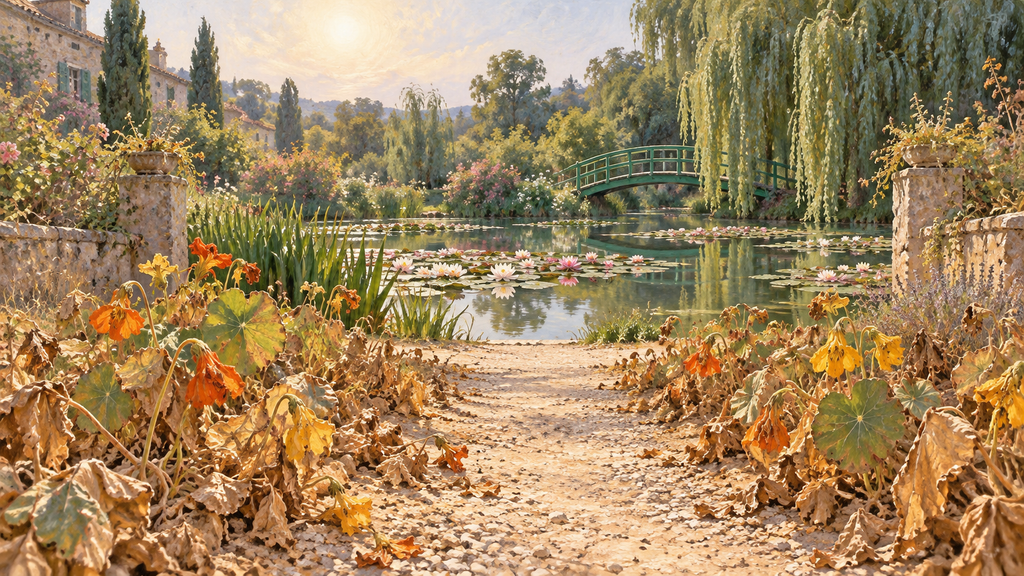
Nasturtiums are the round red, orange, and yellow flowers you find in almost any garden center. At Giverny they line both sides of the central path that runs straight out from the front of the house. In summer they sprawl across the gravel until visitors have to wade through the blossoms. It is one of the garden’s signature sights.
This year, the nasturtiums along that central path died in their entirety. Deputy head gardener Rémi Lecoutre showed French reporters the beds that should have been buried in flowers and called it “incredibly sad” and “the first time it has happened to this extent.” Lecoutre joined the foundation as a seasonal worker in 1988 and has watched over the garden ever since. This is the man saying “first time.”
The nasturtiums were not the only casualties. As Lecoutre explained, plants have a physiological response to heat: when temperatures climb too high, they close the stomata on the undersides of their leaves, the tiny openings that let water and air in and out, and they stop flowering. The result was wilted blooms all over the garden, and in some places scorched foliage.
The Water Lilies Shrugged It Off
One flower, however, barely noticed the heat: the water lilies.
The flower that defines Monet’s garden, the one he painted more than any other, came through the heatwaves almost untouched. Several outlets reported that the lilies were “largely unaffected” and even “thriving.”
In a way, that makes sense. Water lilies root underwater. Pond water does not heat up as fast as the air, and it does not dry out. While the plants in the soil were suffering from drought and high temperatures, the lilies were sitting in water the whole time. They are also warm-season flowers to begin with, the kind that decorate summer ponds in Japan too. Heat in itself does not bother them.
So the star of Monet’s paintings stood firm, and the supporting cast that set the star off went down first. That is what happened at Giverny this year.
The gardeners did not just stand and watch. The team of eleven grouped plants closely together to cut evaporation from the soil, combined fine-mist mini sprinklers with underground irrigation that delivers water from below, and watered the weakest plants at night, when lower temperatures mean less evaporation and more water reaching the roots. According to the foundation, the automatic nighttime watering worked well. Even so, the nasturtiums on the central path could not be saved. They will be replanted and should bloom again next year.
Between the Flowers Monet Knew and the Flowers That Can Take the Heat
The hard part comes next.
If summers keep getting hotter, the standard gardening answer is to phase in heat-tolerant varieties. The Giverny team has started looking into that. But this is not an ordinary garden. In Lecoutre’s words, as a historic garden, its plants should stay as close as possible to the ones Monet would have known.
The colors Monet saw, the shapes of the flowers he painted: preserving those is the reason the garden exists. Swap in flowers that did not exist in his time just because they can take the heat, and the garden survives but stops being Monet’s garden. Insist on the flowers of his era, and you may watch them die every summer.
At the same time, Lecoutre has also said that this is “not a museum garden, but truly a space that evolves with its time.” Monet himself never froze the garden in place during his 43 years there; he planted and replanted, dug and expanded, over and over. The garden visitors see today was restored from the 1970s onward, after it had fallen into ruin following his death, and it is not an exact copy of what he left. Seen that way, adjusting the garden to a hotter climate may not be so unusual in its history after all.
2026 marks 100 years since Monet’s death, and this autumn the Musée de l’Orangerie and the Musée Marmottan Monet in Paris are each opening commemorative exhibitions. The flowers a painter captured a century ago withered in the heat a century later, while the lilies in his pond kept blooming as they always have. Standing in front of the Water Lilies in a gallery, it may be worth sparing a thought for the garden outside the frame, where the story is still going on.
Related products
You can find books and products related to this article on Amazon.
If you buy through the links above, this blog may earn a commission.
Sources
Monet’s gardens in Giverny suffer damage from record heatwaves (ARTnews, August 20, 2026)
Heatwaves in France Damage Beloved Flowers at Monet’s Gardens (Hyperallergic, August 20, 2026)
Mainland France has endured a record 52 heatwave days since mid-June (Le Monde, August 19, 2026)


コメント