This article contains affiliate links. As an Amazon Associate I earn from qualifying purchases.
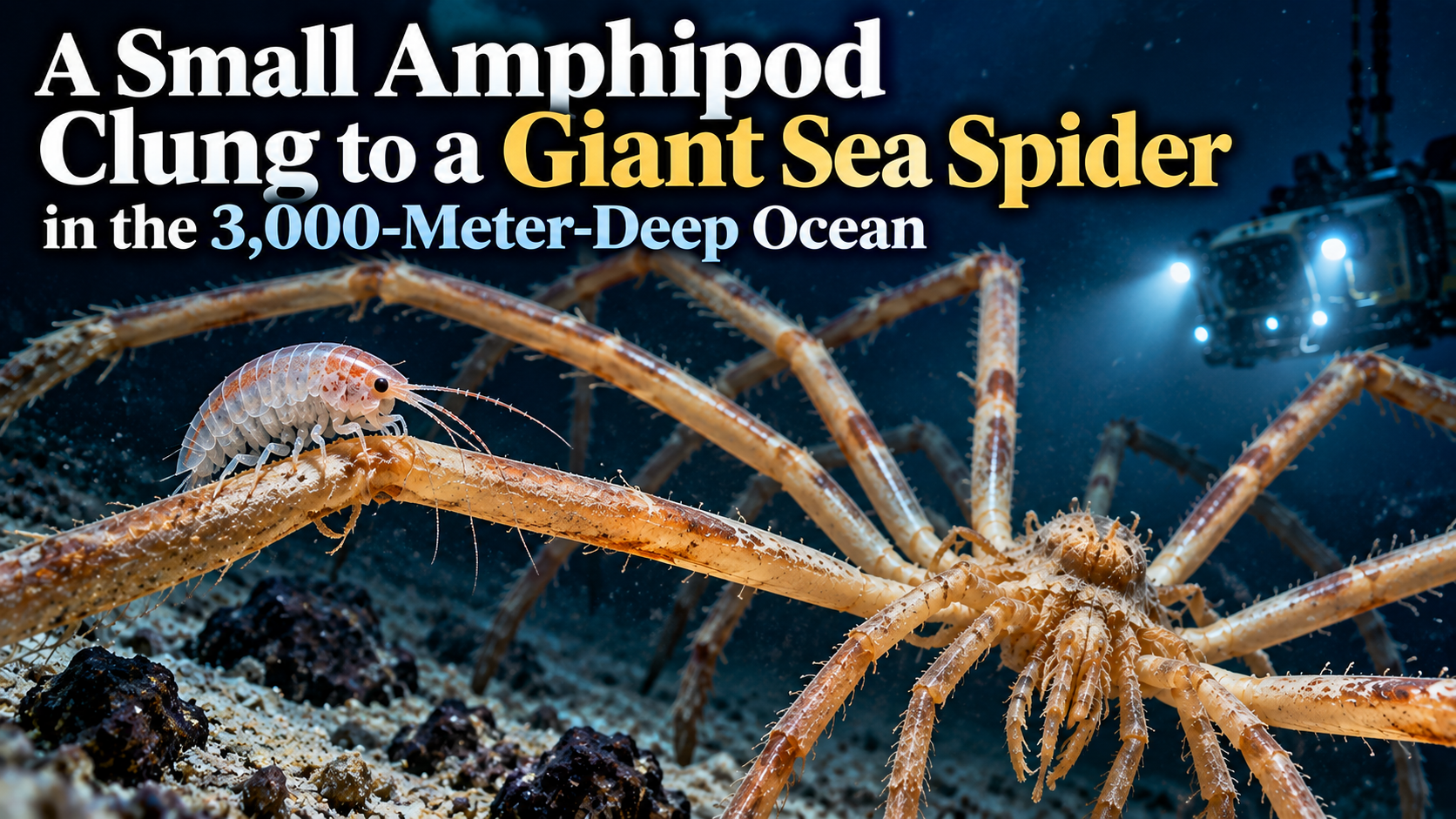
In November 2024, at a depth of 3,155 meters off the coast of Chile, the camera of a remotely operated vehicle picked out a single giant sea spider, the largest kind of sea spider known, with legs that can stretch tens of centimeters across. Clinging to those long, thin legs were three small crustaceans.
One deep-sea animal riding on another might have been written off as a curious one-off. But four days later, some 225 kilometers away, the same pairing turned up again on camera. A short paper documenting the two encounters, by a team from Chile, Portugal, Germany and the United States, appeared in the journal Ecology in September 2026.
A Giant Sea Spider That Is Mostly Legs, and an Amphipod That Cannot Swim Well
The vehicle in question was Colossendeis colossea. Despite the name, sea spiders are not spiders. They belong to a separate group of arthropods that live only in the sea. The body is tiny and the animal looks like little more than a bundle of legs, so much so that parts of the gut and reproductive organs extend into the legs themselves. Colossendeis colossea is the largest of them, with a leg span of up to about 70 centimeters. It has been found on deep seafloors between roughly 420 and 5,200 meters in every ocean except the Arctic.
Those long legs are not just for walking. The animal can spread them wide, catch a current and drift a considerable distance. In an ocean as vast as the deep sea, that counts for a lot.
The passengers were Mesopleustes abyssorum, an amphipod. Amphipods are the small, laterally flattened crustaceans you find under rocks at the shore, and the deep sea holds many species of them.
This particular amphipod has long presented a puzzle. It is not a strong swimmer, and it has no planktonic larval stage that currents could carry far and wide. In other words, it has almost no means of dispersing on its own, and yet it has been recorded in the Pacific, Atlantic, Indian and Southern oceans at depths from about 690 to 3,500 meters. The means of travel and the size of the range simply do not match. There is even a lingering suspicion that what we call one species is really several look-alikes lumped together.
The Same Scene Repeated Four Days Later, 225 Kilometers Away
The observations were made by the Schmidt Ocean Institute’s research vessel Falkor (too) and its remotely operated vehicle SuBastian, during a 55-day cruise from October to December 2024 that surveyed submarine canyons and methane seeps along the Chilean margin.
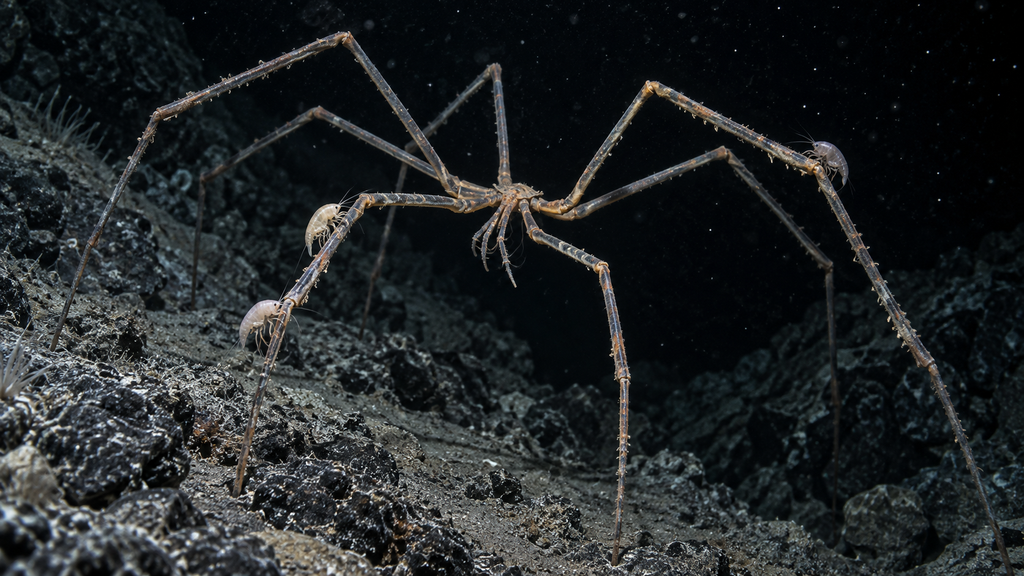
The first encounter came on November 24, in a steep, rocky submarine canyon at 3,155 meters. Three amphipods were attached to the sea spider: two larger individuals on the sensory and reproductive appendages near the front of the body, and a smaller one farther back on a walking leg.
Had it ended there, it would have been one odd photograph. But four days later, about 225 kilometers away and 2,698 meters down, another Colossendeis was walking across the seafloor, and two amphipods were riding on its legs too.
And the way they were holding on was anything but casual. The amphipods gripped the sea spider’s legs with long, claw-like structures at the tips of their own limbs, and they stayed attached even after the animals were collected and brought up to the ship. This did not look like accidental contact.
The identity of the riders is just as interesting. In both encounters, the two larger amphipods sitting together near the front were a male and a female. The third animal in the first encounter was a female carrying eggs. For tiny animals scattered across the deep sea, finding each other is no small task. The team suggests that the sea spider may be more than a ride: it may serve as a mobile meeting point where widely dispersed amphipods can come together and breed.

A Record Left Behind Only Once, a Century Ago
There is, in fact, a precedent for this pairing. In 1927 the French carcinologist Chevreux reported that this amphipod had been found attached to Colossendeis colossea. But the note was brief, with no photograph or drawing, and it drew almost no attention in the century that followed.
The new observations confirm that old note with living animals, twice, at two separate sites. The team thinks the association may be common and widespread in the waters off Chile.
Phoresis: Getting Around by Hitching a Ride
When one animal uses another as a vehicle, the relationship is called phoresis. A familiar example is a mite clinging to an insect to be carried somewhere new. The researchers think this amphipod may be doing the same thing with sea spiders. A poor swimmer that climbs onto the legs of an animal that rides the currents could travel distances it could never cover alone, and that offers one answer to the puzzle of its oversized range.
Transport may not be the only benefit. The team also lists reaching food in a region where it is scarce, getting away from predators on the seafloor, and finding a mate as possible advantages of riding along.
Still, there are only two observations so far. The paper itself acknowledges that chance contact cannot be ruled out. Nor is it clear whether the amphipods seek out sea spiders in particular or simply grab whatever suitable structure happens to be nearby. More observations on the seafloor, population genetics, and studies of what the amphipods eat will, the authors write, help clarify what this relationship really is.
Deep-sea animals live where both food and partners are hard to come by. In such a place, the simple act of holding on to a leg may matter a great deal for survival.
Related products
You can find books and products related to this article on Amazon.
If you buy through the links above, this blog may earn a commission.
Sources
- Pérez‐Schultheiss, J. et al. (2026). Hitch‐hiking in the deep sea: Amphipods embrace sea spiders in the Southeast Pacific Ocean. Ecology, 107(9), e70443. https://doi.org/10.1002/ecy.70443
- ScienceAlert: Strange Creatures Seen Riding Giant Sea Spiders in The Midnight Ocean (September 16, 2026) https://www.sciencealert.com/strange-creatures-seen-riding-giant-sea-spiders-in-the-midnight-ocean
- Phys.org: Deep-sea crustaceans caught hitching rides on giant sea spiders (September 2026) https://phys.org/news/2026-09-deep-sea-crustaceans-caught-hitching.html
- Schmidt Ocean Institute: Scientists Document Rich Biodiversity Along Underexplored Chilean Coastline https://schmidtocean.org/scientists-document-rich-biodiversity-along-underexplored-chilean-coastline/
コメント