This article contains affiliate links. As an Amazon Associate I earn from qualifying purchases.
In October 2021, a three-year-old female African wild dog left her pack in South Luangwa National Park, in eastern Zambia, together with two of her sisters. The research team tracking her knew her as EWD-1355. Wild dogs live in packs where, as a rule, only one male and one female breed. Everyone else either waits for a turn at the top or leaves to look for a breeding opportunity elsewhere. A set of three-year-old littermates walking out together was nothing unusual.
What came next was. The sisters climbed and descended the wall of the Great Rift Valley again and again, crossed major rivers and highways, and walked into Mozambique and back. They covered more than 2,300 km. Along the way they reached the home range of a large pack in Lower Zambezi National Park, but they neither joined it nor lured any of its males away. In June 2022, EWD-1355 died in a wire snare set for bushmeat.
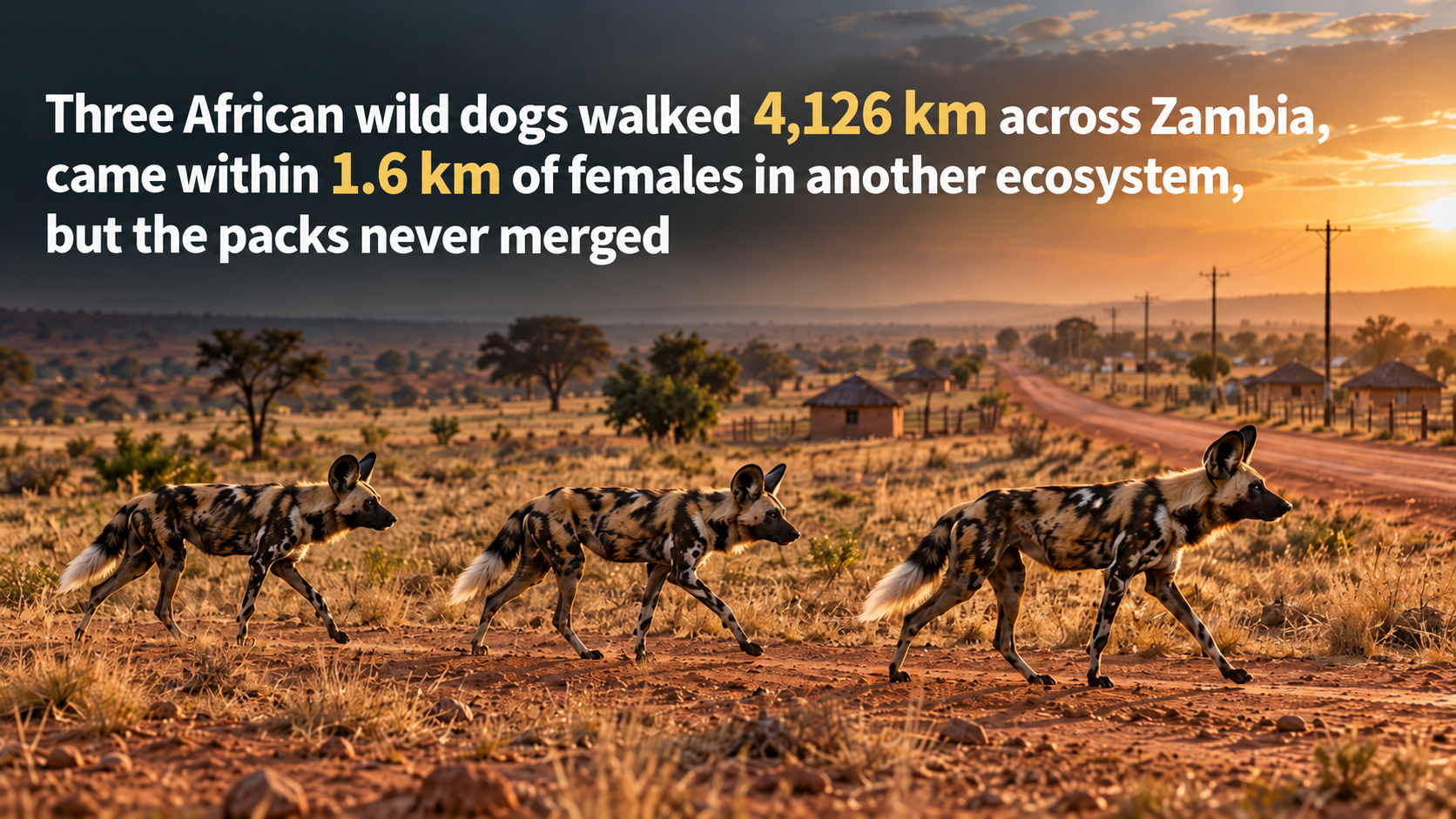
Scott Creel of Montana State University and the Zambian Carnivore Programme, which has been studying large carnivores in Zambia for years, kept following GPS-collared wild dogs on long journeys after that. In September 2026 they reported the results in the journal Ecology, including a record-breaking trek of 4,126 km. The record itself is striking. But the real point of the paper is that being able to walk somewhere and being able to connect with the dogs living there turned out to be two different things.
Seven Three-Year-Olds Leave Kafue
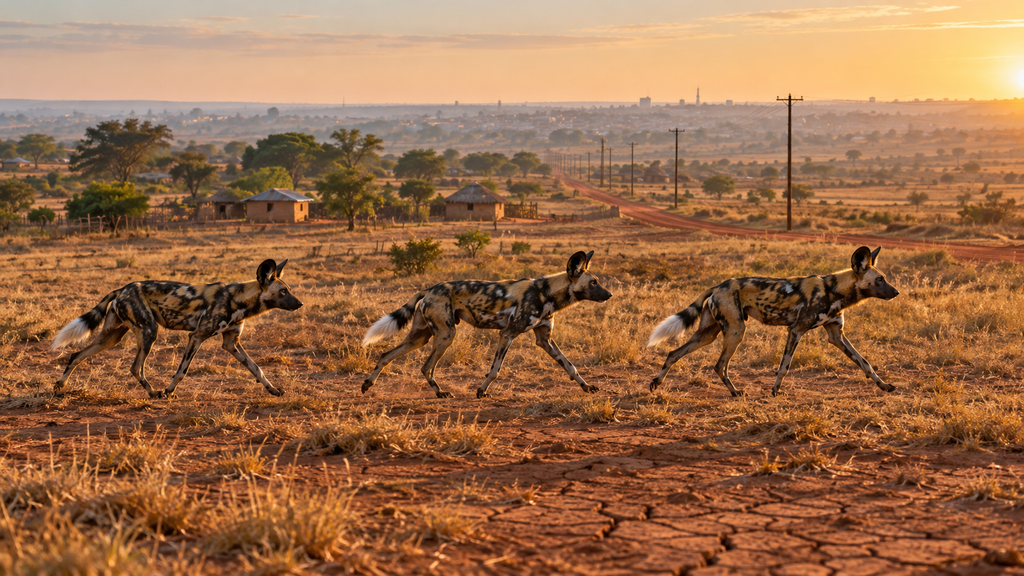
The setting is Kafue National Park in west-central Zambia. In July 2025, four three-year-old females left the park’s Mayukuyuku pack. Two weeks later, three three-year-old males from the same pack followed. The pack held 18 adults and yearlings at the time, and the seven dispersers were part of a cohort of 19 pups born in the same year that had all survived to adulthood. With that many same-aged siblings in a large pack, their chances of ever breeding at home were slim. Their departure was expected.
The females, soon down to three, spent several weeks roaming a buffer zone next to their natal range. The males headed east, out of protected land altogether. Central Zambia carries a heavy human footprint, and there is no obvious single route linking Kafue to the protected areas further east.
The collar data show both groups reaching the outskirts of cities with populations in the hundreds of thousands: Kabwe, Kitwe and Ndola. Each time, the dogs turned back the way they had come. After pushing north as far as Ndola, the males retraced their own track almost exactly for 200 km to the south.
A Reunion After 1,200 and 1,400 km
On 18 and 19 September, the brothers and sisters, who had been moving independently, met again in unprotected land 72 km from Kitwe and 78 km from Ndola. By then the females had walked 1,404 km from their natal range and the males 1,203 km. Wild dogs are remarkably good at finding one another by scent, a skill honed by the need to regroup silently after a hunt scatters the pack, and it seems to have served them here.
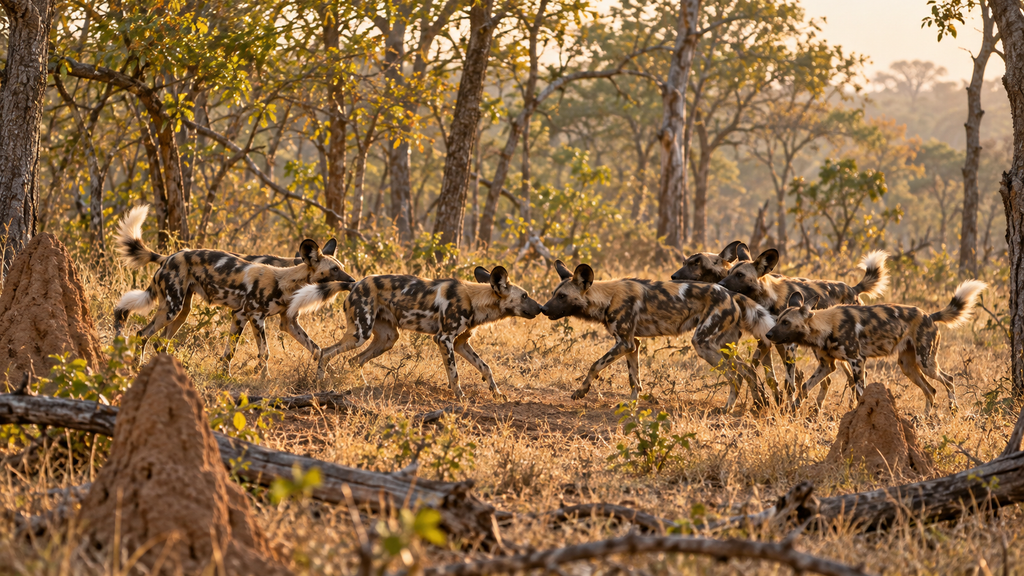
The two groups parted after a single day. On 10 October the sisters arrived in a small patch of forest near Kabwe, and there their journey stopped, at 1,899 km. The collared female began moving back and forth between one fixed spot and the surrounding area, a pattern wild dogs show only when they have newborn pups that cannot travel, or when they keep returning to an injured packmate. The patch was full of active snares at the time. The team concluded that one of the uncollared sisters had been snared and that the others would not leave her. On 23 October the collared female died as well, and her collar was later found cut off with a knife. The fate of the last sister is unknown.
Within 1.6 km of Females from Another Ecosystem
After leaving their sisters, the three males doubled back south. They avoided the Great North Road, which links the capital, Lusaka, with the industrial cities of the Copperbelt, and followed the same route they had used going north. On reaching Kabwe for the second time they found a way around it to the east. They then ran into two large reservoirs, each uncrossable for 20 to 30 km, skirted both, and kept going east. On 9 November they entered the Chisomo and Petauke game management areas. This land is well connected to South Luangwa National Park and belongs to the Luangwa Valley ecosystem, home to one of the largest and densest wild dog populations on the continent.
On 14 November the brothers were within 14 km of four females that had dispersed from the Kasweta pack in South Luangwa. Over six days, the two groups’ paths came within 1.6 km of each other. The females had walked 1,538 km and the males 2,356 km, from natal ranges 546 km apart in a straight line. Zambia’s two stronghold populations, Kafue and the Luangwa Valley, had just been linked by a single set of males on foot.
And yet the two groups did not stay together. The Kasweta females remained in the game management area, possibly with other males, and within days the brothers moved 107 km to the southwest into unprotected land. As of 1 April 2026 the males had covered 4,126 km in total and settled into a new range in the Luano game management area, at the top of the Great Rift escarpment. For wild dogs, that beats the previous record of 3,892 km, set by dogs that walked from the Serengeti ecosystem to Tsavo West National Park in Kenya.
9,863 km Walked, Almost No Connection Made
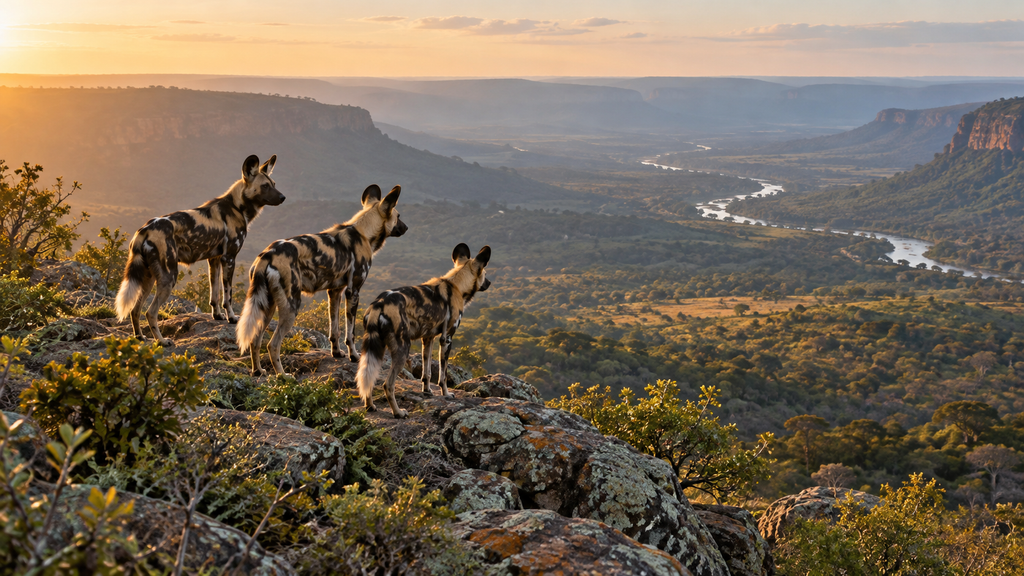
At this point the paper lines up four journeys: the sisters of EWD-1355, the Mayukuyuku brothers, the Mayukuyuku sisters and the Kasweta females. Together they add up to 9,863 km. Interstate 90, which crosses the entire United States, is 4,860 km long, so this is roughly twice that. Even so, these four movements produced almost no genetic or demographic connection between populations.
The reason lies in wild dog society. When wild dogs meet strangers, they usually fight, and the fights are often fatal. Joining another pack is difficult, dangerous and frequently fails. Arriving is only half the battle.
Recent research tends to treat dispersal, the process of leaving a natal group and settling somewhere else, as a matter of environmental conditions such as vegetation, roads and human settlement. Creel and his colleagues agree that this view is useful, but they stress that dispersal is fundamentally a social process. Dispersing dogs do favour passable terrain, but what they are looking for is not land. It is other wild dogs. Unless the conditions that push animals out of one pack line up with the conditions that let them into another, no amount of walking connects two populations.
Built to Cross Human Land, Defenceless Against Snares
There is an evolutionary reason wild dogs can cover such distances through human-dominated country. Among Africa’s large carnivores they are the underdogs, outcompeted by lions and spotted hyenas, and they have evolved to move fast and straight to get away from them. In an earlier GPS study by the same team, wild dogs outside protected areas moved at 1.7 times their average speed inside protected areas, with turning angles 2.4 times smaller, in nearly straight lines. The pattern closely resembles how they move after an encounter with lions. The team’s hypothesis is that land full of people registers as just another kind of land full of dangerous competitors, and the dogs cross it the same way.
None of that helps against wire snares. A snare lies hidden on a game trail in the vegetation, makes no sound, carries almost no scent, and resembles nothing dangerous in the natural world. Even dogs that survive being snared may not learn to avoid them; one individual is on record as having been caught four times. And because wild dogs refuse to abandon an immobilised packmate, a single snare can take several of them.
The paper does not end on a bleak note, though. The long-distance movements the team has observed link seven of Zambia’s national parks, confirming on the ground what genetic data had already suggested: none of the country’s wild dog populations is isolated. Similar journeys have been recorded in Tanzania, Botswana and Zimbabwe, and most wild dog populations across eastern and southern Africa may still be connected. Some 40 percent of Zambia has some form of wildlife protection, and some corridors, notably along the Luangwa Valley, are protected. Others, like the route east from Kafue, are not. The team puts the protection of corridors between stronghold populations at the top of the list for wild dog conservation.
Because African wild dogs are endangered, the raw collar data have not been published; the tracks are shown in the paper’s figures and videos. Which pack, if any, the three brothers are now living with at the end of their 4,126 km has yet to be confirmed.
Related products
You can find books and products related to this article on Amazon.
If you buy through the links above, this blog may earn a commission.
Sources
- Creel, S., Matsushima, S., Mwape, H., Mayani-Nkhoma, B., Banda, K., Goodheart, B., Reyes de Merkle, J. et al. (2026). Extraordinary movements connecting distant ecosystems by African wild dogs (Lycaon pictus). Ecology, 107(9), e70504. https://doi.org/10.1002/ecy.70504 (open access; full text also on Europe PMC)
- Smithsonian Magazine (16 September 2026): Three Wild Dogs Made a Record-Breaking Trek Across Zambia, Traveling More Than 2,500 Miles in Search of Mates
- The Conversation Africa (September 2026, by Scott Creel, republished on AllAfrica): 3 African Wild Dogs Travelled Over 4,000km to Find Mates – Why That’s Good News for the Endangered Species

コメント