This article contains affiliate links. As an Amazon Associate I earn from qualifying purchases.
A note before we start: this article was written with the help of Claude, an AI model. The work described here comes from a different lab and a different kind of model, but since the piece is about what AI can and cannot do, it seemed fair to say so up front.
When a cargo ship or crew capsule approaches the International Space Station (ISS), the last few hundred meters still rest on human eyes and on control procedures refined over decades. Position and velocity are estimated with a Kalman filter (a method that nudges a running estimate toward each new sensor reading), a camera picks out the target, and the vehicle follows a fixed corridor at a fixed pace. It is reliable. It is also rigid: send the same vehicle to a different port on the far side of the station, and much of the procedure has to be rebuilt.
A preprint posted in September 2026 by a Stanford University team led by Duncan Eddy and Mykel Kochenderfer brings a different idea to this problem: a “world model.” Instead of hand-written rules, the capsule learns how it moves in space and how the view from its camera changes, then tries out many possible futures in its head before committing to a move. The team calls the model Out-of-this-World-Model. Everything happened in simulation, but the results had a twist worth telling.
Many Futures, Tried Before Moving
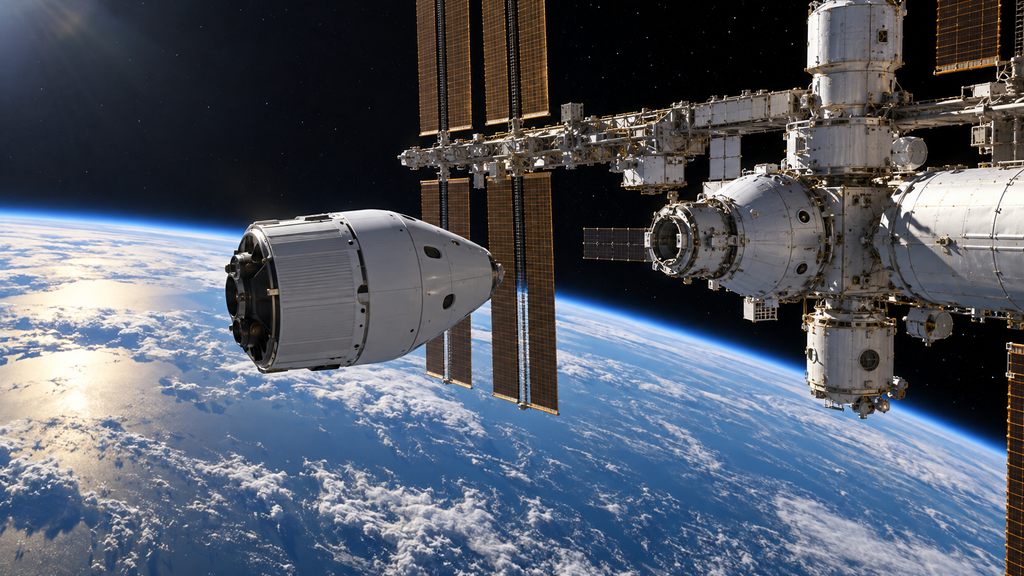
A world model is an AI’s internal model of “what happens to the world if I do this.” The idea took off in research that predicts the next frame of a video game from the current one, and it is now finding its way into robotics. This model takes in the capsule’s position, velocity and attitude as numbers, plus images from a nose-mounted camera, and predicts where the capsule will be and what it will see a few seconds after a given burst of its thrusters (the small rockets used to adjust position and attitude). Under the hood it is a transformer, the same kind of architecture as a language model, with about 6.4 million learned parameters. Next to the large models used for image generation, that is tiny.
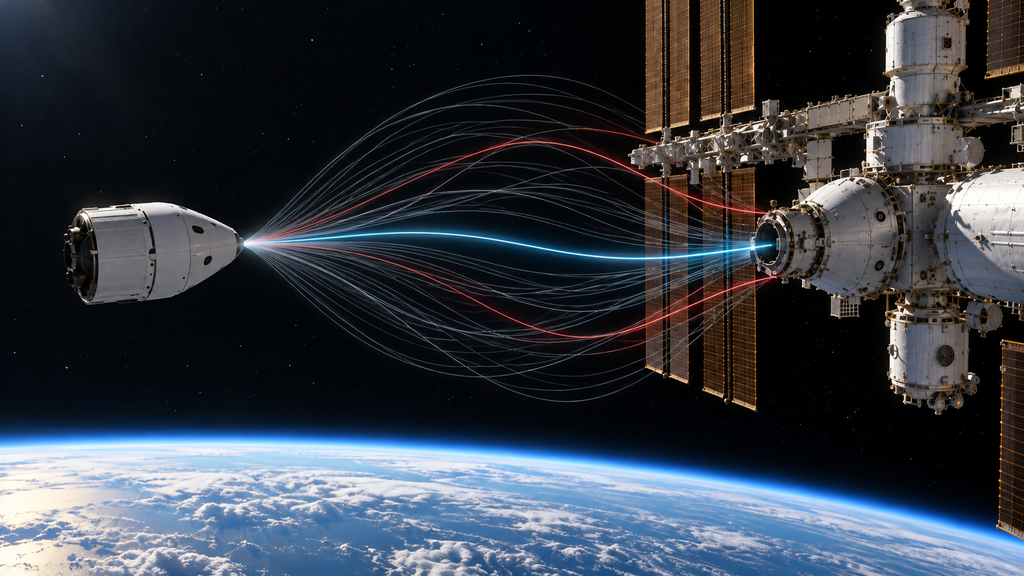
Here is how the capsule uses that prediction. From its current state it imagines 128 candidate sequences of thruster commands, rolls each one 64 steps into the future, weights the candidates that get close to the port without touching the station, averages them, and executes only the first 8 steps. Then it imagines 128 new candidates. Repeating this, it creeps toward the port. When the press described this as teaching spacecraft to “dream,” they meant this part, the rolling out of futures in the model’s head. The paper itself calls it a step toward spacecraft that reason about the consequences of their actions before executing them.
One more property matters here. The model’s predictions come with a degree of confidence. Rather than committing to a single future image, it outputs a spread of possibilities, so when the real view disagrees with the prediction, the model can tell that something it does not know about is happening. That property turns out to have an unexpected use later on.
Half a Million Flights, Generated in Six Hours
The weakness of world models is their appetite for recorded experience. For a spacecraft, you cannot collect that with the real thing. So the team wrote its own orbital-mechanics library, AstroJAX, which runs the physics of a spacecraft (gravity, atmospheric drag, the pull of the Sun and Moon, solar radiation pressure, rotational dynamics) in many parallel copies on a GPU. The station is a NASA-derived 3D model in its February to May 2015 configuration. A camera on the capsule’s nose has an 82-degree field of view, and the scene it sees, including the textured Earth, the starfield and the changing direction of sunlight, is rendered at 20 frames per second.
The capsule is a Dragon-class vehicle weighing 12 tonnes. Each attempt starts 100 to 225 meters from the station with a 360-second limit. The station’s structure is wrapped in 313 boxes that count as keep-out zones, and drifting more than 750 meters away counts as an escape and ends the attempt. In this environment, a mix of three behaviors (random motion, circling the station, and heading for a port) generated 500,000 recorded state transitions in about 6 hours on a single NVIDIA H100 GPU. Training the model on that data took about 24 hours.
Five ports appear in the training data: Harmony forward, Harmony nadir, Zvezda aft, Pirs nadir and Rassvet nadir. The remaining three, Harmony zenith, Poisk zenith and Unity nadir, never appear. They were held back deliberately, to test whether the model could reach a port it had never seen.
The Rival: Reinforcement Learning With 25 Million Practice Steps
The comparison was against PPO, a standard reinforcement learning method (one that learns behavior by being rewarded when things go well). It trained inside the same simulator, running 32 environments in parallel for a total of 25 million steps of trial and error. The world model learned from 500,000 transitions, so in sheer experience the gap is fifty to one. The reinforcement learning side also got some help so that the docking reward could reach it: a slower control rate, a softened keep-out zone, and an extra reward term for closing distance. The paper is explicit that this single method is its only baseline.
Each port was tried 50 times, and an attempt counted as a success if the capsule came within 1 meter of the port without ever touching the structure. On the five training ports the world model succeeded 61% of the time versus 36% for reinforcement learning. The breakdown is telling. The world model reached Harmony forward 76% of the time and Zvezda aft 70% of the time, two ports where the reinforcement learning policy stalled 10 to 12 meters out and never arrived. Reinforcement learning, for its part, reached the three downward-facing ports at 68%, 60% and 52%.
At Unseen Ports, Reinforcement Learning Ran Away
The biggest difference showed up at the three ports absent from training. Given nothing but the target port’s position and orientation, the world model reached Unity nadir 48% of the time, Poisk zenith 42% and Harmony zenith 30%. Reinforcement learning reached only Unity nadir (50%) and never once reached either zenith port. Unity nadir is approached from below, like the Pirs and Rassvet ports it had trained on, so it fell within the shapes it already knew. The zenith ports resembled no approach it had ever practiced.
Look at what happened on the failed attempts and the picture sharpens. At the two zenith ports, the reinforcement learning capsule left the 750-meter operating zone in 88% of attempts. It drifted away before ever getting close. The world model’s capsule never once left the zone, at any of the eight ports. Pooled over all eight, the world model succeeded 53% of the time and reinforcement learning 29%; on the unseen ports alone it was 40% versus 17%, more than double.
The team reads it this way. Reinforcement learning transfers to a new situation only when it looks like one it has practiced. The world model has learned how motion and the camera view around the station actually behave, so whichever port it is pointed at, it can at least make the approach.
The Arrivals Are Still Rough
Some numbers that keep the result honest. The world model’s collision rate is higher than reinforcement learning’s: 39% on the training ports (versus 35%) and 60% on the unseen ports (versus 36%). There is a catch in that comparison, though. Reinforcement learning fled the zenith ports before getting close, so it had no chance to collide. The world model pressed a full approach every time, into the most cluttered parts of the station, and that is where it hit things. That is the team’s explanation.
And a real docking has conditions beyond position: within 10 centimeters of the port, slower than 0.5 meters per second, attitude within 5 degrees, rotation under 0.5 degrees per second. Under these strict conditions the ranking flips. Within 1 meter and meeting all four conditions, reinforcement learning managed 36% and the world model 13%. Within 10 centimeters it was 11% versus 3%. The world model gets to the port but arrives with its attitude and rotation not yet settled. Reinforcement learning, being slower, arrives squarely aligned.
The team attributes this gap to tuning effort rather than to the method. The reinforcement learning reward was reworked over many training runs to produce slow, well-pointed arrivals, whereas the world model’s cost function (what it prioritizes when choosing among candidate futures) received little tuning and favors avoiding collisions over arriving pointed. Weighting the final attitude and rotation terms more carefully should help, the paper argues, though this has not yet been tested.
Noticing Something It Had Never Seen
Finally, the use for that “degree of confidence” mentioned earlier. The team staged approaches in which another Dragon spacecraft, never present in the training data, was already docked right next to the target port. Within what it had learned, the world model predicts that nothing is there, so as the capsule closes in, prediction and reality diverge and the model’s confidence score drops. With a threshold on that score, it distinguished the 20 approaches with an unexpected neighbor from the 25 without one with 98% accuracy.
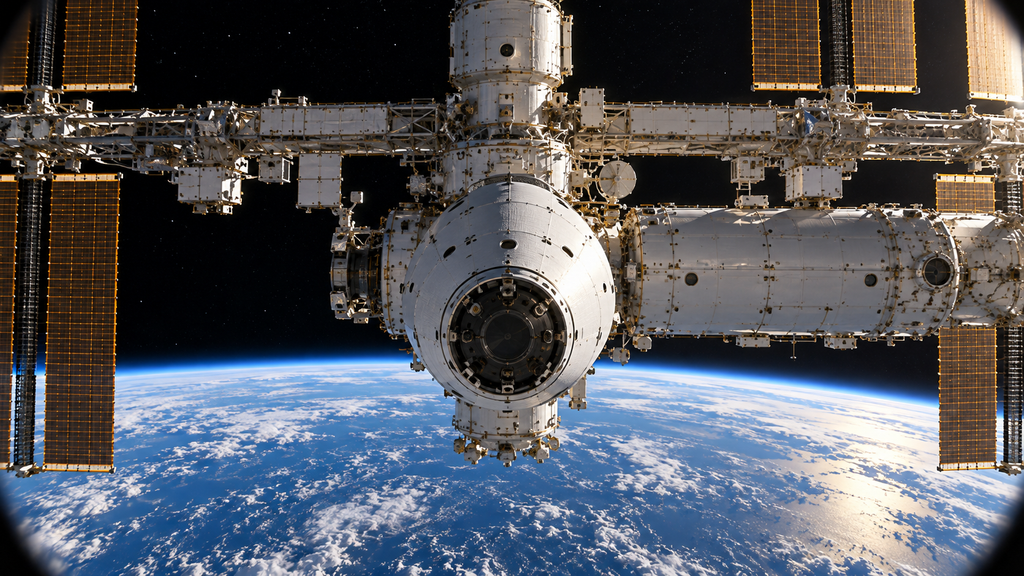
No separate anomaly detector was bolted on. The prediction learned for docking doubles as a “something is off” signal. The team plans to use it to ease off the approach when the score falls, as a way of cutting collisions, and to apply the same idea to spotting unusual behavior in other satellites.
How Far From a Real Spacecraft
To repeat: all of this is simulation, and the paper has not been peer reviewed (it was presented at the 2026 AMOS conference, and the environment and model code are public). The best success rate is around 60%, and under the strict conditions it falls below 10%. Nobody is proposing to hand a crewed capsule to this model, and the paper does not claim otherwise.
Even so, a 6.4-million-parameter model trained on half a million recorded transitions went for ports it had never seen, never fled, and noticed a neighbor it had never been shown. That is not a small thing. Plans for inspecting, refueling and retrieving satellites in orbit are multiplying, and when every target has a different shape, teaching a vehicle how its world behaves may suit the job better than rewriting a procedure each time. This study puts numbers on that possibility.
Related products
You can find books and products related to this article on Amazon.
If you buy through the links above, this blog may earn a commission.
Sources
- Eddy, D., Ward, I. R., Kim, G. R., Kochenderfer, M. J. (2026). GPU-Accelerated Astrodynamics World Models for Spacecraft Rendezvous and Proximity Operations. arXiv:2609.03067 (preprint, not yet peer reviewed; CC BY 4.0). https://arxiv.org/abs/2609.03067
- Universe Today (September 24, 2026): Stanford Engineers Teach Spacecraft to “Dream” Their Way to the Space Station


コメント