This article contains affiliate links. As an Amazon Associate I earn from qualifying purchases.

| Name | Cooksonia. Named in 1937 by the British botanist William Henry Lang after Isabel Cookson, the Australian botanist who collected the specimens. Type species: C. pertoni |
| Group | Land plant, among the earliest members of the vascular plant lineage. Whether the genus is a natural group is doubted (see below) |
| Age | Middle Silurian (Wenlock, about 432 million years ago) to Early Devonian (about 393 million years ago) |
| Found in | The type species comes from the English-Welsh border country (Perton Quarry, Herefordshire). Others from Ireland, the Czech Republic, Brazil, China and elsewhere around the world |
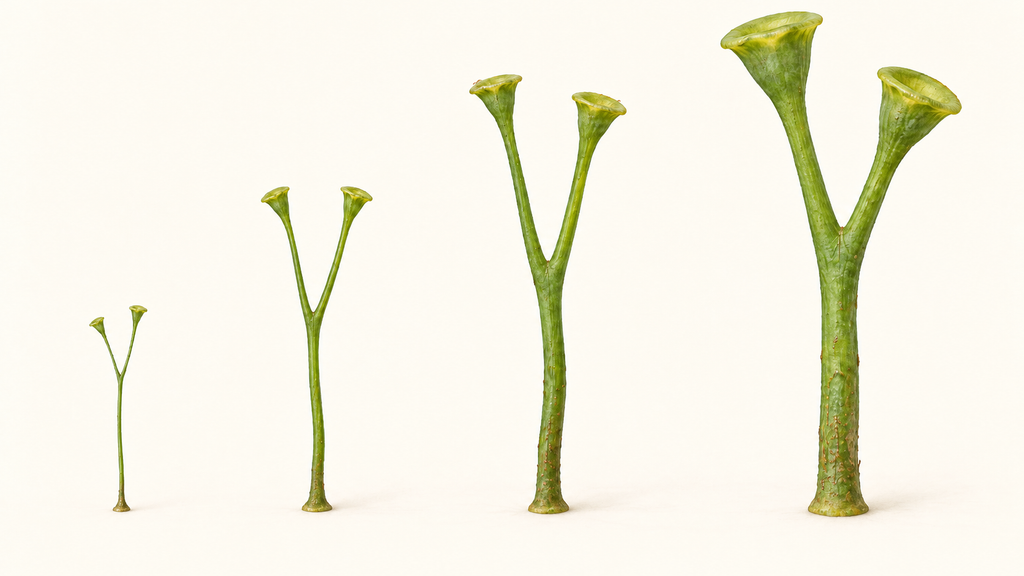
| Size | A few centimeters tall. Stems 0.3 to 3 mm thick, a tenfold spread between kinds |
| Body plan | No leaves and no roots. A thin stem forks in two a few times, and each tip carries a spore capsule |
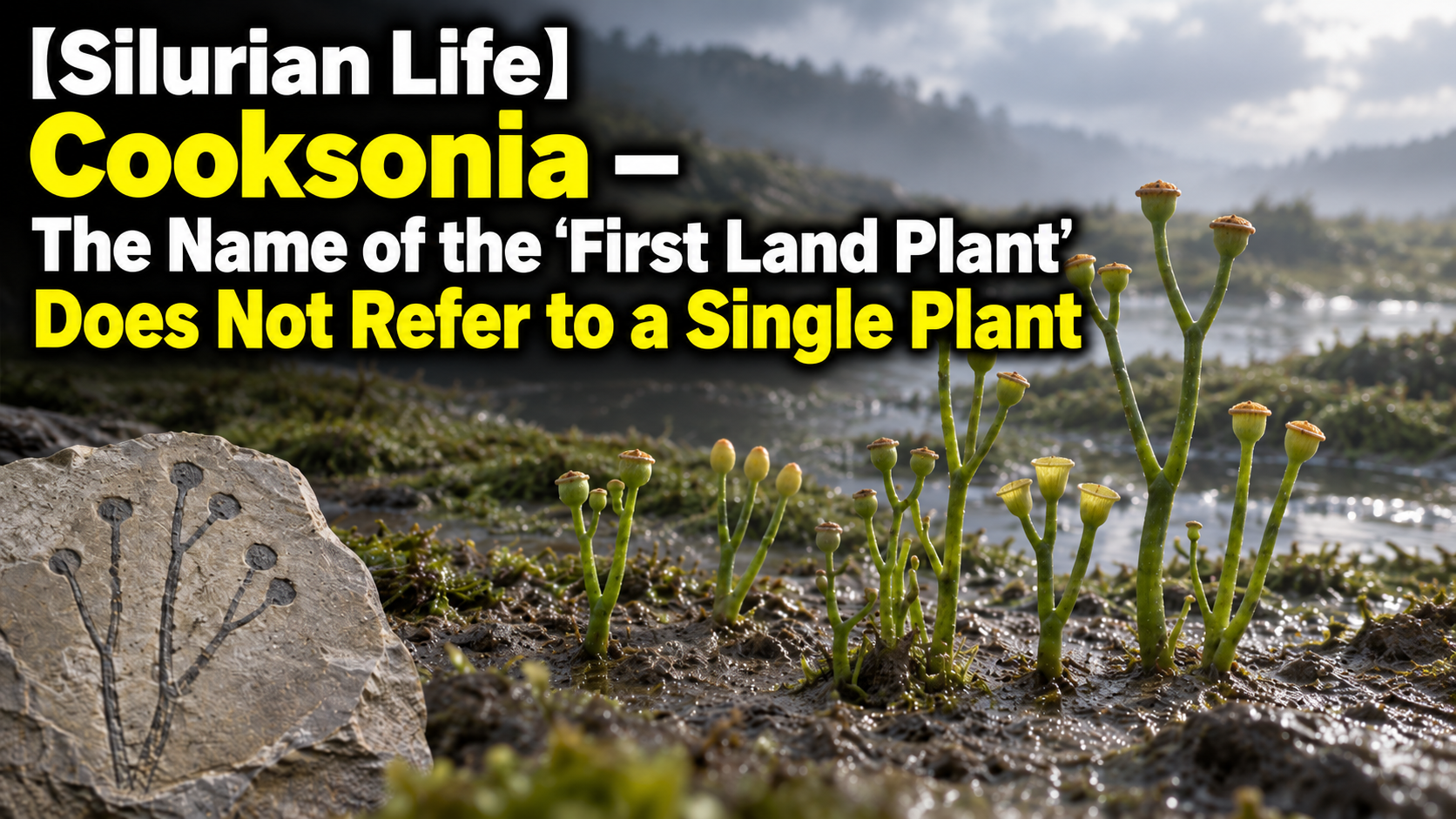
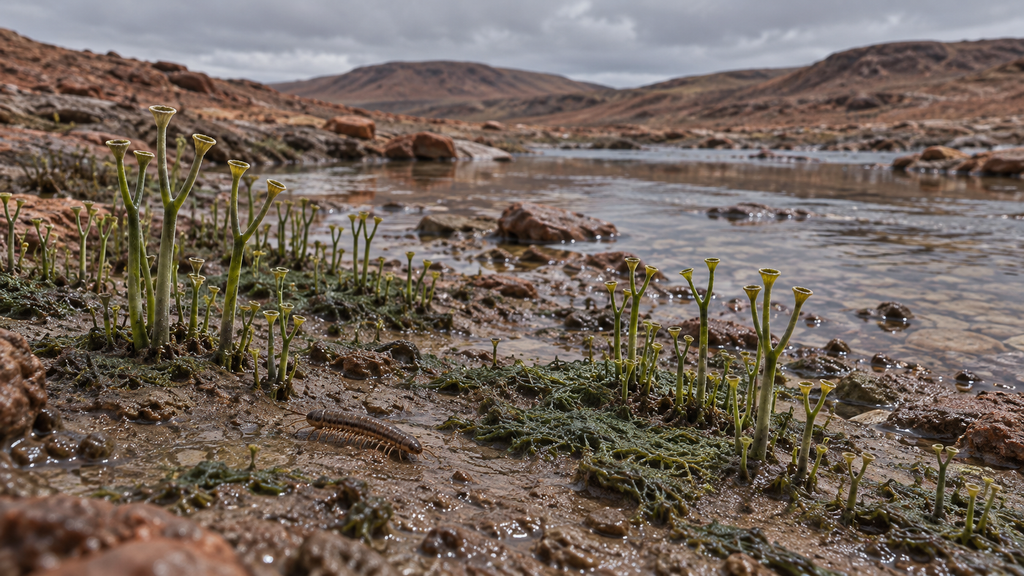
Cooksonia is a small plant a few centimeters tall that grew on land in the Silurian. It had no leaves and no roots, only thin forking stems with spore capsules at the tips, and reference books usually present it as “the first land plant” or “the first vascular plant”. The fossils gathered under this name, however, are not one plant: they are a collection of several different plants that happened to share the same shape.
Appearance and way of life
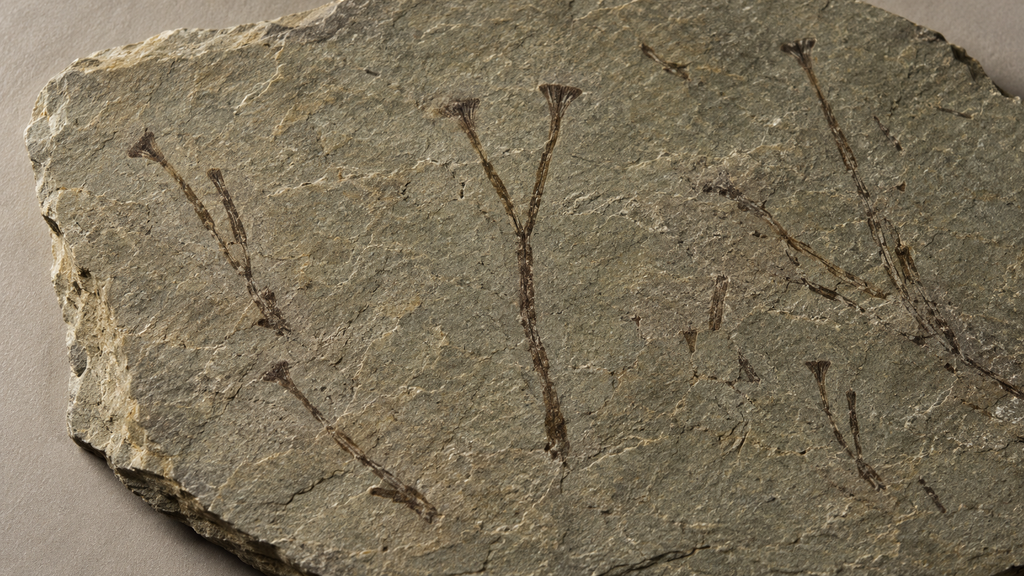
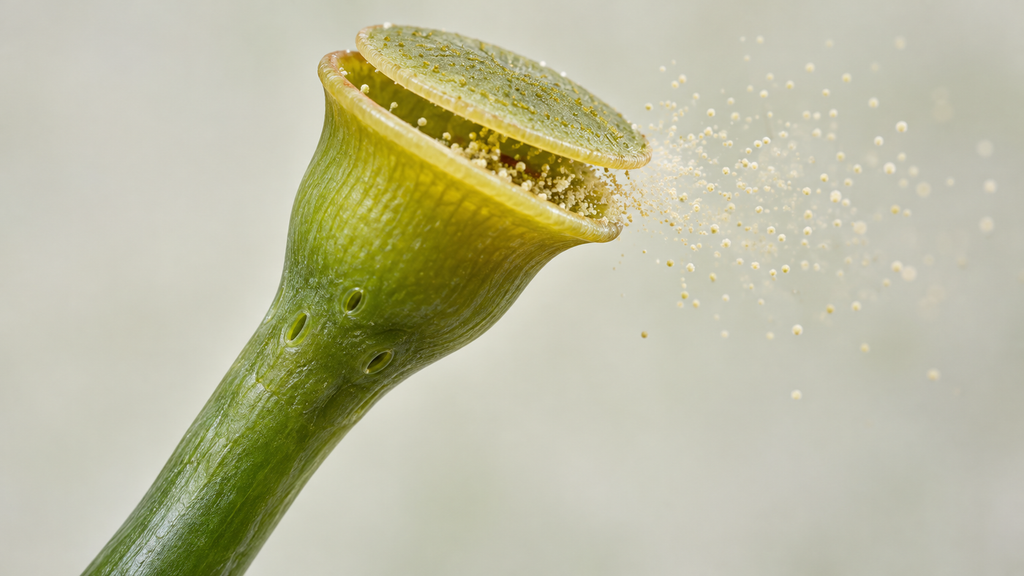
The fossils are found as impressions of thin stems pressed onto rock surfaces. Most stems are about a millimeter thick. Each forks in two, repeats the fork once or twice more, and ends in spore capsules (sporangia). The capsule is a trumpet-shaped widening of the stem tip with a lid on top, which opened to release the spores. There are no leaves and no roots. A horizontal stem below ground is assumed, but it has not been preserved.
Some stems carry stomata. In living plants stomata are the pores through which air enters for photosynthesis, but in Cooksonia they cluster near the stem tips, and one view is that they served transpiration to draw water up to the capsules. A water-conducting strand of tracheids in the center of the stem was first confirmed in 1992, in a single specimen of C. pertoni from Pridoli-age rocks of the English-Welsh border country. That specimen is the basis for treating Cooksonia as a vascular plant, but the strand has been confirmed in only a small fraction of specimens.
Cooksonia grew on damp lowlands near rivers and the sea. The same beds yield fossil spores, other small plants consisting of bare stems, and fragments of early arthropods. For the thinnest stems, the supporting and water-conducting tissues fill the whole cross-section and leave no room for photosynthetic tissue, which has led to the suggestion that these plants could not feed themselves and depended on a separate generation of the life cycle (the gametophyte) that has not been found as a fossil. That argument was made in 2008; in 2018 the oldest known Cooksonia, C. barrandei from the Czech Republic at about 432 million years old, was judged stout enough to photosynthesize on its own.
One name, several plants
The first specimens were collected in 1934 by Isabel Cookson in the border country of England and Wales. Cookson was an Australian botanist who studied plants of the same age in Australia, and in 1935 she had described Baragwanathia together with Lang. In 1937 Lang described her specimens and made her name the name of the genus.
What Lang used to define the genus was shape: a leafless thin stem that forks in two and carries short, wide spore capsules at the tips. Fossils fitting that description then turned up in Silurian and Early Devonian rocks around the world and were reported as Cooksonia. In 1980 the oldest record at that time came from Wenlock-age rocks in Ireland.
When fossils gathered by shape were examined more closely, the contents did not match. Capsules with the shape of C. pertoni were found to contain several kinds of spores with different wall structures, and the species was split into subspecies on that basis. Different spores mean different plants. The conducting strand, as noted above, has been confirmed in a single specimen, and whether the other “Cooksonia” had one is unknown. The stems also varied in thickness between kinds by an amount hard to reconcile with a single genus.
In 2010 Paul Gonez and Philippe Gerrienne of the University of Liège in Belgium reviewed all the species that had been described as Cooksonia. Because Lang’s original description had designated no type specimen, they chose one from Perton Quarry and narrowed the definition of the genus to plants with trumpet-shaped, lidded capsules. In their phylogenetic analysis the species assigned to Cooksonia did not form a single lineage: they scattered from the base of the vascular plants to the lycophyte side. Only two species remained in the genus, C. pertoni and the Brazilian C. paranensis; several others were moved to new genera such as Aberlemnia, and the rest were left unassigned.
The name Cooksonia has thus come to mean something closer to a grade of form, “early land plants with no leaves, forking stems and spore capsules at the tips”, than a single plant. The one green stalk drawn in reference books as the first land plant is in fact several lineages that arrived at the same shape, called by one name.
Related products
You can find books and products related to this article on Amazon.
If you buy through the links above, this blog may earn a commission.
Sources
- Lang, W. H. (1937). On the plant-remains from the Downtonian of England and Wales. Philosophical Transactions of the Royal Society of London B 227, 245–291. https://doi.org/10.1098/rstb.1937.0004
- Edwards, D. & Feehan, J. (1980). Records of Cooksonia-type sporangia from late Wenlock strata in Ireland. Nature 287, 41–42. https://doi.org/10.1038/287041a0
- Edwards, D., Davies, K. L. & Axe, L. (1992). A vascular conducting strand in the early land plant Cooksonia. Nature 357, 683–685. https://doi.org/10.1038/357683a0
- Boyce, C. K. (2008). How green was Cooksonia? The importance of size in understanding the early evolution of physiology in the vascular plant lineage. Paleobiology 34, 179–194. https://doi.org/10.1666/0094-8373(2008)034[0179:HGWCTI]2.0.CO;2
- Gonez, P. & Gerrienne, P. (2010). A new definition and a lectotypification of the genus Cooksonia Lang 1937. International Journal of Plant Sciences 171, 199–215. https://doi.org/10.1086/648988
- Libertín, M., Kvaček, J., Bek, J., Žárský, V. & Štorch, P. (2018). Sporophytes of polysporangiate land plants from the early Silurian period may have been photosynthetically autonomous. Nature Plants 4, 269–271. https://doi.org/10.1038/s41477-018-0140-y


コメント