This article contains affiliate links. As an Amazon Associate I earn from qualifying purchases.
| Name | Meganeura monyi. The genus name means “large veins” in Greek |
| Classification | Insecta, Meganisoptera (Meganeuridae). A distant relative of modern dragonflies |
| Age | Late Carboniferous (about 300 million years ago) |
| Where found | Commentry, Allier, central France |
| Wingspan | About 70 cm |
| Length | Some sources give nearly 40 cm |
| Weight | About 100 to 150 g, according to an estimate from the Natural History Museum in London |
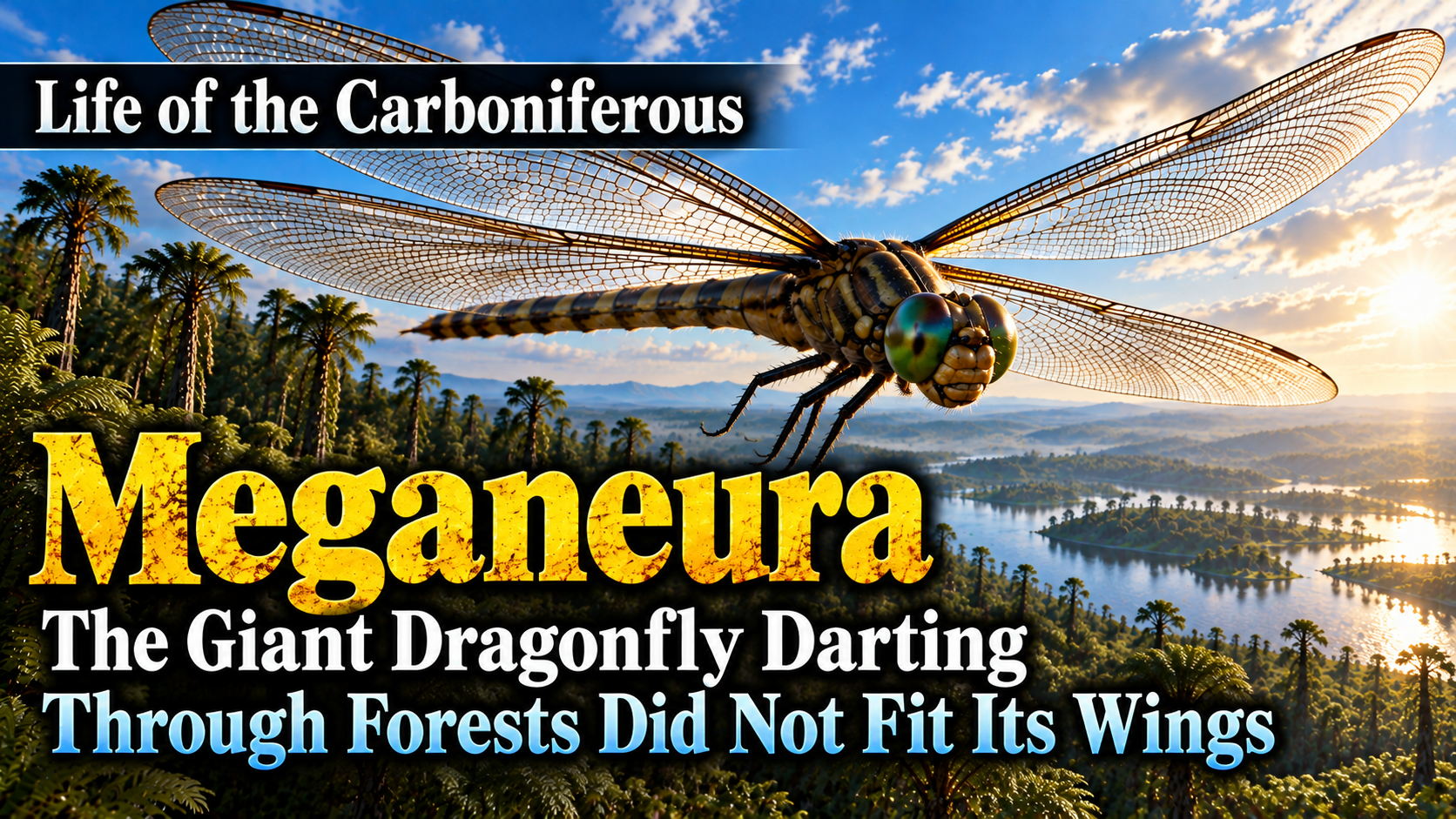
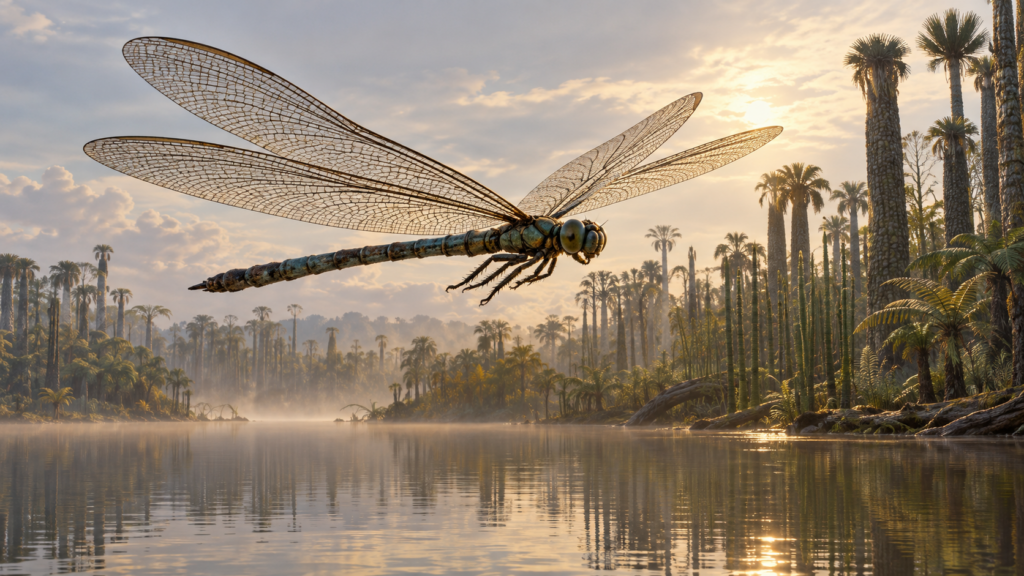
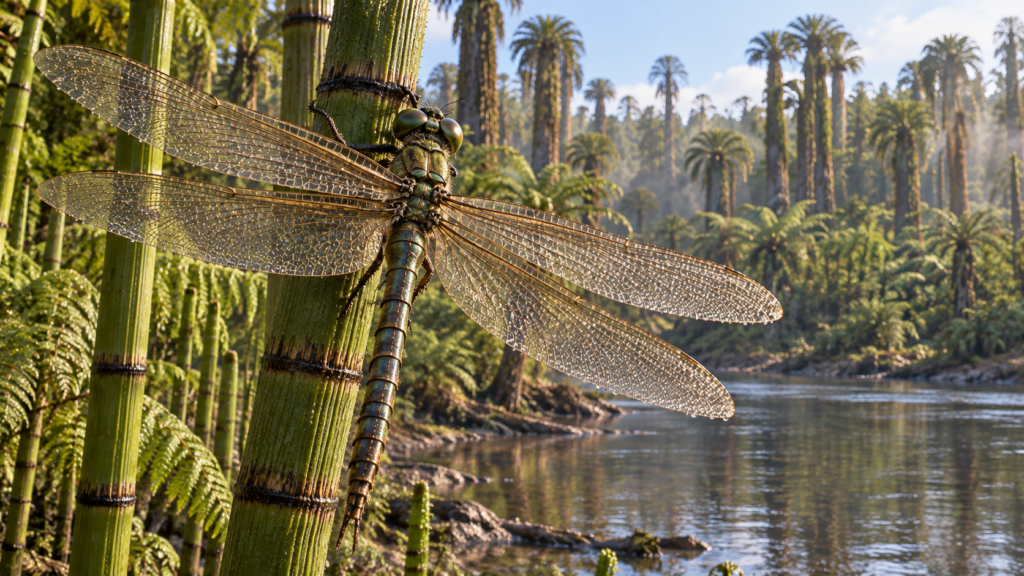
Meganeura was a giant dragonfly-like insect of the Late Carboniferous. Its wingspan was about 70 cm, more than three times that of the largest living dragonflies. It is known as one of the largest flying insects in Earth’s history and has been depicted in books and documentaries darting through Carboniferous swamp forests, but that style of flight does not fit the structure of its wings.
Form and Life
Meganeura had a long, slender body with two pairs of long wings, and looked ahead with a head bearing large compound eyes. Although it resembled modern dragonflies, it was not a true dragonfly (order Odonata) but belonged to Meganisoptera, a group that branched off before them. These insects are also called “griffinflies” in English, and the relatives of Meganeura flourished from the Carboniferous into the Permian.
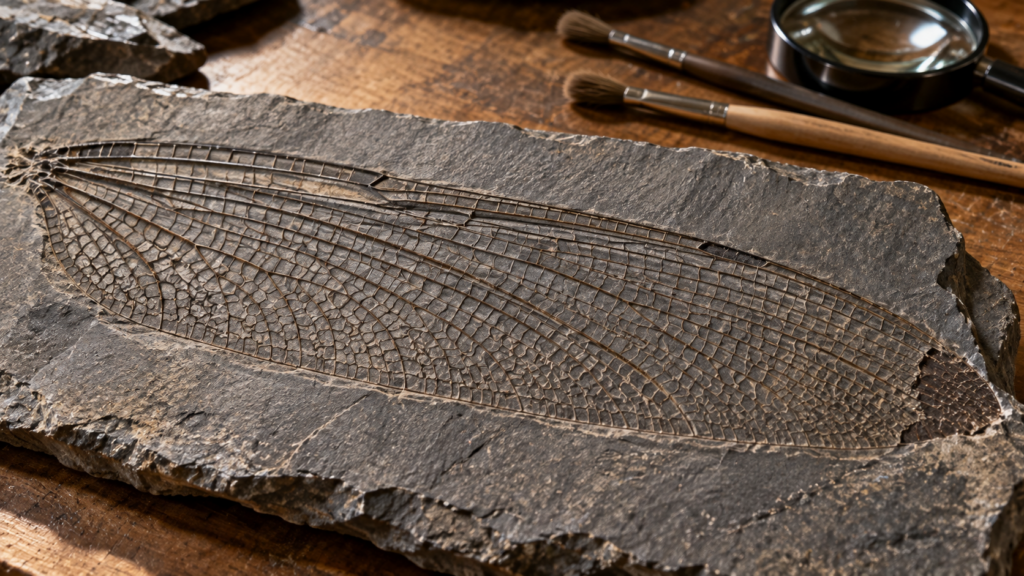
Commentry, where its fossils are found, is a former coal-mining town. About 300 million years ago, the area was a mountain basin with a lake, surrounded by giant lycopsids (scale trees), horsetail relatives (Calamites), tree ferns and gymnosperms called cordaites. Meganeura monyi was named in 1885 by the French entomologist Charles Brongniart. The town of Commentry uses the insect as its emblem.
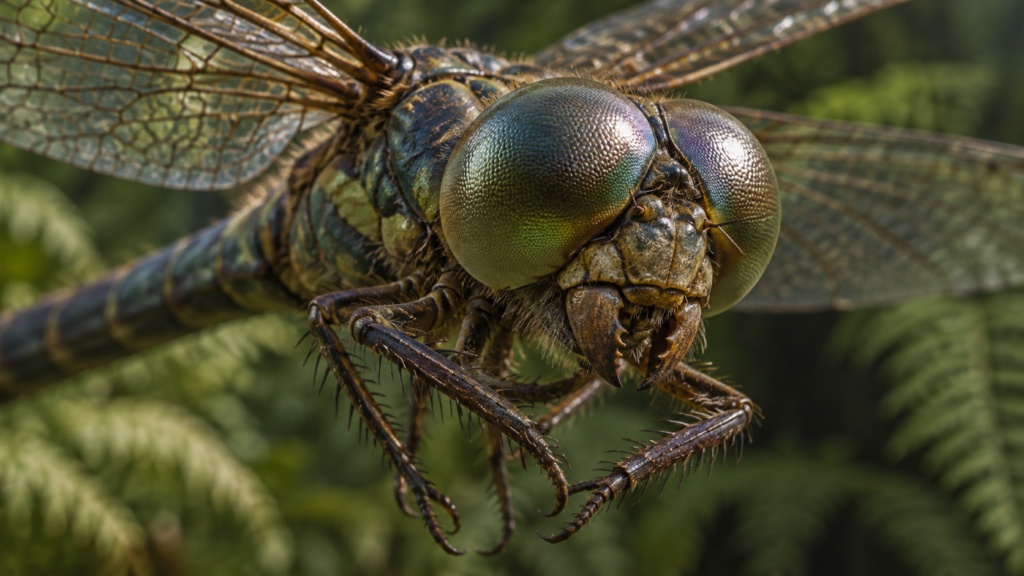
Meganeura was a predator that caught and ate other insects. Its shins and feet were lined with strong spines, and it is thought to have used them the same way modern dragonflies do, forming a basket with their legs to catch insects in flight. Its larvae are thought to have lived in water, like the nymphs of modern dragonflies. At the time, there were not yet any birds, bats or pterosaurs in the air to eat insects. The relatives of Meganeura held the position of top aerial predators until gliding vertebrates appeared about 30 million years later.
The high oxygen content of the air at the time is often cited as the reason they could grow so large. Some researchers, however, point to the absence of aerial predators, and there is a view that neither explanation is sufficient on its own.
Darting Through Forests Did Not Fit Its Wings
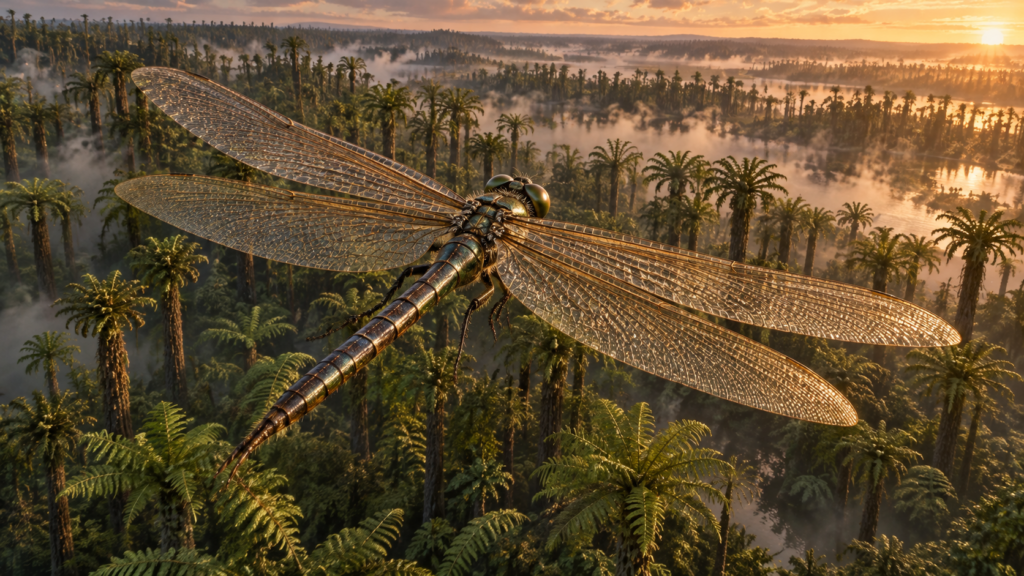
Meganeura monyi is the most famous giant dragonfly, but its fossils are poorly preserved. While large parts of the wings survive, the detailed shape of the head, especially the mouthparts and compound eyes, was essentially unknown. As a result, the version shown in books and documentaries was the rough shape of the wings and body with the head of a modern dragonfly attached. Its way of life was treated the same way: the standard image became one of the insect weaving between trees in Carboniferous wetland forests towering with giant lycopsids, hunting for prey.
In 2018, André Nel of the French National Museum of Natural History and colleagues re-examined the type specimen of a close relative from the same Commentry deposits, Meganeurites gracilipes. This specimen had a well-preserved head, yet it had gone unstudied for a long time. They found sturdy jaws lined with sharp teeth and large compound eyes, with the upper portions especially enlarged. This is a structure for seeing far upward, and among modern dragonflies it is found in the type called “hawkers,” which patrol open spaces looking for prey.
The team also gave weight to the fact that the wings of the Meganeuridae lack the “nodus,” a joint-like structure found in the wings of modern dragonflies. Modern dragonflies use the nodus to twist their wings, allowing them to change direction abruptly in flight. Without this structure, the Meganeuridae were probably far less maneuverable than dragonflies. Even Meganeurites had a wingspan of about 32 cm, and weaving through dense forest would have quickly damaged its long wings.
From this, the team concluded that the relatives of Meganeura were predators that patrolled open spaces, such as large rivers and lakes, open woodland or the air above the forest canopy, rather than the interior of dense forests. They also suggest that for Meganeurites, the even larger Meganeura monyi flying in the same skies may have been a predator. No fossil head of Meganeura itself has yet been found, but the head and wing structure of its relative point to an animal that flew in the open air above water and forest rather than among the trees.
Related products
You can find books and products related to this article on Amazon.
If you buy through the links above, this blog may earn a commission.
Sources
Nel, A., Prokop, J., Pecharová, M., Engel, M. S. & Garrouste, R. (2018). Palaeozoic giant dragonflies were hawker predators. Scientific Reports 8, 12141. https://doi.org/10.1038/s41598-018-30629-w
Nel, A., Fleck, G., Garrouste, R., Gand, G., Lapeyrie, J., Bybee, S. M. & Prokop, J. (2009). Revision of Permo-Carboniferous griffenflies (Insecta: Odonatoptera: Meganisoptera) based upon new species and redescription of selected poorly known taxa from Eurasia. Palaeontographica Abteilung A 289, 89–121. https://doi.org/10.1127/pala/289/2009/89
Natural History Museum. Giant dragonflies. https://www.nhm.ac.uk/discover/giant-dragonflies.html
Garrouste, R. & Nel, A. (2018). Are the Palaeozoic era’s giant dragonflies still among us? The Conversation. https://theconversation.com/are-the-paleozoic-eras-giant-dragonflies-still-among-us-102384
コメント