This article contains affiliate links. As an Amazon Associate I earn from qualifying purchases.
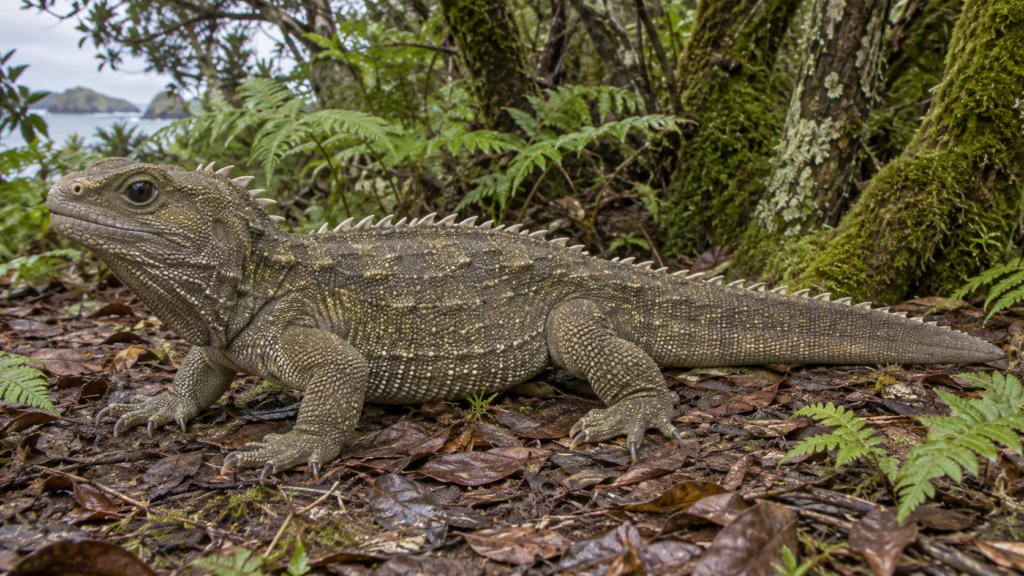
| Name | Tuatara (Sphenodon punctatus). The Māori name means “peaks on the back,” after the row of spines along its back. The genus name Sphenodon is said to mean “wedge tooth” |
| Classification | Reptile; Lepidosauria; Rhynchocephalia (Sphenodontia); Sphenodontidae |
| Age | Rhynchocephalians date back to the Middle Triassic. In New Zealand, fossils of close relatives come from rocks about 19–16 million years old (Miocene). Living today |
| Range | New Zealand only. Wild populations survive on 32 islands off the north-east coast of the North Island and in the Marlborough Sounds |
| Length | Adult males about 50 cm. The tail is about as long as the body |
| Weight | Males up to 1–1.5 kg, females about 0.5 kg (sources vary) |
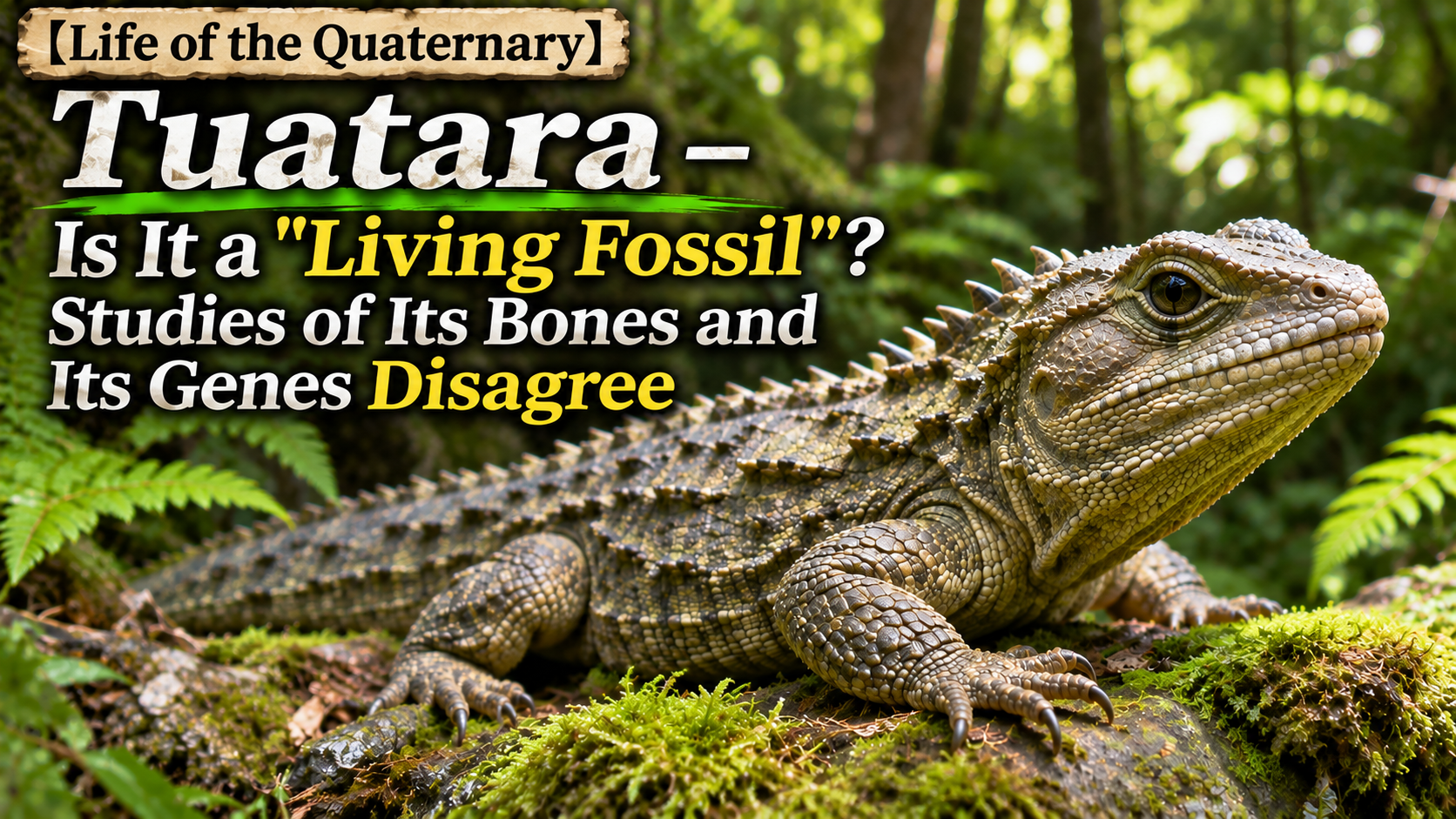
The tuatara is a reptile found only in New Zealand. It looks like a lizard but is not one: it is the only surviving species of Rhynchocephalia, an order that flourished in the Triassic. Its lineage split from that of lizards and snakes about 250 million years ago. It has long been called a “living fossil,” but studies disagree on whether the label fits.
Appearance and Way of Life
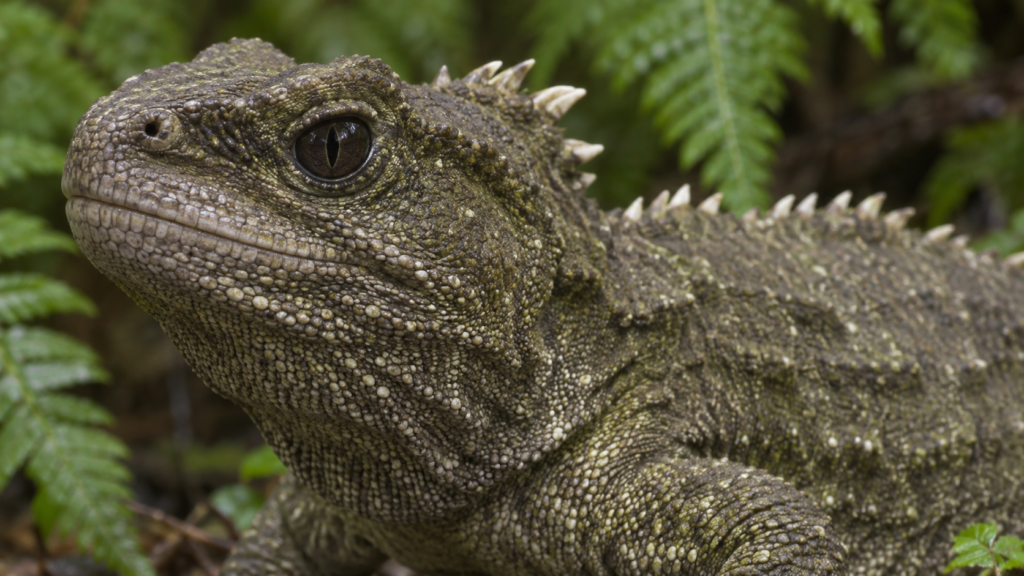
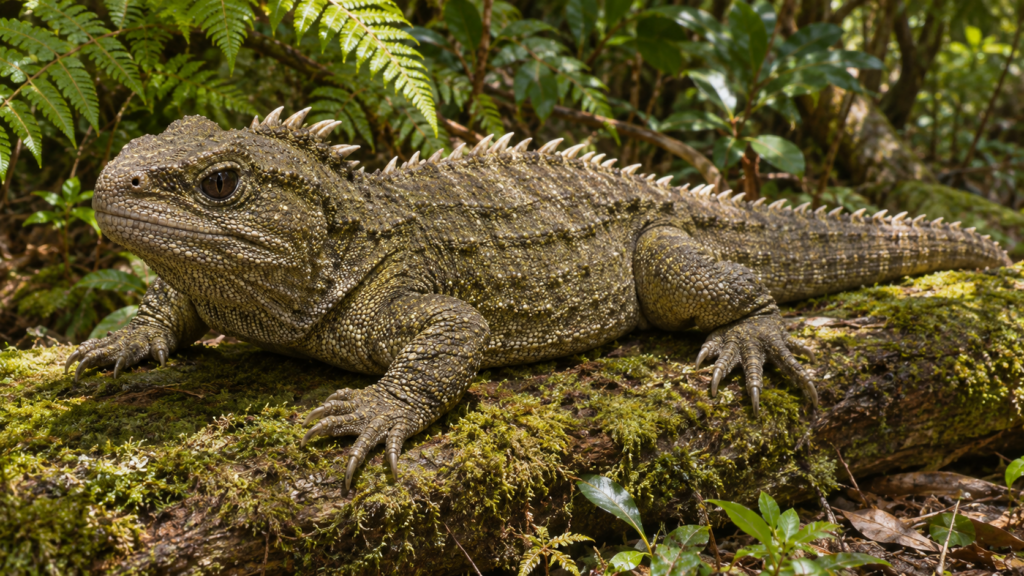
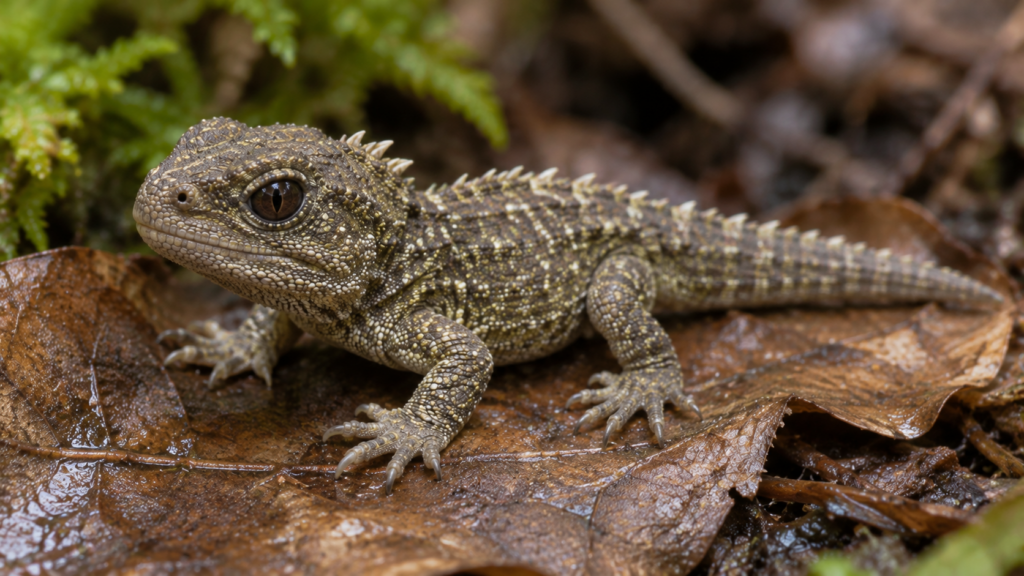
The tuatara is a stocky reptile with a low row of spines along its back. Males are larger than females and have a more prominent crest. According to New Zealand’s Department of Conservation, tuatara live about 60 years on average and up to 100, and keep growing until they are about 35.
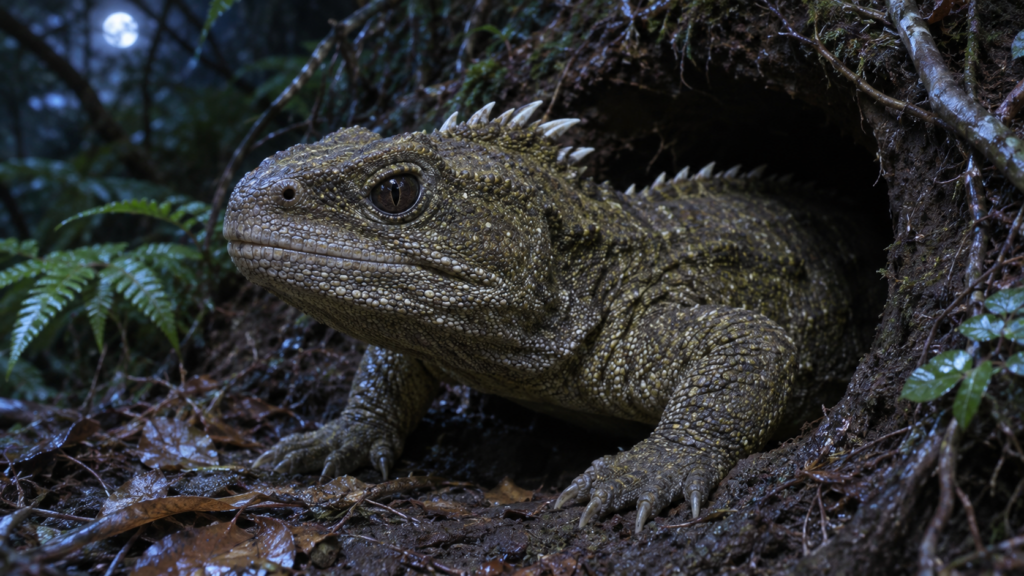
Tuatara are active at night and eat small animals such as beetles, wētā (large New Zealand insects related to crickets), earthworms and spiders. They sometimes take lizards, and the eggs and chicks of seabirds. They live in burrows dug by seabirds such as shearwaters and petrels, or dig their own. The islands where tuatara survive hold seabird colonies, whose droppings enrich the soil. Their preferred body temperature of 16–21°C is said to be the lowest of any reptile.
Their teeth are unusual too. The teeth are projections of the jawbone itself and are never replaced. The upper jaw carries two rows of teeth, and the single row in the lower jaw fits between them. As the mouth closes, the lower jaw slides forward and slices food like a saw. Among living reptiles, birds and mammals, only the tuatara chews this way.
On top of the head is a small “third eye,” the parietal eye. It has a lens and a retina and senses light, but it does not form images. It is covered by translucent skin from birth and becomes hidden under scales with age. It is thought to play a part in the body clock or basking, but its role has not been confirmed.
Tuatara breed slowly. Females lay eggs only once every 2–5 years, and the eggs take about 11–14 months to hatch. The sex of the young depends on nest temperature, with warmer nests producing more males. A study of the North Brother Island population found that, under strong warming, every nest site there could produce only males by the mid-2080s.
Wild populations remain only on offshore islands, and about ten more populations have been established by moving animals to other islands and to mainland sanctuaries. The tuatara is treated as a single species. In 1989 the North Brother Island population was recognized as a separate species, Sphenodon guntheri, but after a genetic reassessment the two were merged again in 2009. There are about 100,000 tuatara in the world.
Is It a “Living Fossil”?
The oldest known rhynchocephalian is Wirtembergia, from Middle Triassic rocks in Germany. The group split into many species in the Late Triassic and Early Jurassic and spread worldwide. It later dwindled; the last fossils outside New Zealand come from Argentina, about 70 million years ago in the Late Cretaceous. In 2009, jaws and teeth closely resembling the tuatara’s were reported from rocks about 19–16 million years old in Central Otago, showing that the lineage had been in New Zealand at least since then.
Studies of bones disagree on whether the tuatara is a “living fossil” whose form has stayed the same since ancient times. A 2012 study compared the skull shape of the tuatara with that of 13 fossil relatives. It found large differences from a much bigger Cretaceous relative and concluded that the tuatara is not a product of evolutionary standstill but the last survivor of a diverse group. The paper’s title says the findings “dispute the persistent ‘living fossil’ label.”
In 2017, a team at the University of Bristol defined a “living fossil” as a lineage that evolves slowly and whose shape sits near the middle of its group’s range of shapes, and then examined the shape of the lower jaw. They found that the tuatara evolved especially slowly and sits close to the center of the group’s range, and so supported the “living fossil” label.
Genetic studies have reversed each other as well. A 2008 study that compared ancient and modern DNA reported that tuatara DNA changes faster than any rate yet recorded in vertebrates, and argued that changes in body form and in DNA are not linked. A rebuttal followed the next year, and the question became a debate. In 2020, the study that sequenced the full tuatara genome compared parts of the DNA that have little effect on how genes work, and found the tuatara to be the slowest-evolving lepidosaur analyzed so far, the opposite of the 2008 claim. The genome is about 5 billion base pairs, much of it made up of diverse repeated sequences.
Depending on whether researchers look at the whole skull, the lower jaw, or different parts of the DNA, the same animal comes out as either “unchanged” or “changing.” Whether the tuatara deserves to be called a “living fossil” is still unsettled among researchers.
Related products
You can find books and products related to this article on Amazon.
If you buy through the links above, this blog may earn a commission.
About the images
The images in this article are illustrations created with AI (ChatGPT), and you are welcome to use them. If you do, we would appreciate a link back to this article as the source.
Sources
Department of Conservation (New Zealand), Tuatara https://www.doc.govt.nz/nature/native-animals/reptiles-and-frogs/tuatara/
New Zealand Herpetological Society, Tuatara https://www.reptiles.org.nz/node/21
Gemmell, N. J. et al. (2020). The tuatara genome reveals ancient features of amniote evolution. Nature 584, 403–409. https://doi.org/10.1038/s41586-020-2561-9
Meloro, C. & Jones, M. E. H. (2012). Tooth and cranial disparity in the fossil relatives of Sphenodon (Rhynchocephalia) dispute the persistent ‘living fossil’ label. Journal of Evolutionary Biology 25, 2194–2209. https://doi.org/10.1111/j.1420-9101.2012.02595.x
Herrera-Flores, J. A., Stubbs, T. L. & Benton, M. J. (2017). Macroevolutionary patterns in Rhynchocephalia: is the tuatara (Sphenodon punctatus) a living fossil? Palaeontology 60, 319–328. https://doi.org/10.1111/pala.12284
University of Bristol (2017). Tuatara is a ‘living fossil’ after all https://www.bristol.ac.uk/news/2017/february/living-fossil-.html
Hay, J. M. et al. (2008). Rapid molecular evolution in a living fossil. Trends in Genetics 24, 106–109. https://doi.org/10.1016/j.tig.2007.12.002
Hay, J. M. et al. (2010). Genetic diversity and taxonomy: a reassessment of species designation in tuatara (Sphenodon: Reptilia). Conservation Genetics 11, 1063–1081. https://doi.org/10.1007/s10592-009-9952-7
Jones, M. E. H. et al. (2009). A sphenodontine (Rhynchocephalia) from the Miocene of New Zealand and palaeobiogeography of the tuatara (Sphenodon). Proceedings of the Royal Society B 276, 1385–1390. https://doi.org/10.1098/rspb.2008.1785
Jones, M. E. H. et al. (2012). Shearing mechanics and the influence of a flexible symphysis during oral food processing in Sphenodon (Lepidosauria: Rhynchocephalia). The Anatomical Record 295, 1075–1091. https://doi.org/10.1002/ar.22487
Mitchell, N. J. et al. (2008). Predicting the fate of a living fossil: how will global warming affect sex determination and hatching phenology in tuatara? Proceedings of the Royal Society B 275, 2185–2193. https://doi.org/10.1098/rspb.2008.0438
Sues, H.-D. & Schoch, R. R. (2023). The oldest known rhynchocephalian reptile from the Middle Triassic (Ladinian) of Germany and its phylogenetic position among Lepidosauromorpha. The Anatomical Record 307, 776–790. https://doi.org/10.1002/ar.25339
Supporters of Tiritiri Mātangi, Tuatara: a three-eyed monster? (parietal eye) https://tiritirimatangi.org.nz/blog/tuatara-a-three-eyed-monster

コメント