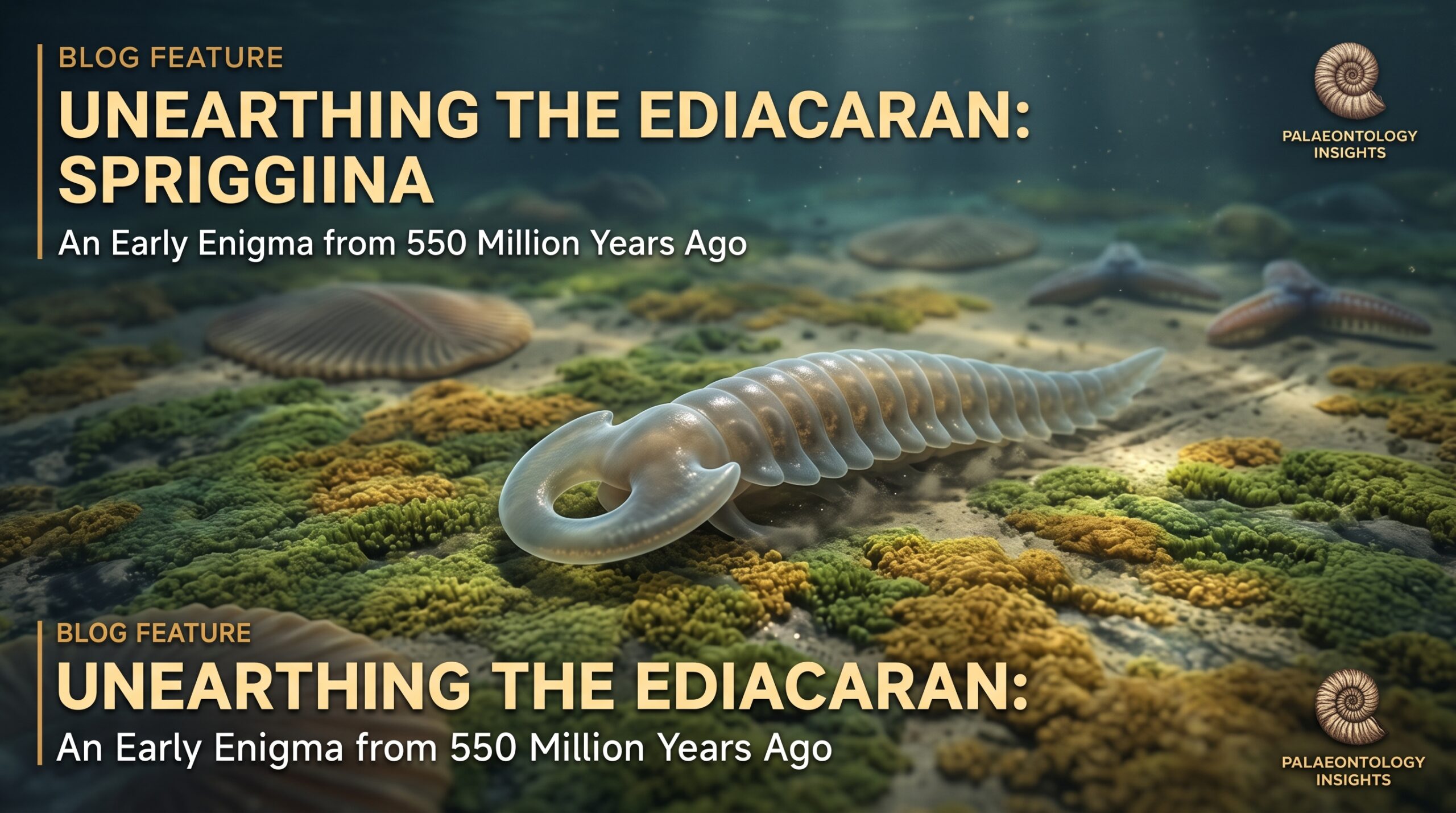

| Name | Spriggina (“Sprigg’s creature,” after its discoverer Reg Sprigg) |
| Classification | Affinity unknown (proposals include the extinct phylum Proarticulata) |
| Age | Ediacaran, at the end of the Proterozoic in the Precambrian (about 550 million years ago) |
| Found in | The Flinders Ranges of South Australia (found nowhere else) |
| Length | About 3 to 5 cm |
Spriggina was an organism with a long, segmented body that lived on the Ediacaran seafloor about 550 million years ago. With a crescent-shaped part resembling a head and a trunk tapering to the rear, it looks at first glance like a relative of polychaete worms or trilobites. But look closely at the segments and the left and right do not face each other neatly; they are offset by half a step. Because of that half-step offset, more than half a century after its discovery, what group it belongs to remains undecided.
Form and way of life
The body is a long oval, 3 to 5 cm in size. At the front is a horseshoe-shaped region that looks like a head, and from there dozens of narrow segments run backward, tapering to an end. Some specimens have segments angled obliquely backward into a chevron pattern; others are nearly straight.
All fossils are found as impressions on the underside of sandstone beds. It had no hard parts such as shell or bone, yet the clarity of the impressions suggests a body firm enough to leave a distinct mold. No legs, on the other hand, have ever been found. Some suggest it may have had eyes, but the sandstone grains in which the fossils are cast are coarse, making details of the body hard to read, so this has not been confirmed. Some specimens preserve a round structure at the center of the head that may be a mouth, but for the same reason the interpretation is unsettled.
The seafloor of the time was covered throughout by mat-like films woven by microbes. Spriggina lived on top of them, and many researchers take the distinction between head and tail as a sign that it could move under its own power. Some have suggested it was a predator, but with even the mouth difficult to confirm, what it ate remains speculation. The same strata yield soft-bodied organisms emblematic of the Ediacaran, including Dickinsonia and Tribrachidium.
Symmetrical at a glance, offset by half a step
The classification of Spriggina has been unstable since it was described in 1958. Martin Glaessner, who named it, took the segmented body as indicating a polychaete relative, an annelid. Later, because the horseshoe-shaped head closely resembles a trilobite’s, it was proposed as close to the ancestry of the arthropods including trilobites, and drew attention as a forerunner of the animals that would explode in diversity in the Cambrian.
What halted that view was the arrangement of the segments. In both polychaetes and trilobites, segments face each other as mirror images across the midline. The segments of Spriggina, however, are offset by half a step and arranged alternately. This arrangement is called glide symmetry, and it matches the body plan of no animal alive today. Russian researchers treated the offset as genuine anatomy and classified Spriggina, together with Dickinsonia and others, in an independent phylum that died out at the end of the Precambrian: the Proarticulata. A phylum is one of the largest units of classification, a category on a par with Arthropoda or Chordata. On this view, Spriggina is not an ancestor of anything but a member of a lineage that vanished without descendants.
The story does not end there, however. Researchers are divided over whether the offset really reflects the anatomy of the living animal or is distortion acquired as a soft body was buried in sand and fossilized. Australian researchers largely favor distortion; Russian researchers take it as genuine anatomy; and a 2022 review notes that the disagreement remains unresolved. Whether the body segments are offset by half a step — that single point alone — is the fork that makes this organism either a trilobite relative or an inhabitant of an extinct phylum.
A fossil carrying its discoverer’s name
The genus name Spriggina comes from the geologist Reg Sprigg. In 1946, while surveying a mine in the Ediacara Hills of South Australia, Sprigg found traces of strange organisms on rock surfaces. That was the beginning of the great discovery later known as the Ediacaran biota. He initially failed to win over those around him, including the prominent geologist Douglas Mawson, but kept pressing the case, and in time these were recognized as fossils of the oldest large organisms then known. The species name floundersi honors Ben Flounders, an amateur who contributed to the fossil search.
In 2017 it was adopted as the official state fossil of South Australia. In a public vote it took roughly half the ballots, beating Dickinsonia, Tribrachidium and others. David Attenborough contributed words of endorsement to the selection, noting that its head and segmented body raise the possibility of a primitive brain. Found nowhere in the world but the Flinders Ranges, this fossil has become, along with its discoverer’s name, a symbol of the state.


Sources
Ivantsov, A. Yu. Vendian Animals in the Phylum Proarticulata
Geological Magazine (2022) Following the logic behind biological interpretations of the Ediacaran biotas
Government House South Australia: Prehistoric Wonders: Fossils from South Australia’s Past
ABC News Reg Sprigg honoured with South Australia’s first fossil emblem, the Spriggina
Government of South Australia, YourSAy: Help choose a fossil emblem for South Australia
コメント