This article contains affiliate links. As an Amazon Associate I earn from qualifying purchases.
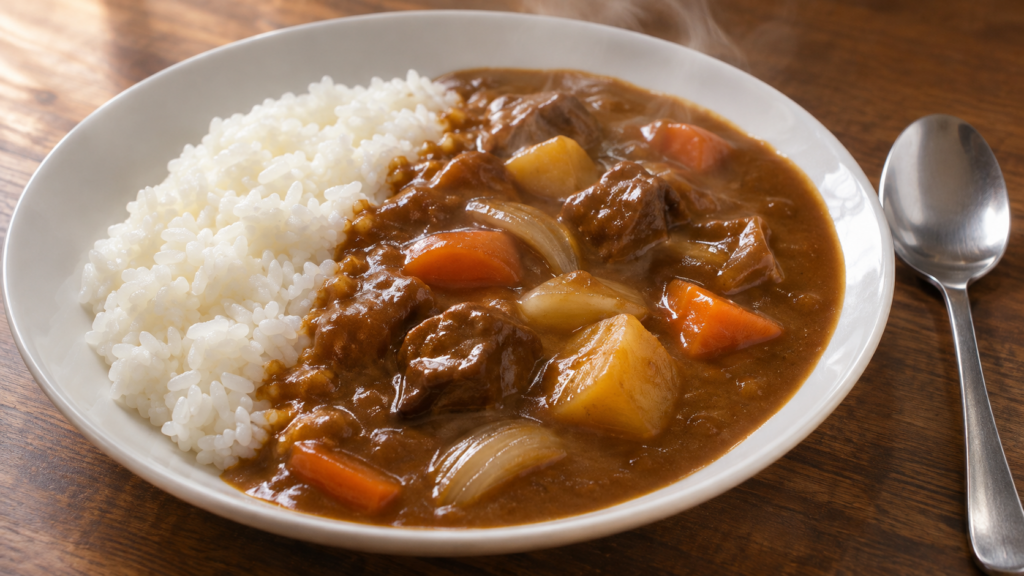
Japanese curry rice is made by browning meat and vegetables, simmering them in water, then thickening and seasoning the pot with store-bought Japanese curry roux (solid blocks of curry sauce base sold in boxes) and serving it over rice. Two things decide how it turns out: cooking the vegetables through before the roux goes in, and turning off the heat when you add the roux. Roux dropped into a boiling pot dissolves poorly and leaves lumps.
Ingredients (6 servings)
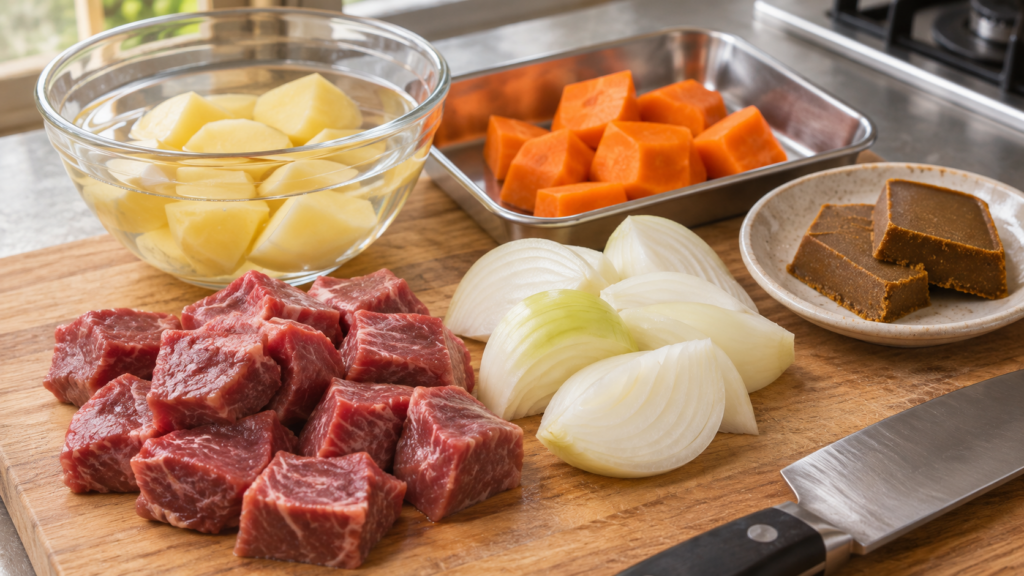
- Beef (stewing cubes) or pork (bite-sized pieces): 250 g
- Onions: 2 medium (400 g)
- Potatoes: 1 1/2 medium (230 g)
- Carrot: 1/2 medium (100 g)
- Vegetable oil: 1 tbsp
- Water: 850 ml
- Japanese curry roux: half a box (6 servings, about 115 g)
- Cooked Japanese rice: 6 servings
Match the amount of water to what is printed on your box of roux. To make 12 servings with a whole box, double the ingredients and the water. If you simmer with the lid on, reduce the water by about 100 ml.
Instructions
1. Cut the ingredients
Cut the meat and vegetables into bite-sized pieces. Cut the onions into wedges. Soak the cut potatoes in water, then drain.
2. Brown the meat and vegetables
Heat the oil in a heavy-bottomed pot and brown the meat over medium heat. When it has some color, add the onions, potatoes and carrot and stir-fry until the onions soften.
3. Add the water and simmer
Add the water and bring it to a boil. Skim off the foam and simmer over low to medium heat for about 15 minutes. The vegetables are done when a bamboo skewer slides easily into the carrot.
4. Turn off the heat and dissolve the roux
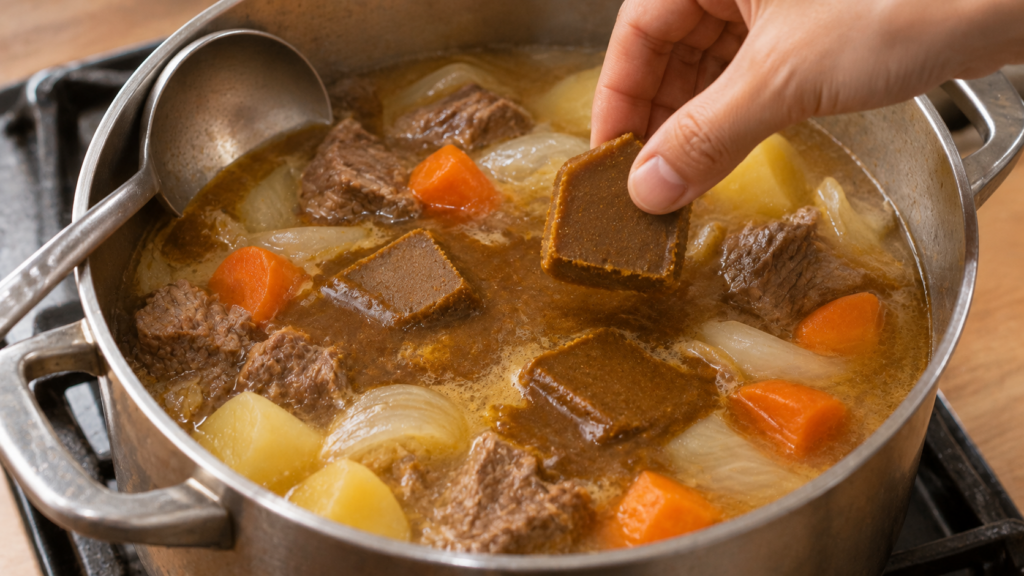
Turn off the heat and wait until the bubbling stops. Break the roux into pieces, drop them in and stir with a ladle until they dissolve.
5. Simmer until thick
Return the pot to low heat and simmer for about 10 minutes, stirring from the bottom now and then. Turn off the heat once the curry has thickened.
6. Serve
Put rice on each plate and pour the curry over it.
Tips for good results
Add the roux with the heat off
Roux dissolves poorly in a boiling liquid and melts better once the temperature drops a little. Adding it after you turn off the heat and the bubbling has stopped keeps lumps from forming. Roughly chopping the roux with a knife first makes it dissolve even more easily.
Cook the vegetables before the roux goes in
Once the roux dissolves, the liquid thickens and the vegetables cook more slowly. Simmer the carrots and potatoes until a skewer goes through them before you add the roux.
Use a heavy pot and low heat after adding the roux
Thickened curry scorches easily on the bottom of the pot. Use a heavy pot that spreads heat slowly, keep the heat low once the roux is in, and stir from the bottom now and then.
Browning the onions adds flavor
Chopping the onions finely and cooking them until golden brown, without letting them burn, gives the curry more flavor.
Add the potatoes later if you want them to hold their shape
Potatoes fall apart and dissolve into the sauce when simmered for a long time. To keep their shape, take the potatoes out after browning and return them to the pot about 10 minutes into the simmering.
If something goes wrong
Lumps of roux remain
The roux went into a boiling pot. Turn off the heat and press the lumps against the side of the pot with the back of a ladle to dissolve them. Next time, add the roux after the heat is off and the bubbling has stopped, and chop it first.
The curry is thin and runny
There was too much water, or it did not simmer long enough after the roux went in. Keep stirring over low heat and cook it down until it thickens. Putting a spoon or ladle that has been in someone’s mouth back into the pot can also make the curry lose its thickness, so taste from a separate dish.
It scorched on the bottom
The heat was too high after adding the roux, or it was not stirred often enough. Next time, use a heavy pot, keep the heat low after the roux goes in, and stir from the bottom now and then.
The potatoes fell apart
They simmered too long. Next time, add the potatoes later as described above. Waxy potatoes, which hold their shape better than floury ones, also help.
The carrots or potatoes are still hard
They did not simmer long enough before the roux went in. Vegetables cook slowly once the sauce is thick, so cover the pot and keep it on low heat until a skewer goes through. Next time, check with a skewer before adding the roux.
Related products
You can find books and products related to this article on Amazon.
If you buy through the links above, this blog may earn a commission.
About the images
The images in this article are illustrations created with AI (ChatGPT), and you are welcome to use them. If you do, we would appreciate a link back to this article as the source.
Sources
House Foods, “Basic curry recipe” (in Japanese) https://housefoods.jp/data/curryhouse/cook/basic.html
House Foods Group, “Vermont Curry: how to make” (in Japanese) https://housefoods-group.com/products/jp/recipe/vmt.html
S&B Foods, “Basic curry rice” (in Japanese) https://www.sbfoods.co.jp/recipe/detail/01915.html
Minna no Kyou no Ryouri (NHK), “The classic curry” by Makiko Oda (in Japanese) https://www.kyounoryouri.jp/recipe/30429_THE+%E5%AE%9A%E7%95%AA%E3%82%AB%E3%83%AC%E3%83%BC.html
Lettuce Club, “Curry rice” by Yoshiko Fujino (in Japanese) https://www.lettuceclub.net/recipe/dish/6611/
Ajinomoto Park, “Curry rice” (in Japanese) https://park.ajinomoto.co.jp/recipe/card/710189/


コメント