This article contains affiliate links. As an Amazon Associate I earn from qualifying purchases.
| Name | Paraceratherium (Paraceratherium; also known as Baluchitherium and Indricotherium) |
| Classification | Mammalia, Perissodactyla, Paraceratheriidae (relatives of rhinoceroses) |
| Period | Paleogene, Oligocene (about 31 to 28 million years ago for the oldest species, about 26.5 million years ago for a species described in 2021) |
| Found in | Pakistan, China, Mongolia, Kazakhstan (fragments also known from Turkey and elsewhere) |
| Length | About 8.2 m (the American Museum of Natural History’s 1936 restoration of the largest individuals, from snout to the back of the hips, not counting the tail) |
| Shoulder height | About 5.3 m (the museum’s 1935 restoration of the largest individuals) |
| Weight | About 11 tonnes on average, perhaps 15 to 20 tonnes for the largest individuals (1993 estimate) |
| Skull length | About 1.3 m (a skull from Mongolia) |
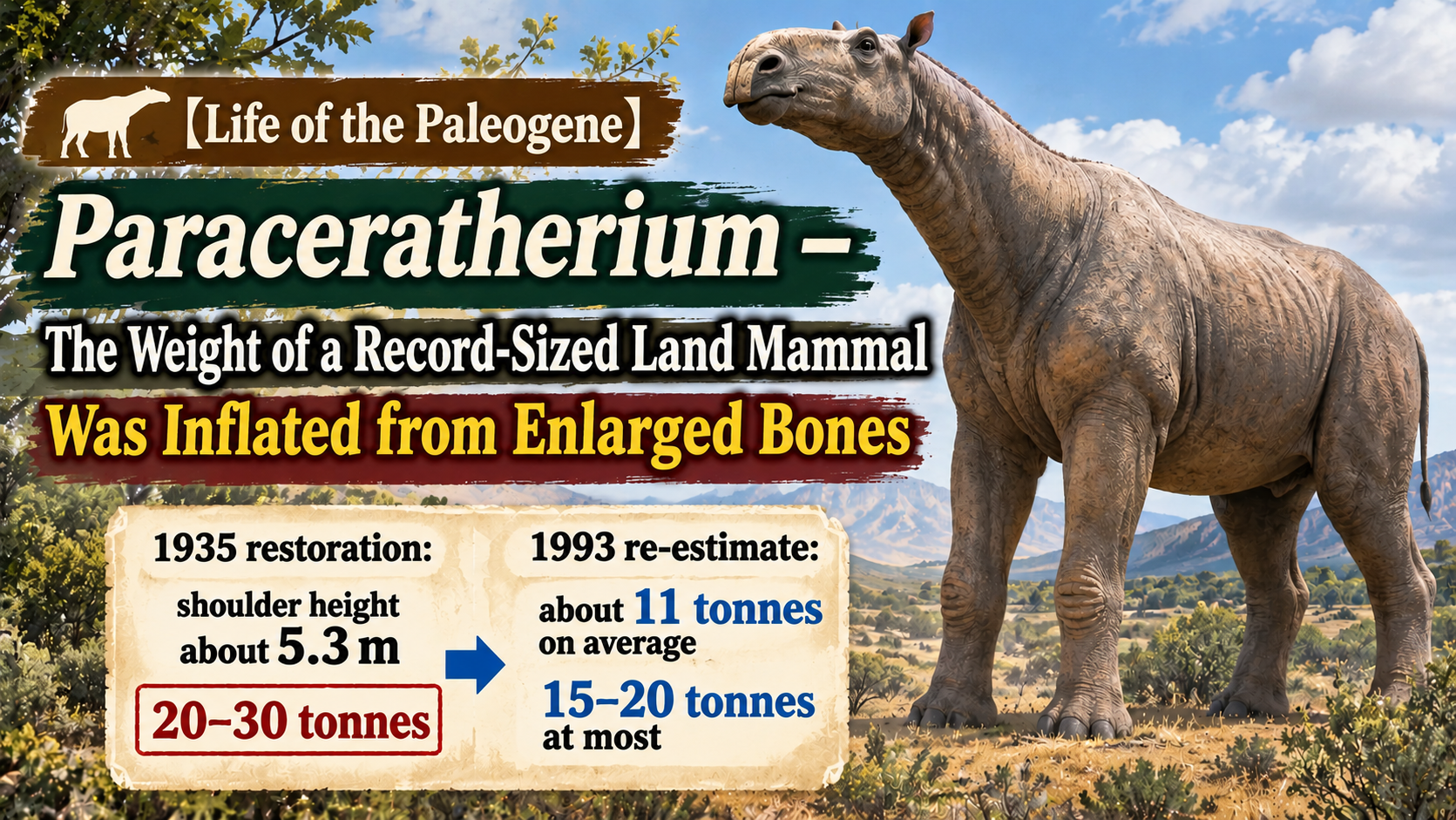
Paraceratherium was a large plant-eating mammal related to rhinoceroses. It lived in Asia during the Oligocene and ranks among the largest land mammals ever known. For decades, books gave its weight as 20 to 30 tonnes, but that figure came from a restoration built by enlarging smaller bones.
Appearance and Way of Life
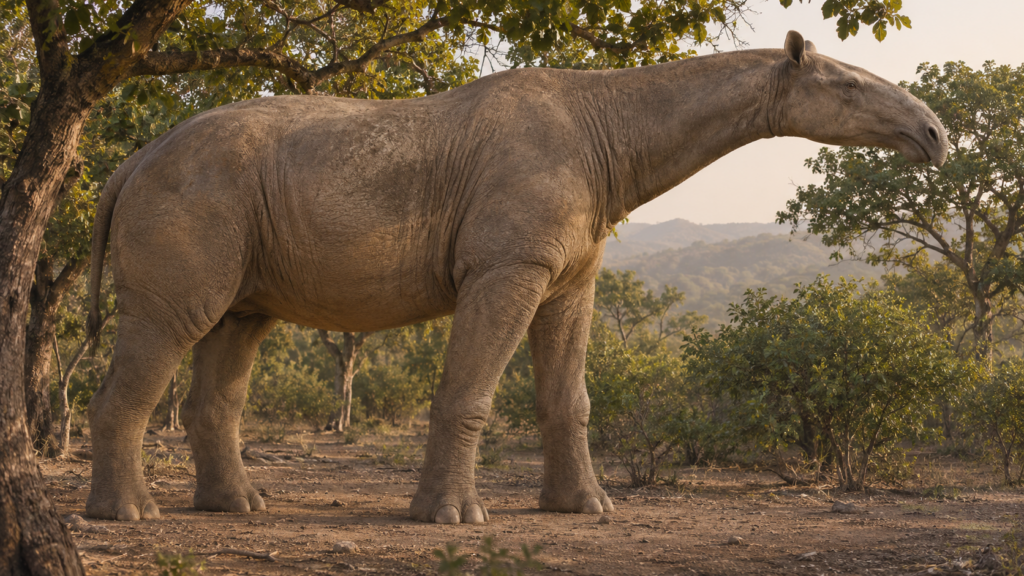
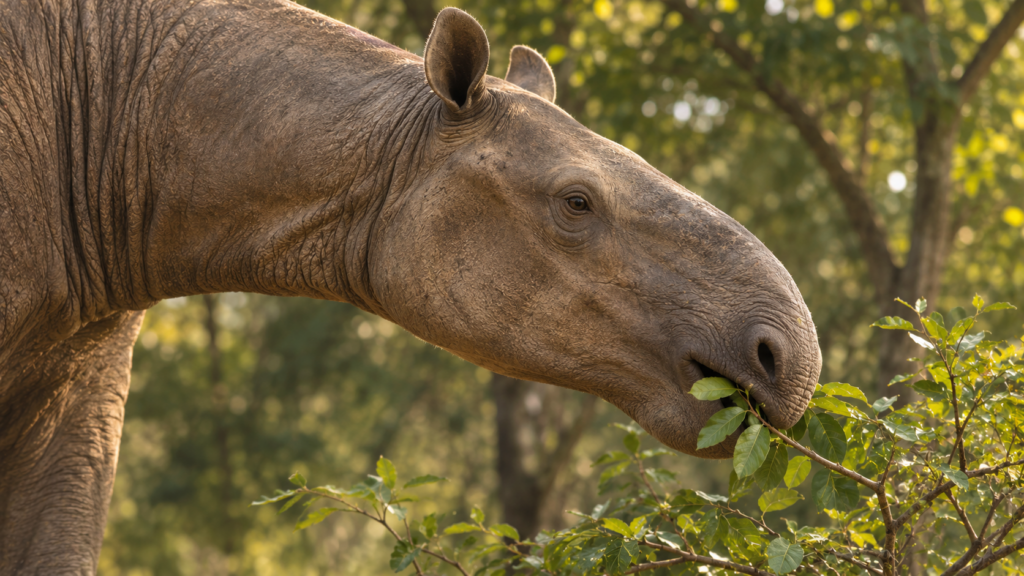
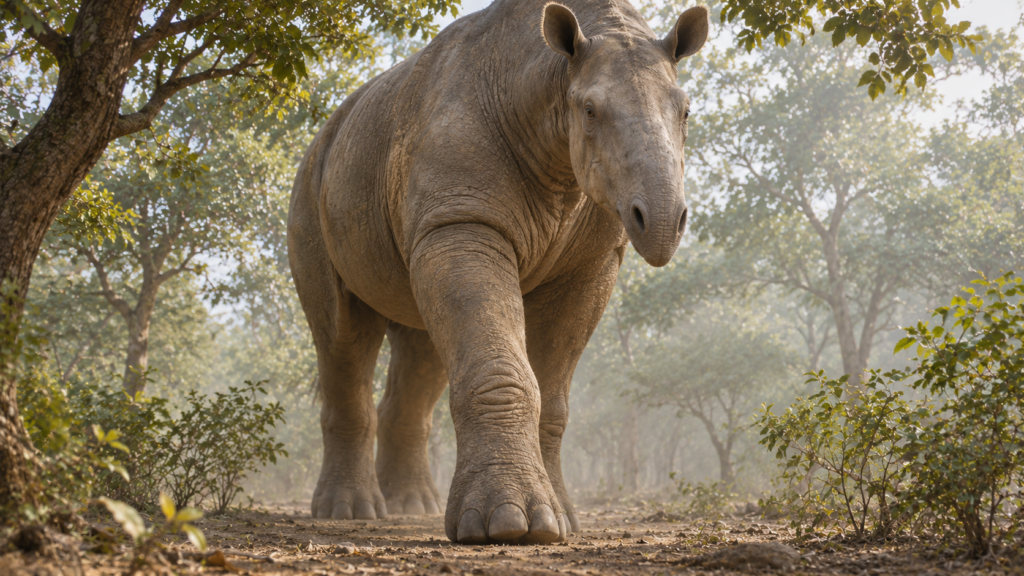
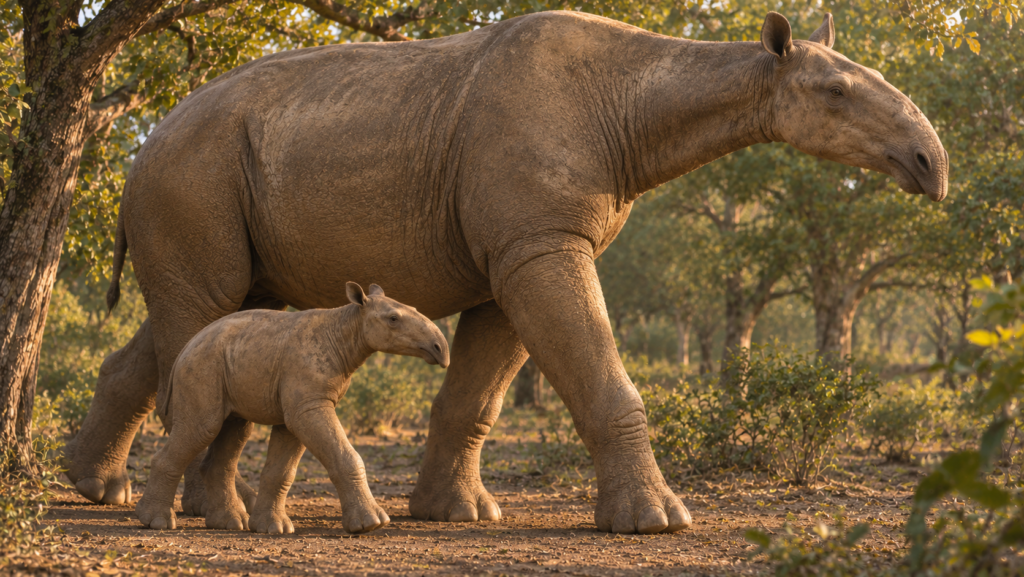
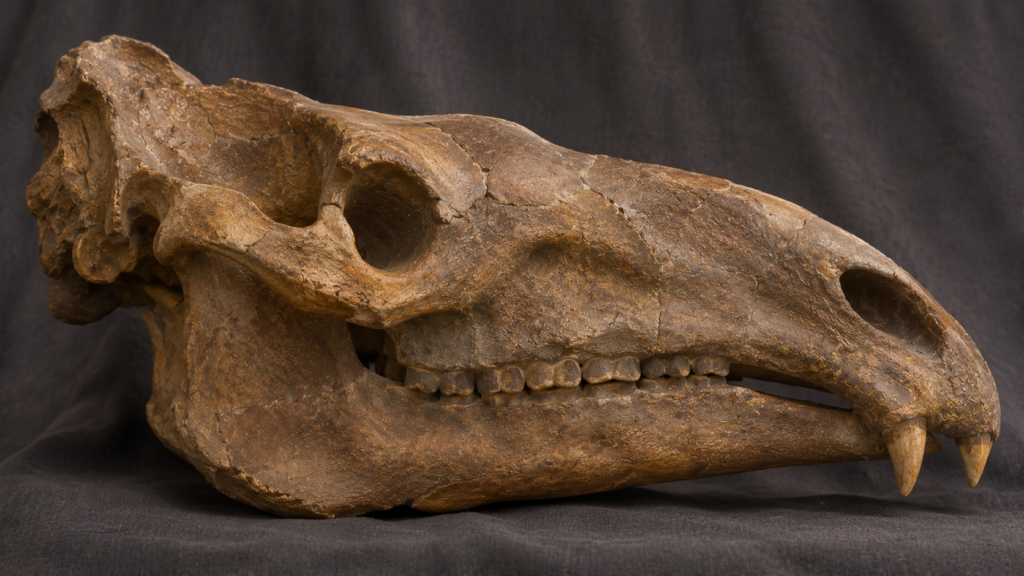
Paraceratherium was a tall animal with four long legs and a long neck, far longer in both leg and neck than any living rhinoceros. Its upper front teeth were downward-pointing cones, and two lower front teeth jutted forward. The skull of a species described from China in 2021 has a deep notch above the nose, which suggests a short, mobile nose.
It is thought to have eaten the leaves of shrubs and similar plants. In 1936, Walter Granger and William Gregory of the American Museum of Natural History judged from the shape of the neck bones that it could not raise its head much above the shoulders, and concluded that it usually kept its head low and fed on relatively low bushes. They interpreted the upper front teeth as tools for pulling up shrubs with a downward swing of the head. Its cheek teeth were fairly small and not shaped for grinding tough grasses.
The rocks it is found in suggest open country with a mix of woodland and grassland. Beds yielding the species described in 2021 also contain its close relative Dzungariotherium, a chalicothere, and a large omnivorous entelodont.
Most fossils come from Pakistan, China, Mongolia and Kazakhstan. The 2021 study traced a route in which the oldest species lived in Mongolia, spread west to Kazakhstan and then south to Pakistan, and later moved north again. The Tibetan region had not yet risen into a high plateau, so the animals could pass between north and south across low ground.
A Record Size Inflated from Enlarged Bones
The name Paraceratherium first appeared in 1911, when the British paleontologist Clive Forster-Cooper named a lower jaw found in the Bugti Hills of what is now Pakistan, then part of British India. It came from a very old individual and was 72 cm long; its two forward-jutting front teeth were the main reason he set up a new genus. In the same report he also mentioned an enormous neck vertebra, the atlas, 47.5 cm wide.
More names followed. In 1913 Forster-Cooper gave a new genus name to bones from the same hills, corrected the genus name the following month, and the animal came to be called Baluchitherium. In 1915 the Russian paleontologist Alexei Borissiak named Indricotherium. In 1922 the American Museum of Natural History’s Central Asiatic Expedition found a skull in Mongolia, and the next year Henry Fairfield Osborn described it as a new species of Baluchitherium. By 1936 Granger and Gregory were already writing that these might all be the same animal. Today Baluchitherium and Indricotherium are treated as part of Paraceratherium, and the name Paraceratherium is used.
The size figures grew out of a restoration from the 1930s. In 1935 Granger and Gregory redrew the whole skeleton from the bones collected in Mongolia. The bones varied widely in size from one individual to another; the long bones of the front foot, for example, ranged from 39 cm to 63.5 cm. The two scientists sorted the bones into four size grades and scaled the smaller ones up by 1.2 to 1.4 times to match the largest grade. The skeleton they assembled this way stood about 5.3 m at the shoulder.
This “largest grade” skeleton long served as the yardstick for the animal’s size, and weights of 20 to 30 tonnes spread through the textbooks. In 1993 Mikael Fortelius and John Kappelman re-estimated the weight from bone measurements, using more than 90 calculations. They arrived at an average of about 11 tonnes, with the largest individuals probably reaching 15 to 20 tonnes. They pointed out that the figure of 20 to 30 tonnes was too high and traced it back to the enlarged bones of the 1930s restoration. The title of their paper was “The largest land mammal ever imagined.”
Even after the re-estimate, Paraceratherium was about as large as the biggest elephants and remains among the largest land mammals known. What changed was the number used to describe its size.
Related products
You can find books and products related to this article on Amazon.
If you buy through the links above, this blog may earn a commission.
About the images
The images in this article are illustrations created with AI (ChatGPT), and you are welcome to use them. If you do, we would appreciate a link back to this article as the source.
Sources
Forster-Cooper, C. (1911). Paraceratherium bugtiense, a new genus of Rhinocerotidae from the Bugti Hills of Baluchistan. Preliminary notice. Annals and Magazine of Natural History (8) 8, 711–716. https://doi.org/10.1080/00222931108693085
Forster-Cooper, C. (1913). Correction of generic name. Annals and Magazine of Natural History (8) 12, 504. https://doi.org/10.1080/00222931308693431
Granger, W. & Gregory, W. K. (1935). A revised restoration of the skeleton of Baluchitherium, gigantic fossil rhinoceros of Central Asia. American Museum Novitates 787. https://archive.org/details/revisedrestoratno78gran
Granger, W. & Gregory, W. K. (1936). Further notes on the gigantic extinct rhinoceros, Baluchitherium, from the Oligocene of Mongolia. Bulletin of the American Museum of Natural History 72, 1–73. https://archive.org/details/bulletin-american-museum-natural-history-72-001-073
Fortelius, M. & Kappelman, J. (1993). The largest land mammal ever imagined. Zoological Journal of the Linnean Society 108, 85–101. https://doi.org/10.1111/j.1096-3642.1993.tb02560.x
Deng, T. et al. (2021). An Oligocene giant rhino provides insights into Paraceratherium evolution. Communications Biology 4, 639. https://doi.org/10.1038/s42003-021-02170-6
Chinese Academy of Sciences (2021). New species of giant rhino discovered in China (EurekAlert!) https://www.eurekalert.org/news-releases/922022

コメント