This article contains affiliate links. As an Amazon Associate I earn from qualifying purchases.
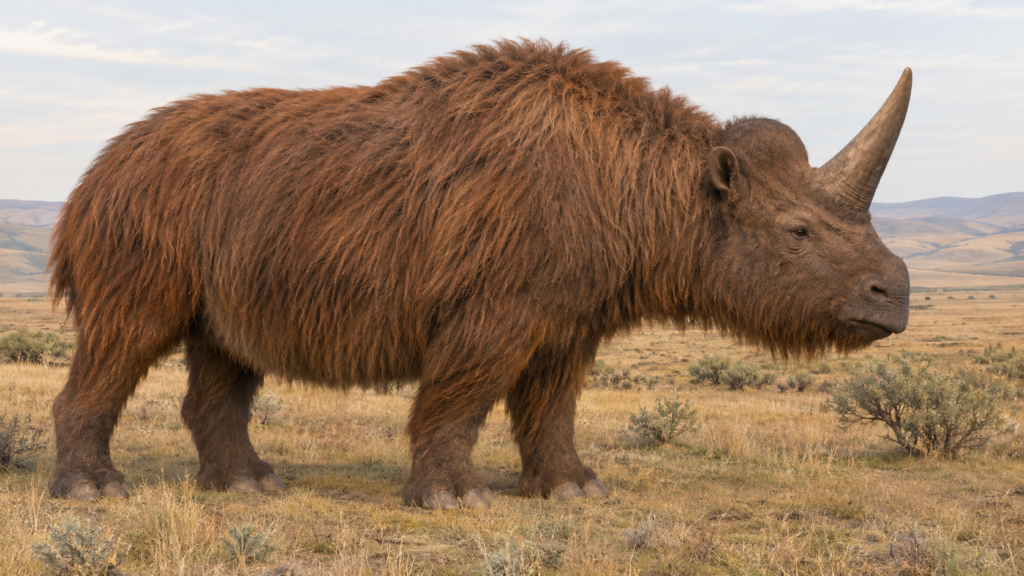
| Name | Elasmotherium sibiricum (Elasmotherium sibiricum; “thin-plate beast,” after the tooth enamel folded like stacked thin plates) |
| Classification | Mammalia, Perissodactyla, Rhinocerotidae, Elasmotheriinae |
| Period | Quaternary, Pleistocene (survived until at least about 39,000 years ago) |
| Found in | Steppes from Eastern Europe to Central Asia (southern Russia, Ukraine, Moldova, Kazakhstan, Uzbekistan and elsewhere) |
| Length | At least 4.5 m in large individuals |
| Shoulder height | Over 2 m |
| Weight | Estimated at up to about 3.5 tonnes |
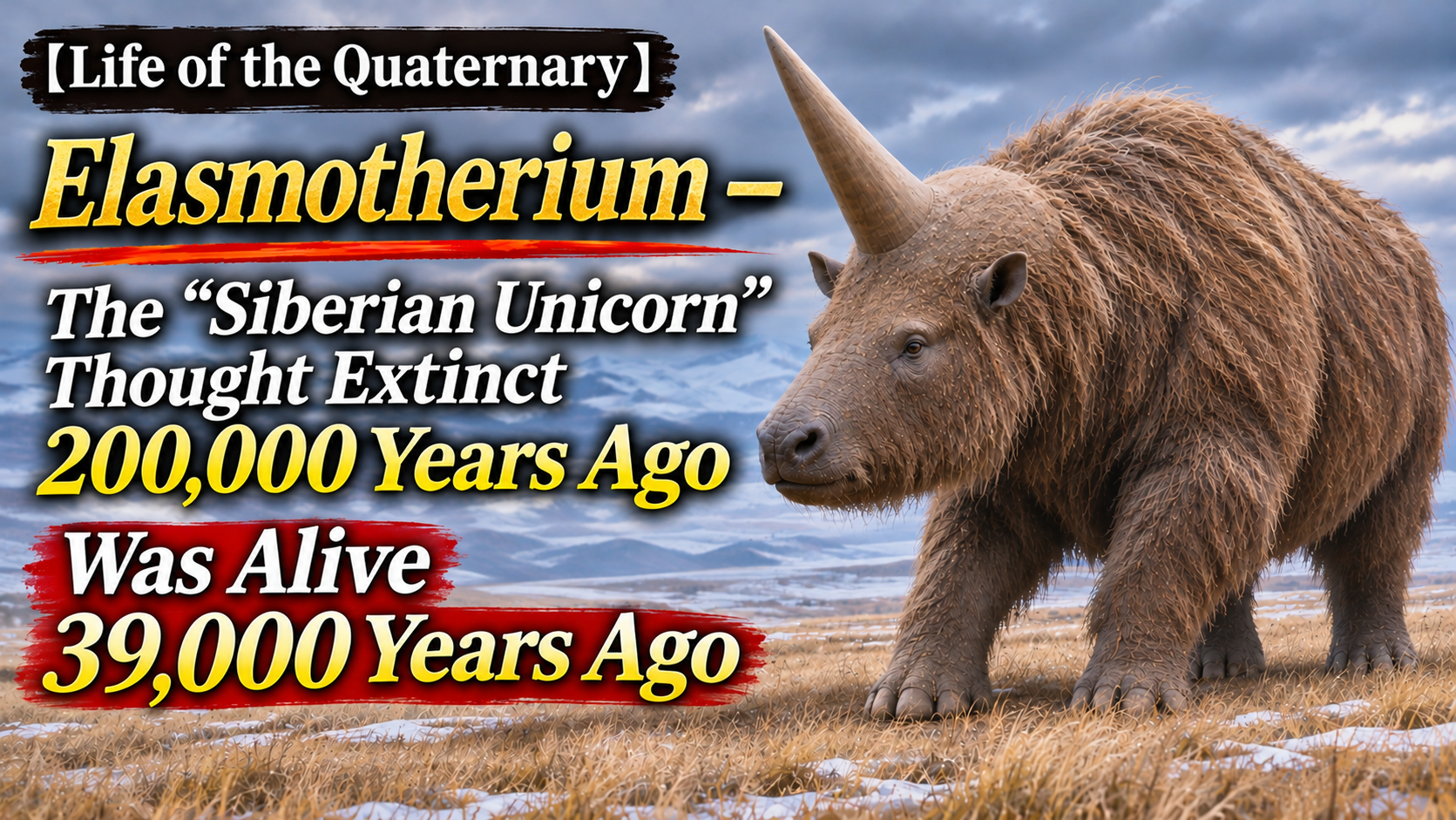
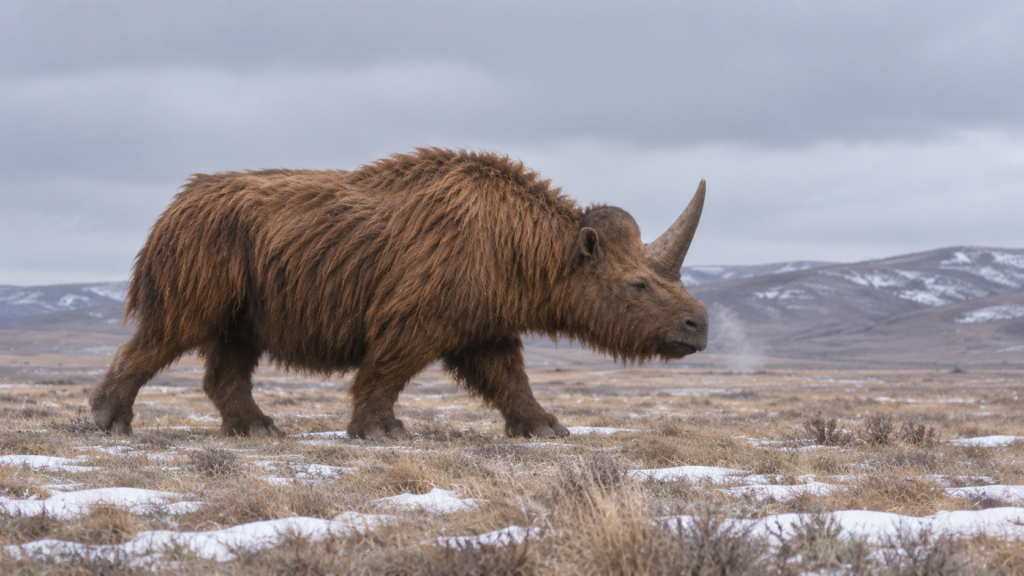
Elasmotherium sibiricum was a large rhinoceros that lived on the grasslands of Pleistocene Eurasia. It is thought to have carried a big horn on its forehead, which has earned it the nickname “Siberian unicorn.” For a long time it was believed to have died out around 200,000 years ago, but a 2018 study showed it was still alive at least about 39,000 years ago.
Appearance and Way of Life
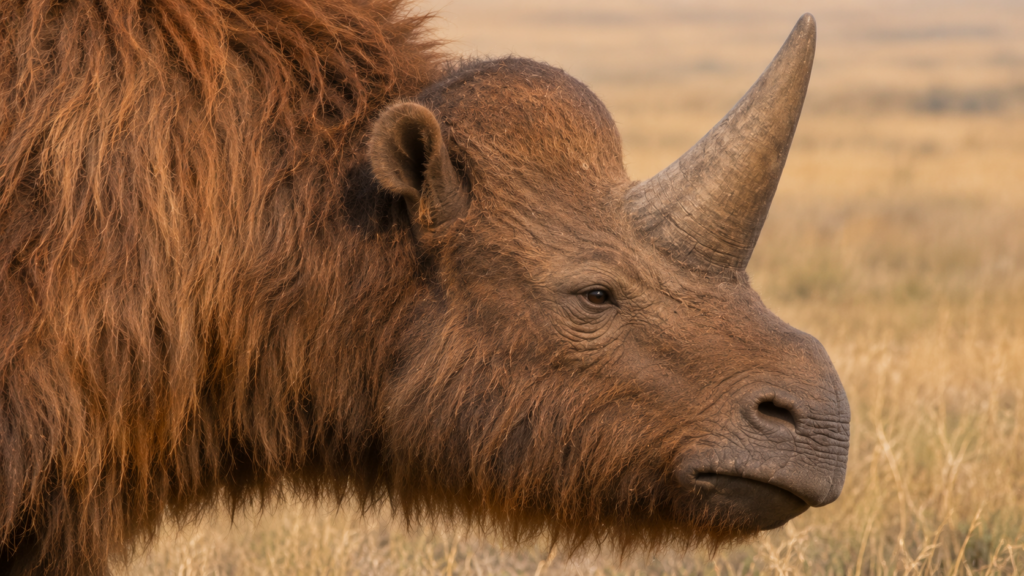
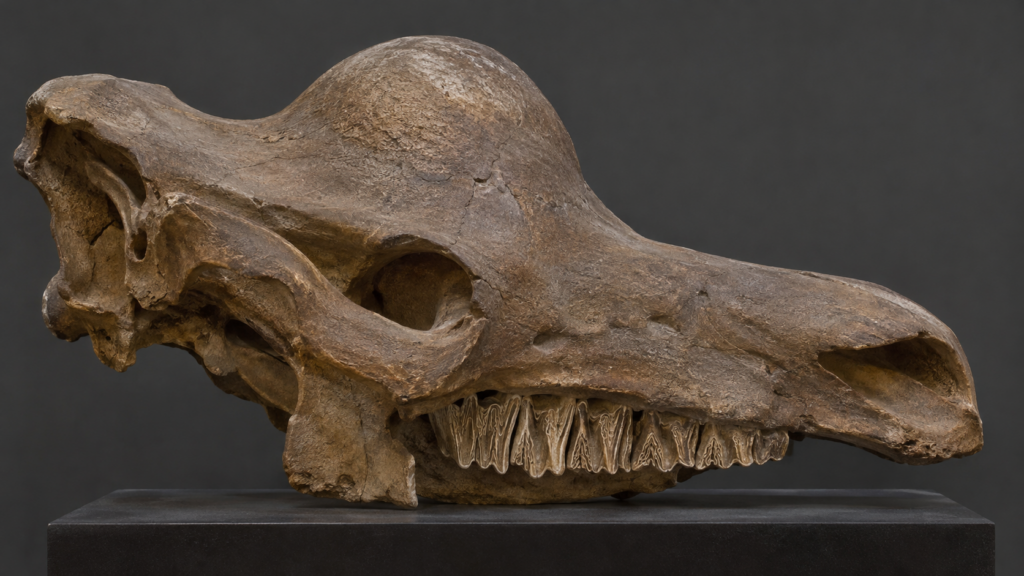
Elasmotherium was as big as the largest living rhinos or bigger, and stood on four thick legs. An adult male’s skull measured 86 to 89 cm, and on the forehead was a large domed swelling about 25 to 35 cm across. A horn is thought to have grown from this dome, but no fossil of the horn itself has been found. Rhino horn is made of keratin rather than bone, and it rarely fossilizes. The outer wall of the dome is thin, and a 2021 study argued that it is unlikely to have supported a very large horn and that the horn was probably smaller.
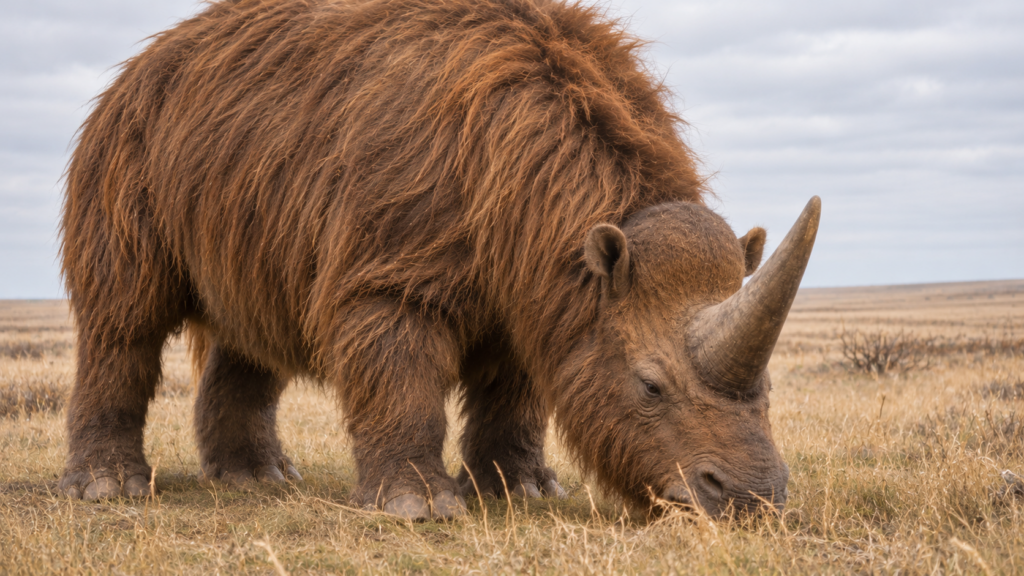
Its teeth were high-crowned and kept growing throughout life. The enamel was finely folded in wavy layers, which is where the name “thin plate” comes from. Teeth like these suit an animal that keeps eating hard, abrasive food. The 2018 research team measured carbon and nitrogen isotope ratios in the teeth and confirmed that it ate tough, dry grasses on dry steppe.
The genus name was announced in 1808 by Gotthelf Fischer von Waldheim, a naturalist in Moscow, and in 1809 he named the species Elasmotherium sibiricum. “Sibiricum” means “of Siberia,” but where the original specimen was actually found is unknown. Fossils have turned up across the steppe belt of central Eurasia, from southern Russia through Ukraine, Moldova, eastern Kazakhstan and Uzbekistan to Azerbaijan in the Caucasus.
A Rhino Thought Gone 200,000 Years Ago Was Alive 39,000 Years Ago
Elasmotherium sibiricum was long thought to have gone extinct around 200,000 years ago. As a result, its disappearance was treated as a separate event from the extinction of large animals at the end of the Pleistocene, when the woolly mammoth, the Irish elk and the sabre-toothed cat vanished. That date, however, had never been based on directly dating the fossils.
A team including Pavel Kosintsev and Adrian Lister of the Natural History Museum in London dated Elasmotherium bones with accelerator mass spectrometry radiocarbon dating. The first few specimens all came out younger than 40,000 years. The team then extended the dating to bones from 23 individuals and checked the results with a second method that dates only specific compounds extracted from the bone. They found that Elasmotherium sibiricum survived in Eastern Europe and Central Asia until at least about 39,000 years ago, and possibly as late as about 35,000 years ago. The results were published in 2018 in the journal Nature Ecology & Evolution.
Those dates overlap with the time when modern humans and Neanderthals were already in Eurasia. Even so, the team considers it unlikely that people caused the extinction. They think a combination pushed the species over the edge: its complete dependence on tough grasses of the dry steppe, its naturally small population and the sharp swings in climate at the time. The last records coincide with a cold phase in the North Atlantic about 40,000 years ago. Other large animals in Eurasia were also being replaced around 40,000 years ago, and the extinction of Elasmotherium came to be counted as part of that turnover.
The team also recovered DNA from the fossils. It showed that the Elasmotherium group (the subfamily Elasmotheriinae) and the group that includes all five living rhino species (the subfamily Rhinocerotinae) had split by the Eocene, about 43 million years ago. DNA settled a debate that the shapes of fossils alone had not resolved. Elasmotherium sibiricum was the last survivor of this ancient lineage, and with its extinction the subfamily Elasmotheriinae came to an end.
Related products
You can find books and products related to this article on Amazon.
If you buy through the links above, this blog may earn a commission.
About the images
The images in this article are illustrations created with AI (ChatGPT), and you are welcome to use them. If you do, we would appreciate a link back to this article as the source.
Sources
Kosintsev, P., Mitchell, K. J., Devièse, T., van der Plicht, J., Kuitems, M., Petrova, E., Tikhonov, A., Higham, T. et al. (2019). Evolution and extinction of the giant rhinoceros Elasmotherium sibiricum sheds light on late Quaternary megafaunal extinctions. Nature Ecology & Evolution 3, 31–38 (published online 26 November 2018). https://doi.org/10.1038/s41559-018-0722-0
Sci.News (2018). Giant Siberian Rhinoceros Lived alongside Early Modern Humans. https://www.sci.news/paleontology/elasmotherium-sibericum-06653.html
Wikipedia. Elasmotherium. https://en.wikipedia.org/wiki/Elasmotherium


コメント