
This article contains affiliate links. As an Amazon Associate I earn from qualifying purchases.
Japanese custard pudding, or purin, comes out smooth or full of tiny holes depending on two things: mixing and straining the custard without whipping in air, and steaming it over very low heat and letting it finish in the residual heat. This basic recipe makes four puddings in molds of about 100 ml, steamed in a frying pan instead of a steamer, followed by tips for getting it right.
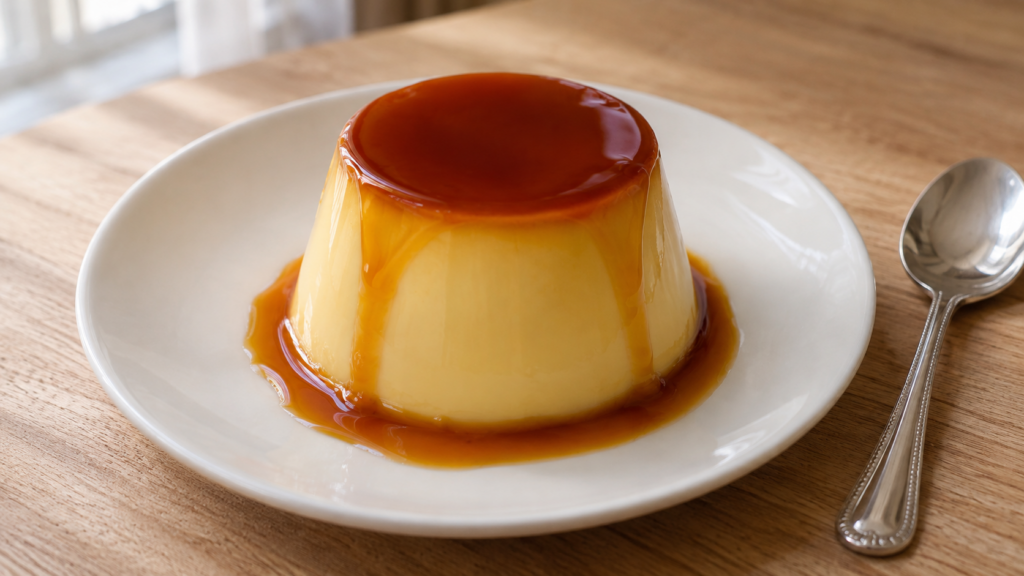
Ingredients (four molds of about 100 ml)
- Eggs: 2
- Milk: 250 ml
- Sugar: 60 g
- Vanilla extract: a few drops (optional)
- Butter or vegetable oil: a little, for greasing the molds
Caramel sauce
- Sugar: 50 g
- Water: 1 tbsp
- Boiling water: 1 to 1 1/2 tbsp
The custard works out to about 125 ml of milk and 30 g of sugar per egg. Besides pudding molds, heatproof ramekins also work.
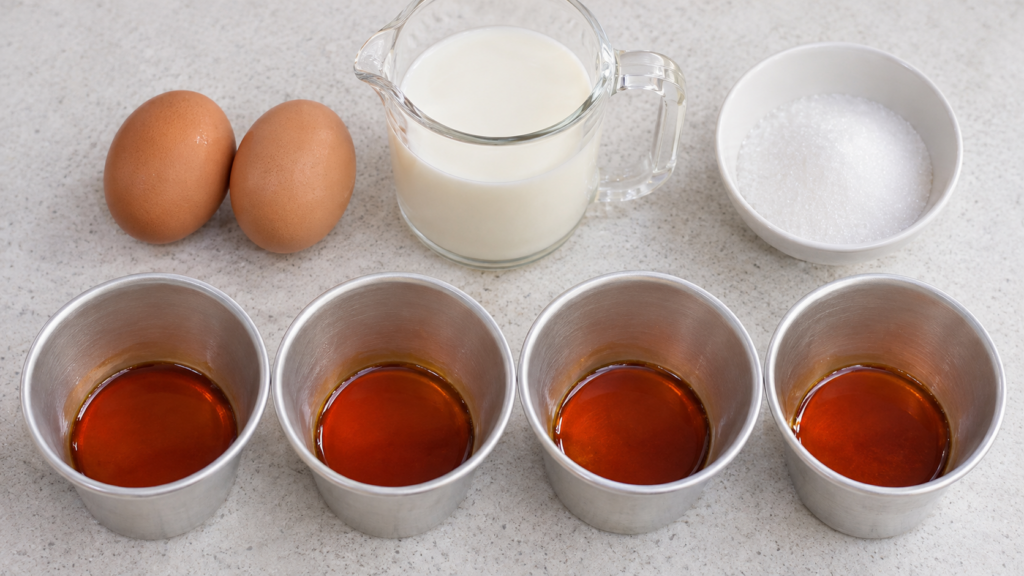
Method
1. Grease the molds
Brush the inside of each mold thinly with butter or oil.
2. Make the caramel sauce
Put 50 g of sugar and 1 tbsp of water in a small saucepan over medium-high heat. Let it cook without stirring. When it starts to color, turn the heat to low and swirl the pan to even out the color. When it turns a deep amber, take it off the heat and dip the bottom of the pan in water for a few seconds. Add the boiling water and swirl to combine. While it is still hot, divide it among the molds and leave it to set.
3. Warm the milk
Put half the milk and the 60 g of sugar in a heatproof bowl and microwave, uncovered, at 600 W for about 1 minute. Stir to dissolve the sugar, then add the rest of the milk.
4. Make and strain the custard
Crack the eggs into another bowl and mix them without making them foamy. Add the milk a little at a time, stirring, then add the vanilla. Strain through a tea strainer or fine-mesh sieve. Skim off any foam on the surface with a spoon.
5. Fill the molds and set them in the frying pan
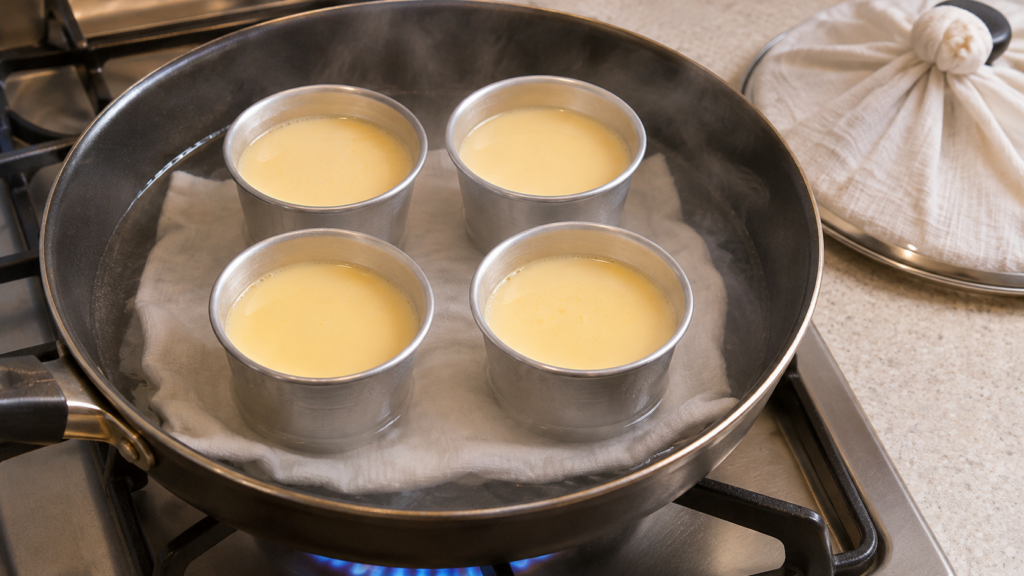
Gently pour the custard into the molds over the caramel. Lay a cloth (or about three stacked paper towels) in a frying pan that has a lid, and stand the molds on it. Pour boiling water around the molds to a depth of about 2 cm. Wrap the lid in a dry cloth so that drips don’t fall onto the puddings, and tie the corners on top of the lid to keep them away from the flame.
6. Steam over very low heat
Cover and set over medium heat. When steam begins to rise, turn the heat down as low as it goes and steam for about 15 minutes. Turn off the heat and leave the pan covered for about 15 minutes. Tilt a mold slightly: if the surface is set, the puddings are done. If the center still looks liquid, steam for a few more minutes over very low heat and let them rest covered again.
7. Chill and unmold
Let them cool slightly, then chill in the refrigerator for at least 1 hour. Run a bamboo skewer around the inside edge of each mold, place a plate on top, turn it over, and give it two or three gentle shakes to release the pudding.
Tips for getting it right
Stop the caramel before it overcooks
Caramel keeps darkening from the heat of the pan after you turn off the burner, and if it goes too far it turns bitter. Take it off the heat just before it reaches the color you want, and dip the bottom of the pan in water to cool it down. The caramel spatters violently when you add the boiling water, so keep your face away. Boiling water spatters less than cold water.
Don’t whip the custard, and skim the foam after straining
Straining the custard gives it a smoother texture. Foam left on the custard leaves holes on the surface after steaming, so mix the eggs without whipping and skim off the foam after straining.
Never let it boil: very low heat, then residual heat
When the heat is too strong and the custard gets too hot, small holes (called su in Japanese) form inside the pudding. Steam over heat low enough that the water never boils, and finish by turning off the heat and letting the residual heat set the custard. If too much steam is building up, slip a chopstick between the lid and the pan to leave a small gap so the temperature doesn’t climb too high.
Wrap the lid in a cloth
While the puddings steam, water droplets collect on the underside of the lid. Wrapping the lid in a cloth lets the cloth soak up the drips so they don’t fall onto the puddings.
If something went wrong
The pudding has tiny holes inside. The heat was too high or the water was boiling. Next time, turn the heat right down as soon as steam appears, and open a small gap under the lid if the steam is strong.
It didn’t set in the given time. How quickly the custard cooks depends on the size and material of the molds and the strength of your burner. Steam a few minutes at a time over very low heat, then leave it covered and check again.
The caramel is bitter. It was cooked too long. Next time, take it off the heat just before it fully darkens and dip the pan in water right away.
The surface has holes or bumps. Foam was left on the custard, or water dripped from the lid. Skim the foam after straining, and wrap the lid in a cloth.
The pudding won’t come out of the mold. The skewer may not have reached the bottom. Run it along the inside of the mold all the way to the bottom before turning it over.
Related products
You can find books and products related to this article on Amazon.
If you buy through the links above, this blog may earn a commission.
About the images
The images in this article are illustrations created with AI (ChatGPT), and you are welcome to use them. If you do, we would appreciate a link back to this article as the source.
Sources
- NHK Kyo no Ryori, “Purin” by Yoko Kosuge (in Japanese)
- NHK Kyo no Ryori, “Purin” by Kyoko Tateno (in Japanese)
- NHK Kyo no Ryori, “Custard Purin” (in Japanese)
- DELISH KITCHEN, “Pudding Made in a Frying Pan” (in Japanese)
- Shirogohan.com, “Steamed Pudding Made in a Pot” (in Japanese)
- Morinaga Milk, “Custard Pudding” (in Japanese)
- Meiji, “Custard Pudding” (in Japanese)


コメント