This article contains affiliate links. As an Amazon Associate I earn from qualifying purchases.
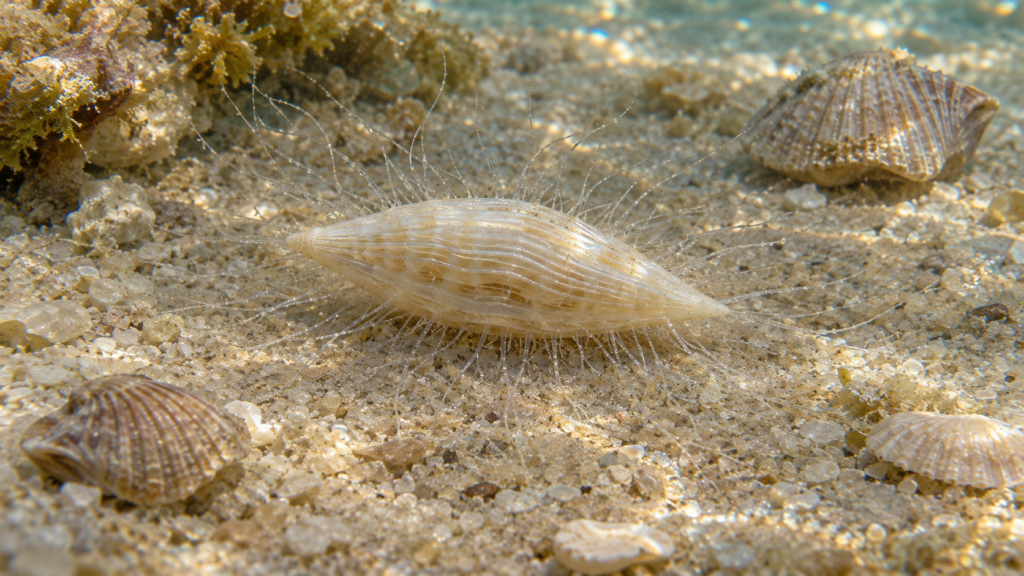
| Name | Fusulinids. The group is named after the genus Fusulina, described in 1829. The name comes from the Latin for “spindle,” after the shape of the shell |
| Classification | Foraminifera, fusulinids (single-celled protists) |
| Age | End of the Early Carboniferous to the end of the Permian (about 323 to 252 million years ago), most abundant from the Late Carboniferous through the Permian |
| Locality | Every continent except Antarctica. In Japan, limestones such as Akiyoshidai in Yamaguchi Prefecture and Kinshozan in Ogaki, Gifu Prefecture |
| Size | Mostly from about 1 mm to a little over 1 cm long. Some Permian individuals exceeded 10 cm |
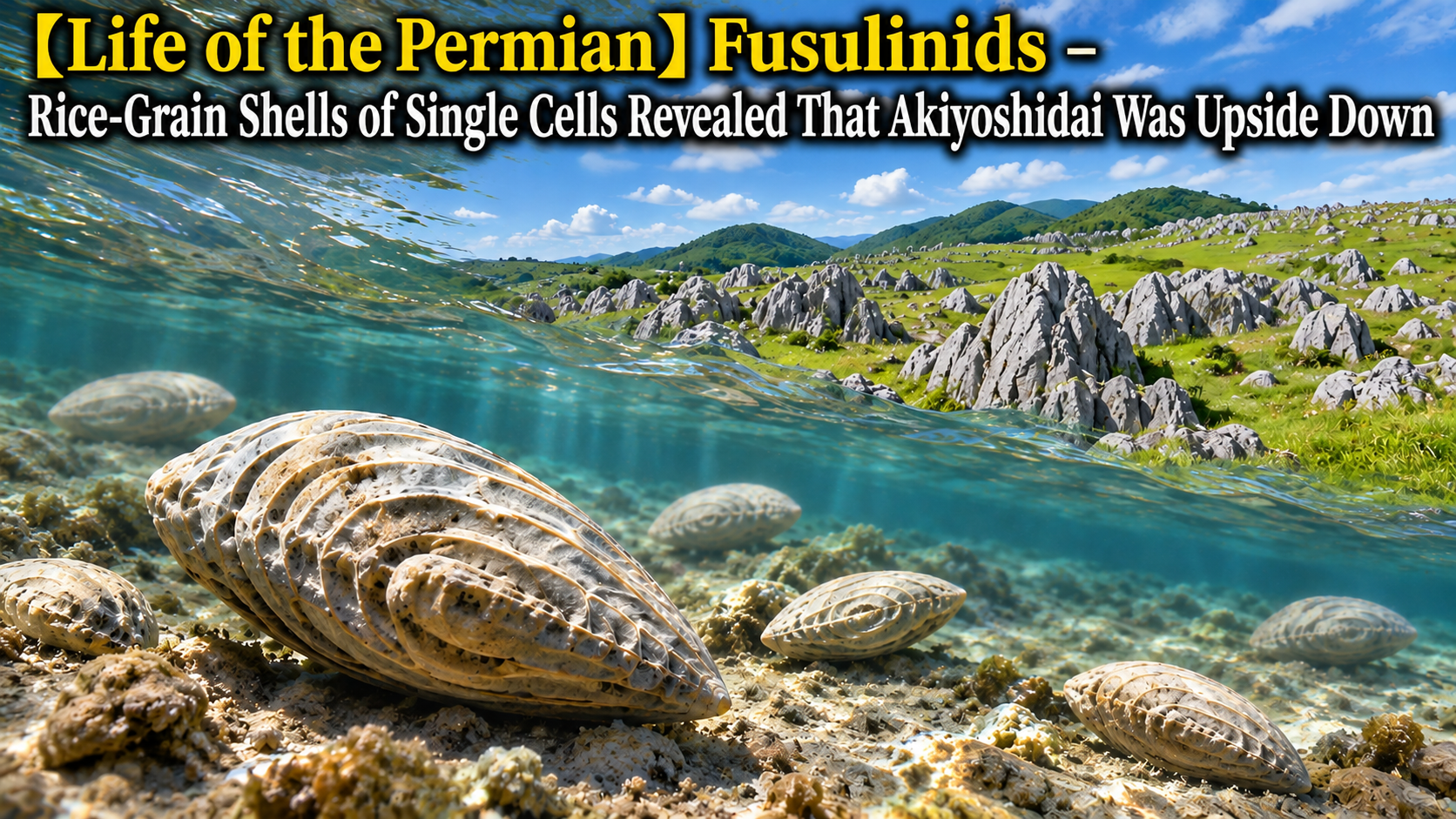
Fusulinids were single-celled foraminifera that lived on the floors of warm, shallow seas from the Carboniferous to the Permian. Their spindle-shaped calcite shells were about the size of a grain of rice or wheat, and in places entire limestone beds consist almost wholly of fusulinid shells. In Japan they are known as the fossils that showed the rock layers of Akiyoshidai in Yamaguchi Prefecture to be turned upside down.
Appearance and Life
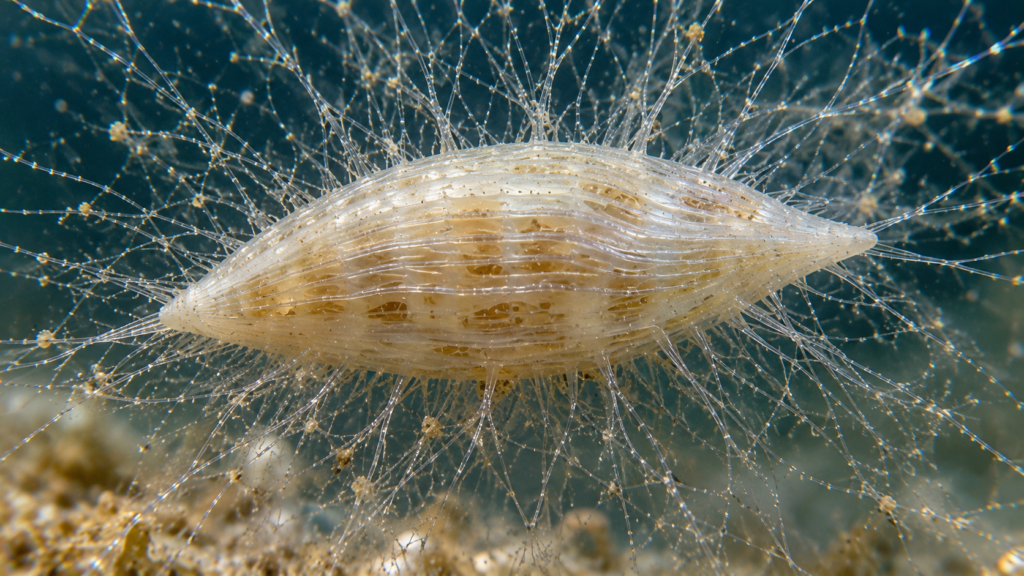
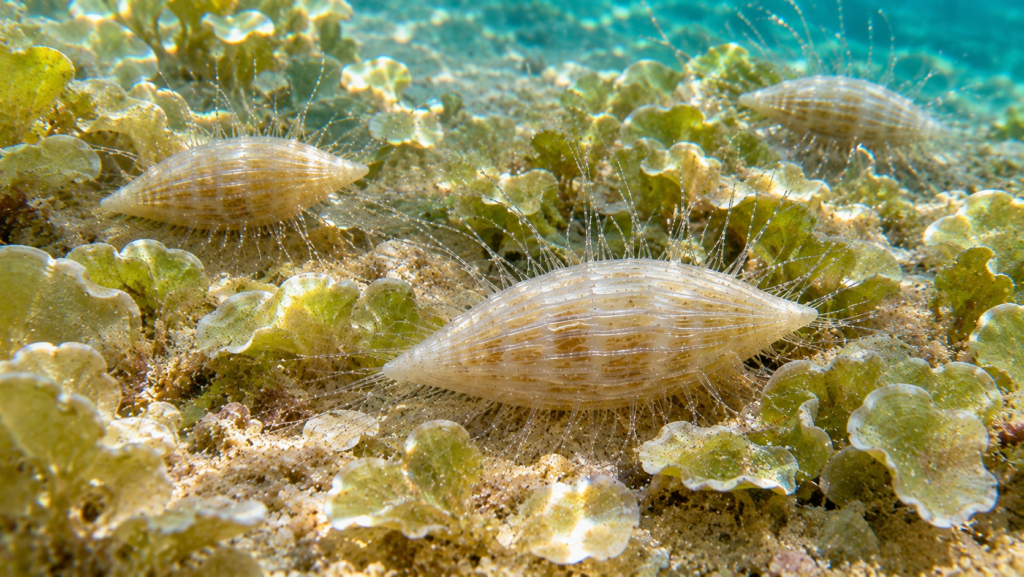
Foraminifera are amoeba-like single-celled organisms that build shells of calcite or other materials, and many species still live in today’s oceans. They extend thin, threadlike pseudopodia through openings in the shell to catch food and move across the sea floor. Fusulinids belonged to this group, and a single cell built a shell from a few millimeters to several centimeters long.
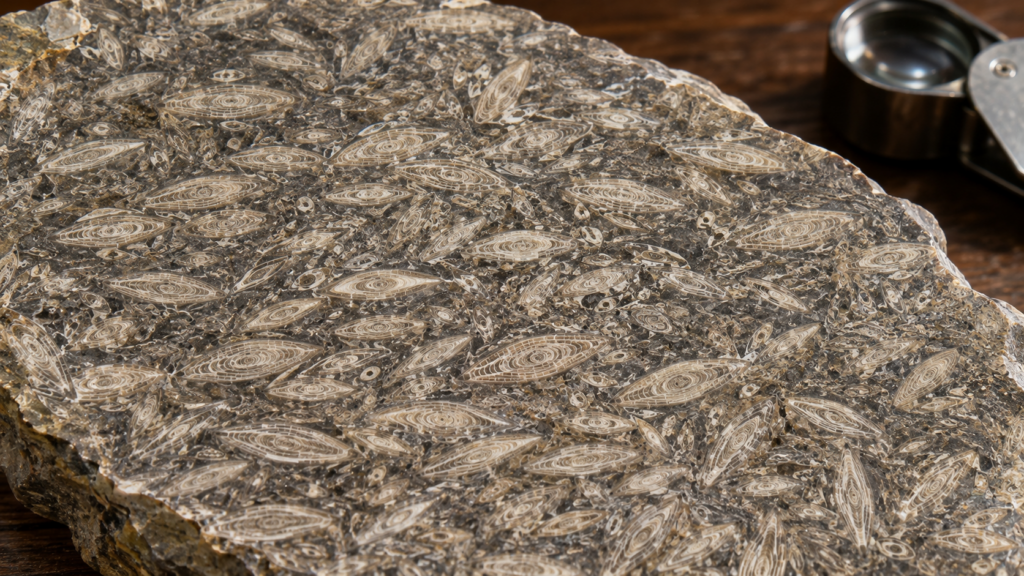
From the outside the shells all look like similar spindles, but inside they are finely partitioned. The shell grew by coiling around a long axis, and each coil was divided by walls into many small chambers. Over time the internal structure became more elaborate, with wavy partitions and shell walls with a fine, honeycomb-like texture. Because species cannot be told apart from the outside, researchers identify them by grinding shells into thin sections or polishing cut surfaces and examining them under a microscope.
Their shapes and sizes varied, from nearly round to elongated like a rugby ball. Some Permian individuals grew longer than 10 cm. A 2012 study linked this gigantism to high levels of oxygen in the atmosphere at the time. Large foraminifera in today’s oceans house algae inside their cells and draw nourishment from their photosynthesis. Fusulinids are widely thought to have hosted algae in the same way, though most of the evidence is indirect.
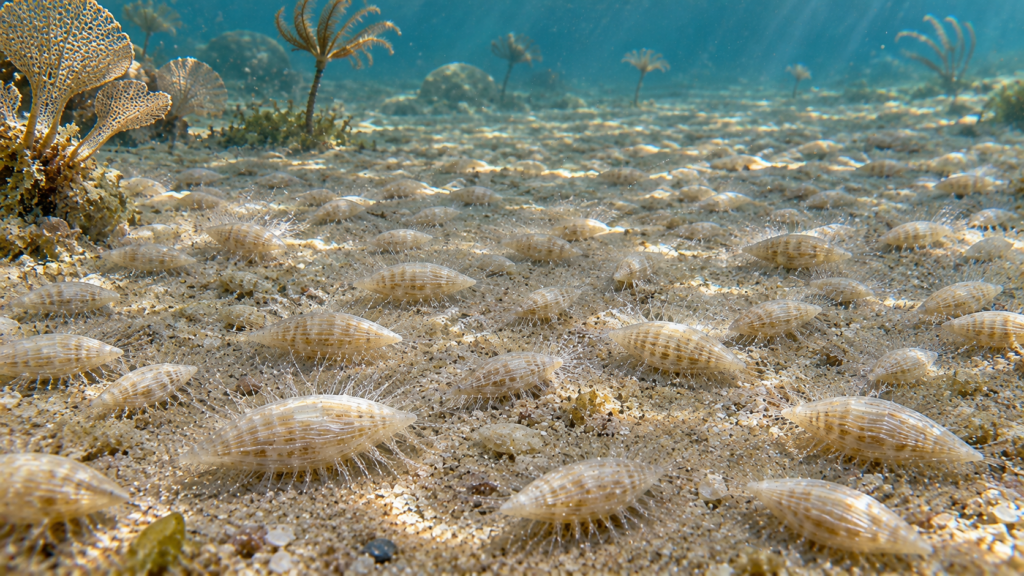
Fusulinids appeared at the end of the Early Carboniferous and spread through shallow seas worldwide from the Late Carboniferous into the Permian. Kansas has limestone beds made almost entirely of fusulinid shells. Many species disappeared toward the end of the Middle Permian; according to a 2013 study, 88 percent of species were lost over about 9 million years. The survivors died out in the mass extinction at the end of the Permian, about 252 million years ago.
The Fossils That Turned Akiyoshidai Upside Down
Fusulinid species replaced one another in quick succession and spread widely across the globe. That made them index fossils: the species a rock layer contains can date it precisely. They have long been used to study Carboniferous and Permian rocks.
The limestone of Akiyoshidai in Yamaguchi Prefecture, one of Japan’s largest karst plateaus, was deciphered this way. In 1923 the geologist Yoshiaki Ozawa examined the sequence of fusulinid species in the Akiyoshi limestone. Normally, the lower a rock layer lies, the older it is. But in parts of Akiyoshidai, layers containing younger fusulinids lay below layers containing older ones. Ozawa concluded that the rocks of Akiyoshidai had been overturned on a large scale.
In the current interpretation, the Akiyoshi limestone began as a reef that grew on top of a submarine volcano in the open ocean. The reef was carried north by plate motion and collided with the foundation of the Japanese islands, and the northern part of the limestone is thought to have been flipped over in the collision. The clue that revealed the overturn was the fusulinid shells that had piled up within the reef.
Kinshozan in Ogaki, Gifu Prefecture, is another limestone mountain known for its fusulinids. One species found there, Parafusulina japonica, is said to be the first Japanese fossil ever given a scientific name.
Related products
You can find books and products related to this article on Amazon.
If you buy through the links above, this blog may earn a commission.
About the images
The images in this article are illustrations created with AI (ChatGPT), and you are welcome to use them. If you do, we would appreciate a link back to this article as the source.
Sources
Geological Survey of Japan, Chishitsu News No. 456 (1992), in Japanese (the overturned structure of Akiyoshi and Ozawa 1923; interpretation as a reef on a seamount) https://www.gsj.jp/data/chishitsunews/92_08_09.pdf
Geological Survey of Japan, Chishitsu News, in Japanese (bibliographic details of Ozawa 1923) https://www.gsj.jp/data/chishitsunews/72_04_11.pdf
Kinshozan Fossil Museum, Ogaki City, newsletter (June 2019), in Japanese (shape and size of fusulinids; Parafusulina japonica) https://www.city.ogaki.lg.jp/cmsfiles/contents/0000000/664/201906fuzurina.pdf
Kansas Geological Survey, GeoKansas: Fusulinids (size, age range, Kansas limestones, identification by thin section) https://geokansas.ku.edu/fusulinids
Payne, J. L. et al. (2012). Late Paleozoic fusulinoidean gigantism driven by atmospheric hyperoxia. Evolution 66(9), 2929–2939. https://doi.org/10.1111/j.1558-5646.2012.01626.x
Zhang, S. & Payne, J. L. (2012). Size-frequency distributions along a latitudinal gradient in Middle Permian fusulinoideans. PLoS ONE 7(6), e38603. https://doi.org/10.1371/journal.pone.0038603
Groves, J. R. & Wang, Y. (2013). Timing and size selectivity of the Guadalupian (Middle Permian) fusulinoidean extinction. Journal of Paleontology 87(2), 183–196. https://doi.org/10.1666/12-076R.1
WoRMS, Fusulina Fischer de Waldheim, 1829 https://www.marinespecies.org/aphia.php?p=taxlist&tName=Fusulina

コメント