This article contains affiliate links. As an Amazon Associate I earn from qualifying purchases.
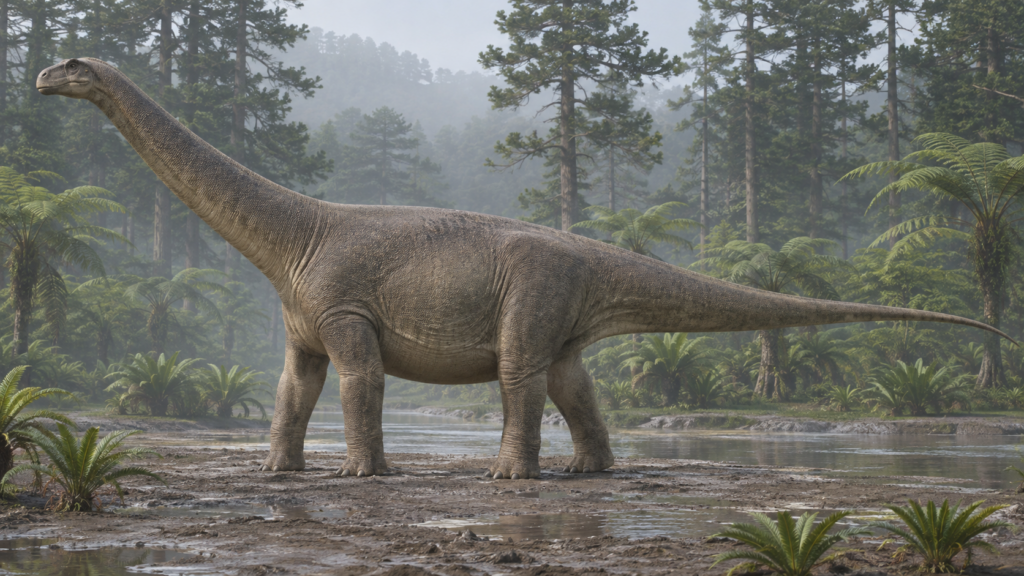
| Name | Tambatitanis amicitiae, nicknamed “Tambaryu” (the Tamba dragon) in Japan. The genus name joins “Tamba”, where the fossil was found, with the Greek titanis, giant. The species name comes from the Latin for “friendship” |
| Classification | Saurischia, Sauropoda, Titanosauriformes; possibly a member of Euhelopodidae, a group known only from East Asia |
| Age | Early Cretaceous. The lower formation of the Sasayama Group, where the fossil was found, is thought to be early Albian. A tuff low in the same formation has been dated to about 112 million years ago |
| Found in | The bed of the Sasayama River at Kamitaki, Sannan-cho, Tamba City, Hyogo Prefecture, Japan |
| Length | Estimated at about 15 m |
| Head size | A few tens of centimetres |
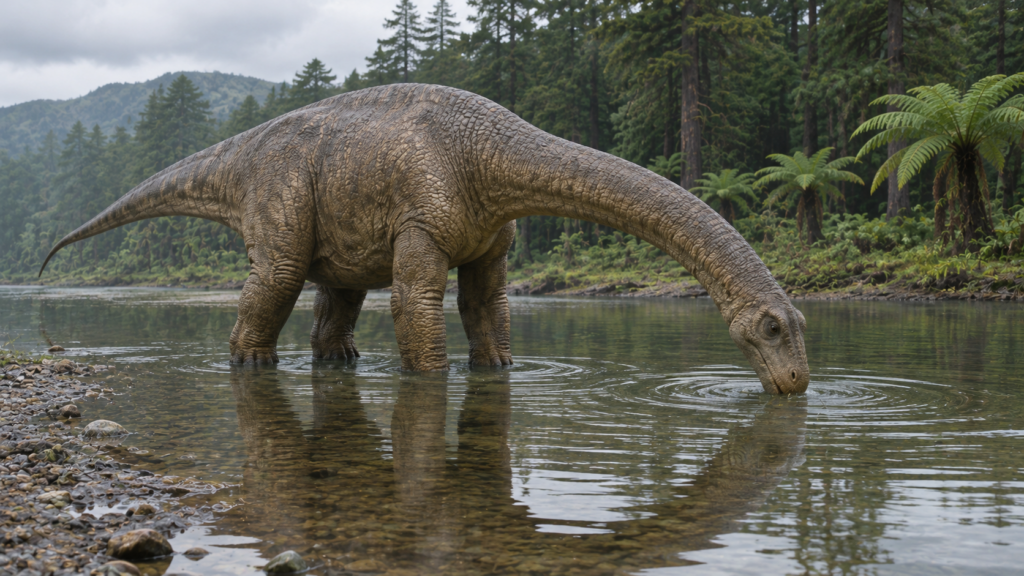
Tambatitanis is a sauropod that lived in Japan in the Early Cretaceous. It was a large plant-eating dinosaur with a long neck and a long tail, estimated at about 15 metres long. Two local men found its fossil on a riverbed in Tamba City, Hyogo Prefecture, in 2006, and it was named as a new genus and species in 2014. The species name, amicitiae, honours the friendship between the two.
Appearance and Way of Life
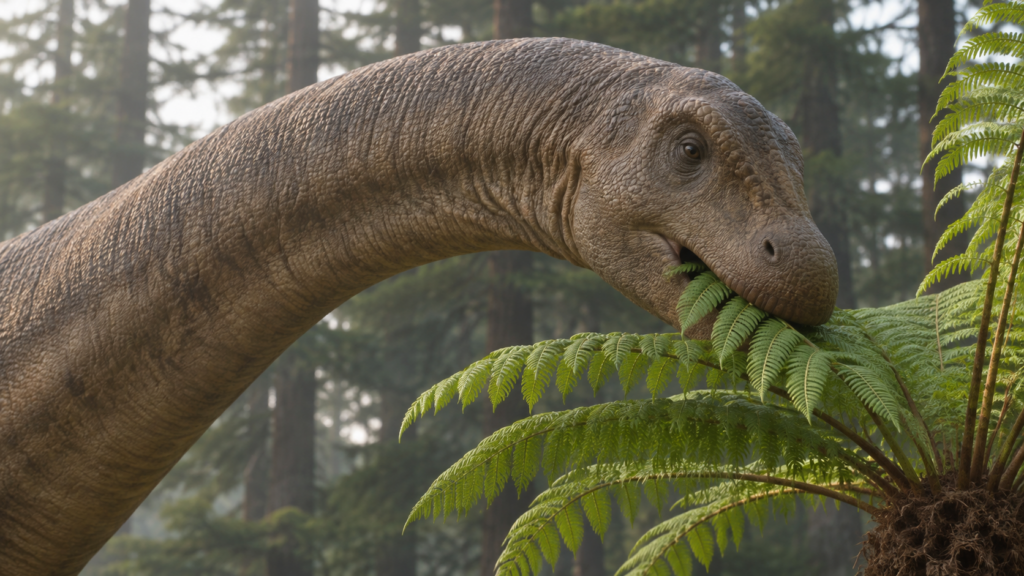
Tambatitanis stood on four pillar-like legs and carried a small head at the end of a long neck. The head was only a few tens of centimetres long. The bones found belong to a single animal: teeth, the rear part of the skull that held the brain (the braincase), part of a lower jaw, neck bones, ribs, parts of the backbone, hip bones, 22 tail vertebrae and 17 chevrons (V-shaped bones attached beneath the tail vertebrae). The bones lay together within an area of about 6 by 4 metres.
The paper that named it lists eight features that set it apart from other sauropods, all of them in the tail vertebrae, chevrons and braincase. In the vertebrae at the base of the tail, the spine that rises from the top of each bone curves strongly forward in a bow, and its tip swells into a rounded knob. The chevrons at the base of the tail are, relative to body size, the longest of any sauropod. Its anatomy marks it as an early member of the titanosauriforms, and the paper suggests it may belong to the group that includes the Chinese sauropod Euhelopus.
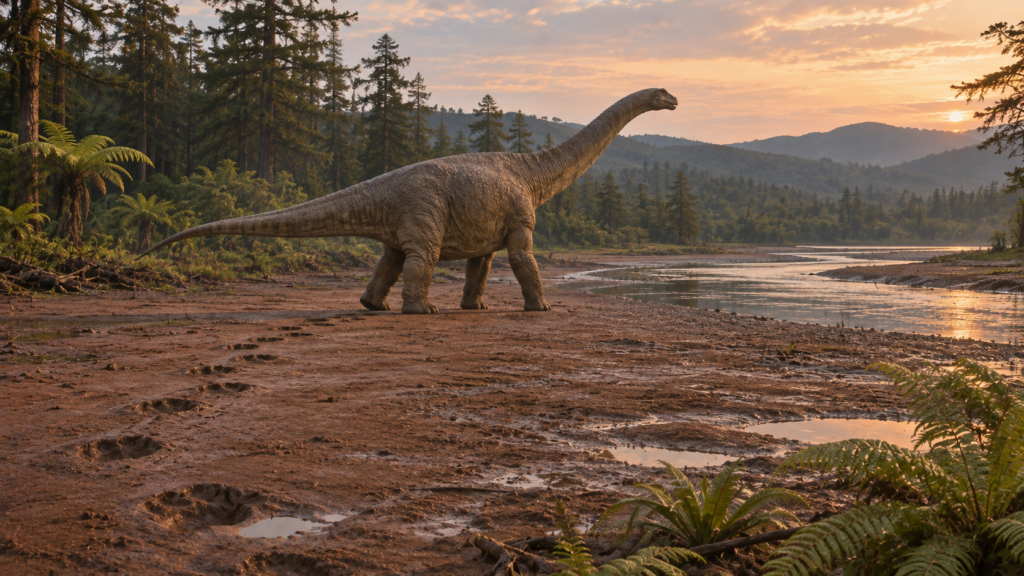
The fossil was buried in reddish mudstone, made of mud that spread over a plain when the river flooded. The same layer has also produced frog bones (including complete skeletons), lizard teeth and jaws, and teeth shed by other dinosaurs. Those teeth came from ornithopods related to the hadrosaurs, armoured ankylosaurs, therizinosaurs and early tyrannosaur relatives. The frogs were named Hyogobatrachus wadai and Tambabatrachus kawazu in 2015, and fossil dinosaur eggshell from the site was described as a new type in the same year. In 2020, very small theropod eggs, estimated to have weighed about 10 g, were reported from the locality. Tambatitanis lived on a riverside plain alongside small dinosaurs, frogs and lizards.
A Riverbed Fossil, Dug Out Only in Winter
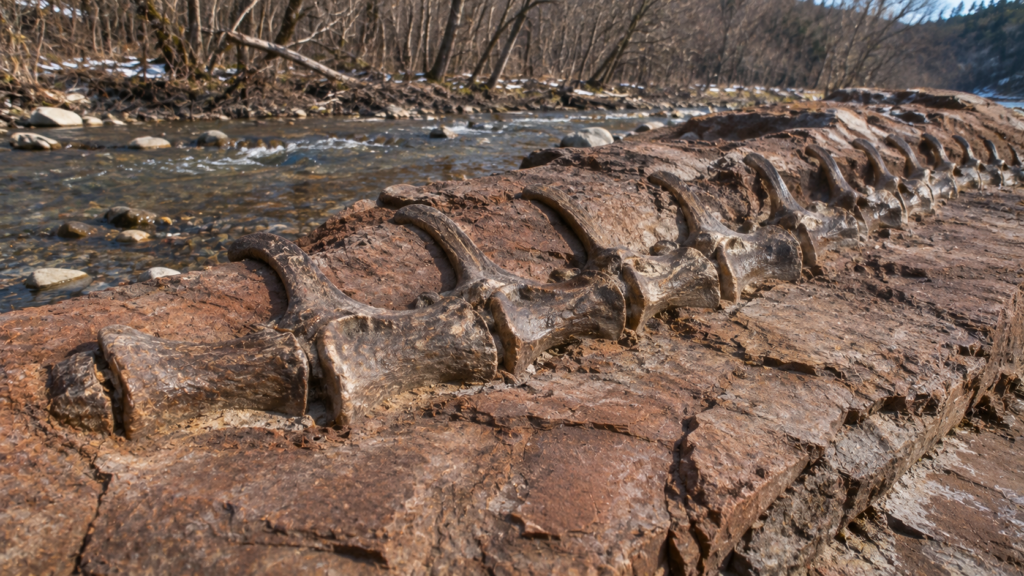
The fossil was found on 7 August 2006. Shigeru Murakami and Kiyoshi Adachi, who both lived in Tamba City, spotted bone exposed in rock on the bed of the Sasayama River. The two were amateur fossil hunters.
The bones lay in a hard layer of mudstone exposed in the riverbed. The layer can only be dug during a short period in winter, when there is little rain and the river is at its lowest. The first excavation ran from January to March 2007, and digging continued winter after winter, with the main excavations lasting until 2012. The paper counts five seasons of digging; Tamba City and other sources count six winter excavations.
In 2007, the braincase turned up while the excavated rock was being cleaned. It was the first sauropod skull material ever found in Japan. The braincase lay right next to the bones at the base of the tail. The museum’s interpretation is that after the animal died, its muscles contracted and bent the body strongly backward, bringing the head and tail close together before it was buried.
After the bones had been cleaned and studied, Haruo Saegusa and Tadahiro Ikeda of the Museum of Nature and Human Activities, Hyogo, described it as a new genus and species in the journal Zootaxa in August 2014. The paper states that the species name refers to the friendship between its discoverers, Mr Murakami and Mr Adachi. Eight years passed between the discovery and the naming.
Related products
You can find books and products related to this article on Amazon.
If you buy through the links above, this blog may earn a commission.
About the images
The images in this article are illustrations created with AI (ChatGPT), and you are welcome to use them. If you do, we would appreciate a link back to this article as the source.
Sources
Saegusa, H. & Ikeda, T. (2014). A new titanosauriform sauropod (Dinosauria: Saurischia) from the Lower Cretaceous of Hyogo, Japan. Zootaxa 3848(1), 1–66. https://doi.org/10.11646/zootaxa.3848.1.1
Museum of Nature and Human Activities, Hyogo (2007). Presentation to the Palaeontological Society of Japan on the Tamba sauropod (PDF, Japanese) https://www.hitohaku.jp/research/news/kaisetu.pdf
Hyogo Prefectural Board of Education (2016). Press release for the Tambaryu exhibition at the Museum of Nature and Human Activities (PDF, Japanese) https://www.hyogo-c.ed.jp/~board-bo/kisya28/2806/280624hitohaku.pdf
JST Science Portal (14 August 2014). The Tamba dinosaur turns out to be a valuable new genus and species (Japanese) http://scienceportal.jst.go.jp/newsflash/20140814_01/
Tambaryu (Tamba City). About Tambaryu (Japanese) https://www.tambaryu.com/tenji_kyouryu/382.html
Tanaka, K. et al. (2020). Exceptionally small theropod eggs from the Lower Cretaceous Ohyamashimo Formation of Tamba, Hyogo Prefecture, Japan. Cretaceous Research 114, 104519. https://doi.org/10.1016/j.cretres.2020.104519
コメント