This article contains affiliate links. As an Amazon Associate I earn from qualifying purchases.
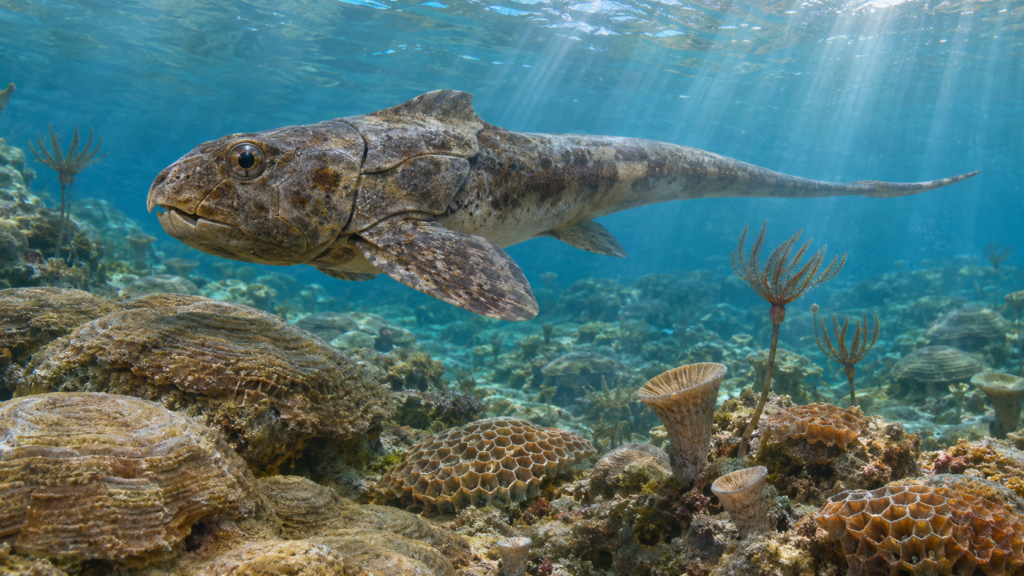
| Name | Materpiscis attenboroughi. The genus name is Latin for “mother fish.” The species name honors Sir David Attenborough, who first drew attention to the Gogo fossil sites in his 1979 television series Life on Earth |
| Classification | Placoderm, ptyctodontid |
| Age | Late Devonian, early Frasnian (about 380 million years ago) |
| Locality | Gogo Formation, Kimberley region, Western Australia (near Fitzroy Crossing) |
| Length | About 25 cm according to press reports (the original description gives no length) |
| Specimen | One adult carrying a single embryo and what appears to be an umbilical cord (Western Australian Museum, WAM 07.12.1) |
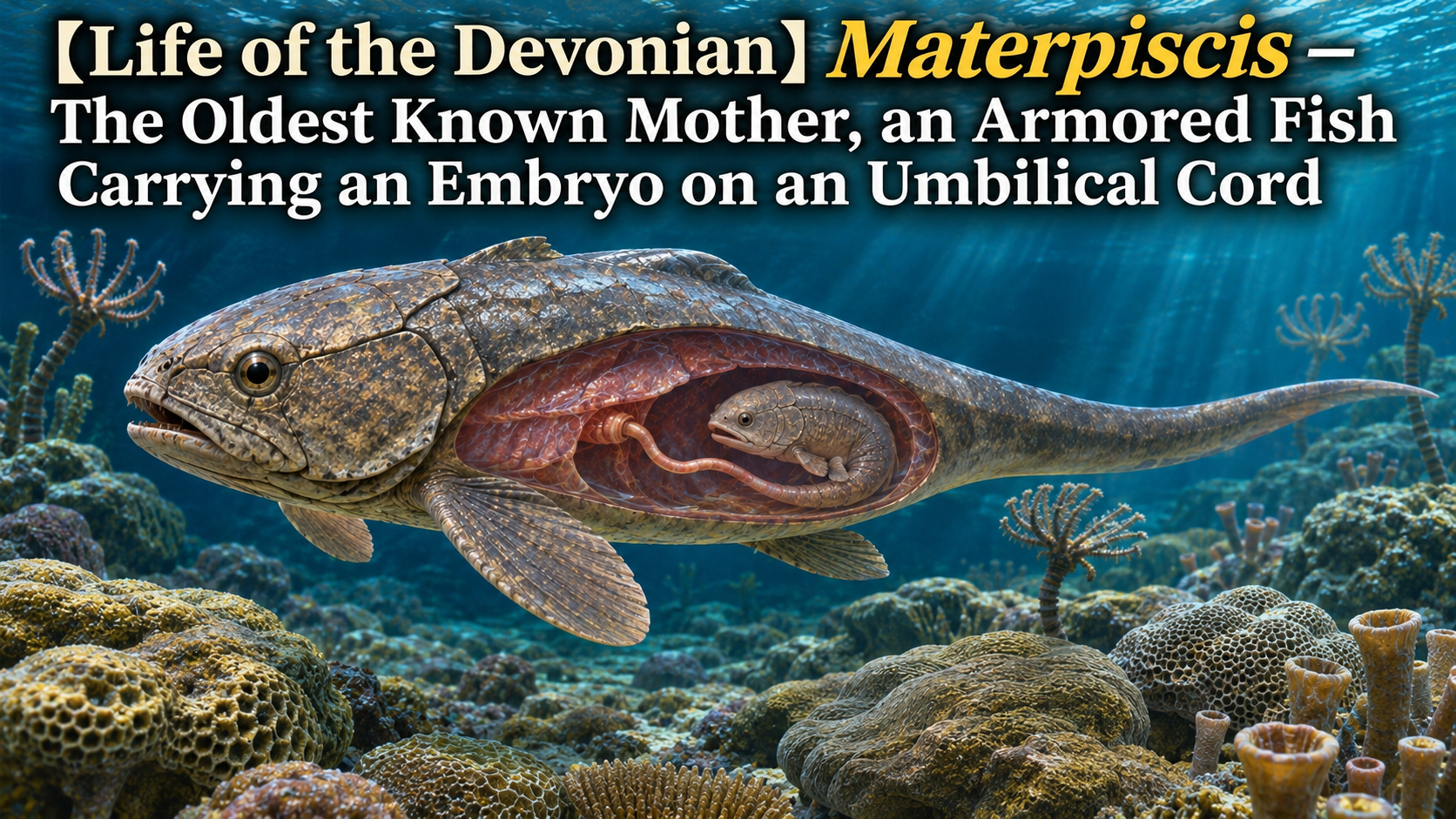
Materpiscis is a placoderm, one of the armored fishes whose head and chest were encased in bony plates, from the seas of the Late Devonian. The specimen described in 2008 held an embryo inside its body, along with a structure interpreted as an umbilical cord linking the embryo to its mother. It is regarded as the oldest evidence of live birth in any vertebrate.
Appearance and Life
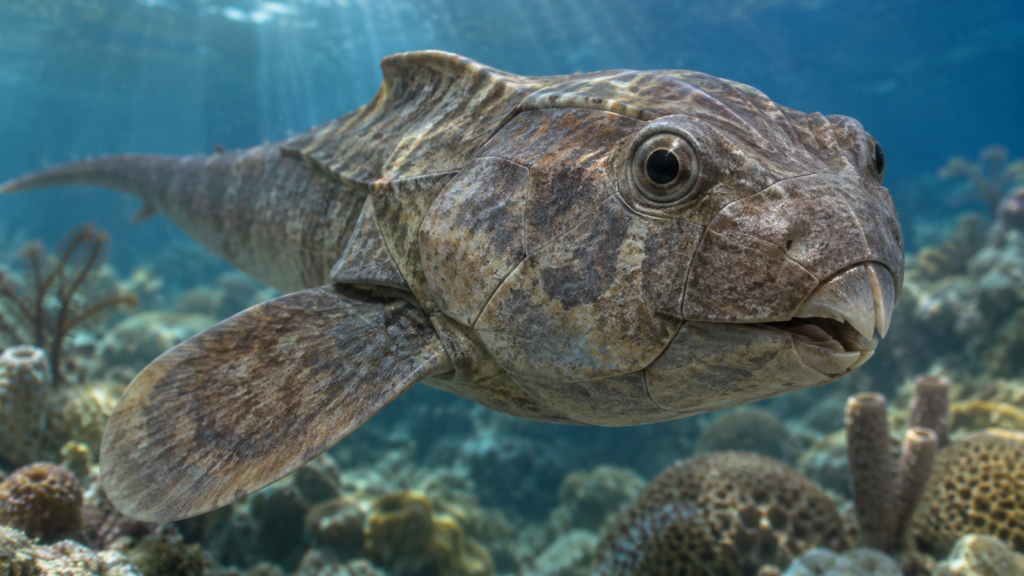
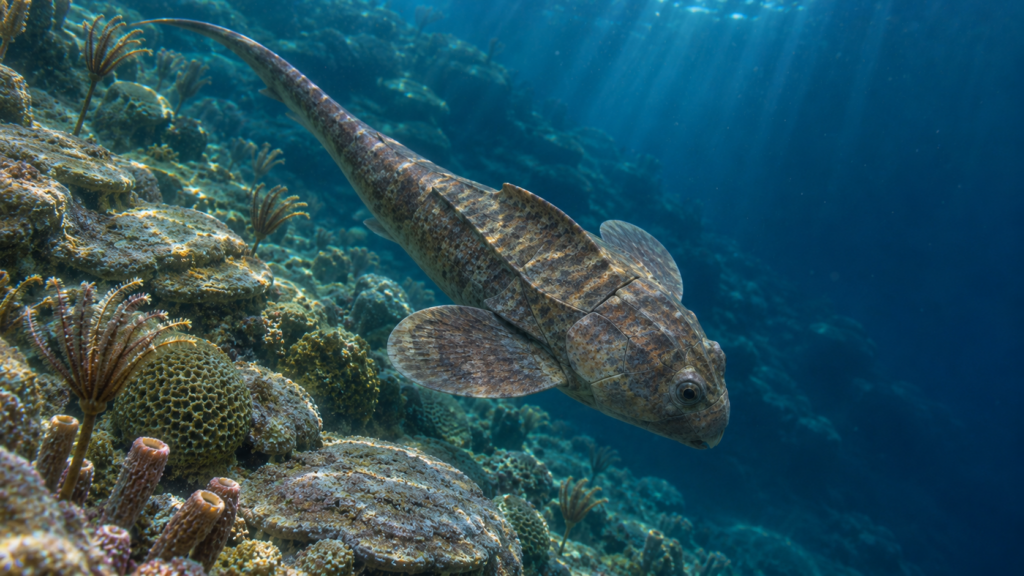
Placoderms were fishes armored with bony plates around the head and chest. They flourished in Devonian seas and rivers and disappeared at the end of the Devonian. The large predator Dunkleosteus belongs to the same group. Materpiscis was a ptyctodontid, a branch of small placoderms with reduced, thin armor and a smooth, scaleless body behind it that tapered into a slender tail. With their big heads and large eyes, ptyctodontids are often compared to modern chimaeras.
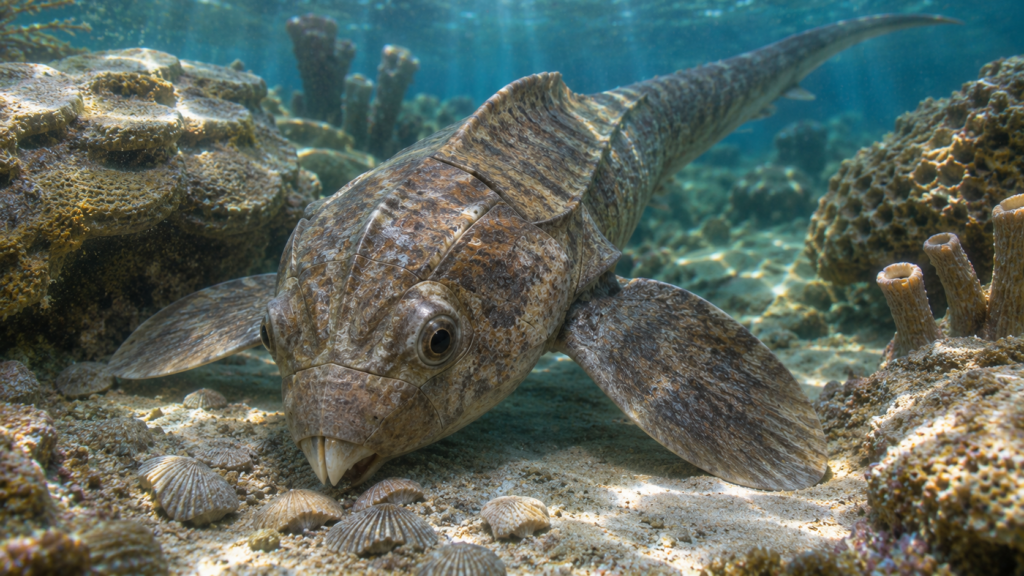
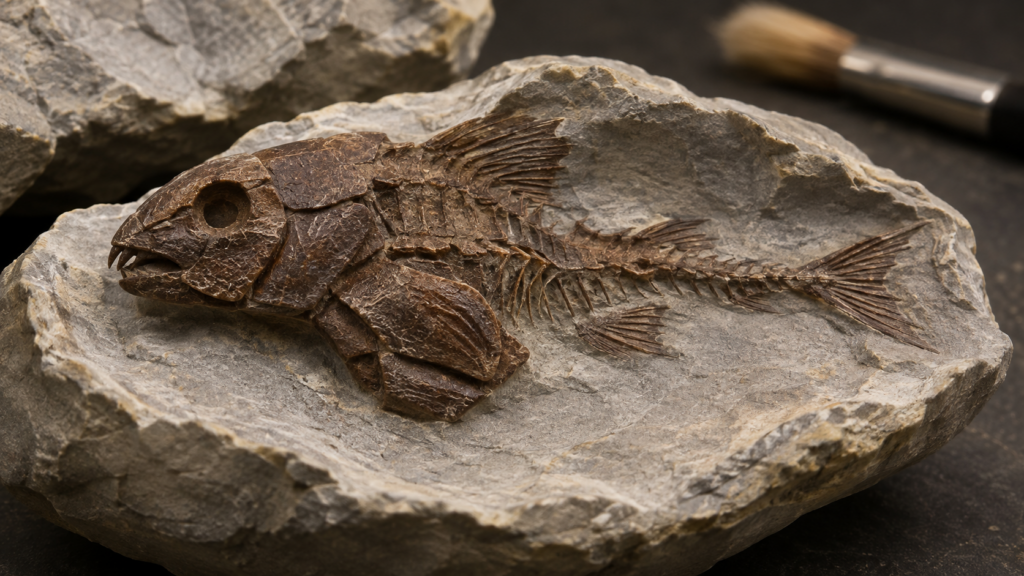
Instead of teeth, the mouth held robust tooth plates. In Materpiscis the upper and lower plates met only at their tips. Ptyctodontids are thought to have lived near the sea floor and crushed hard-shelled prey such as shellfish with these plates. The bone plate at the back of the head came to a forward point, and raised ridges on top of the skull carried the sensory canals.
The Gogo Formation preserves a tropical reef from the Late Devonian. The reef was not built by modern reef corals but by stromatoporoids, a group related to sponges, and by extinct lineages of corals. Fish carcasses that sank into the deeper water around the reef were enclosed in limestone nodules in the sea-floor mud and fossilized in three dimensions without being crushed. Soaking a nodule in weak acetic acid dissolves the limestone and frees the bones in their original shape. Gogo has also yielded the oldest fossilized muscle and nerve fibers known in jawed vertebrates.
The Oldest Mother, With Her Umbilical Cord
The Materpiscis specimen was collected at Gogo in 2005 by an expedition based at the Australian National University. Paleontologist John Long freed it from its nodule with acetic acid, and it was CT-scanned at the Australian National University. Inside the body lay a cluster of small fish bones.
The researchers concluded that these bones were not a meal. They showed no breakage and no etching by stomach acid. They lay near the backbone rather than in the gut, curled up with the jaws closed. The tooth plates matched those of the mother’s species, and the small fish was about a quarter of the adult’s size. Near the embryo was a thin, slightly twisted white tube that led to an oval mass, possibly a yolk sac. Under the electron microscope, the tube’s surface showed epithelial tissue, small pits and a channel for blood vessels. The team interpreted the tube as an umbilical cord and concluded that the embryo was nourished by its mother as well as by its yolk.
The paper, by Long, Kate Trinajstic of the University of Western Australia and colleagues, appeared in Nature in May 2008. In the same study, a specimen of the related Austroptyctodus collected in 1986 was re-examined and found to contain three small embryos.
Growing young inside the body requires the eggs to be fertilized inside the mother. The Materpiscis embryo shows that internal fertilization in vertebrates dates back at least 380 million years. Embryos were later found in another Gogo placoderm, Incisoscutum, and in 2009 claspers, the male copulatory organs, were confirmed in the bones of its pelvic fins. In 2014, male claspers and paired plates in females were reported in Microbrachius, a placoderm from an even earlier time. The view that internal fertilization goes back to the early history of placoderms has gained support.
Related products
You can find books and products related to this article on Amazon.
If you buy through the links above, this blog may earn a commission.
About the images
The images in this article are illustrations created with AI (ChatGPT), and you are welcome to use them. If you do, we would appreciate a link back to this article as the source.
Sources
Long, J. A., Trinajstic, K., Young, G. C. & Senden, T. (2008). Live birth in the Devonian period. Nature 453, 650–652. https://doi.org/10.1038/nature06966
Plazi, Materpiscis attenboroughi Long et al. 2008 (taxonomic section of the original description: specimen number, etymology, embryo and umbilical cord) https://tb.plazi.org/GgServer/xml/126A8965FF9F761AFF5EBA4EFD7EFA75
Long, J. A., Trinajstic, K. & Johanson, Z. (2009). Devonian arthrodire embryos and the origin of internal fertilization in vertebrates. Nature 457, 1124–1127. https://doi.org/10.1038/nature07732
Ahlberg, P. et al. (2009). Pelvic claspers confirm chondrichthyan-like internal fertilization in arthrodires. Nature 460, 888–889. https://doi.org/10.1038/nature08176
Long, J. A. et al. (2015). Copulation in antiarch placoderms and the origin of gnathostome internal fertilization. Nature 517, 196–199. https://doi.org/10.1038/nature13825
The University of Western Australia News (2008). Sir David Attenborough honoured by fishy find (year of collection, acid preparation, CT and electron microscopy) https://www.news.uwa.edu.au/200805302901/research/sir-david-attenborough-honoured-fishy-find
ScienceDaily (2008). Oldest vertebrate live birth (summary of the announcement) https://sciencedaily.com/releases/2008/06/080606104814.htm
NBC News (2008) (report giving a length of about 25 cm) https://www.nbcnews.com/id/wbna24861957
Wikipedia, Materpiscis (ptyctodontid lifestyle and appearance) https://en.wikipedia.org/wiki/Materpiscis

コメント