This article contains affiliate links. As an Amazon Associate I earn from qualifying purchases.
| Name | Cockroaches (the Carboniferous fossils are called “roachoids”, cockroach-like insects). A well-studied species is Archimylacris eggintoni |
| Classification | Insect, Dictyoptera (the group that includes cockroaches, termites and mantises). Carboniferous roachoids sit outside the lineage that leads to modern cockroaches |
| Age | Cockroach-like insects were already abundant in the Late Carboniferous (about 315 million years ago); fossils of the modern cockroach lineage start in the Early Cretaceous |
| Where found | Carboniferous fossils are common in the coal measures of North America and Europe (Mazon Creek, Illinois, USA; Coseley, UK, and elsewhere) |
| Body length | 2–9 cm for Carboniferous forms. Specimens measured from Mazon Creek are 16–25 mm |
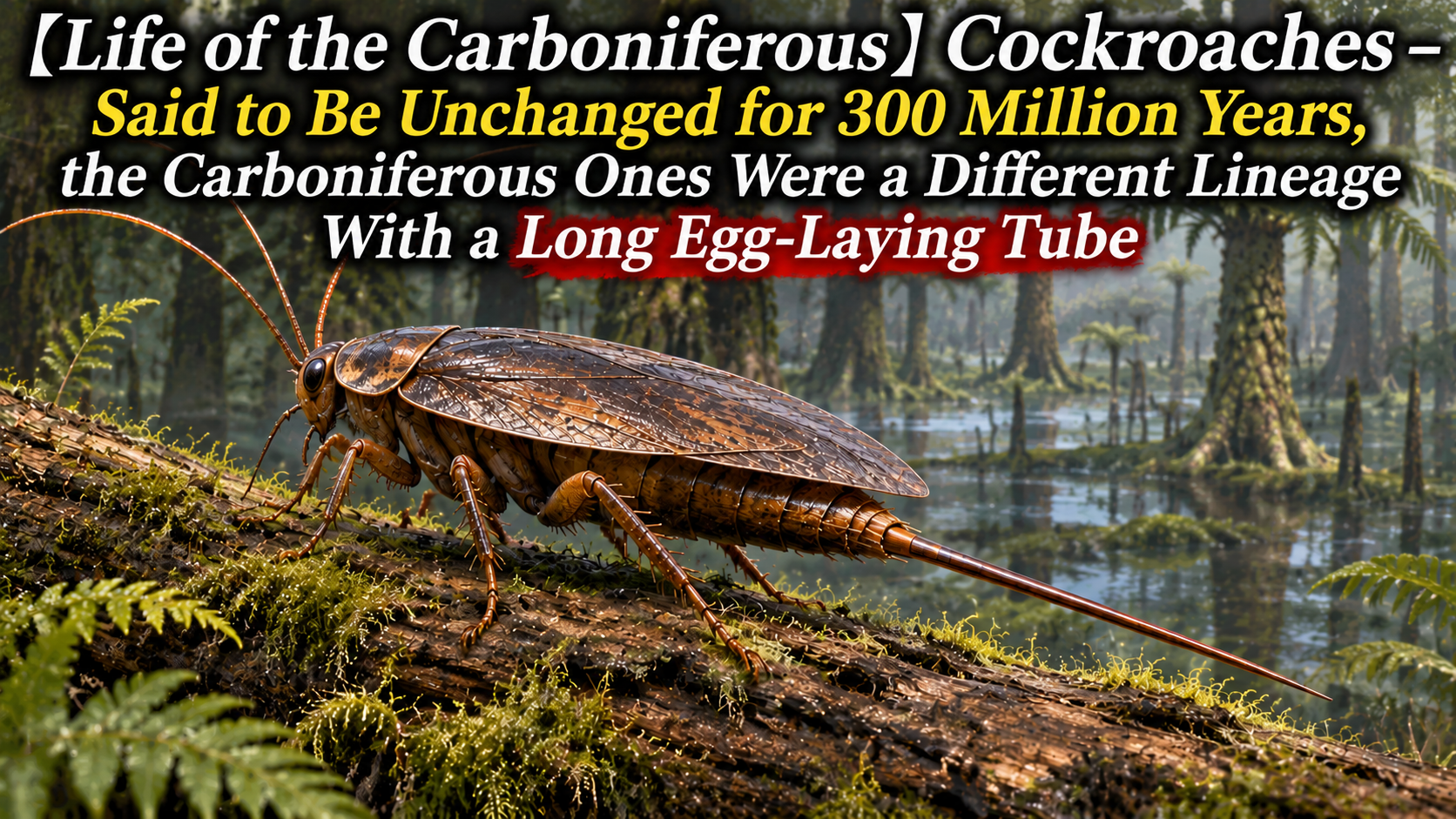
Cockroaches are insects with a flat body and a large plate on the thorax that covers the head. The Carboniferous coal measures have produced many fossils of insects that look very much like today’s cockroaches, and cockroaches have been called “insects that haven’t changed in 300 million years”. The Carboniferous ones, however, had a long egg-laying tube at the tip of the abdomen that modern cockroaches lack, and they belonged to a different lineage.
Appearance and Life
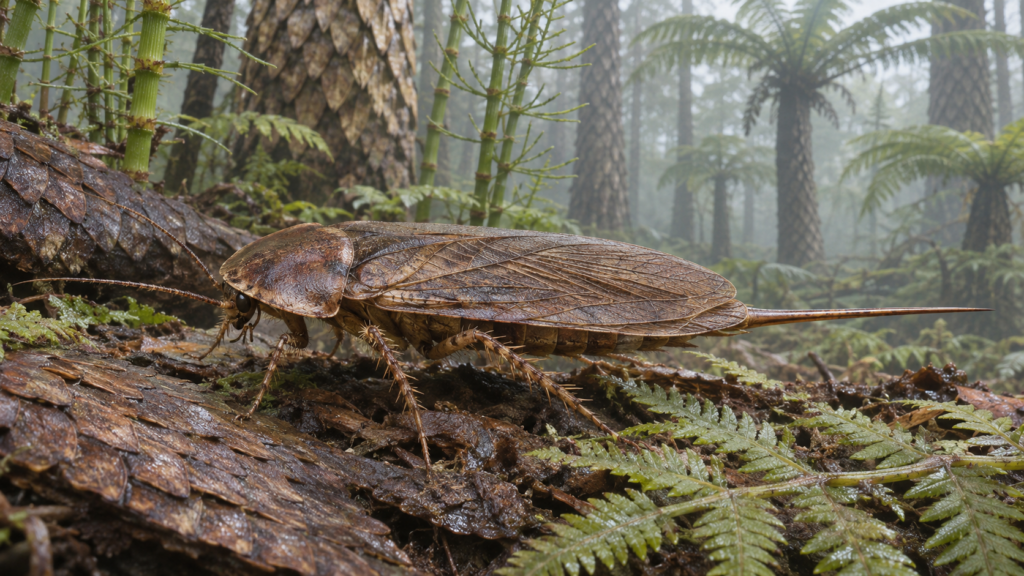
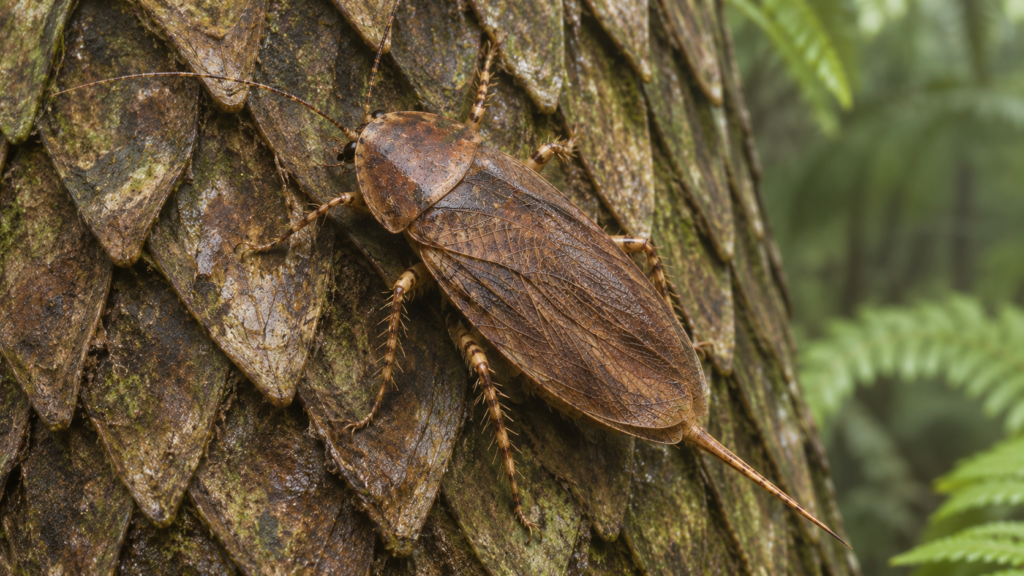
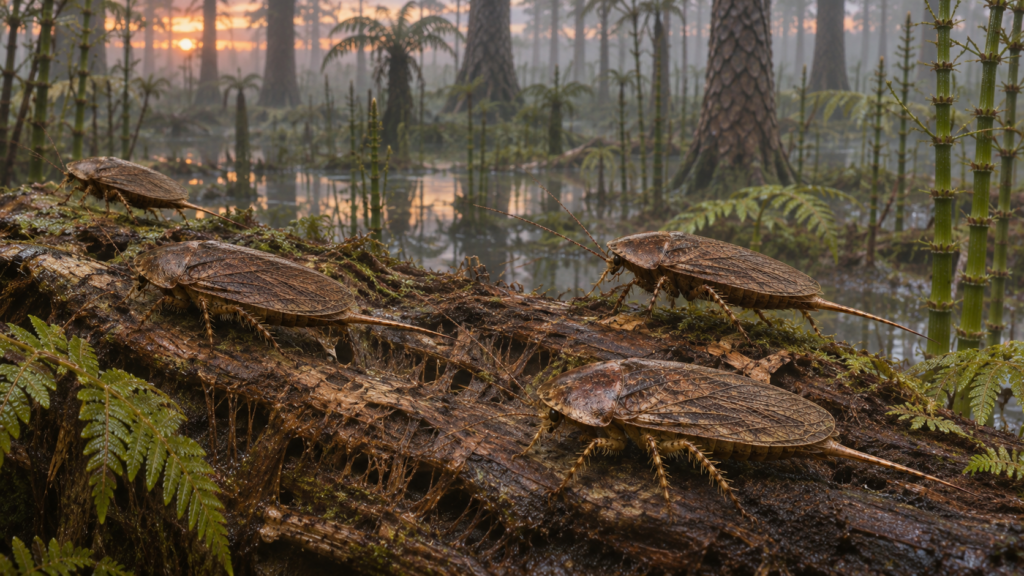
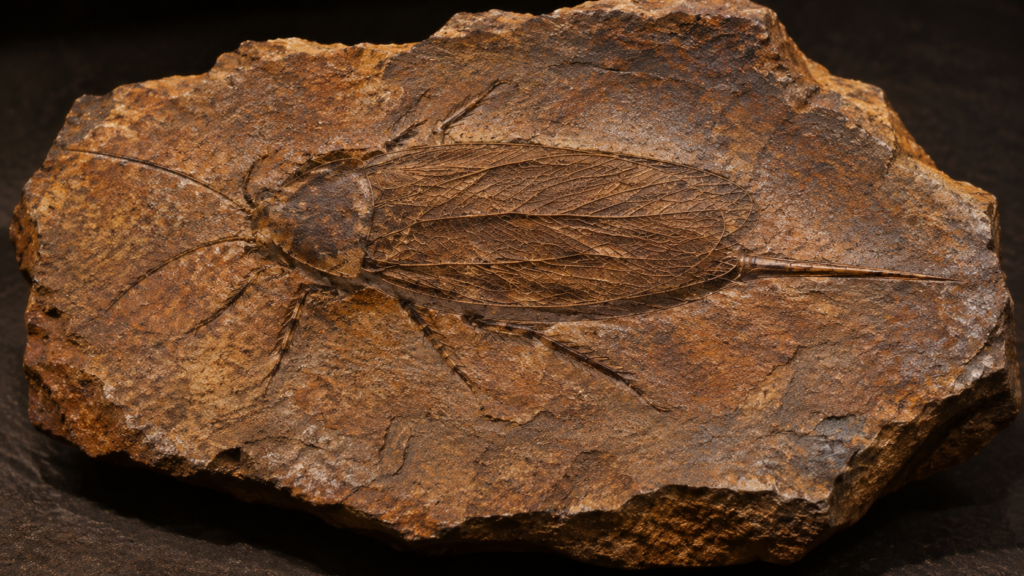
Carboniferous roachoids had a flat, oval body, a shield-like plate on the front of the thorax covering the head, long antennae and long wings with prominent veins. In appearance they closely resemble modern cockroaches. Archimylacris eggintoni, from Coseley in England, is about 311 million years old. In 2010, Russell Garwood of Imperial College London and a colleague scanned the fossil with X-ray CT and reconstructed in 3D the body buried in the rock. From the claws and adhesive pads on its feet, they inferred that it could climb trees, spent most of the day on the forest floor, and fed on rotting plant and insect matter.
The Late Carboniferous was a time when giant club mosses, horsetails and tree ferns formed forests in swamps. Fallen leaves and branches piled up thickly on the forest floor. Roachoids were very common in this period, and at Mazon Creek in Illinois they are the most common group among the insect fossils found. In 1906, the American palaeontologist Elias Sellards, who studied Carboniferous cockroach fossils, wrote that cockroaches were more abundant in the coal measure period than in any later period.
A Long Egg-Laying Tube at the Tip of the Abdomen
Female modern cockroaches lay their eggs bundled in a hard case called an ootheca. Their egg-laying tube, the ovipositor, is short and hidden inside a pouch at the tip of the abdomen, so it can’t be seen from outside. Mantises also lay their eggs in bundles, but their short ovipositor sticks out.
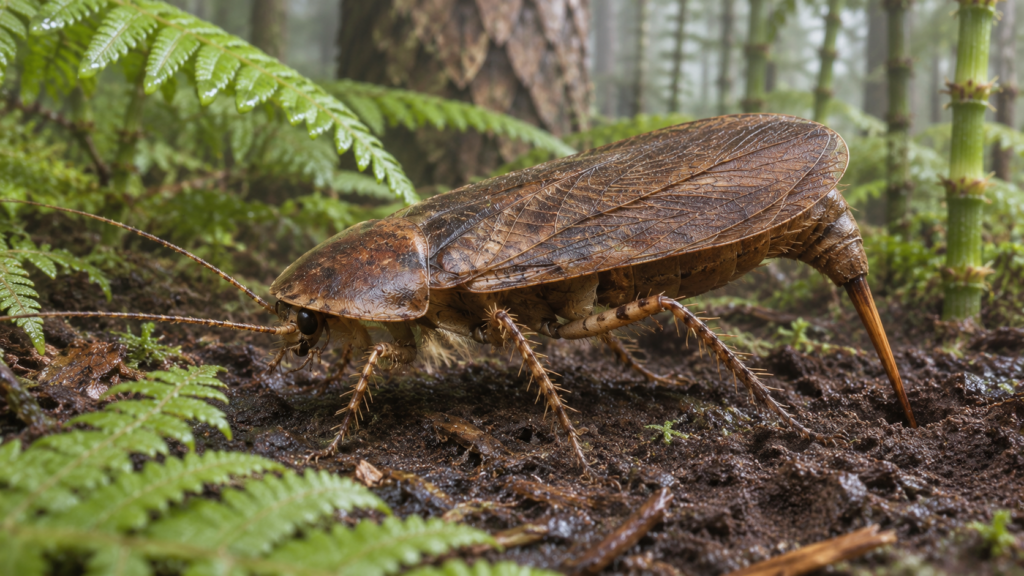
Female Carboniferous roachoids had a long ovipositor that projected backward from the tip of the abdomen, similar in shape to those of katydids and crickets. A 2018 study of the ovipositors of Mazon Creek fossils concluded from this shape that Carboniferous roachoids laid their eggs one at a time, inserting them into a substrate such as soil or plant material. Bundling eggs into a case is thought to be linked to the ovipositor becoming shorter.
Roachoids with a long, external ovipositor are found from the Carboniferous through the Permian and into the Mesozoic. In fossils about 115 million years old from the Crato Formation in Brazil, forms with long ovipositors and forms with short ones lived at the same time, and some specimens still carry an ootheca.
The modern cockroach lineage, which includes termites, is defined by an ovipositor hidden inside the body and by laying eggs in an ootheca. The oldest fossils that fit this definition are termites from the Early Cretaceous, about 139 million years ago. Termites were shown by a 2007 genetic analysis to be a group within the cockroaches. A 2019 study that used genes to estimate when the modern cockroach lineage began to branch gave a figure of about 205 million years ago, near the end of the Triassic, and concluded that most of the major lineages of modern cockroaches split during the Cretaceous.
The roachoids so common in the Carboniferous coal measures were insects near the base of the lineage leading to cockroaches, termites and mantises, and modern cockroaches are a lineage that appeared after them. The flat body and large thoracic plate have lasted more than 300 million years, but the insects inside that shape were replaced.
Related products
You can find books and products related to this article on Amazon.
If you buy through the links above, this blog may earn a commission.
About the images
The images in this article are illustrations created with AI (ChatGPT), and you are welcome to use them. If you do, we would appreciate a link back to this article as the source.
Sources
Hörnig, M. K., Haug, C., Schneider, J. W. & Haug, J. T. (2018). Evolution of reproductive strategies in dictyopteran insects – clues from ovipositor morphology of extinct roachoids. Acta Palaeontologica Polonica 63. https://doi.org/10.4202/app.00324.2016
Evangelista, D. A. et al. (2019). An integrative phylogenomic approach illuminates the evolutionary history of cockroaches and termites (Blattodea). Proceedings of the Royal Society B 286, 20182076. https://doi.org/10.1098/rspb.2018.2076
Inward, D., Beccaloni, G. & Eggleton, P. (2007). Death of an order: a comprehensive molecular phylogenetic study confirms that termites are eusocial cockroaches. Biology Letters 3, 331–335. https://doi.org/10.1098/rsbl.2007.0102
Garwood, R. & Sutton, M. (2010). X-ray micro-tomography of Carboniferous stem-Dictyoptera: new insights into early insects. Biology Letters 6, 699–702. https://doi.org/10.1098/rsbl.2010.0199
Nel, A. et al. (2014). The beetle-like Palaeozoic and Mesozoic roachoids of the so-called “umenocoleoid” lineage (Dictyoptera: Ponopterixidae fam. nov.). Comptes Rendus Palevol 13, 545–554. https://doi.org/10.1016/j.crpv.2014.05.002
Imperial College London (2010). Ancient cockroach unveiled. https://www.imperial.ac.uk/news/102083/ancient-cockroach-unveiled/
Sellards, E. H. (1906). Geological History of Cockroaches. Popular Science Monthly 68. https://en.wikisource.org/wiki/Popular_Science_Monthly/Volume_68/March_1906/Geological_History_of_Cockroaches
コメント