
This article contains affiliate links. As an Amazon Associate I earn from qualifying purchases.
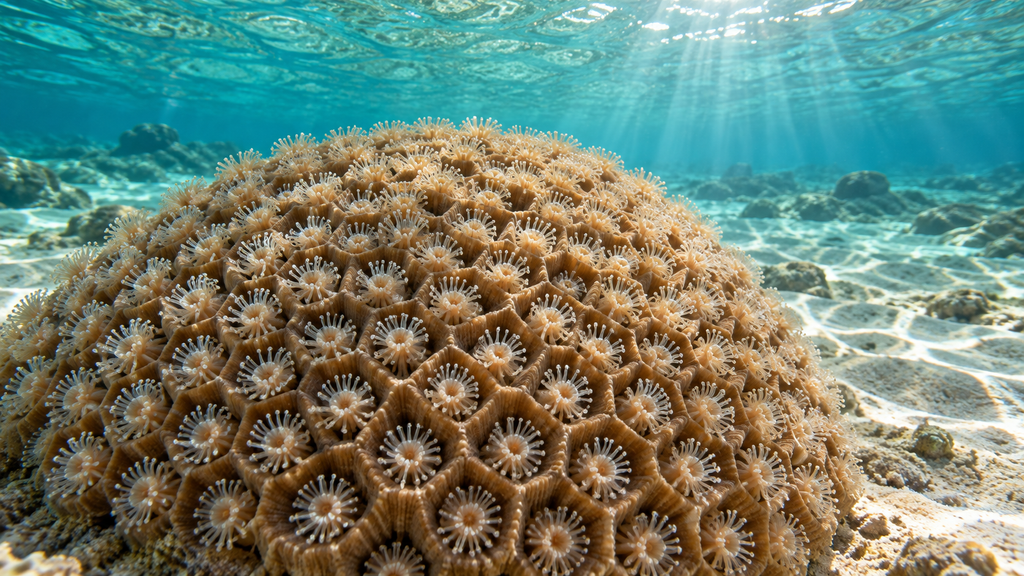
| Name | Favosites, the “honeycomb coral” (from the Latin favus, “honeycomb”) |
| Classification | Cnidaria, Anthozoa, Tabulata (extinct tabulate corals) |
| Age | Late Ordovician to Late Permian (about 450 to 260 million years ago). Most abundant in the Silurian and Devonian |
| Found in | Worldwide. The type species comes from Gotland, Sweden. In Japan, Silurian strata in Iwate and Gifu prefectures, among others |
| Colony size | From palm-sized to several tens of centimeters across. Hemispherical, domed, or sheet-like |
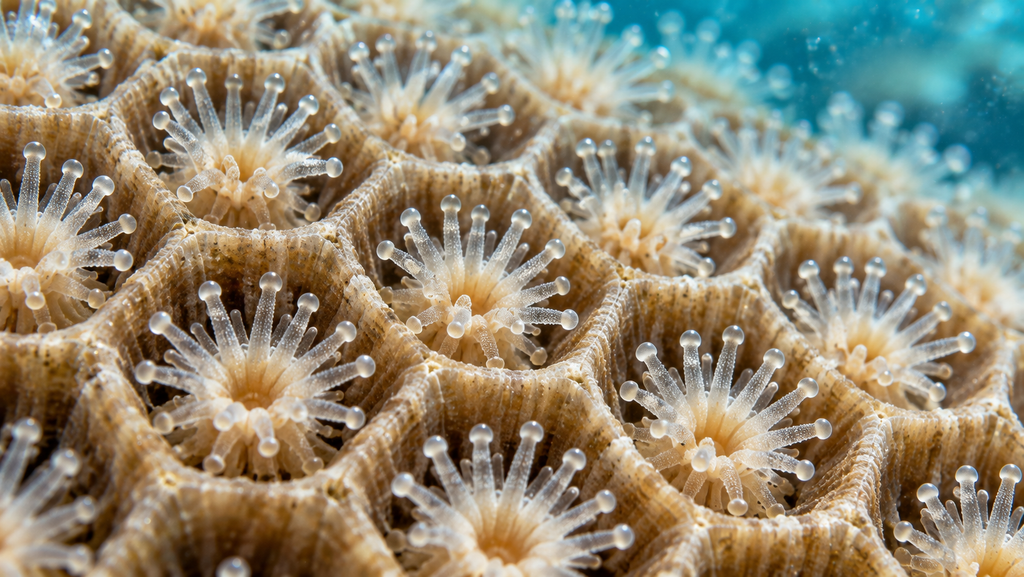
| Individual (polyp) size | Each opening about 1 to 2 mm across. Each polyp had 12 tentacles |
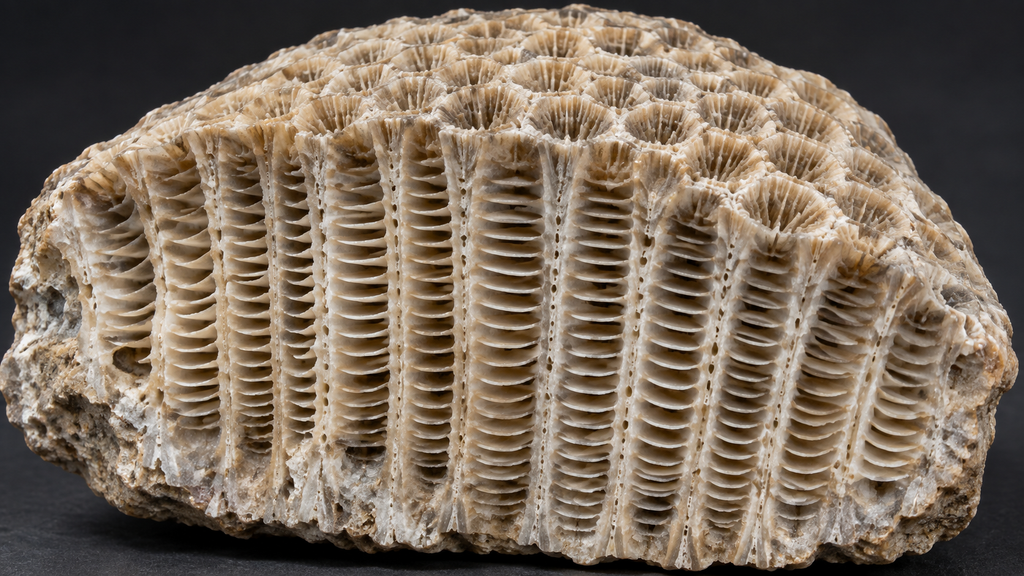
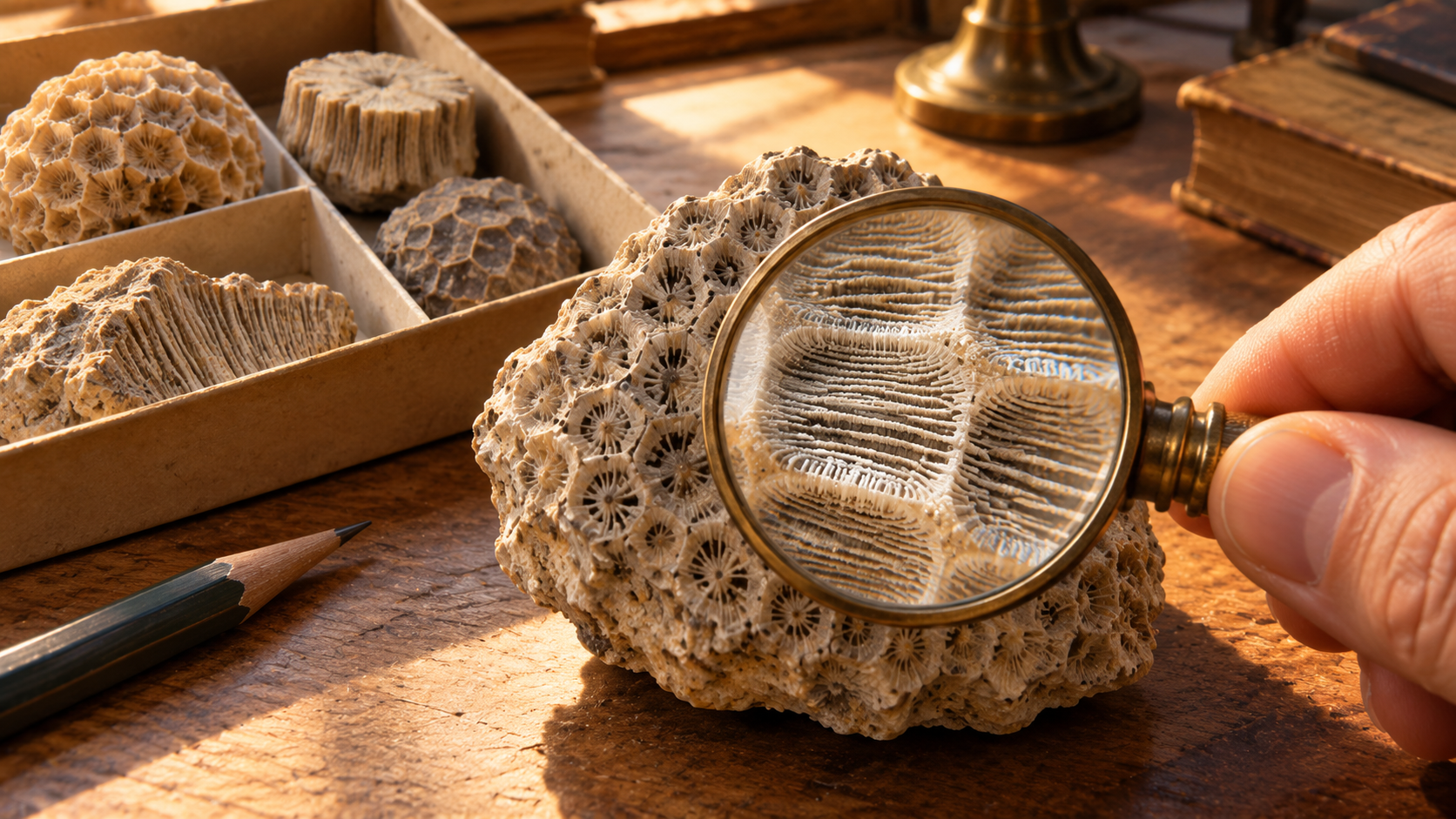
Favosites is a tabulate coral that lived in the seas of the Paleozoic Era. It formed colonies of thousands of tightly packed hexagonal tubes only a few millimeters wide, and a broken surface looks so much like a honeycomb that the resemblance gave the genus its name. It was one of the main builders of reefs in the shallow seas of the Silurian and Devonian, and the fine growth lines etched into its skeleton were used as evidence that a day on Earth was once shorter than it is now.
Appearance and Way of Life
Each tube in the colony is called a corallite, and each one housed a single polyp, the individual coral animal. Inside the tube, horizontal plates were laid down at regular intervals. As the polyp extended its skeleton upward, it sealed off the space below that it no longer used, and these plates, called tabulae, are what give tabulate corals their name. The walls between neighboring tubes are pierced by rows of tiny holes, and the tissues of adjacent polyps are thought to have connected through them. As in living corals, this let the whole colony share nutrients.
Coral fossils normally preserve nothing but the skeleton, but Favosites has specimens in which the polyps themselves turned to stone. They were found in rocks about 430 million years old (Early Silurian) on Anticosti Island in Quebec, Canada, and were reported in 1985. At the mouth of each tube, the shape of a polyp with 12 tentacles spread wide had been preserved by calcification. A few individuals had 11 or 13, but 12 was the rule. The discovery mattered for another reason as well. In the 1970s, living sponges with a skeletal structure much like that of tabulate corals had been found, and some researchers had proposed that tabulates were not corals at all but relatives of sponges. The confirmation of tentacled polyps settled the question: tabulate corals are cnidarians, that is, true corals.
The polyps caught plankton with their tentacles. In addition, they may have hosted photosynthetic algae inside their bodies. A 2014 study of skeletons from Silurian to Permian tabulate corals found that in several species, including Favosites, the carbon and oxygen isotope values were close to those of modern corals that live in symbiosis with algae. Modern reef-building corals owe their ability to construct large reefs in shallow water to these symbiotic algae, and the same arrangement appears to have existed at least as far back as the Silurian.
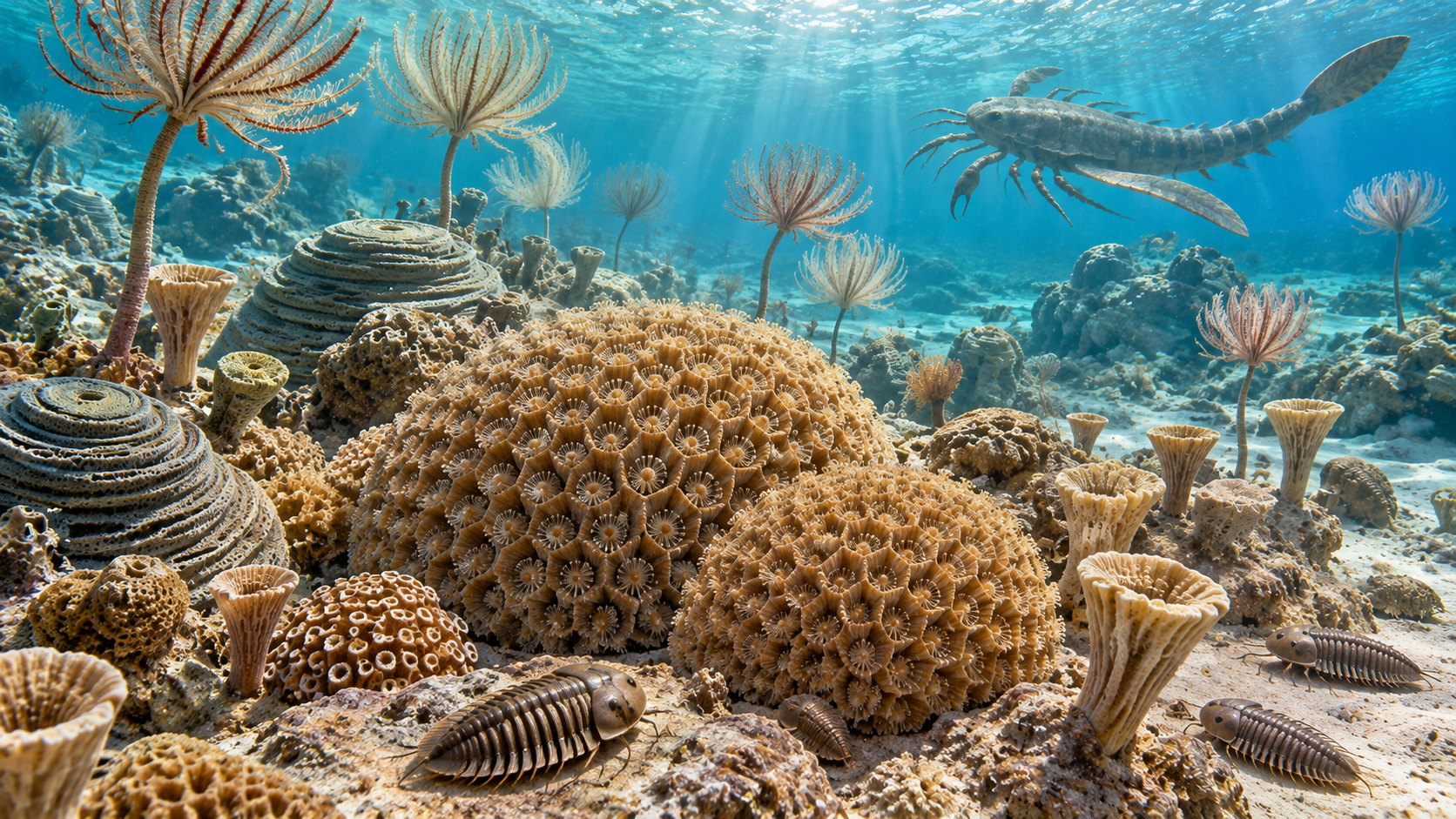
Favosites lived in warm, shallow seas near the equator. Its partners in building the Silurian reefs were the stromatoporoids, a group of sponges; the chain corals, whose corallites link up in chain-like patterns; and the rugose corals, shaped like thick horns. Among them, Favosites played the role of forming solid masses. Around the reefs grew crinoids, which spread flower-like bodies on the tips of stalks, while trilobites crawled across the seabed, brachiopods clustered in shell-like colonies, and sea scorpions more than a meter long swam past. The stony corals (scleractinians) that build reefs today did not appear until the Triassic; the reefs of the Paleozoic were built by an entirely different cast. Tabulate corals were hit hard by the mass extinction of the Late Devonian and died out at the end of the Permian. They are not the direct ancestors of living corals.
Fossils in Limestone Around the World
The genus was named in 1816 by the French naturalist Lamarck. The type species was described from Silurian limestone on the island of Gotland, Sweden, and its species name, gothlandicus, refers to the island. Gotland is known as a place where Silurian reefs are preserved in their entirety, and Favosites is one of its signature fossils.
Fossils have been found on every continent except Antarctica. In the Silurian and Devonian limestones of New York, Michigan, Ontario, and elsewhere in North America, they are common enough to pick up as loose stones in riverbeds and quarries. In Japan, relatives of Favosites have been reported from Silurian strata in the southern Kitakami Mountains of Iwate Prefecture and the Hida Gaien belt of Gifu Prefecture. Because polishing brings out the honeycomb pattern beautifully, the fossils are sometimes worked into decorative stone.
The Length of a Year, Recorded in Growth Lines
Earth’s rotation is slowing, very gradually, because the Moon’s gravity pulls on the oceans. In theory, days in the past were shorter than they are now, and a year contained more than 365 of them. But until the mid-20th century, there was no way to check this directly.
The answer came from John Wells, a paleontologist at Cornell University in the United States. From studying living corals on Pacific islands, Wells knew that corals change their activity between day and night and lay down one fine line on the surface of the skeleton each day. Corals also form a thicker band once a year in response to seasonal change, much like a tree ring. Counting the fine lines within a single annual band would therefore reveal how many days there were in a year when that coral was alive.
Wells chose well-preserved corals from Middle Devonian rocks in New York State and counted lines in several genera, including Favosites and the rugose corals Heliophyllum and Eridophyllum. The result was 385 to 410 lines per annual band, averaging about 400. Modern corals counted the same way averaged about 360. Corals from the Carboniferous, the period after the Devonian, averaged 390. The numbers fell as time went on, exactly as predicted. The findings were published in March 1963 as a paper of less than three pages in Nature, and they drew the attention of astronomers and geophysicists. If a year had 400 days, a day lasted roughly 22 hours.
The only tool involved was a hand lens. At a time when research was being driven by huge instruments and enormous budgets, this work, which measured the history of Earth’s rotation with fossils and a magnifying glass, left a strong impression on the scientists of the day. The same method was later tried on the growth lines of other organisms, such as bivalves and stromatolites, and the field of using fossils as “clocks” began here.
Wells’s counts carry the error that comes with counting lines by eye. Even so, the broad picture agrees with later, more precise measurements. In 2020, a study examined the shell of a Late Cretaceous bivalve (about 70 million years old) by tracking changes in its chemical composition while shaving it with a laser, and concluded that a year at the time had 372 days and a day lasted about 23 and a half hours. Roughly 400 days in the Devonian, 372 in the Cretaceous, 365 today. The figure read from the growth lines of Favosites fits neatly into this sequence.
After Wells died in 1994, the specimens he had counted were transferred from Cornell University to the Paleontological Research Institution (PRI) in Ithaca, New York, but their location among the vast collections was lost for a long time. In November 2019, a staff member searching for unrelated specimens came across two boxes labeled “Coral Chronology Material,” and the specimens inside, together with the handwriting on the labels, confirmed that these were the very corals used in the paper.
Related products
You can find books and products related to this article on Amazon.
If you buy through the links above, this blog may earn a commission.
Sources
Wells, J. W. (1963) Coral Growth and Geochronometry. Nature 197, 948–950
Copper, P. (1985) Fossilized polyps in 430-Myr-old Favosites corals. Nature 316, 142–144
Digital Atlas of Ancient Life, “Tabulate corals (Tabulata)”
AGU press release, “Ancient shell shows days were half-hour shorter 70 million years ago” (2020)
コメント