This article contains affiliate links. As an Amazon Associate I earn from qualifying purchases.
| Name | Brontoscorpio, from the Greek for “thunder” and “scorpion.” In 2026 it was found to be the same animal as the older name Praearcturus gigas, meaning “the giant before Arcturus” (Arcturus is a genus of crustaceans related to woodlice) |
| Classification | Arthropoda, Chelicerata, scorpions. Thought to have branched off before the group that contains all living scorpions |
| Age | Early Devonian (Lochkovian, about 415 million years ago). Previously thought to be Late Silurian |
| Where found | The border region of England and Wales: Rowlestone in Herefordshire, Trimpley in Worcestershire, and quarries near Talgarth in Wales, among others (St Maughans Formation) |
| Length | About 1 m (estimated). When it was described as Brontoscorpio, its length was estimated at 77 to 94 cm |
| Pincer length | Up to about 16 cm |
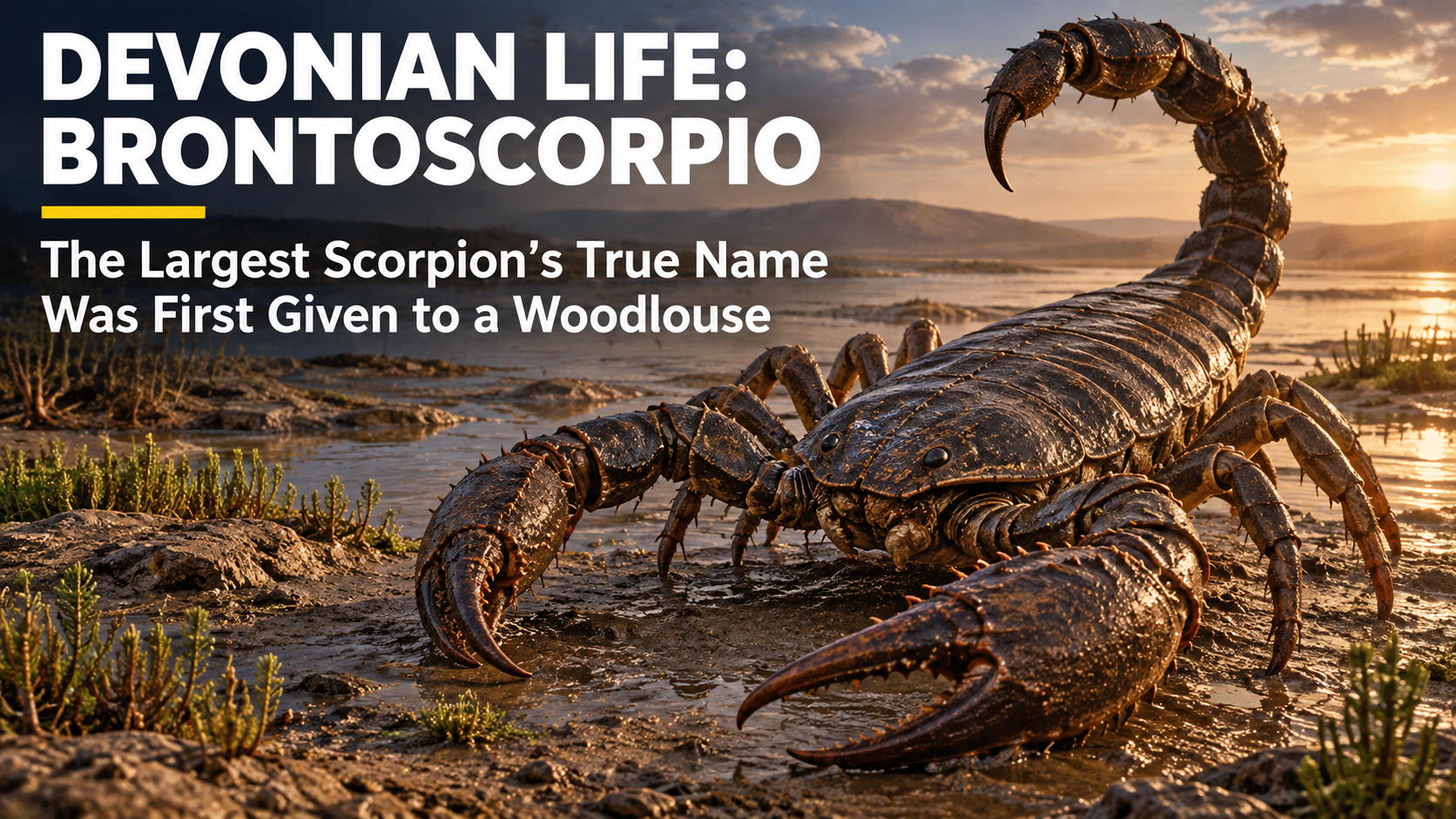
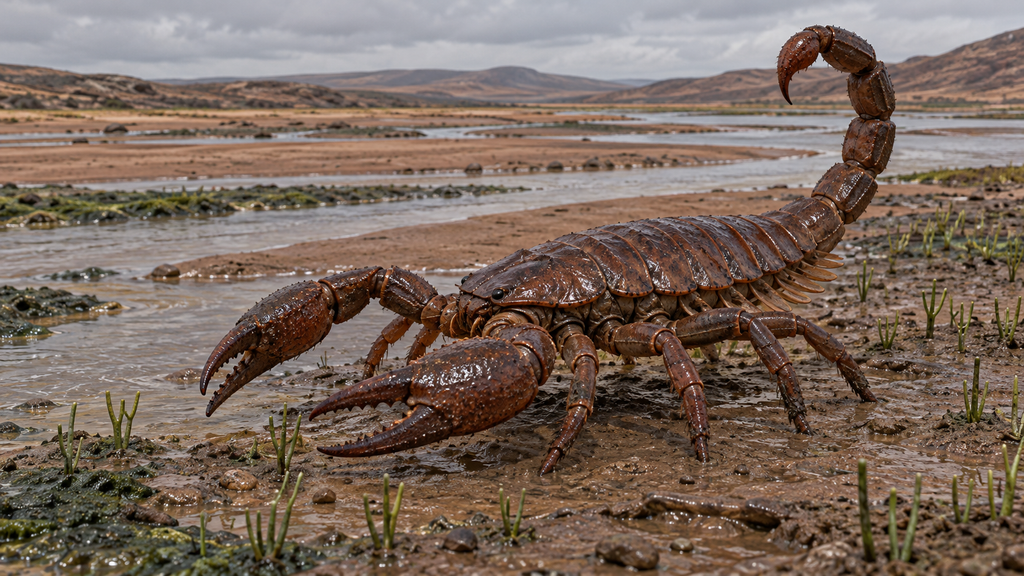
Brontoscorpio was a giant scorpion that lived along the rivers of Early Devonian Britain. It is estimated at about 1 meter long, four to five times the size of the largest living scorpion, and is regarded as the largest scorpion known. No complete fossil exists, however; everything known comes from fragments. In 2026 its fossils were concluded to belong to the same animal as fossils named more than 150 years earlier as a “giant woodlouse,” and its scientific name changed as a result.
Appearance and Life
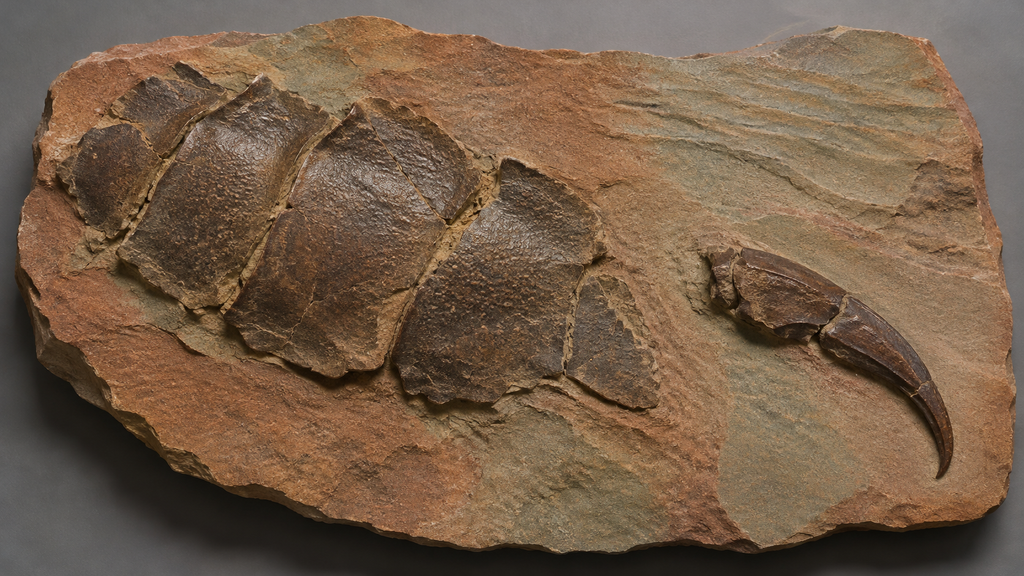
The known fossils are fragments: plates from the back and belly of the body, and parts of the pedipalps, the limbs that carry a scorpion’s pincers. Nothing of the tail has been found. The whole-body reconstruction is made by fitting these pieces onto the body plan of living and fossil scorpions.
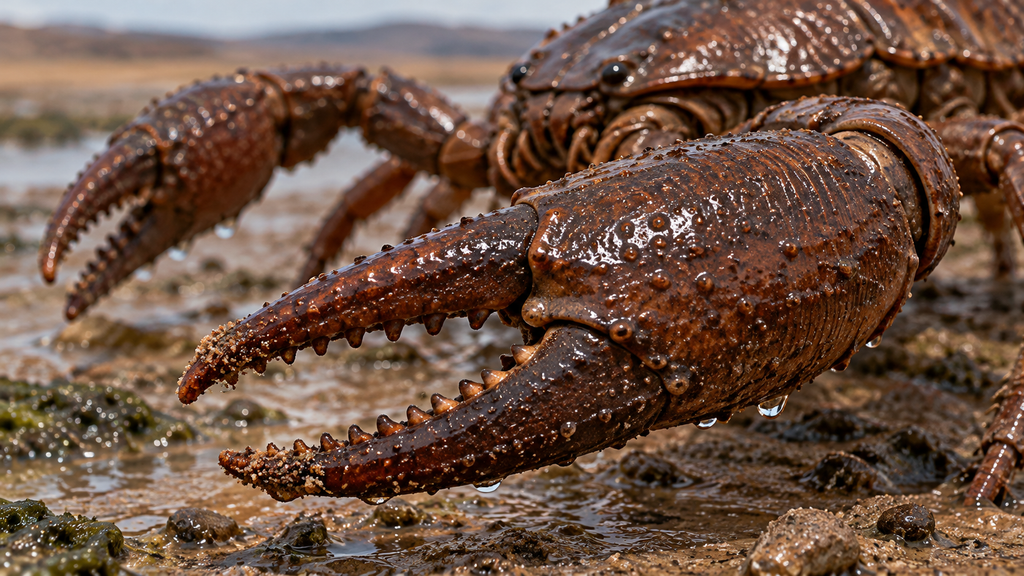
Several features led researchers to identify it as a scorpion. The movable finger of the pincer sits on the outer side of the fixed finger, as in living scorpions and the reverse of the claws of lobsters and other crustaceans. Fine ridges run across the surface of the pedipalps; some living scorpions rub similar ridges together to make a hissing sound. And the sternum, a plate on the underside, is long and nearly triangular with a groove down the middle. The sternum of living scorpions is small and usually pentagonal, so for a long time this shape looked unlike a scorpion. In 2015 a well-preserved ancient scorpion, Eramoscorpius, was described from rocks about 430 million years old in Ontario, Canada, and it turned out to have a sternum of the same shape, which made the comparison possible.
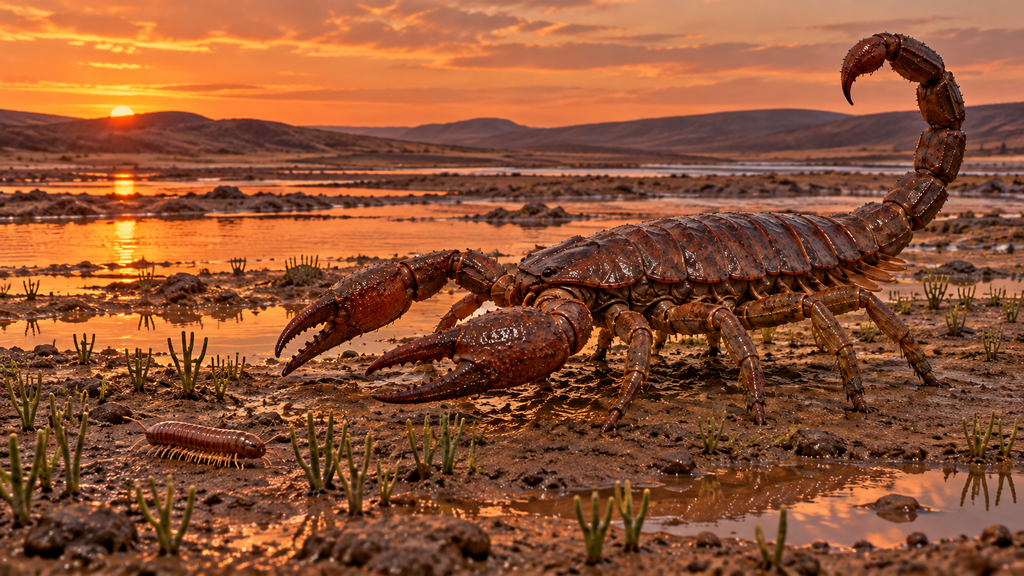
The animal lived around braided rivers and their floodplains. There were no trees on land yet. The ground was covered by small leafless plants a few centimeters to a few tens of centimeters tall, and land animals were mostly small arthropods such as millipedes and relatives of spiders. The rivers, by contrast, held armored jawless fish and sea scorpions such as Pterygotus.
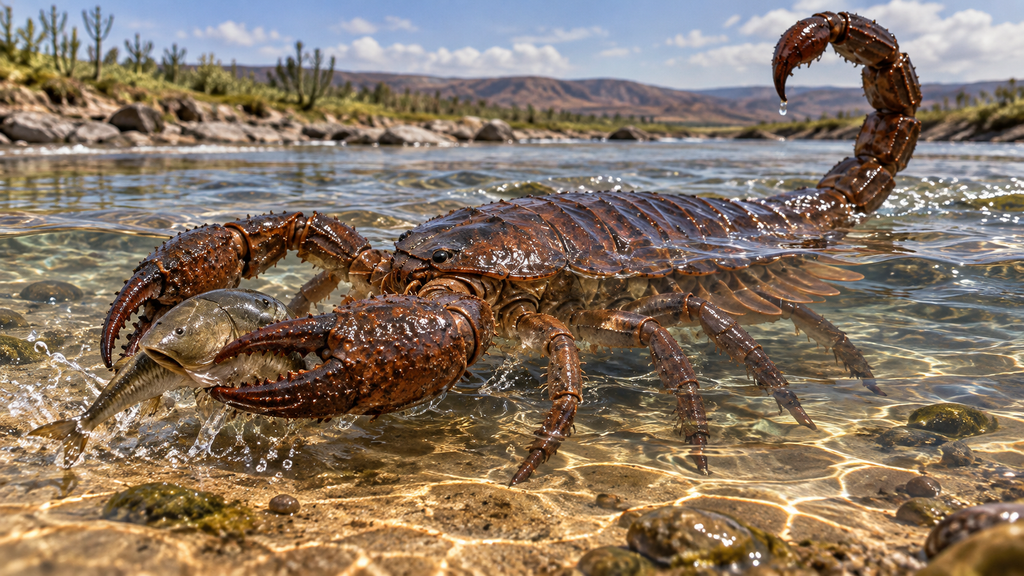
Some specimens show fin-like flaps along the sides of the abdomen, similar to the swimming appendages of lobsters. Together with the fact that the fossils come from river deposits, this led the 2026 study to suggest that the animal may have lived in or beside water and moved between water and land. There are doubts that small prey on land alone could have fed a body this size, and one view holds that it hunted fish and sea scorpions in the rivers. The researchers note that more fossils are needed to confirm what the flaps were for.
The size of giant Carboniferous dragonflies and millipedes is sometimes explained by high levels of atmospheric oxygen. This scorpion reached about 1 meter at least 50 million years earlier. The research team thinks the lack of other large predators, rather than oxygen, allowed it to grow so large.
The Giant Scorpion’s Name Was Given to a Woodlouse
In the early 1870s, Henry Woodward, a geologist at the British Museum, described fossil body segments of a large arthropod from a quarry at Rowlestone in Herefordshire. Woodward took it for a giant isopod, a crustacean in the group that includes woodlice and pill bugs, and named it Praearcturus gigas. The name refers to the living isopod genus Arcturus and means “the giant before Arcturus.”
The fossil was fragmentary, and later interpretations swung widely. In 1885 the German paleontologist Zittel placed it with Arthropleura, the giant Carboniferous millipede relative, and in 1934 it was added to a list of sea scorpions. In 1969 it was judged too fragmentary to classify. In 1980 the British paleontologist Rolfe interpreted it as a scorpion for the first time, and in 1986 the American paleontologist Kjellesvig-Waering erected a family of scorpions for it.
In the meantime, in 1972, Kjellesvig-Waering had described a fossil about 10 cm long from Trimpley in Worcestershire as the movable finger of a giant scorpion’s pincer, and named it Brontoscorpio anglicus. That single finger was all he had. Applying the body proportions of two living scorpion genera, he estimated the total length at 77 to 94 cm. At the time, the fossil was thought to date from the Late Silurian. The name “thunder scorpion” and its estimate of nearly a meter spread through encyclopedias and record books, and Brontoscorpio became the best-known giant scorpion. In 2010, fossils from Wales were also given a separate scientific name.
All of these were fragments, and researchers disagreed on whether they were scorpions at all. In 2024, researchers in Germany and Britain questioned the evidence for a scorpion, and another researcher argued that Praearcturus was more likely a crustacean and that the Brontoscorpio finger might be the tip of a crustacean leg.
In June 2026, Richard Howard, curator of fossil arthropods at the Natural History Museum in London, Russell Garwood of the University of Manchester and colleagues gathered specimens held in several museums, re-examined them with photographs and CT scans, and published the results in the journal Palaeontology. According to news reports, the work took 18 years. From the orientation of the pincer fingers, the ridges on the pedipalps and a sternum shaped like that of Eramoscorpius, they concluded that the animal was a scorpion. They also judged that Brontoscorpio and the Welsh fossils belong to the same animal as Praearcturus gigas, and placed its age not in the Late Silurian but in the Lochkovian stage of the Early Devonian.
When one animal has several scientific names, the earliest one is the valid name. So Brontoscorpio, the name used for the giant scorpion for half a century, was merged into Praearcturus, a name given in the 1870s to what was thought to be a crustacean. The official name of the largest scorpion ever known now refers to a relative of the woodlouse.
Related products
You can find books and products related to this article on Amazon.
If you buy through the links above, this blog may earn a commission.
Sources
Howard, R. J., Garwood, R. J., Edgecombe, G. D. & Legg, D. A. (2026). A revision of Praearcturus gigas: a giant scorpion from the Lower Devonian (Lochkovian) of Britain. Palaeontology 69, e70064. https://doi.org/10.1111/pala.70064
The University of Manchester (3 June 2026). World’s largest scorpion revealed from 415-million-year-old fossils. https://www.manchester.ac.uk/about/news/worlds-largest-scorpion-revealed-from-415-million-year-old-fossils/
Science News (24 June 2026). The world’s largest scorpion lived 415 million years ago. https://www.sciencenews.org/article/largest-scorpion-lived-415-million-years-ago
Kjellesvig-Waering, E. N. (1972). Brontoscorpio anglicus: a gigantic Lower Paleozoic scorpion from central England. Journal of Paleontology 46, 39–42.
Dunlop, J. A. & Garwood, R. J. (2024). A review of fossil scorpion higher systematics. PeerJ 12, e18557. https://doi.org/10.7717/peerj.18557
Braddy, S. J. (2024). Carcinosomatoid eurypterid palaeoecology and phylogeny: ichnology and palaeocommunities. Neues Jahrbuch für Geologie und Paläontologie – Abhandlungen 312, 167–181. https://doi.org/10.1127/njgpa/2024/1206


コメント