| Name | Halkieria. The only species known from a complete body is Halkieria evangelista. The species name is Latin for “bringer of the good news,” after the way this species explained at a stroke the identity of many fossils previously known only as scattered scales |
| Classification | Lophotrochozoan. The currently favored view places it among early mollusks, with a proposal to assign it to its own class, Diplacophora (“two-shell bearers”) |
| Age | Early Cambrian (about 518 million years ago). Isolated scales occur worldwide from the Early to Middle Cambrian |
| Found in | Whole-body fossils come from Sirius Passet in northern Greenland. Scale-only fossils occur on nearly every continent, including Denmark, China, Siberia and Australia |
| Length | 1.5 to 8 cm |
| Weight | A few grams to about 10 grams (no published estimate exists; approximated from living chitons of the same size) |
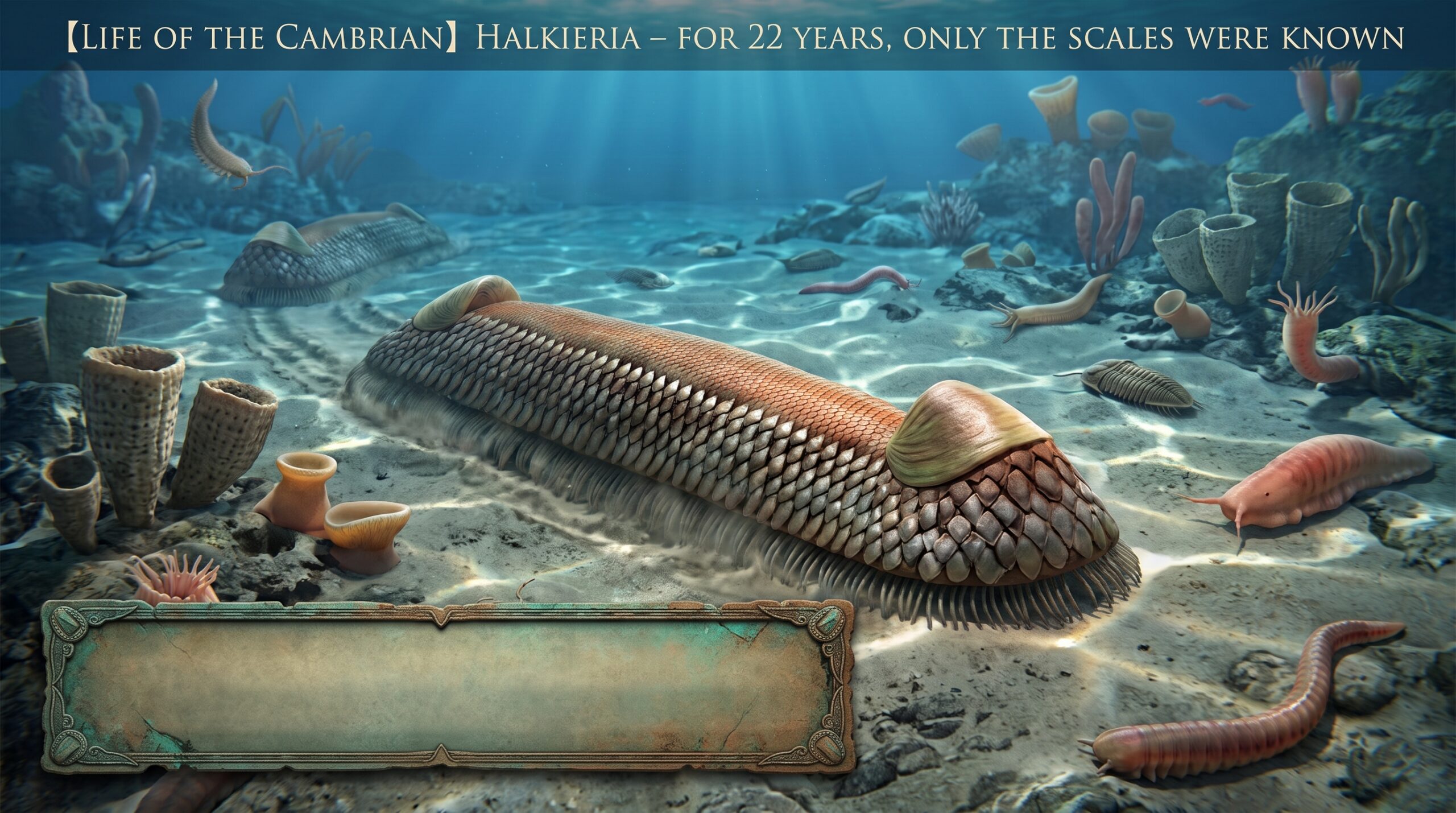
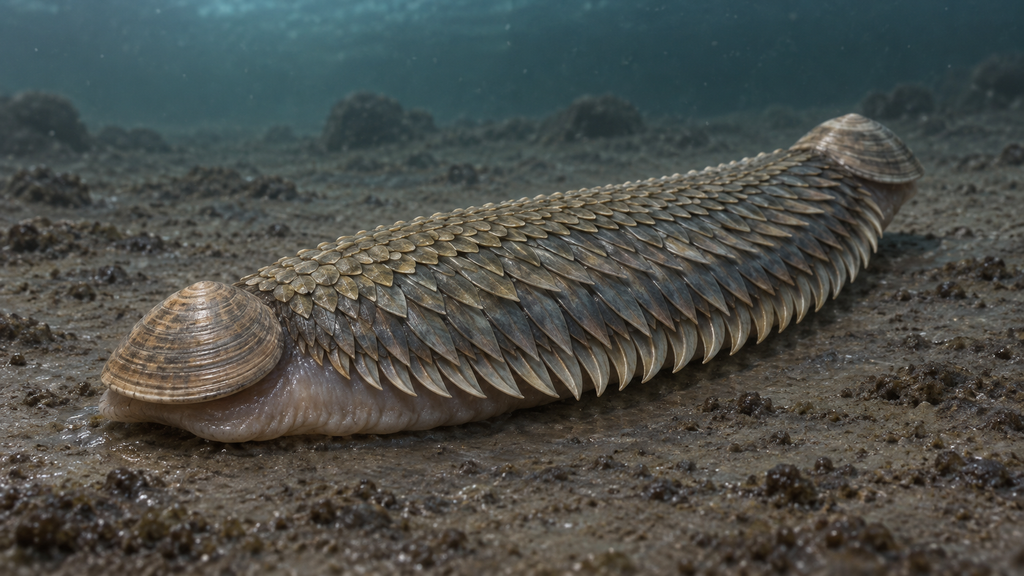
Halkieria was an armored animal that crawled across the Early Cambrian seafloor. Its back was covered in about 2,000 small scales, with a single shell-like plate at the front end of the body and another at the rear. For a long time only the scattered scales were known, as small fossils of unidentified origin, and the whole animal came into view only in 1989.
Form and way of life
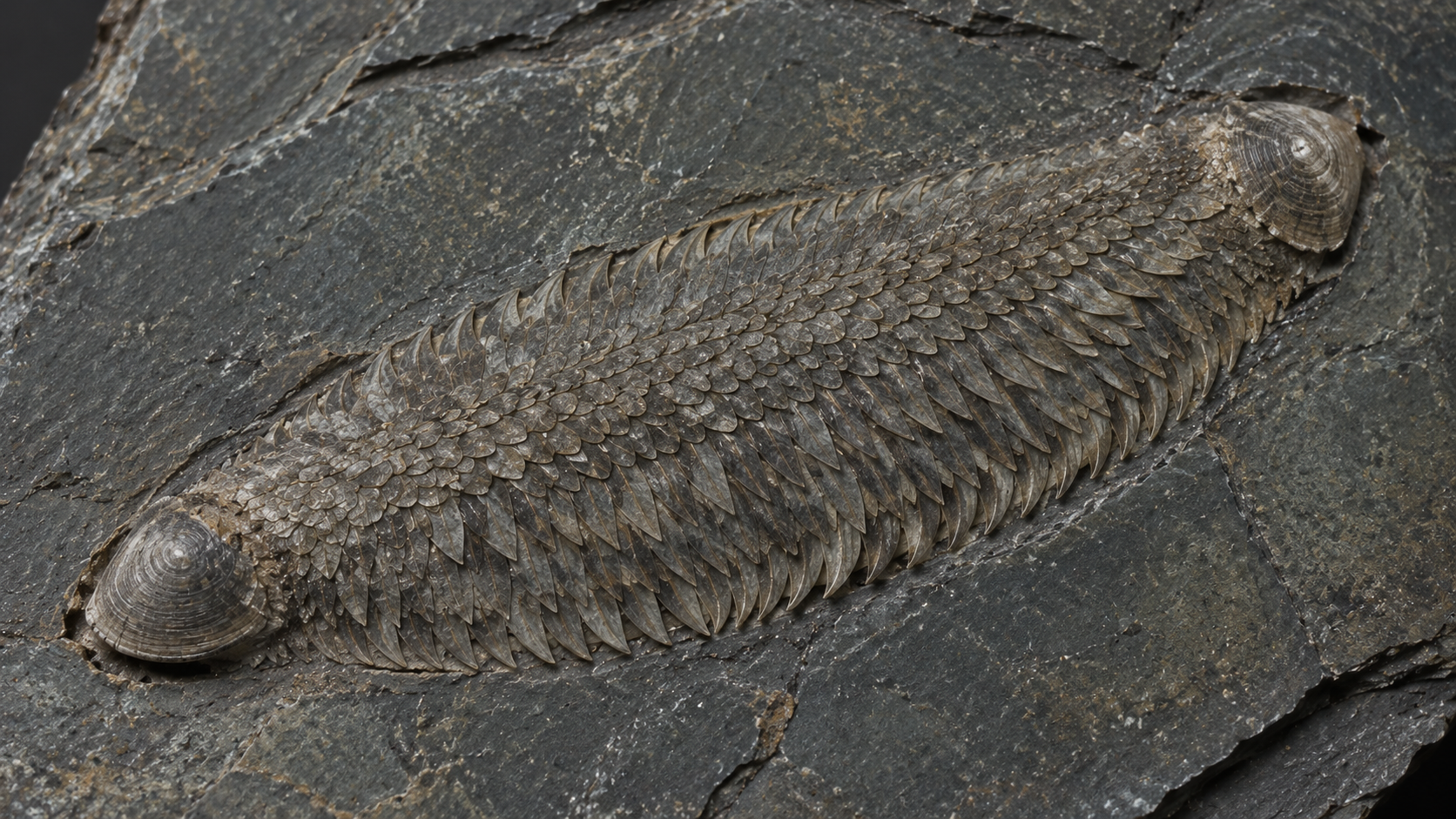
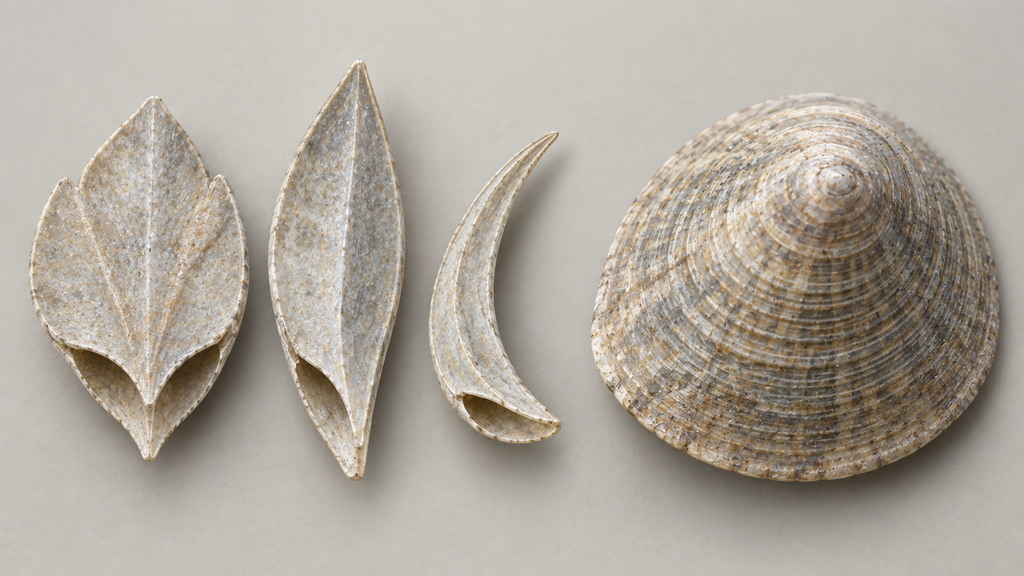
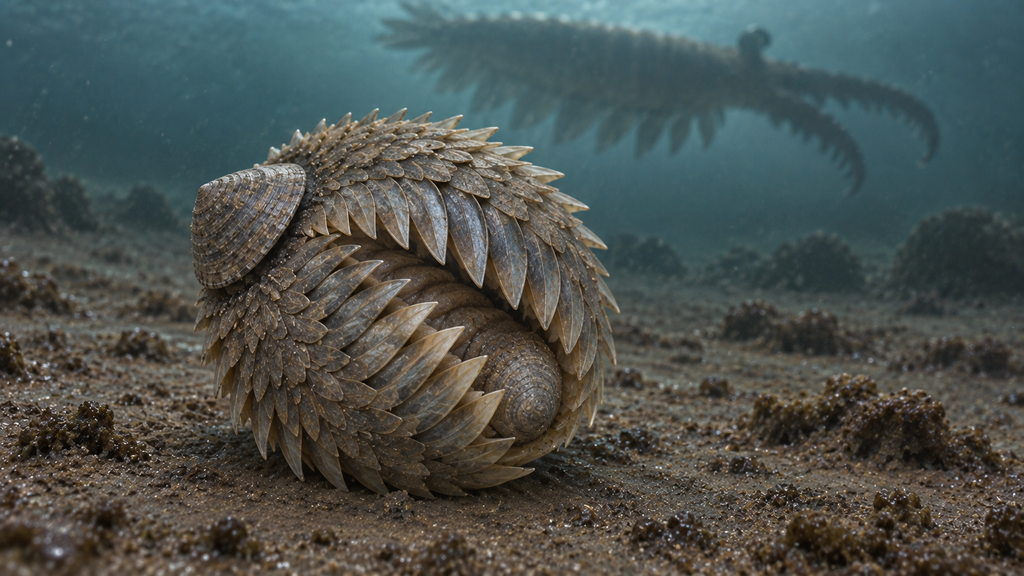
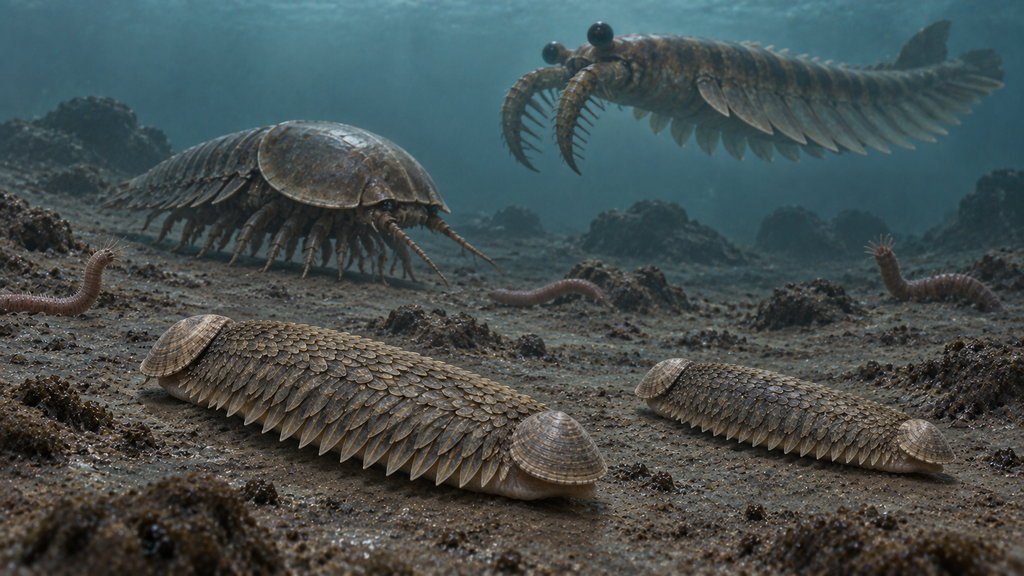
The body is a flattened, slug-like shape, as if pressed from above and below, with the underside forming a soft, scale-free foot. The dorsal scales come in three shapes arranged in bands: maple-leaf-shaped scales along the midline of the back, long blade-like scales to either side of them, and sickle-curved scales along the outer margin, all overlapping like roof tiles. The scales are hollow inside, and individual scales did not enlarge as the animal grew; new scales were added as the body increased in size.
The shells at the front and rear are cap-shaped plates marked with growth lines like tree rings. Unlike the scales, these grew by adding material at the margin. The inner surface of the front shell bears muscle scars, and there is a space beneath the rear shell that may have housed gills. Both scales and shells are thought to have originally been made of calcium carbonate.
With no structures for swimming and none for burrowing into sand, its life was confined to the surface of the seafloor. It presumably crawled by undulating the ventral foot, with the rearward-pointing marginal scales working as non-slip grip. Some specimens are found rolled up like a pill bug, and since rolling arranges the blade-shaped lateral scales to project outward, this is taken to have been a defense against predators. Traces of a gut survive in the rear half of the body, and some studies have identified a structure at the mouth resembling a radula (the toothed tongue characteristic of mollusks), though it may simply be displaced overlapping scales; it is unclear.
The Sirius Passet sea where Halkieria lived also held radiodonts related to Anomalocaris, early arthropods, and polychaete-like annelids. About 10 million years older than the Burgess Shale, this is the cast of the Cambrian explosion in progress.
Twenty-two years of scales alone
The name Halkieria was given in 1967 to small scale fossils found on the island of Bornholm in Denmark: hollow scales a few millimeters long. Around the same time, such scales, spines and small shells began turning up in quantity from Early Cambrian strata around the world, and came to be grouped as the small shelly fossils. They are fragments of the earliest animals to begin leaving skeletons in the fossil record, but since only isolated parts appeared, almost nothing was known about which fragment belonged to what animal.
The turning point was fieldwork at Sirius Passet in northern Greenland in 1989. Like the Burgess Shale, these strata are an exceptional locality preserving soft tissue, and they yielded a set of specimens with the scales still attached to the body. Halkieria evangelista, described by Simon Conway Morris and John Peel in 1990, showed for the first time the whole animal, with the arrangement of the scales and the pair of shells front and rear. These specimens explained at once that the three kinds of scattered scales came from different areas on the back of a single animal, and that the cap-shaped shells among the small shelly fossils were also part of this animal.
Two shells, and the brachiopod-fold hypothesis
Once the whole animal was known, the next question was what group it belonged to. No living animal has both an armor of scales and a shell at each end. In their detailed 1995 description, Conway Morris and Peel placed Halkieria close to the brachiopod lineage. Brachiopods resemble bivalves in having two shells, but the way the shells meet and the internal organs are entirely different, and they still live on the seafloor today.
Pushing that line further was the brachiopod-fold hypothesis, proposed in 2003. The idea is that in an animal like Halkieria, the body shortened and the front and rear shells enlarged until the body folded ventrally at the middle, bringing the front and rear shells face to face to close. On this account, both brachiopod shells were originally dorsal, and the brachiopod body should be understood as folded front to back. That Halkieria carried shells at the front and rear of the same animal was the fossil evidence supporting it.
In 2005, Jakob Vinther and Claus Nielsen re-examined the original specimens and published a paper treating Halkieria as a mollusk, on the grounds that every reliably observable feature is consistent with living mollusks. The fine canal structures inside the scales are shared with the canals of the sensory organs in the shell plates of chitons. Since it fits no living class, however, a new class named Diplacophora — after its two shells — was proposed. In 2017, Calvapilosa, a closely similar animal with an armor of scales but only a single shell, was described from Ordovician strata in Morocco and positioned as an intermediate in the lineage running from Halkieria to the chitons.
The fold hypothesis itself was tested from another direction in the same year, 2017. Examining how the genes specifying the anteroposterior axis operate in brachiopod larvae, the prediction that the shells derive from the front and rear of the dorsal side was not supported. Having two shells front and rear is now regarded not as evidence pointing toward brachiopods, but as one of the body plans early mollusks tried out.
More than thirty other species of Halkieria are known from scattered scales alone, and evangelista remains the only one whose whole-body structure is known.
Sources
Harper, D. A. T. et al. (2017). Brachiopods: origin and early history. Palaeontology, 60.
コメント