This article contains affiliate links. As an Amazon Associate I earn from qualifying purchases.
| Name | Protoceratops, meaning “first horned face” |
| Classification | Ornithischia, Ceratopsia, Protoceratopsidae |
| Age | Late Cretaceous (about 75 to 71 million years ago) |
| Found in | The Gobi Desert of Mongolia (Djadokhta Formation) and Inner Mongolia, China |
| Length | About 2 to 2.5 m |
| Weight | Estimated at about 60 to 100 kg |
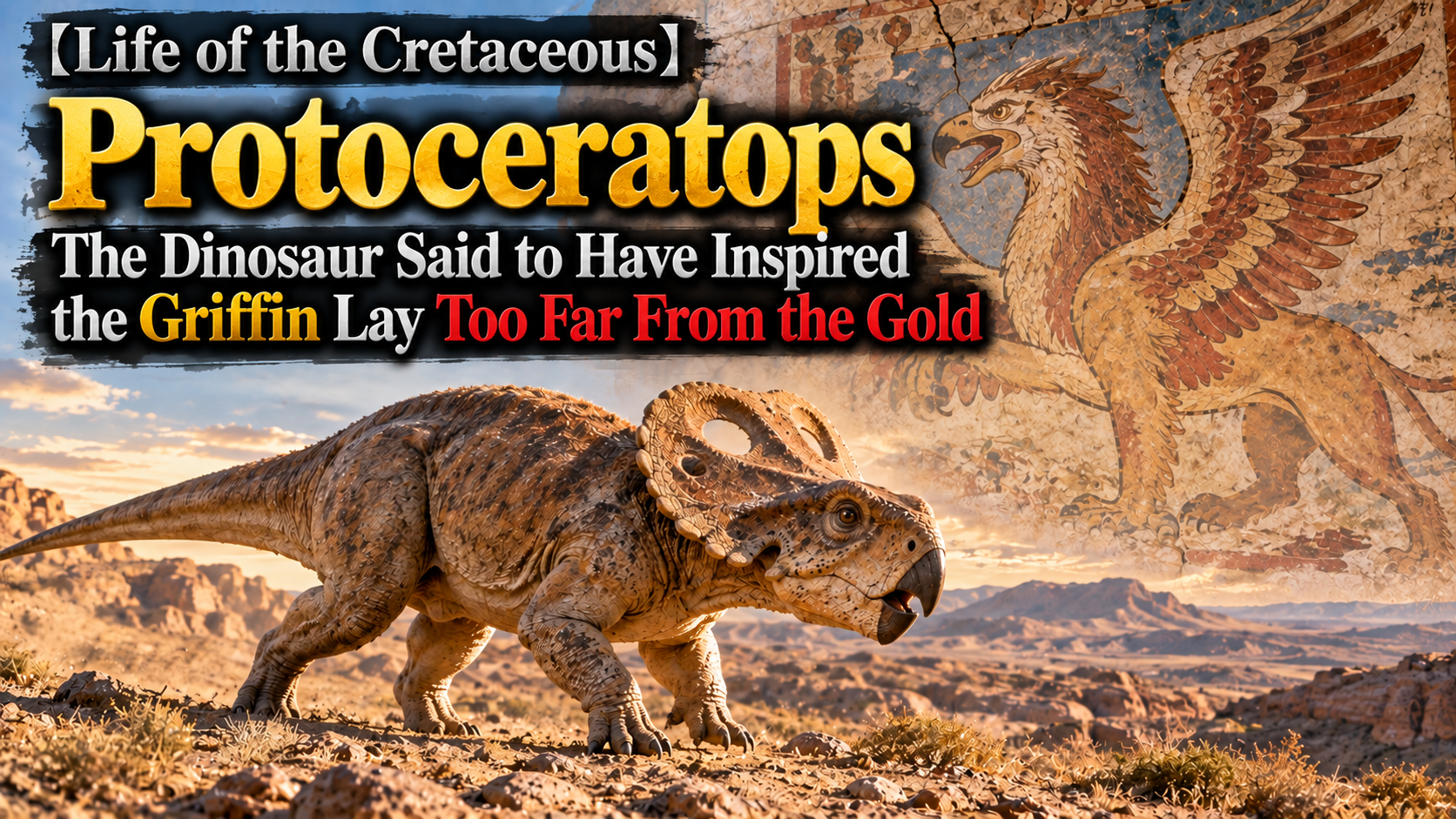
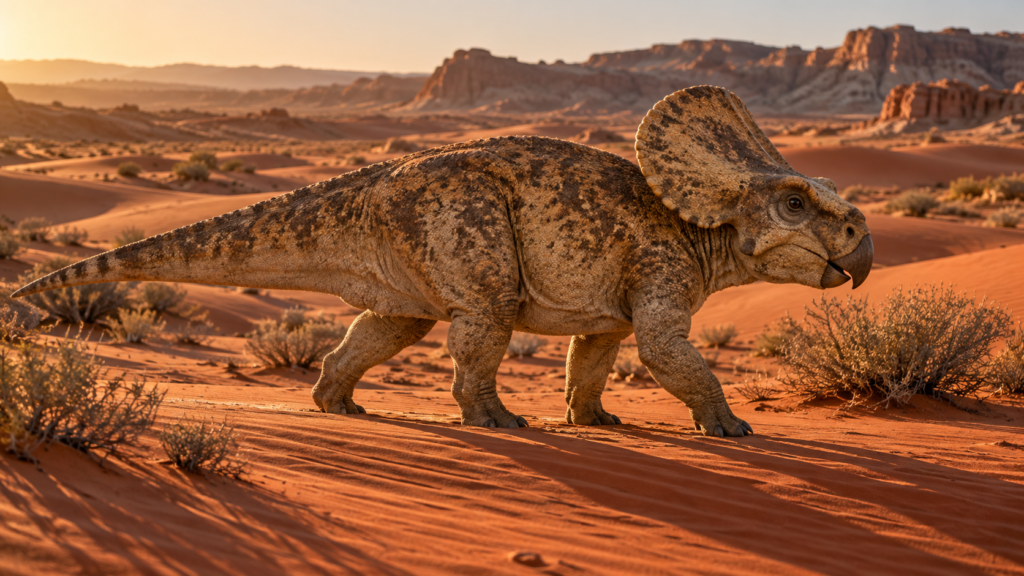
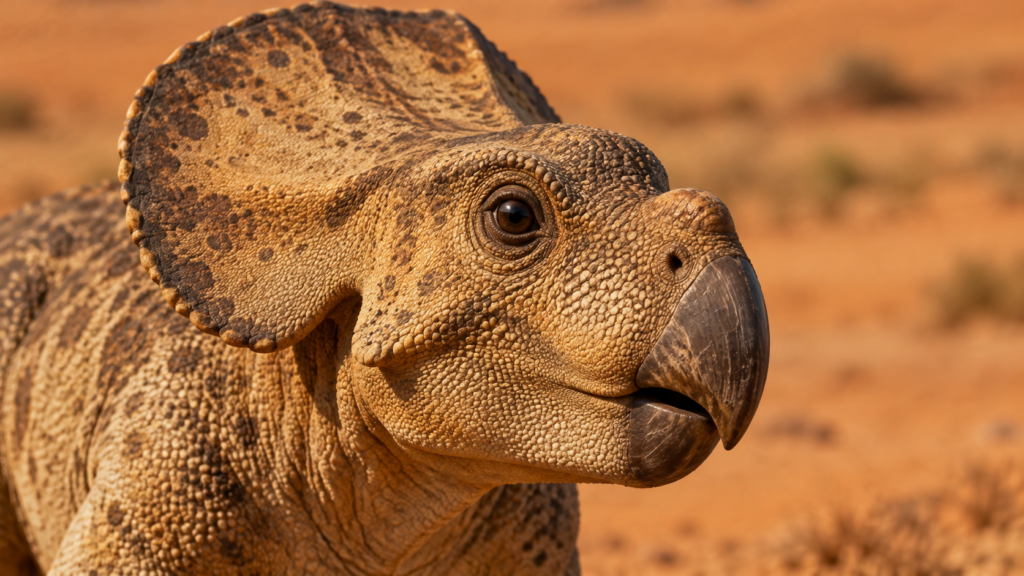
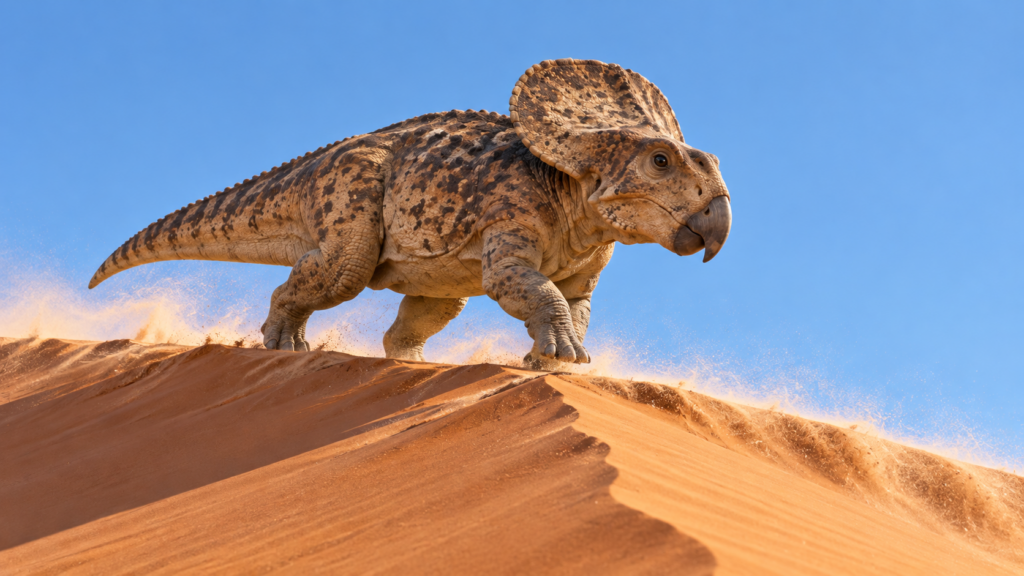
Protoceratops was a four-legged plant-eating dinosaur, a member of the same horned-dinosaur group as Triceratops, that lived among the sand dunes of Late Cretaceous Mongolia. It had a parrot-like beak and a frill flaring from the back of its skull, but no long horns over the eyes or on the nose. Hundreds of individuals have been found, from hatchlings to adults, making it one of the best-sampled dinosaurs known. Since the 1990s it has also been famous as the fossil said to have inspired the griffin, the monster of ancient Greek legend.
Appearance and Way of Life
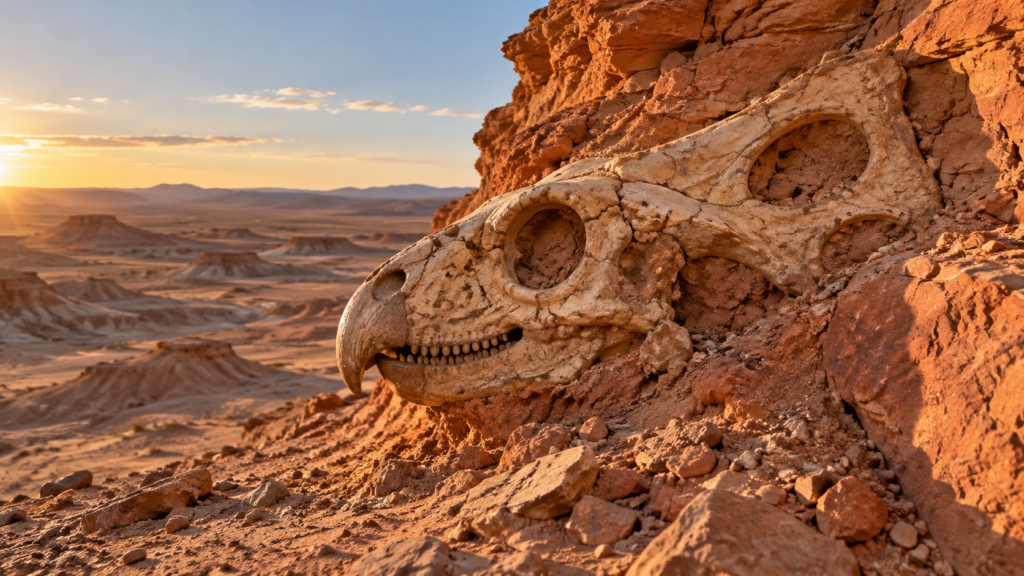
The first fossil was the skull of a young animal, found in 1922 at the Flaming Cliffs of the Gobi Desert by the American Museum of Natural History’s Central Asiatic Expedition. In 1923 Walter Granger and William Gregory described it as a new genus and species. The species name, andrewsi, honors Roy Chapman Andrews, the expedition’s leader. By 1925 more than 100 skulls and skeletons had been collected from the same cliffs, and in 2001 a second species with a broad snout, P. hellenikorhinus, was described from Inner Mongolia, China.
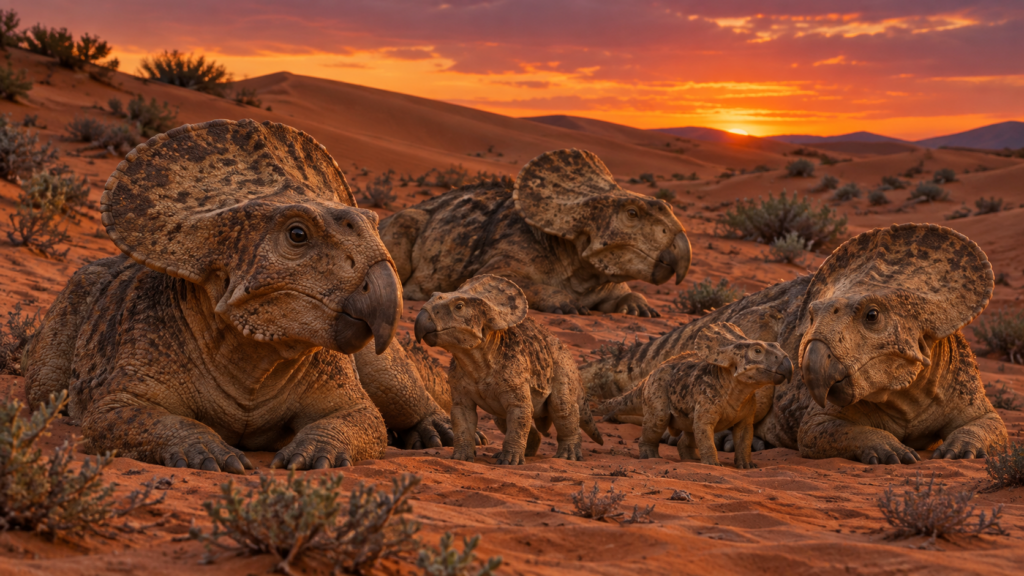
It was roughly the size of a large dog or a sheep, with a head that was big for its body and short, sturdy legs. Behind the beak were rows of blade-like teeth, thought to have sliced up tough plants. The frill was small and flat in youngsters and expanded rapidly as the animals reached adulthood. Growth rings in the bones show that growth slowed at around 9 to 10 years of age and stopped at around 11 to 13.
The Gobi of that time was dry country covered in sand dunes. The same rocks have produced the predatory dinosaur Velociraptor, oviraptorosaurs found near eggs, and small mammals and lizards. In 1971 a Polish–Mongolian expedition discovered a Protoceratops buried together with a Velociraptor in mid-fight: the Velociraptor‘s hind claw is aimed at the Protoceratops‘s neck, while the Protoceratops grips the predator’s right arm in its beak. The pair are thought to have been buried in an instant by a collapsing dune (for more on Velociraptor, see 【Life of the Cretaceous】Velociraptor – The Movie Raptor Was a Different Dinosaur). Eggs are known too, and a 2020 study reported that Protoceratops eggshells were soft and leathery rather than hard and chalky.
The Claim That It Inspired the Griffin
The griffin is an imaginary animal with the body of a lion and the head and wings of an eagle. In ancient Greece it was described as a monster guarding gold in a distant land to the northeast, and in the 5th century BC the historian Herodotus recorded a story in which a one-eyed people, the Arimaspians, stole gold from griffins.
In 1989 the American folklorist Adrienne Mayor proposed that the legend began with dinosaur fossils in Central Asia, and she developed the idea in a 1993 co-authored paper and her 2000 book The First Fossil Hunters. The story runs like this. Nomads prospecting for gold in Central Asia came across Protoceratops skeletons exposed in the desert. A beaked head, four legs and a frill that might be taken for wings were told of as a monster that was part bird and part beast, and the tale traveled west along trade routes to become the Greek griffin. The idea was widely repeated as an example of fossils giving rise to myth, and it appeared in museum displays, popular books and television documentaries.
In 2024 Mark Witton and Richard Hing, palaeontologists at the University of Portsmouth in the UK, published a paper testing the idea against history, geography and anatomy. On geography, Protoceratops fossil sites lie hundreds of kilometres from ancient gold deposits, and in a century of collecting no gold has been reported from them. On history, the griffin was already present in Egyptian and Near Eastern art in the 4th millennium BC, and it became popular in Greece from around the 8th century BC. The spread of griffin imagery is explained by its passing from these older civilizations, not by a westward journey from Central Asia. On anatomy, ancient griffins are consistently combinations of big cats and birds of prey, and most of their proportions and forms do not match Protoceratops. The authors also point out that a dinosaur skeleton exposed at the surface is usually only a weathered fragment, and complete bodies are rarely visible.
Witton and Hing called the link between Protoceratops and the griffin an “ex post facto geomyth”, a myth built after the fact. They accepted that ancient people may well have found dinosaur bones and worked them into their traditions, but concluded that such claims need support from history, geography and palaeontology together. The prevailing view today is the traditional one: the griffin is an imaginary animal that arose within ancient art.
Related products
You can find books and products related to this article on Amazon.
If you buy through the links above, this blog may earn a commission.
About the images
The images in this article are illustrations created with AI (ChatGPT), and you are welcome to use them. If you do, we would appreciate a link back to this article as the source.
Sources
Witton, M. P. & Hing, R. A. (2024). Did the horned dinosaur Protoceratops inspire the griffin? Interdisciplinary Science Reviews 49, 363–388. https://doi.org/10.1177/03080188241255543
University of Portsmouth (2024). New study finds dinosaur fossils did not inspire the mythological griffin. https://www.port.ac.uk/news-events-and-blogs/news/new-study-finds-dinosaur-fossils-did-not-inspire-the-mythological-griffin
Mayor, A. & Heaney, M. (1993). Griffins and Arimaspeans. Folklore 104, 40–66. https://doi.org/10.1080/0015587X.1993.9715853
Norell, M. A. et al. (2020). The first dinosaur egg was soft. Nature 583, 406–410. https://doi.org/10.1038/s41586-020-2412-8

コメント