| Name | Isotelus (Greek for “equal end,” after its head and tail being nearly the same size) |
| Classification | Phylum Arthropoda, Class Trilobita, Order Asaphida, Family Asaphidae |
| Period | Middle to Late Ordovician (extinct at the end of the period, about 444 million years ago) |
| Found in | Mainly North America: New York and Ohio in the United States, Manitoba in Canada, and elsewhere |
| Length | Varies by species; 30–50 cm in the larger ones. The largest, Isotelus rex, reached about 72 cm (about 40 cm wide and 7 cm high) |
| Weight | Probably a few kilograms in the largest species (a rough estimate based on living horseshoe crabs of similar size) |
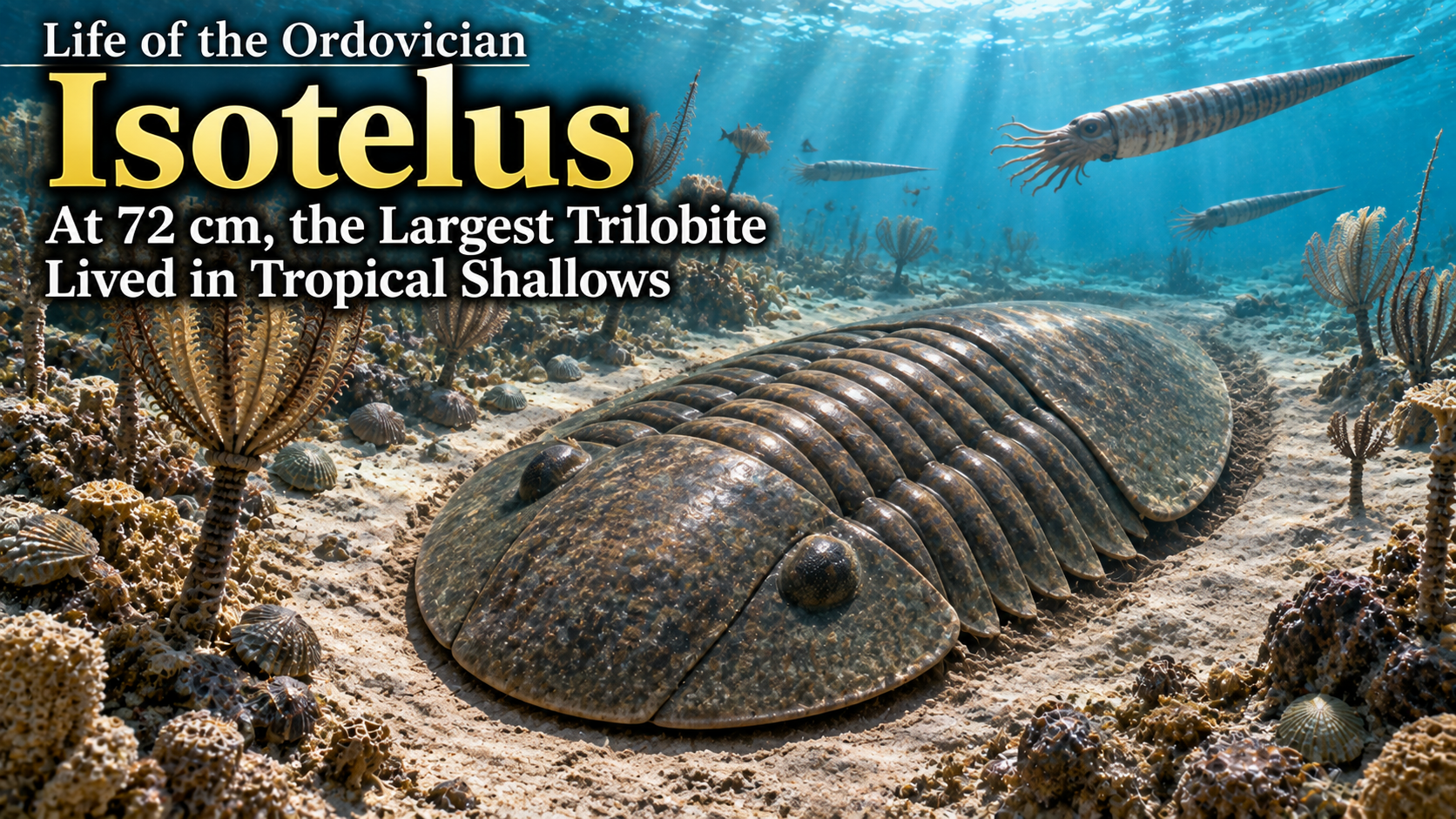
Isotelus is a genus of large trilobites that flourished in the seas of Ordovician North America. Its head and tail are nearly the same size, and its smooth, oval body has very little surface relief. The largest species, Isotelus rex, reached about 72 cm in length and is the largest trilobite ever found complete. This giant did not live in cold polar waters. It lived in warm shallows right on the equator.
Appearance and Way of Life
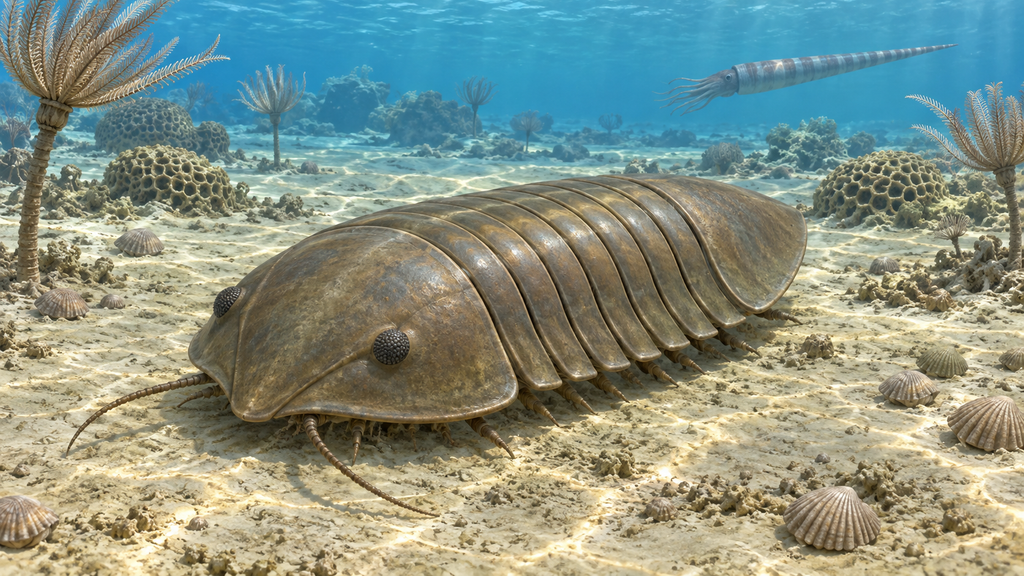
The body is divided into three parts: head, thorax and tail. The head and tail are both rounded triangles of nearly equal size, which is what the genus name “equal end” refers to. The thorax between them consists of eight segments, and by flexing it the animal could roll itself up. The two lengthwise furrows that give trilobites their name are shallow in Isotelus, and the shell bears almost no spines or bumps. The eyes sit slightly raised on either side of the head and are compound eyes packed with tiny lenses. Depending on the species, the rear corners of the cheeks are either rounded or drawn out into backward-pointing spines.
On the underside, in front of the mouth, lies a hard plate called the hypostome. In Isotelus the rear half of the hypostome is deeply split into a fork, and its surface carries fine ridges that resemble a fingerprint. This plate is often found as a fossil on its own, separate from the rest of the shell.
Clues to its diet come from the crawling and digging traces preserved in the same rock layers as the body fossils. The team that described Isotelus rex noted that the shell carried almost no encrusting organisms such as bryozoans, and that large furrow-like traces occur in the same unit. From this they inferred a predator and scavenger that lay half sunk in the mud, plowing a shallow furrow across the seafloor as it probed for prey and carcasses. Trace fossils from the Cincinnati area of the United States have also been read as evidence that it hunted worms living in the mud. Others regard it as a deposit feeder that swallowed mud for its organic content, and its diet remains unsettled.
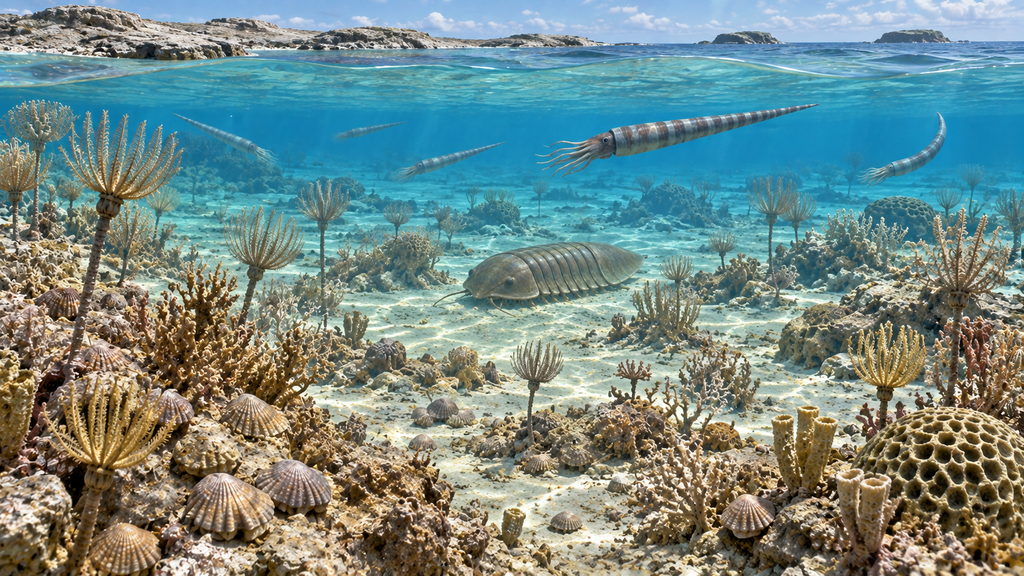
North America at the time, the continent of Laurentia, lay near the equator and was flooded by shallow seas far into its interior. On the limy seafloor, crinoids, brachiopods, bryozoans, tabulate corals and rugose corals grew in clusters, while shelled cephalopods such as straight-shelled nautiloids swam above them. Fish were still mostly small and jawless.
Isotelus has long been a familiar fossil in North America. The genus was described in 1824 from specimens from Trenton Falls, New York. In Ohio, a complete individual about 37 cm long was found in 1919 during construction of Huffman Dam near Dayton. Local third and fourth graders who saw a replica of this specimen in a museum started a letter-writing campaign to their state legislators, and in 1985 Isotelus was designated Ohio’s official state invertebrate fossil.
The World’s Largest Specimen, Isotelus rex
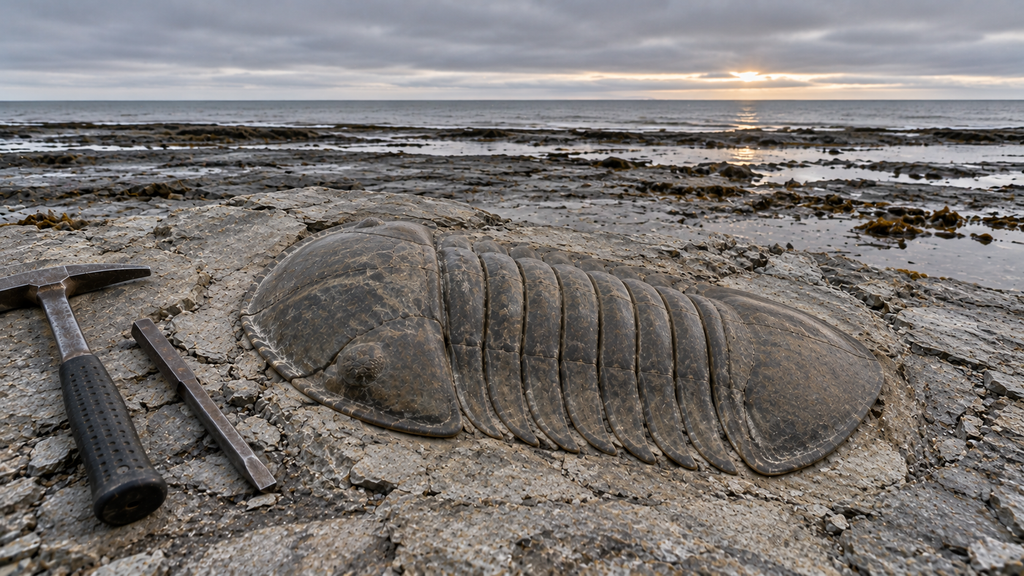
The largest specimen was found at Churchill, a town in northern Manitoba, Canada. It stands on the shore of Hudson Bay and is known today as a place to watch polar bears. On the tidal flats, Late Ordovician limestone about 445 million years old is exposed in thin beds.
A large Isotelus had already been dug out of this shore in 1986, and in 1988 broad crawling tracks were seen on the rock surface that could only have been made by an animal even bigger than the 1986 specimen. The existence of a giant trilobite was known from its tracks before its body was found.
In July 1998 a joint field party from the Manitoba Museum, the University of Manitoba and the Royal Ontario Museum worked the site. On the third day, David Rudkin, a trilobite specialist at the Royal Ontario Museum, spotted part of an enormous trilobite projecting from the limestone beds. The tide was rising and the light was failing, so work stopped for the day. The overlying layers were stripped away and the whole fossil was removed the next day.
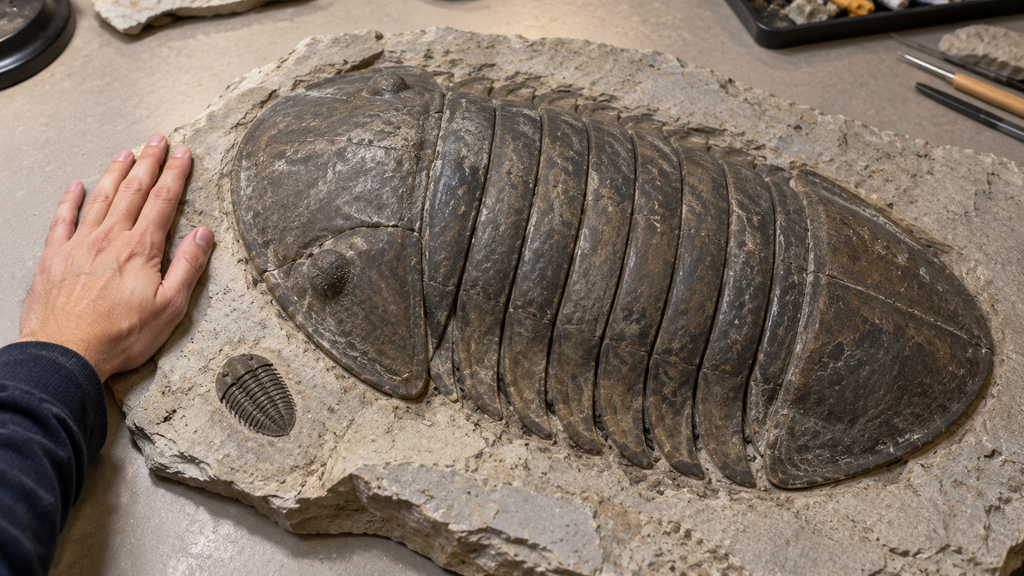
The recovered specimen is a dorsal shell articulated from head to tail, 683 mm long. An estimated 40 mm of the rear edge of the tail had been lost to weathering before discovery, so the living animal was more than 700 mm long. That is almost 70 percent longer than the largest complete trilobite documented until then. In 2003 the team described it as a new species and named it rex, Latin for “king.” It was the first specimen to show beyond doubt that trilobites grew to more than half a metre. The original is on display at the Manitoba Museum in Winnipeg.
A Giant of the Equator, Not the Poles
Among marine arthropods, larger species tend to appear in colder seas. Antarctic waters today are home to sea spiders with leg spans of tens of centimetres, and to isopods and amphipods that grow far larger than their relatives elsewhere. The phenomenon is called polar gigantism. A study published in Nature in 1999 showed that the maximum size of amphipods around the world tracks the amount of oxygen available in the water. Colder water holds more dissolved oxygen, which makes it easier to supply oxygen deep inside a body. On this view, oxygen sets the upper limit on how large a body can be sustained.
Trilobites offer an example that fits this explanation. In 2009, several species of giant trilobites were reported together from a roofing-slate quarry at Arouca in northern Portugal, with complete individuals about 70 cm long and partial fossils suggesting lengths of up to 90 cm. The Iberian Peninsula then lay on the margin of Gondwana, close to the South Pole, and the team that reported the find treats it as a possible case of polar gigantism.
For Isotelus rex the conditions were the reverse. The limestone at Churchill was laid down close to shore in a shallow sea covering the continental interior in the equatorial zone. The water was warm and held less dissolved oxygen than a polar sea. The describing paper presents the specimen as a striking example of “low-latitude gigantism,” in sharp contrast to the polar gigantism that is widespread among marine arthropods today.
In the Ordovician seas, then, trilobites were growing to 70 cm both in cold waters near the South Pole and in warm equatorial shallows. Cold water and abundant oxygen can account for the Portuguese giants, but not for Isotelus rex. There is still no accepted explanation of how it grew so large in warm, shallow water.
Gone with the Ordovician
The asaphids, the group that includes Isotelus, were almost entirely wiped out in the mass extinction at the end of the Ordovician. Because the largest individuals appeared close in time to the extinction, it might seem that growing too large was the cause, but the describing paper rejects that connection.
What the paper points to instead is the way the larvae lived. Asaphid larvae are thought to have drifted in the open water as plankton. At the end of the Ordovician, ice sheets spread across Gondwana, the whole planet cooled rapidly and sea level fell. The shallow seas that had covered the tropical continents drained away, and the drifting larvae and the shallow-water adults lost their habitats at the same time. No Isotelus is found in the seas of the Silurian.
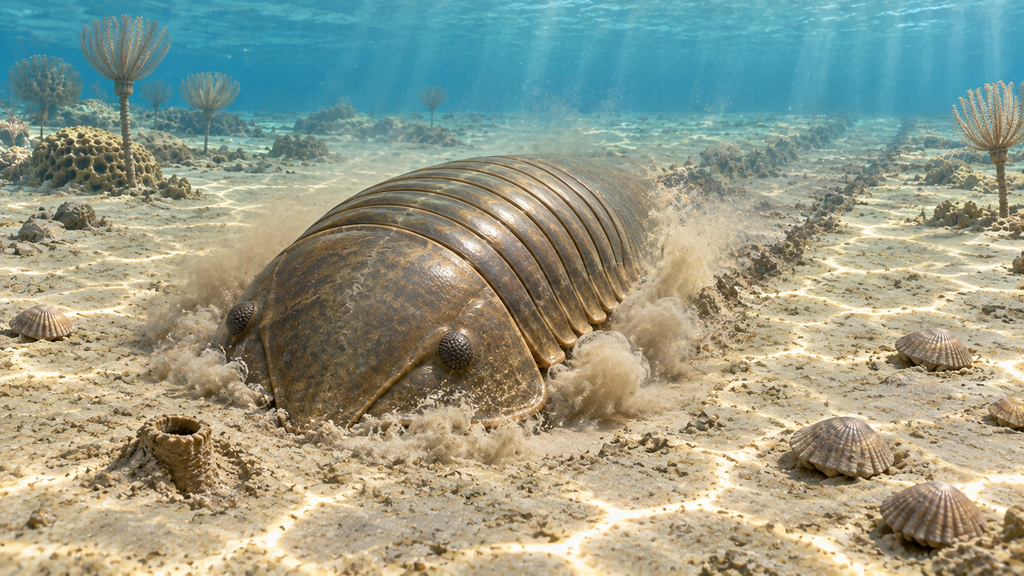
The images below are all generated reconstructions. Photographs of the actual specimen can be seen on the Manitoba Museum and University of Waterloo pages listed in the sources.
Sources
Manitoba Museum, “Replicating rex” (the holotype on exhibit and the making of its replica)
Ohio Department of Natural Resources, GeoFacts No. 6, “Isotelus—Ohio’s State Invertebrate Fossil”

コメント