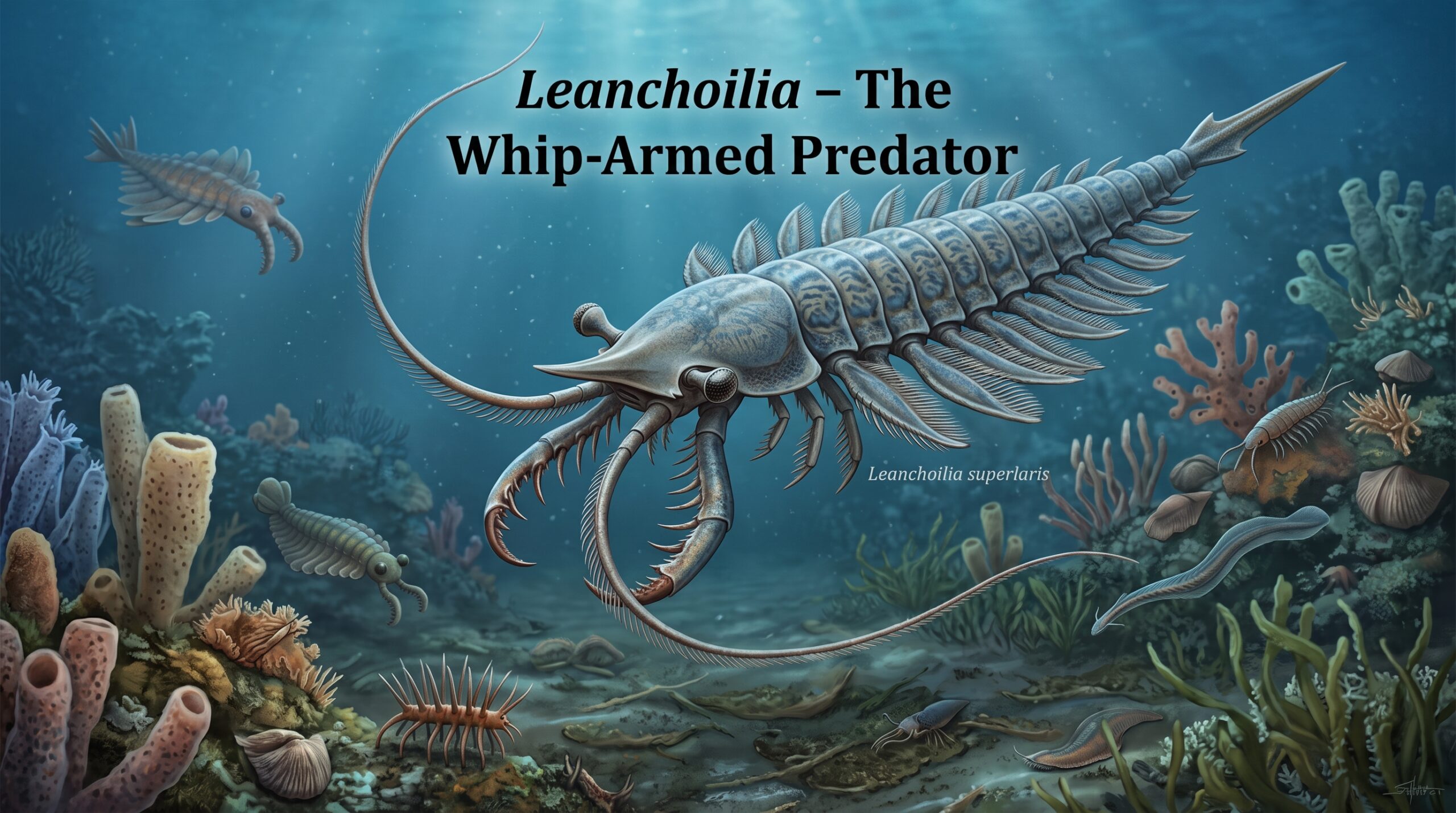
| Name | Leanchoilia, after Leanchoil, a station on the Canadian Pacific Railway. The species name of the type species, superlata, is Latin for “exaggerated” |
| Classification | Phylum Arthropoda, Megacheira (great-appendage arthropods), family Leanchoiliidae |
| Age | Cambrian (the Burgess Shale species about 505 million years ago, the Chengjiang species in China about 518 million years ago) |
| Found in | British Columbia, Canada (the Burgess Shale); Utah, USA; Yunnan Province, China (Chengjiang) |
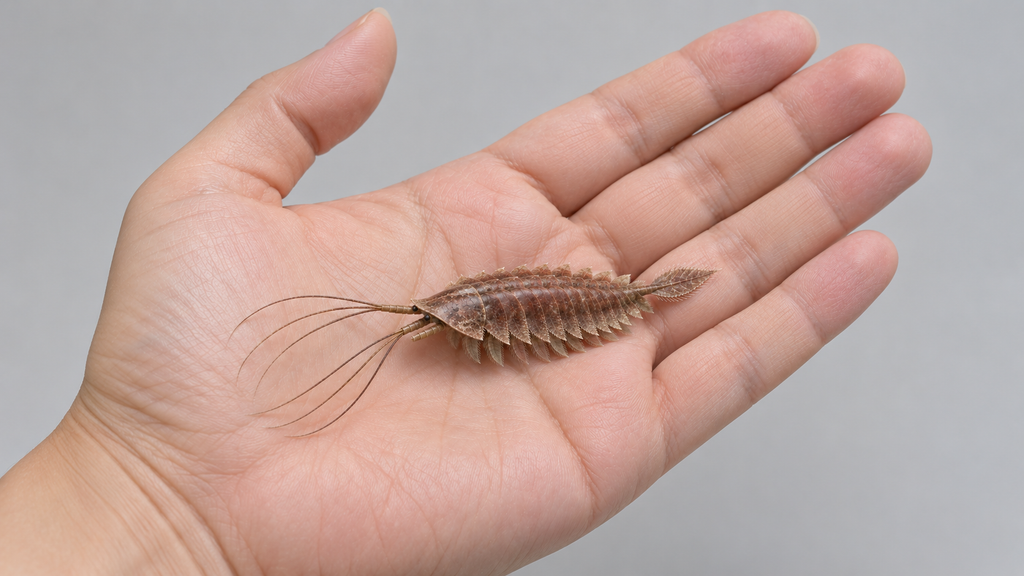
| Length | Up to about 12 cm (excluding the whips). Most specimens used in research are 2.4 to 7 cm |
| Described | 1912, by Charles Walcott |
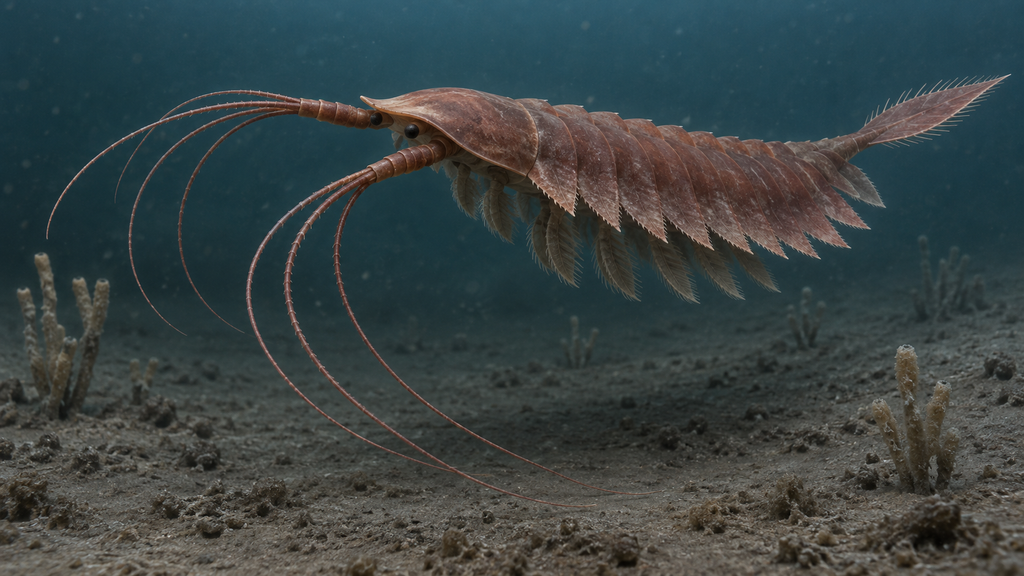
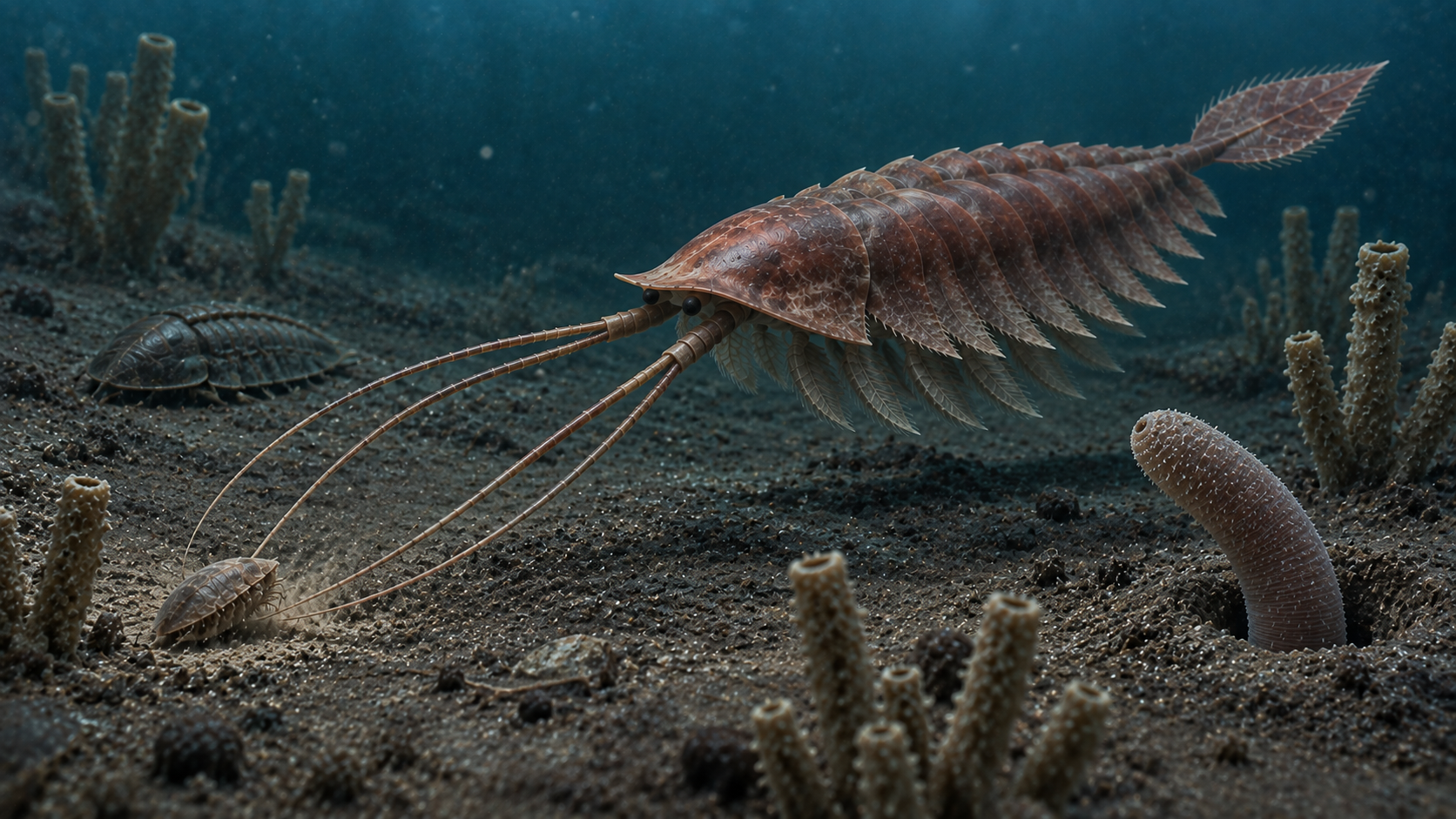
Leanchoilia was an arthropod of the Cambrian sea. In front of its head it carried a pair of arms known as great appendages, from which three long whips extended on each side, six in all. In the 1980s it was interpreted as an eyeless animal feeding on mud and carcasses; later re-examination found eyes, and it is now regarded as a predator that pursued prey.
Form and anatomy
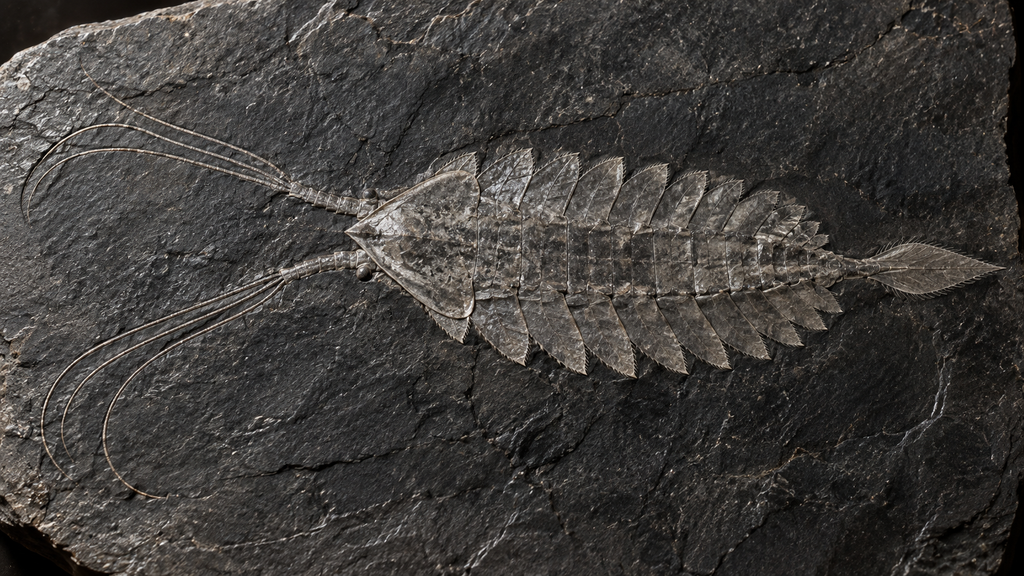
The body divides into a head covered by a single shield, a trunk of eleven segments, and a telson shaped like a spearhead. The tip of the head shield projects as a short horn curving upward. Each trunk segment extends laterally as a plate, its margin lined with fine serrations like saw teeth. Setae grew along the margin of the telson. The cuticle was not mineralized as in trilobites; the exoskeleton was entirely soft.
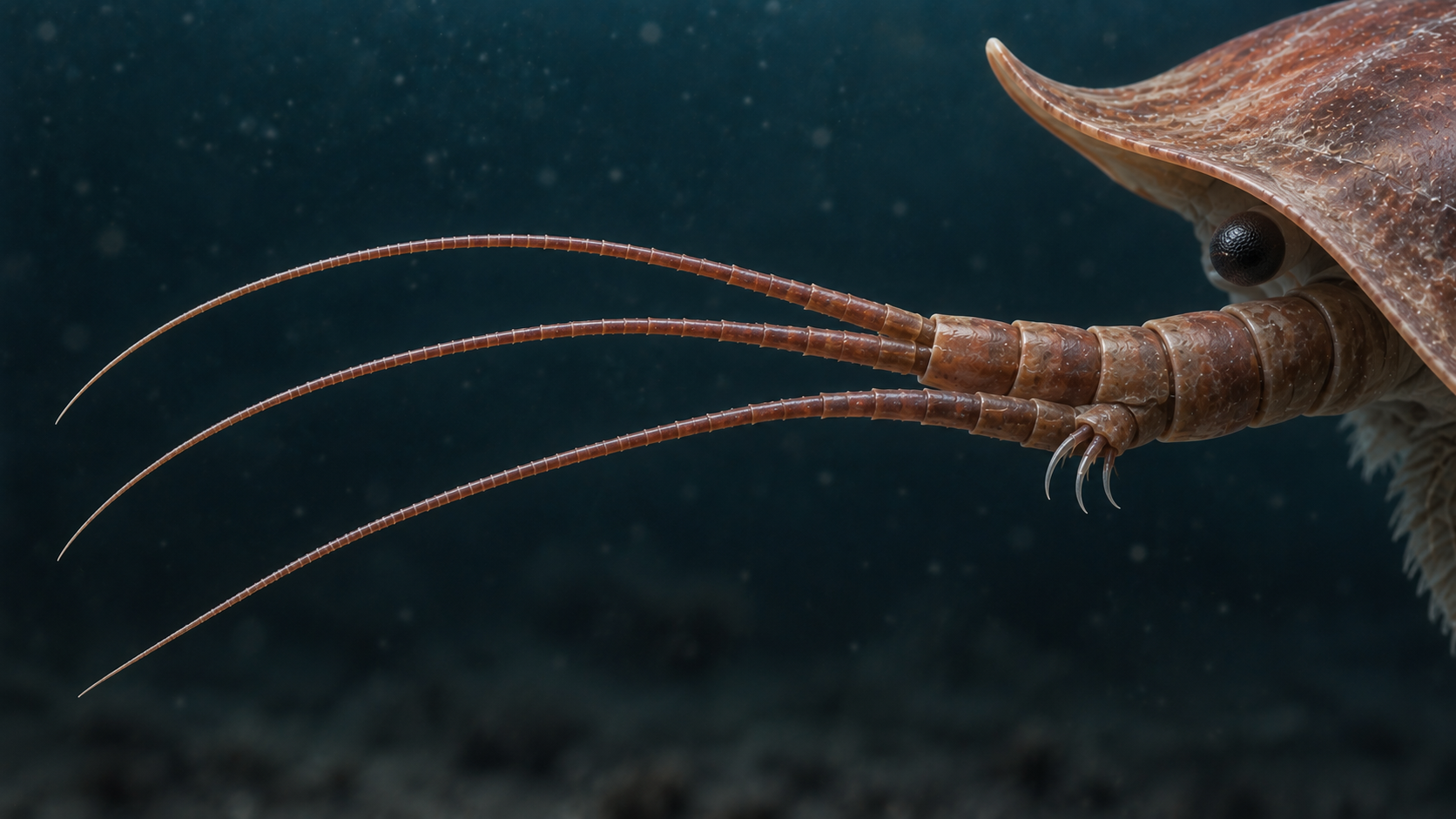
The great appendage, its most distinctive feature, consists of a peduncle at the base and a claw region beyond it. From each of the three elements of the claw extends a long spine, ending in a whip divided into fine annulations. The whips are thought to have served as sensory organs for probing the surroundings. At the very tip is a small element bearing four inward-curving hooked spines, with which the animal could grasp whatever the whips located. Sensory organ and grasping tool, in other words, were combined in a single arm.
All the limbs behind the great appendages are built alike. Each divides in two at the base: the inner branch a segmented leg, the outer a paddle-like plate fringed with setae along its margin. On the inner side of each limb base is a stout bundle of spines, which allowed food to be crushed between the bases on either side.
Way of life, and the animals of the same sea
Leanchoilia swam near the seafloor and also moved across it. A 2012 study showed that the paddle-like outer branch was suited to swimming, with joints that folded on the return stroke to reduce resistance and locked when pushing against the water.
Its abundance varies greatly between localities within the Burgess Shale. At the famous Walcott Quarry it makes up only about 0.1 percent of the assemblage, while the Raymond Quarry on the same ridge has yielded over 1,200 specimens. The Royal Ontario Museum has collected more than 1,500 specimens of the genus in fieldwork since 1975.
The same sea held Anomalocaris, Marrella, the trilobite Olenoides, and Ottoia, which burrowed into the seafloor mud. Ottoia is often found on the same slabs as Leanchoilia. In China it was proposed that Leanchoilia ate worms such as Ottoia, but in the Burgess Shale the two are of almost the same body size, so rather than predator and prey they appear to have been predators after similar prey.
From eyeless mud-eater to sighted predator
Walcott, describing Leanchoilia in 1912, wrote that the animal had eyes. Raymond, re-examining it in 1935, took the same position. Later work cast doubt on their existence, however, and the detailed redescription published by Bruton and Whittington in 1983 concluded that Leanchoilia had no eyes. On that interpretation its way of life was depicted accordingly: an animal probing the seafloor with its whips and feeding on mud and carcasses.
The view began to change in 2002. Butterfield showed that the structures arranged along both sides of the gut are digestive glands, preserved in three dimensions by replacement with phosphate. From those glands and the gut contents, Butterfield argued that what Leanchoilia ate was not mud but animal matter, and that it was a predator or a scavenger.
In 2007, García-Bellido and Collins re-examined the Royal Ontario Museum’s more than 1,500 specimens and confirmed eyes concealed beneath the head shield. In 2012, Haug and colleagues judged them to be compound eyes, on the grounds of their short stalks, and showed at the same time that the body axis is slimmer than earlier reconstructions had it, that the limb bases bear spines for crushing food, and that the tip of the great appendage is built to actually grasp. That study concluded that Leanchoilia was an agile predator actively pursuing prey, and rejected the earlier interpretations of scavenging and mud-feeding.
The number of eyes is counted differently from study to study. The 2007 work described two on each side, four in all. The 2012 work read the two on each side as a single connected eye, one on each side, each divided into two swellings. The Royal Ontario Museum’s current account describes one pair of large lateral eyes on short stalks and one pair of small mushroom-shaped median eyes. All these readings agree that Leanchoilia had eyes and that it was a predator.
The relationship to spiders and scorpions
One hypothesis holds that the great appendage shares an origin with the chelicerae that spiders, scorpions and horseshoe crabs carry in front of the mouth. Both are the foremost appendages of the head, and both are shaped for grasping. In 2014, a larva of Leanchoilia illecebrosa from Chengjiang in China was reported and published as a 520-million-year-old larva belonging to the chelicerate lineage.
In April 2026, Megacheliceraxus, the oldest arthropod with unambiguous chelicerae, was reported in Nature from strata about 500 million years old in Utah. The phylogenetic analysis in that study places the megacheirans, Leanchoilia among them, “probably” within the chelicerate lineage in the broad sense. Other analyses place the megacheirans in a more basal position, and their placement is not yet settled.
Sources
Royal Ontario Museum, “The Burgess Shale”: Leanchoilia superlata
Butterfield, N.J. (2002) Leanchoilia guts and the interpretation of three-dimensional structures in Burgess Shale-type fossils. Paleobiology 28, 155–171.
Liu, Y. et al. (2014) A 520 million-year-old chelicerate larva. Nature Communications 5, 4440.
コメント