This article contains affiliate links. As an Amazon Associate I earn from qualifying purchases.
| Name | Starfish, or sea stars (class Asteroidea, meaning “star-shaped”) |
| Classification | Phylum Echinodermata, class Asteroidea |
| Age | Early Ordovician (about 480 million years ago) to the present |
| Where found | The oldest known fossils come from the Fezouata Shale in the Anti-Atlas Mountains of Morocco. Today, oceans worldwide |
| Size | About 1 cm to 1 m across the outstretched arms. Most species are 10 to 30 cm |
| Weight | Up to about 5 kg in the sunflower sea star, the heaviest species. Typical species weigh tens to a few hundred grams |
| Number of species | About 1,900 living species |
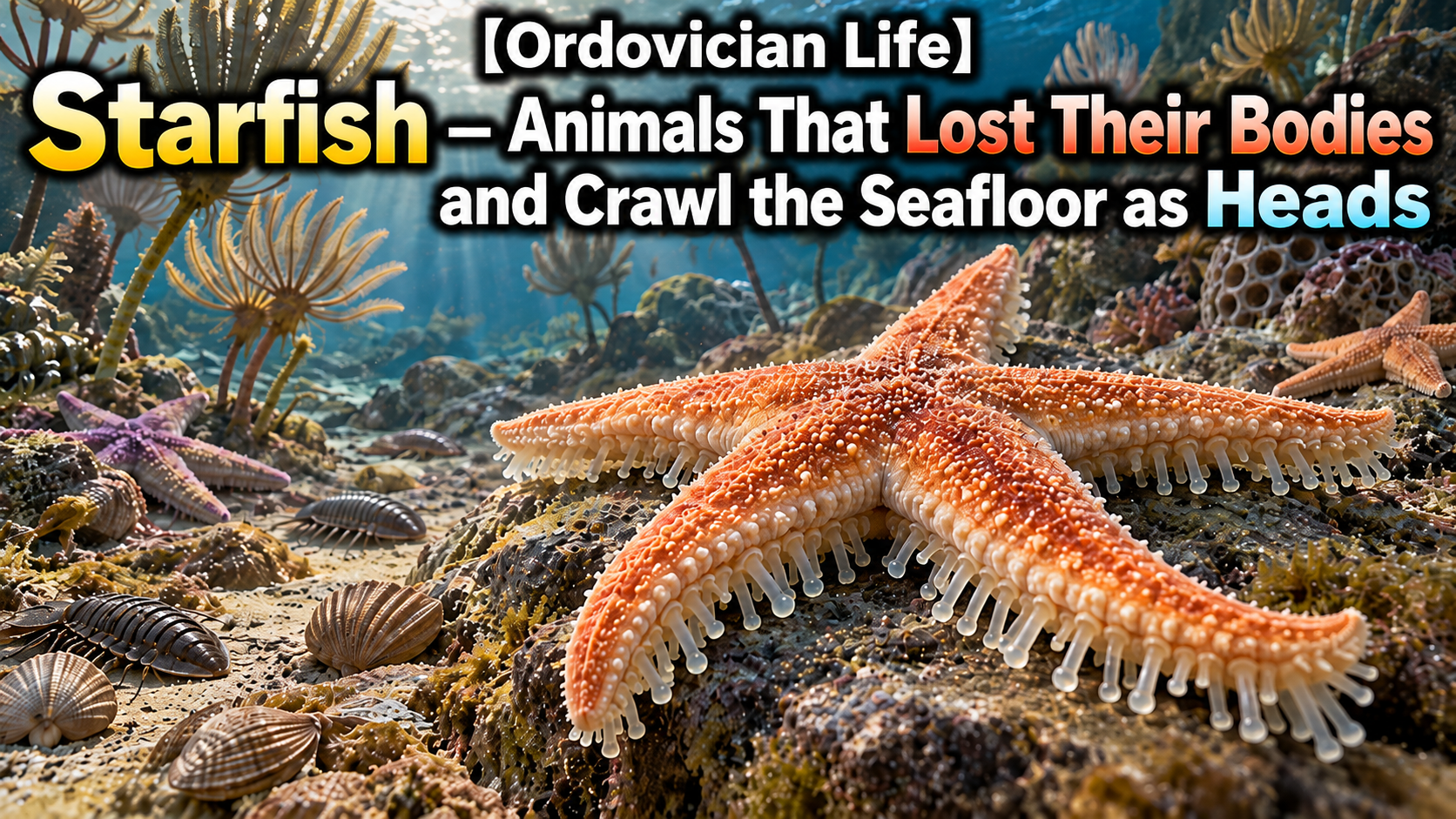
Starfish are echinoderms, the same group as sea urchins and sea cucumbers. Their star-shaped body has five arms radiating from the center, and they crawl over the seafloor mouth-down, feeding on shellfish and other small animals. Their ancestors were bilaterally symmetrical, and starfish larvae still are today. Why the adult body became five-fold has been an open question for more than 150 years. In 2023, a genetic study offered an answer: almost the entire body of a starfish corresponds to a head.
Appearance and way of life
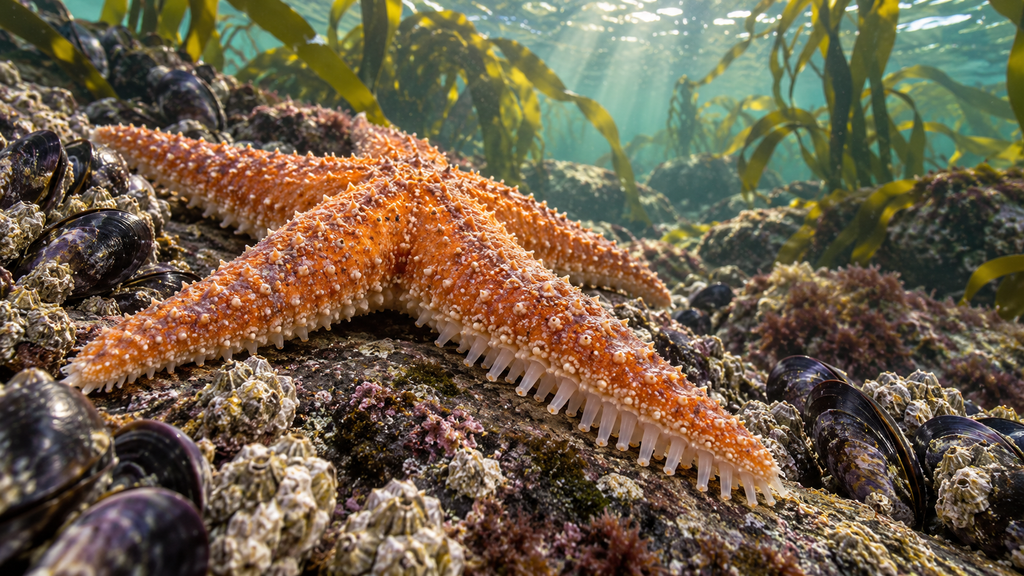
A starfish has a central disc with arms extending from it. Five arms is the basic pattern, but some species have six or seven, and a few have more than twenty. Beneath the skin lies a mosaic of small calcium carbonate plates, joined to one another by muscle and connective tissue. This connective tissue can change its own stiffness, so a starfish can go soft to squeeze into a crevice or lock itself rigid to withstand waves.
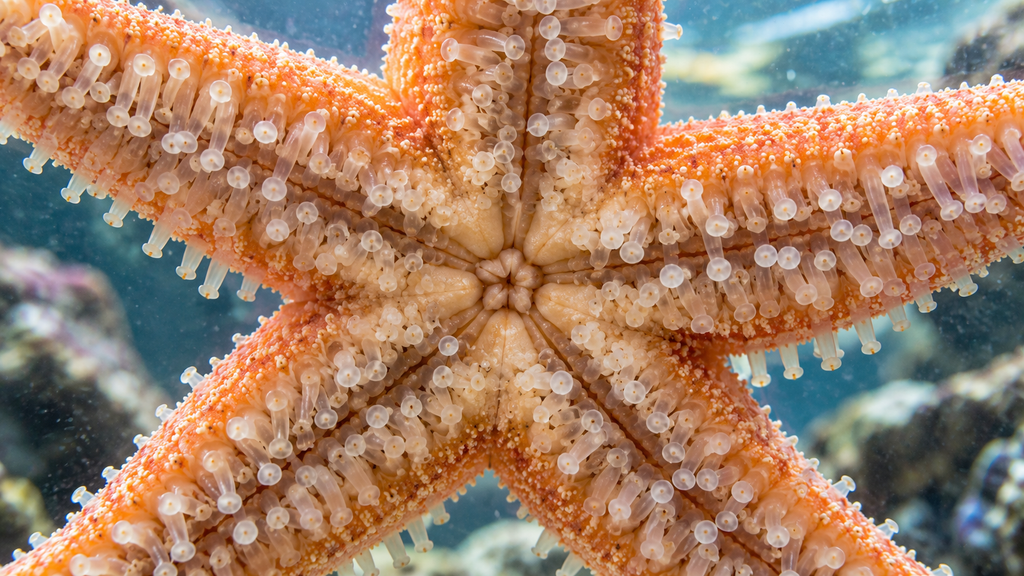
A groove runs along the underside of each arm, lined with rows of slender tube feet. The tube feet are filled with seawater and connected to a system of internal canals called the water vascular system. Water pressure extends each foot, a sucker at the tip grips the surface, and the foot contracts to pull the body along. Hundreds of feet repeat this cycle to move the animal. The sunflower sea star has more than 15,000 tube feet and can cover about a meter a minute.
Their way of eating is unusual. To eat a clam or mussel, a starfish grips the shell with its tube feet, pries open a narrow gap, and pushes its own stomach out through its mouth and into the shell, digesting the prey inside. Each arm ends in a red eyespot that cannot form images but senses changes in light. There is no brain; a ring of nerves around the mouth and a nerve running down each arm control the body. A lost arm regrows, and in some species a single severed arm can regenerate a whole animal.
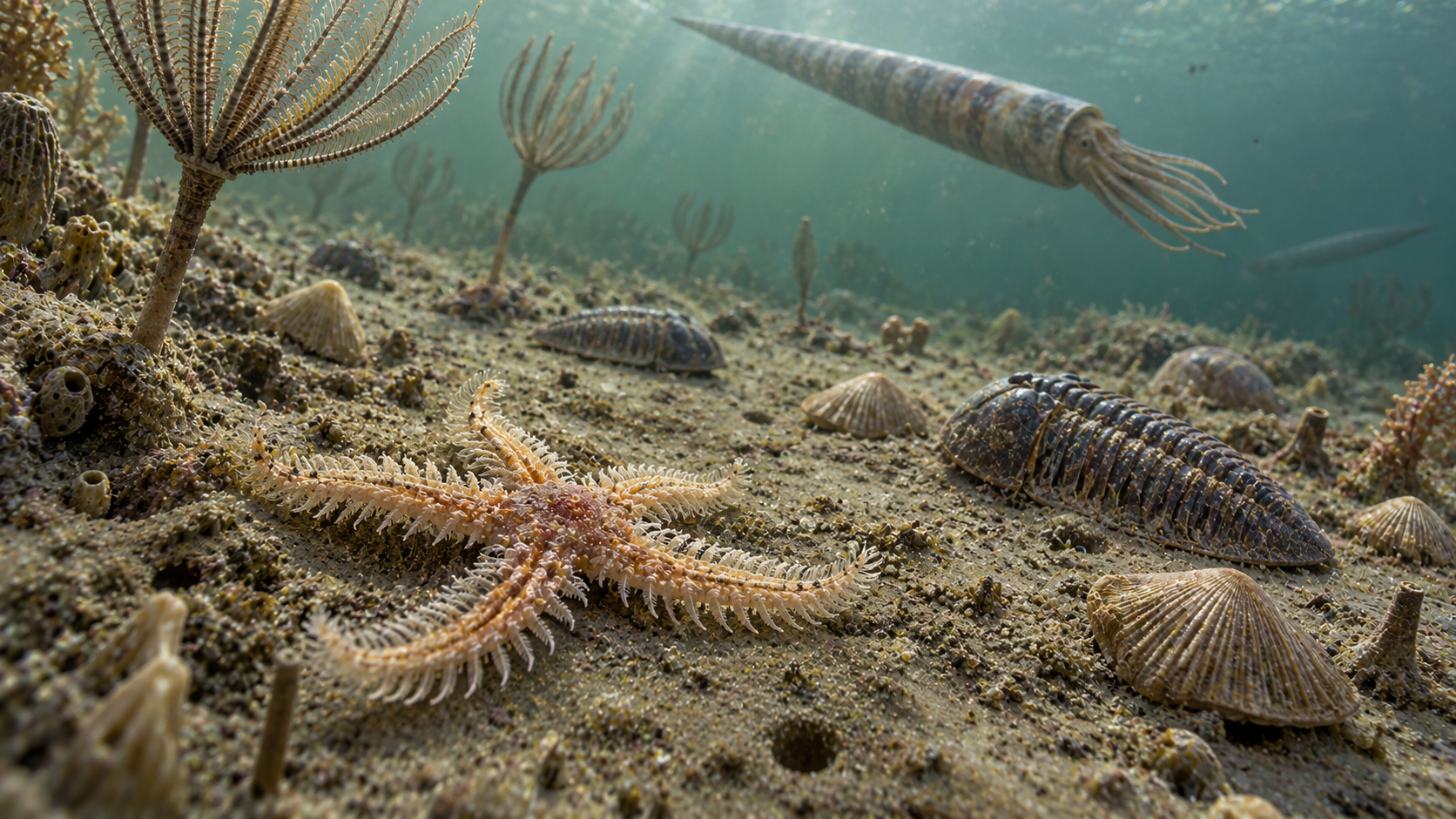
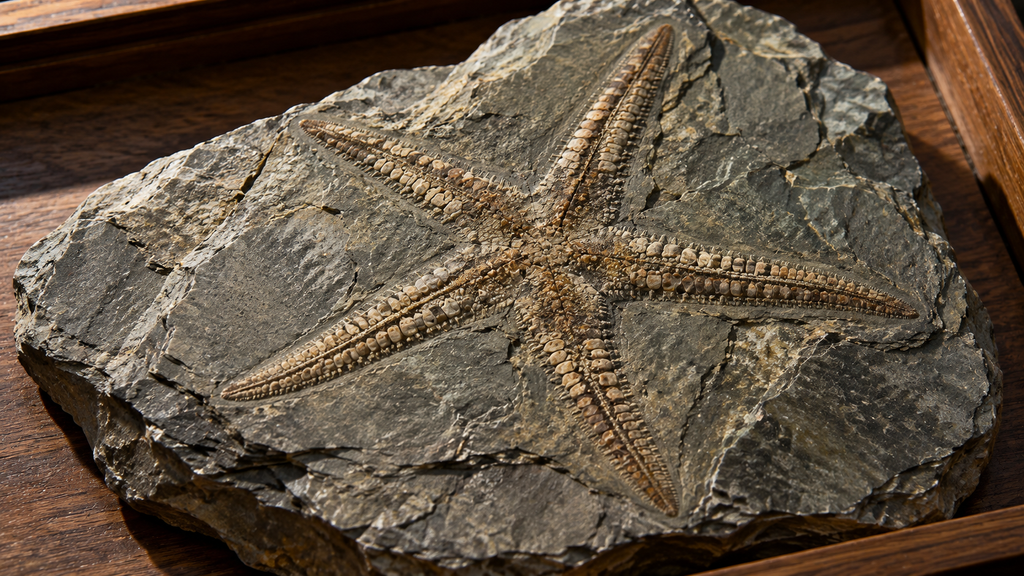
A starfish only becomes a fossil if it is buried before its plates fall apart after death. Whole-body fossils are therefore rare and tend to turn up in clusters at sites with exceptional preservation. The oldest known is Cantabrigiaster fezouataensis from the Fezouata Shale of Morocco, dating to the earliest Ordovician (Tremadocian, about 480 million years ago). Described in 2021 by Aaron Hunter of the University of Cambridge and a colleague, its arm skeleton is built in a way that sits between crinoids and starfish, and of the skeletal elements found in living starfish it had only those associated with the food groove running down the center of each arm. The team interprets it as an early stage in the separation of the starfish lineage from crinoid-like ancestors.
The Ordovician was a time when marine animal diversity rose sharply. The seafloor was home to trilobites, brachiopods, straight-shelled cephalopods, and tabulate corals. The starfish and brittle star lineages diverged during this period, and starfish have since passed through the end-Permian and end-Cretaceous mass extinctions with little change to their basic body plan.
The predator that sets the cast of the rocky shore
Starfish are the animal behind the concept of the “keystone species” in ecology. Beginning in 1963, Robert Paine of the University of Washington repeatedly removed the mussel-eating orange starfish Pisaster from a stretch of rocky shore in Washington State. In the cleared plot, mussels took over the rock surface, and the roughly fifteen species that had lived there dropped by about half within a few years. A single predator, unremarkable in either numbers or bulk, had been determining which animals lived there. Paine published the result in 1966 and coined the term “keystone species” for such animals in 1969.
The same relationship showed up when starfish declined. Starting in 2013, sea star wasting disease spread along the Pacific coast of North America. Lesions appear on the body, arms drop off, and the animal disintegrates within days. More than twenty species from Mexico to Alaska were affected. The hardest hit was the sunflower sea star, with an estimated six billion individuals lost; it is now listed as Critically Endangered by the IUCN. The sea urchins it had been eating multiplied, grazed down the kelp, and kelp forests were lost over wide areas. The cause remained unknown for over a decade. In 2025, a team from the University of British Columbia, the Hakai Institute, and partner institutions isolated a strain of the bacterium Vibrio pectenicida from the body fluid of diseased starfish and reproduced the disease by exposing healthy sunflower sea stars to it, confirming the bacterium as a causative agent.
A starfish is almost entirely head
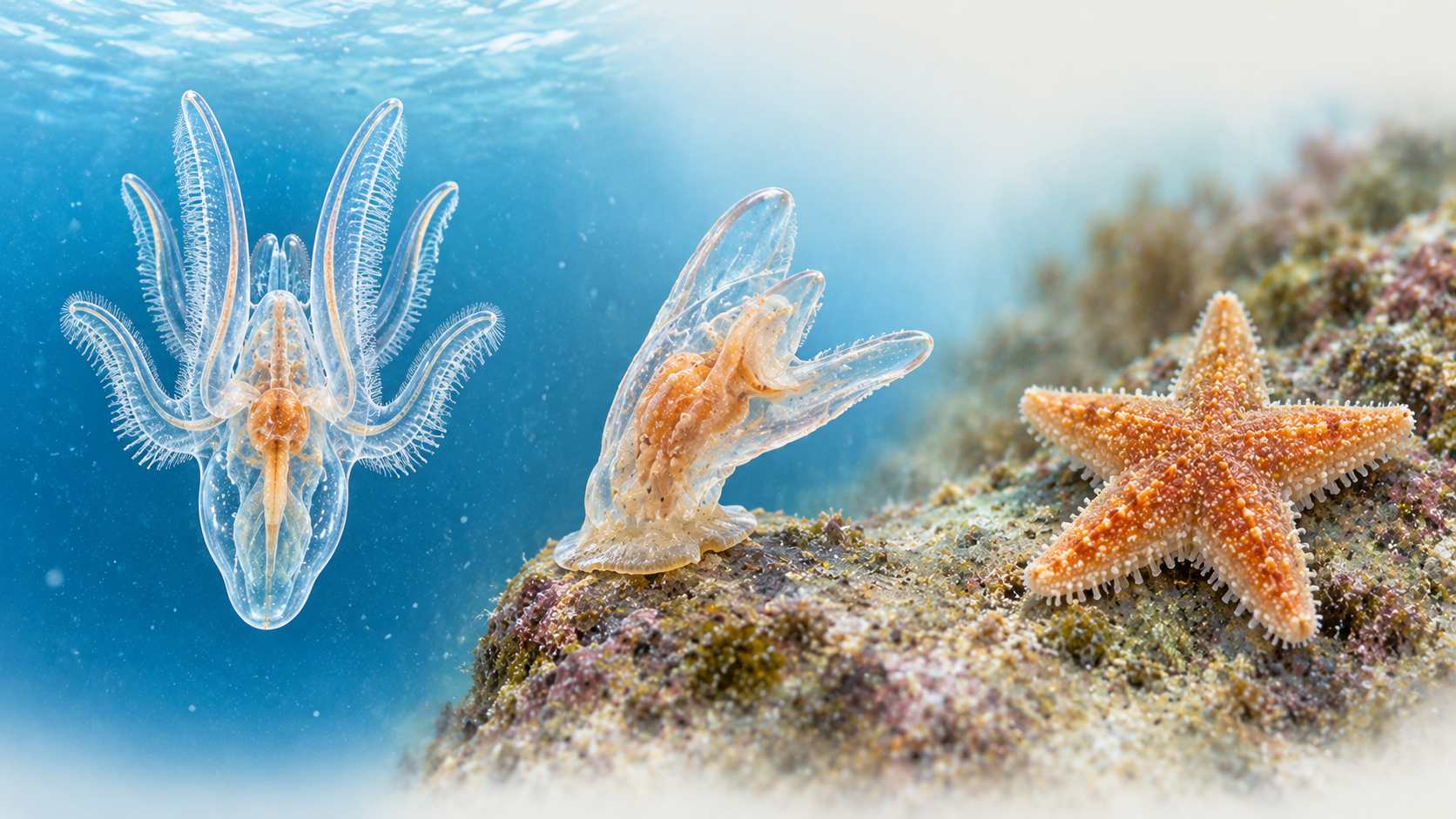
Animal bodies fall broadly into two kinds of symmetry. Humans, fish, and insects are bilaterally symmetrical, with left and right halves mirroring each other. Jellyfish and sea anemones are radially symmetrical, with the same structures repeating around a central axis. Echinoderms such as starfish are five-fold radially symmetrical as adults, but their larvae are bilateral and swim with a clear head end and tail end. A starfish larva, called a bipinnaria, drifts as plankton for several weeks before settling on the seafloor and reorganizing its body into a five-armed juvenile. Which part of the bilateral ancestral body corresponds to which part of the adult starfish has been debated since the 19th century.
In 2023, a team led by Laurent Formery and Christopher Lowe at Stanford University answered the question from the genetic side. The clue was the set of genes that lays out the front-to-back axis of animal bodies. The genes that build a fly’s head are the same ones that build a human head, and the order in which these genes act from head to tail is shared widely across animals. The team took juveniles of Patiria miniata, a starfish from the shallow waters of California, cut them into thin sections, and built a three-dimensional map of where more than thirty of these genes were active.
The result was a front-to-back sequence in each arm. The line of the groove running down the center of each arm’s underside expressed the genes that mark the tip of the head in other animals, and moving outward toward the edge of the arm, genes corresponding to the back of the head and then the tail appeared in order. In other words, each of the five arms carries its own front-to-back axis, with the midline as the front and the edge as the back. And the genes that build the trunk, the region that should lie between head and tail, were not active anywhere on the starfish body surface. Formery described the result as a starfish having lost its entire trunk, leaving just a head crawling along the seafloor.
The study offers a new view of how a five-fold body arose from a bilateral ancestor. Earlier explanations tried to work out how a bilateral body was twisted and folded into five parts. This result reads differently: the front-to-back axis itself remains, the trunk region has disappeared, and the head region is repeated five times. The same researchers went on to find the same gene arrangement in brittle stars, suggesting that a head-only body is common to echinoderms. At the same time, this is a result from genes on the body surface and does not account for the origins of the internal organs or the skeleton. Hunter, who described Cantabrigiaster, has also said that why starfish came to have five arms remains an open question from the fossil side as well.
Related products
You can find books and products related to this article on Amazon.
If you buy through the links above, this blog may earn a commission.
Sources
Formery, L. et al. (2023) Molecular evidence of anteroposterior patterning in adult echinoderms. Nature 623, 555–561. https://www.nature.com/articles/s41586-023-06669-2
ScienceDaily / Stanford University (November 1, 2023) Where is a sea star’s head? Maybe just about everywhere. https://www.sciencedaily.com/releases/2023/11/231101134930.htm
Hunter, A. W. & Ortega-Hernández, J. (2021) A new somasteroid from the Fezouata Lagerstätte in Morocco and the Early Ordovician origin of Asterozoa. Biology Letters. https://www.ncbi.nlm.nih.gov/pmc/articles/PMC7876607
University of Cambridge press release (January 19, 2021) New starfish-like fossil reveals evolution in action. https://www.cam.ac.uk/research/news/new-starfish-like-fossil-reveals-evolution-in-action
Paine, R. T. (1966) Food web complexity and species diversity. The American Naturalist 100, 65–75. http://dx.doi.org/10.1086/282400
Prentice, M. B. et al. (2025) Vibrio pectenicida strain FHCF-3 is a causative agent of sea star wasting disease. Nature Ecology & Evolution 9, 1739–1751. https://doi.org/10.1038/s41559-025-02797-2
University of British Columbia press release (August 4, 2025) ‘Disease detectives’ discover cause of sea star wasting disease. https://science.ubc.ca/news/2025-08/disease-detectives-discover-cause-sea-star-wasting-disease-wiped-out-billions-sea

コメント