This article contains affiliate links. As an Amazon Associate I earn from qualifying purchases.
| Name | Graptolite. From the Greek graptos (“written”) and lithos (“stone”), because the fossils look like writing on the surface of the rock |
| Classification | Phylum Hemichordata, Class Pterobranchia, Subclass Graptolithina |
| Age | Early Cambrian to Late Carboniferous (about 516 to 320 million years ago). The drifting forms lived from the Ordovician to the Early Devonian |
| Found in | Worldwide. Especially common in the black mudstones (black shales) of the Ordovician and Silurian |
| Colony size | Mostly a few centimeters; the largest reach several tens of centimeters |
| Zooid size | Around 1 millimeter |
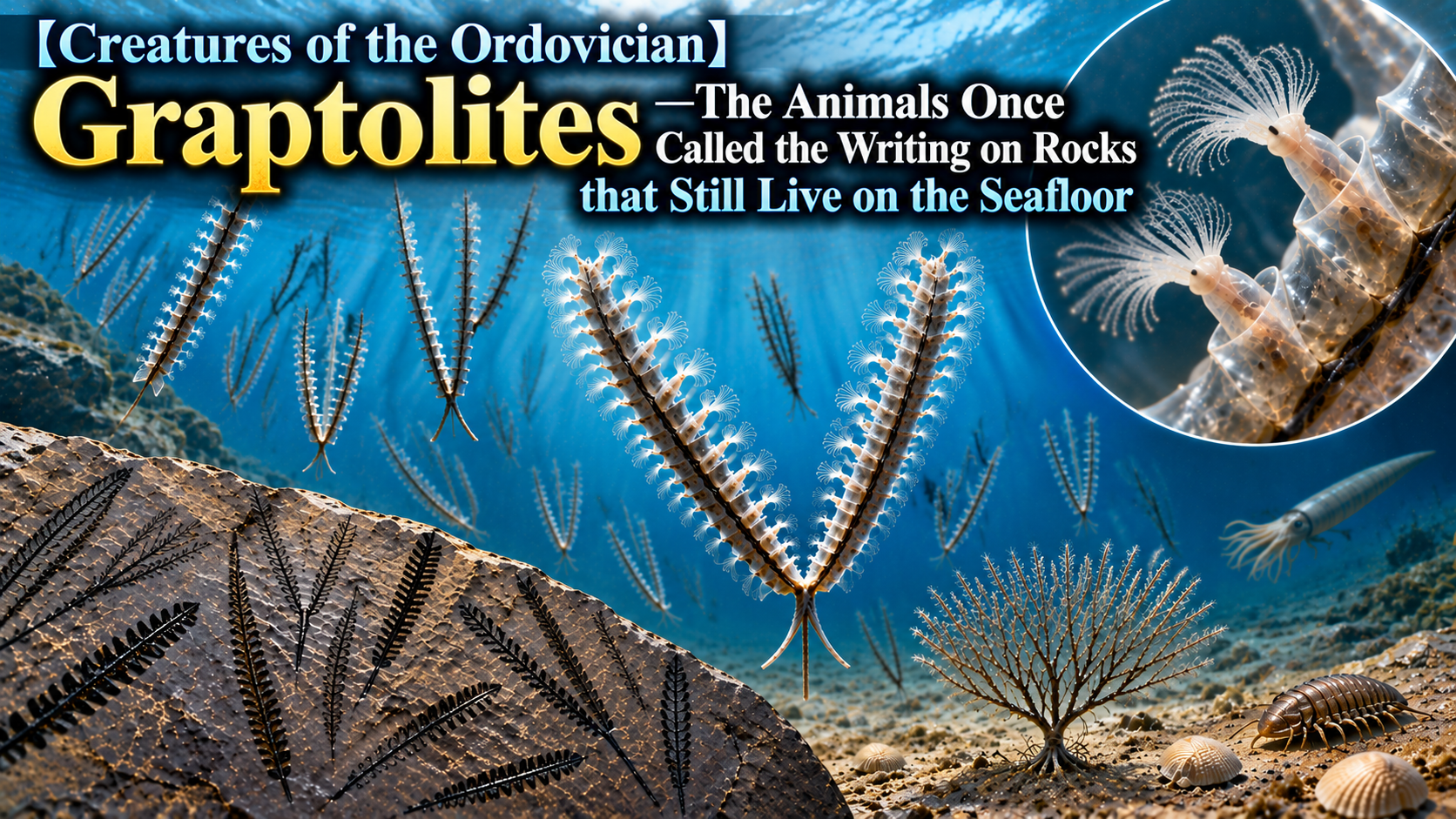
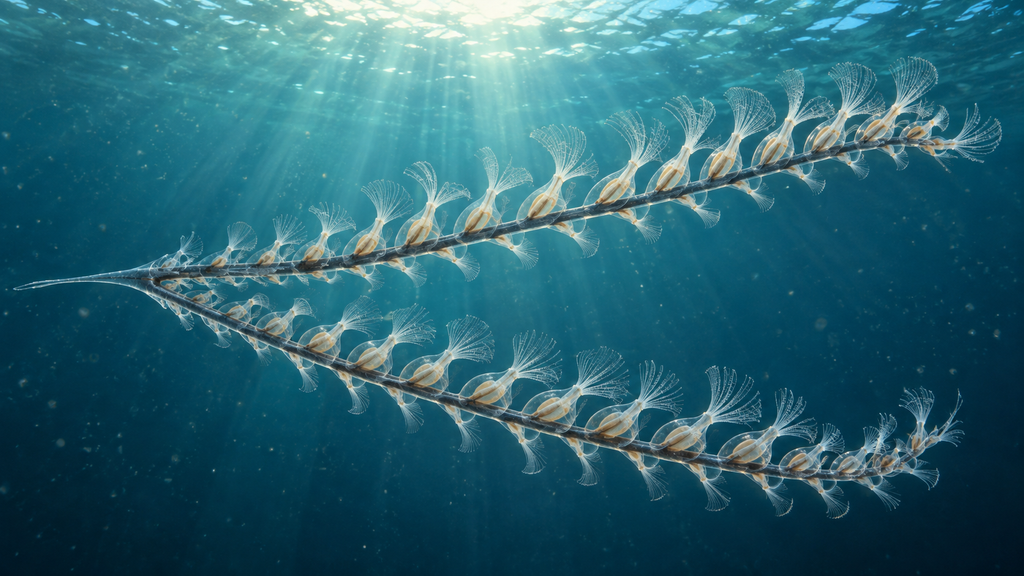
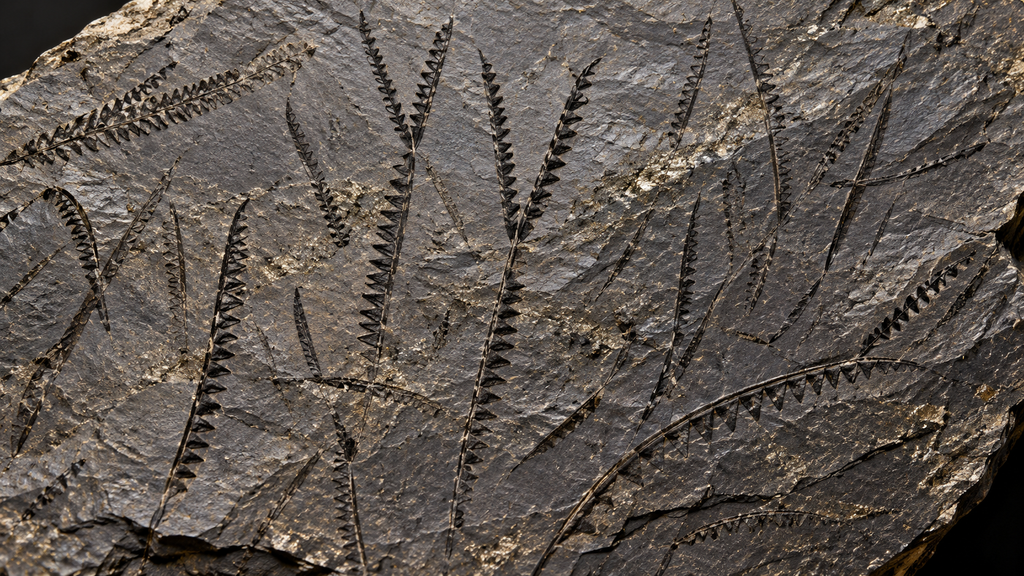
Graptolites were marine animals that built colonies of narrow tubes joined together in branches or strips. Each tube housed a single individual, and the colony as a whole lived as one organism. The fossils appear on the surface of black mudstone as thin lines, as if drawn with a pencil. The shape of the line differs by species: a vertical line with saw-tooth edges, a line forked like a tuning fork, a line coiled into a spiral.
In the seas of the Ordovician and Silurian, these colonies drifted through the water. Because species replaced one another quickly, graptolites rank alongside trilobites and ammonites as the main index fossils used to date rock strata. The name graptolite was originally given, in the eighteenth century, to something that was not considered a fossil at all. And under the current classification, graptolites are not an extinct group.
Appearance and Way of Life
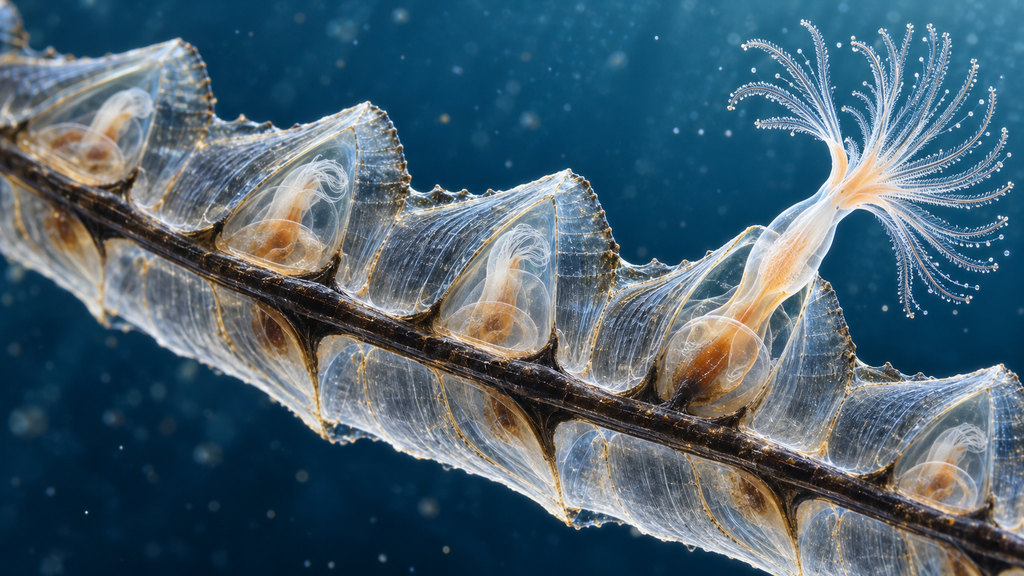
The body of a graptolite fossil is the organic tube that formed the colony. This tube, called the tubarium, contains no minerals such as calcium carbonate. Its material is thought to be a collagen-like protein, though some researchers argue for chitin, and the question is not settled. The tube wall shows a banded pattern of narrow half-rings laid down alternately (fuselli), and this is the single most reliable feature for recognizing a graptolite.
A colony begins with one larva. The larva first builds an initial tube (the sicula), from which the next individual buds off, then the next, and the colony grows outward. The individuals were connected by a shared dark cord (the stolon) running inside the tubes. Each individual was around a millimeter long, and its soft body is almost never preserved. Reconstructions of the living animal are based on a modern relative described below.
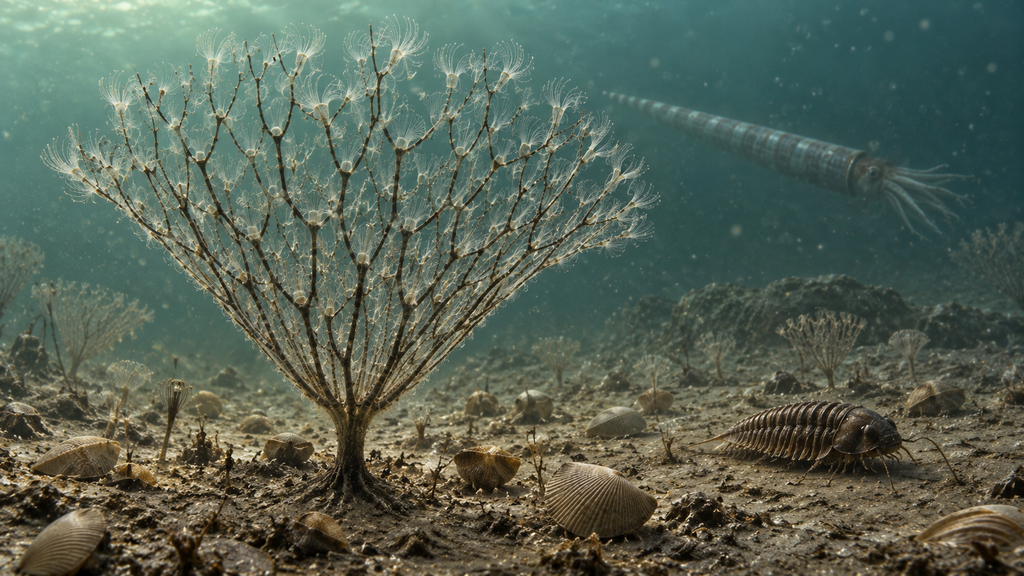
Graptolites had two broad ways of life. The older type rooted itself to the seafloor and raised a branching colony shaped like a fan or a small tree. This group, the dendroid graptolites, appeared in the Cambrian and lasted until the Late Carboniferous. The other type left the seafloor and took up a drifting life in the water column (the graptoloids). They appeared at the start of the Ordovician and became the largest group of animal zooplankton in the Ordovician and Silurian seas. Each individual is thought to have extended its arms outside the tube to gather small particles from the water.
Once they took to drifting, colony shapes became simpler over time. In the Early Ordovician, forms with four hanging branches were common; these gave way to two branches, and in the Middle Ordovician a form appeared in which two branches were fused back to back into a single stalk (Climacograptus and others). By the Silurian, the single-branched Monograptus group had become dominant. Over roughly a hundred million years, the number of branches fell and the arrangement of tubes grew more regular.
The same seas held straight-shelled nautiloids known as orthocones, trilobites, brachiopods, crinoids, and the tabulate corals that built reefs. The black mudstones in which graptolites are so common formed from mud settling on deep, oxygen-poor seafloors. Few bottom-dwelling animals lived in such places, so the graptolite colonies that sank from above piled up almost alone.
Why They Became the Clock of the Strata
Graptolites are prized as index fossils because three conditions came together. Because they drifted, the same species spread widely across continents. Species turned over quickly: in the Ordovician and Silurian, the interval that can be marked off by a single assemblage of species (a biozone) is generally under a million years, and as short as about 300,000 years in some cases. And they were well preserved even in deep-sea mudstones where other fossils rarely survive. Those are the three.
Many of the international boundaries within the Ordovician and Silurian are drawn using changes in the graptolite fauna as the reference line. The base of the Sandbian Stage in the Late Ordovician, for example, is defined by the first appearance of the species Nemagraptus gracilis. This is why strata in Britain, China, North America, and Australia can be matched up along the line of a single species.
Graptolite fossils are also used to measure how much heat a rock layer has experienced. As the organic tube is buried and its temperature rises, it becomes progressively carbonized, and the way it reflects light changes. The principle is the same as measuring the maturity of coal, and in early Paleozoic strata where no coal exists, graptolites take on that role.
The Graptolites That Never Went Extinct
The name graptolite comes from the genus Graptolithus, which Linnaeus used in the first edition of Systema Naturae in 1735. Linnaeus, however, applied the name not to the remains of living things but to markings that had formed on rock surfaces: things that merely looked like fossils. Only in the nineteenth century were they treated as organisms, and for a long time afterward their branching colonies led them to be placed among the hydrozoans, a group close to jellyfish and corals.
The Polish paleontologist Roman Kozłowski changed that view. From earliest Ordovician chert (a siliceous rock) in Poland, Kozłowski extracted graptolites preserved in three dimensions, uncrushed. When he dissolved the rock in acid and examined the surviving organic tubes under a microscope, he could see the banding on the tube walls and the dark cord connecting the individuals. The living animals with the same structures were not hydrozoans but pterobranchs. The work was published in 1949, with the Second World War in between, and it settled the classification of graptolites as hemichordates, a group relatively close to the chordates.
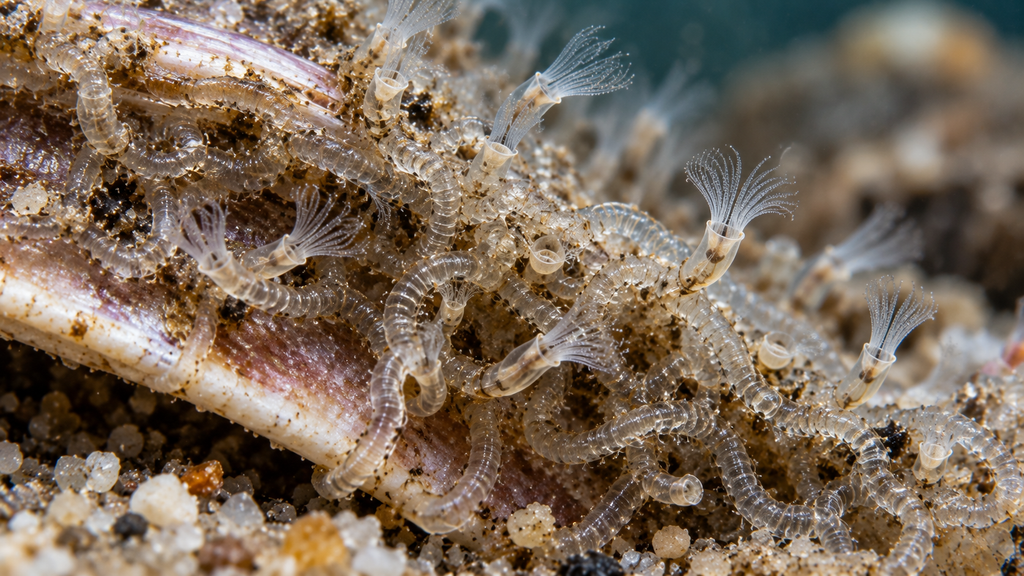
Pterobranchs are colonial animals a few millimeters in size that live in today’s oceans. One of them, Rhabdopleura, was described in 1869 and lives by cementing narrow tubes to the surfaces of rocks and shells. Its tube walls show the same banding as graptolites, its individuals are connected by a dark cord, and its larva builds an initial tube before the colony spreads. For a long time it served as “a living animal that resembles graptolites,” the model for reconstructing the extinct ones.
In 2013, Mitchell and colleagues analyzed the living Rhabdopleura together with the major graptolite groups on a single family tree, based on morphological characters. The result placed Rhabdopleura not outside the graptolites but inside them, among the types that encrust the seafloor. Rhabdopleura possessed every one of the features that unite graptolites as a group. Since that study, Rhabdopleura has been treated not as an animal resembling graptolites but as a graptolite that has survived to the present day. Five species are known, ranging from the intertidal zone to depths of about 900 meters, and from the Arctic to near-Antarctic waters.
This result reshaped the view of graptolite lineage. Both the drifting graptoloids and the seafloor-standing dendroids turn out to have descended from small encrusting colonies that lived on rock, much like Rhabdopleura. In 2025, a graptolite with tube structure closely resembling that of the living Rhabdopleura was reported from early Cambrian strata about 516 million years old, and that form has continued almost unchanged into the modern sea. The showy species that served as the clock of the strata were gone by the Devonian, but the graptolites that kept the original form have been cementing their tubes to the seafloor for 500 million years.
Related products
You can find books and products related to this article on Amazon.
If you buy through the links above, this blog may earn a commission.
References
Mitchell, C.E., Melchin, M.J., Cameron, C.B. & Maletz, J. (2013). Phylogenetic analysis reveals that Rhabdopleura is an extant graptolite. Lethaia, 46, 34–56. https://doi.org/10.1111/j.1502-3931.2012.00319.x
Maletz, J. (2017). Graptolites: fossil and living. Geology Today, 33. https://doi.org/10.1111/gto.12213
Maletz, J. (2014). Graptolite reconstructions and interpretations. Paläontologische Zeitschrift. https://doi.org/10.1007/s12542-014-0234-4
Ramírez-Guerrero, G.M., Kocot, K.M. & Cameron, C.B. (2020). Zooid morphology and molecular phylogeny of the graptolite Rhabdopleura annulata. Canadian Journal of Zoology. https://doi.org/10.1139/cjz-2020-0049
Beli, E., Piraino, S. & Cameron, C.B. (2017). Fossilization processes of graptolites: insights from the experimental decay of Rhabdopleura sp. Palaeontology. https://doi.org/10.1111/pala.12290
Nanglu, K. et al. (2023). Rhabdopleurid epibionts from the Ordovician Fezouata Shale biota and the longevity of cross-phylum interactions. Communications Biology. https://doi.org/10.1038/s42003-023-05377-x
A new graptolite (Pterobranchia) from the early Cambrian Xiaoshiba Lagerstätte of China. Swiss Journal of Palaeontology. https://doi.org/10.1186/s13358-025-00406-0
コメント