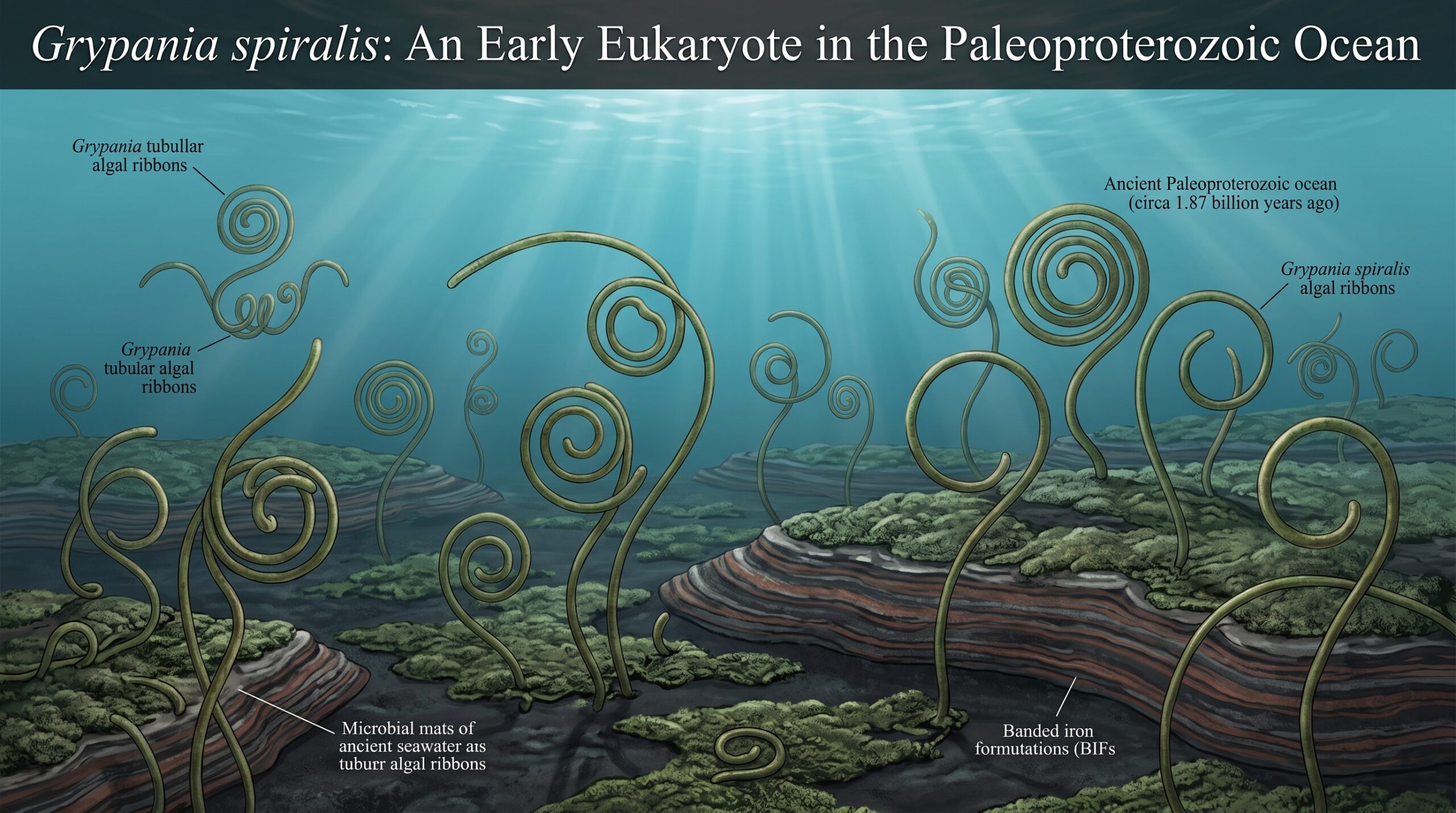

| Name | Grypania, apparently from a Greek word meaning “curved.” The representative species is Grypania spiralis (spiralis = coiled) |
| Classification | Undetermined. One view holds it to be a eukaryotic alga, another a cyanobacterium |
| Age | From about 1.87 billion years ago (Paleoproterozoic) to about 600 million years ago (Ediacaran) |
| Found in | Michigan, USA (the oldest locality), Montana, central India, and northern and southern China |
| Size | Ribbon width 0.5 to 2 mm; coil diameter around 1 to 2 cm. Uncoiled length reaches about 9 cm in the Michigan specimens, with reports of up to 60 cm at other localities |
Grypania is a Proterozoic organism preserved in rock as a ribbon wound into a coil. As fossils go, it is among the oldest large enough to see without a microscope, and it is often cited in the history of life as the marker for when organisms of visible size appeared. What kind of organism it was, however, remains undecided more than 120 years after its discovery.
Form and way of life
What survives as fossil is a thin, dark carbonaceous film. A single unbranched ribbon clings to the surface of mudstone in various configurations — coiled, C-shaped, S-shaped, or nearly straight. The scattered range of shapes is thought to reflect different ways the body collapsed when it fell to the seafloor after death, and a 2016 re-examination of Chinese specimens grouped them all into a single species on the grounds that intermediate forms occur continuously between them.
Because some specimens preserve traces where the ribbon twisted and folded, the body in life is reconstructed not as a flat band but as a soft cylinder: a slender tube 1 to 2 mm thick extending up to tens of centimeters. Reconstructions have been proposed in which it attached to the seafloor and floated its body up into the water to catch light, but no part corresponding to a root or holdfast has been found in the fossils.
That it photosynthesized is broadly accepted by both the eukaryotic-alga camp and the bacterial camp. There were almost no other organisms of visible size in the sea at the time, and what occurs in the same strata is mainly bacterial mats and stromatolites. The oldest locality, the Negaunee Iron Formation in Michigan, is a banded iron formation produced when iron dissolved in seawater combined with oxygen and precipitated, and several hundred specimens were collected from an open-pit iron mine. The organism was living on site at the time oxygen was beginning to increase in the ocean.
From worm trail to alga, from alga to bacterium
The first to describe Grypania fossils was the American geologist Charles Walcott. In 1899 he reported coiled marks from the Belt Supergroup in Montana as trace fossils left by a worm-like animal crawling over mud. If they were animal traces, the origin of animals would reach back more than a billion years further.
That interpretation was overturned in 1976. Walter, Oehler and Oehler re-examined the same specimens and concluded they were not animal traces but a large alga, the body itself preserved as a carbonaceous film. The genus name Grypania was applied at this point. The grounds for treating it as a eukaryote — a cell with a nucleus, hence an alga — were that the coil diameter and the manner of coiling are consistent from specimen to specimen, and that it is orders of magnitude too large for a bacterium.
In 1992, Han and Runnegar reported several hundred specimens from the Michigan iron formation in Science, dating them, on the age estimates of the time, to 2.1 billion years (volcanic rocks were re-dated in 2002, and the current figure is about 1.87 billion years). Several hundred million years older than any locality previously known, it drew attention as a fossil pushing the origin of eukaryotes to the earliest point yet.
Then in 2009, Sharma and Shukla, examining specimens from the Rohtas Formation in central India, reached the opposite conclusion. On the grounds that hollow filamentous sheaths and filaments with cell-like partitions occur in the same strata, they judged it most likely that Grypania belonged with the cyanobacteria. Well-preserved Indian and Chinese specimens show fine striations crossing the ribbon; the eukaryotic-alga view reads these as internal partitions, and the bacterial view as the cell boundaries seen in filamentous cyanobacteria. The same striations are being read by both sides as evidence in their own favor.
There is no clincher because the fossils are flattened into carbonaceous films. Structures that would decisively separate eukaryote from bacterium, such as a nucleus or a cell wall, are not visible. What survives is size and shape alone — the size suggesting a eukaryotic alga, the shape suggesting a filamentous bacterium. The interpretation has changed three times, from worm trail to alga to bacterium, and the usual treatment now is to lead with the eukaryotic-alga view while noting the bacterial one alongside it.


Sources
Walter, Oehler & Oehler (1976) Megascopic algae 1,300 million years old from the Belt supergroup, Montana: a reinterpretation of Walcott’s Helminthoidichnites (Journal of Paleontology)
Han & Runnegar (1992) Megascopic eukaryotic algae from the 2.1-billion-year-old Negaunee Iron-Formation, Michigan (Science)
Schneider et al. (2002) Age of volcanic rocks and syndepositional iron formations, Marquette Range Supergroup (Canadian Journal of Earth Sciences)
Kumar et al. (2004) Pb–Pb age of earliest megascopic, eukaryotic alga bearing Rohtas Formation, Vindhyan Supergroup, India (Precambrian Research)
Sharma & Shukla (2009) Taxonomy and affinity of Early Mesoproterozoic megascopic helically coiled and related fossils from the Rohtas Formation, the Vindhyan Supergroup, India (Precambrian Research)
Wang, Wang & Du (2016) The long-ranging macroalga Grypania spiralis from the Ediacaran Doushantuo Formation, Guizhou, South China (Alcheringa)
Michigan Department of Environment, Great Lakes, and Energy: Oldest Fossil Found in Michigan
コメント