This article contains affiliate links. As an Amazon Associate I earn from qualifying purchases.
| Name | Megarachne servinei. The genus name is Greek for “great spider” |
| Classification | Arthropod, chelicerate, eurypterid (sea scorpion). Placed in the same family as Woodwardopterus from Scotland (not a spider) |
| Age | Latest Carboniferous (about 300 million years ago). The rocks may reach into the earliest Permian |
| Location | San Luis Province, Argentina. Pallero Member of the Bajo de Véliz Formation |
| Length | About 54 cm, based on the 2005 reconstruction. The carapace covering the head is about 17 cm long |
| Known fossils | Two specimens: the one described in 1980 (the carapace and the body plates behind it) and a second carapace later found in the same rock layer |
| Specimens | Museum of Paleontology, National University of Córdoba, Argentina |
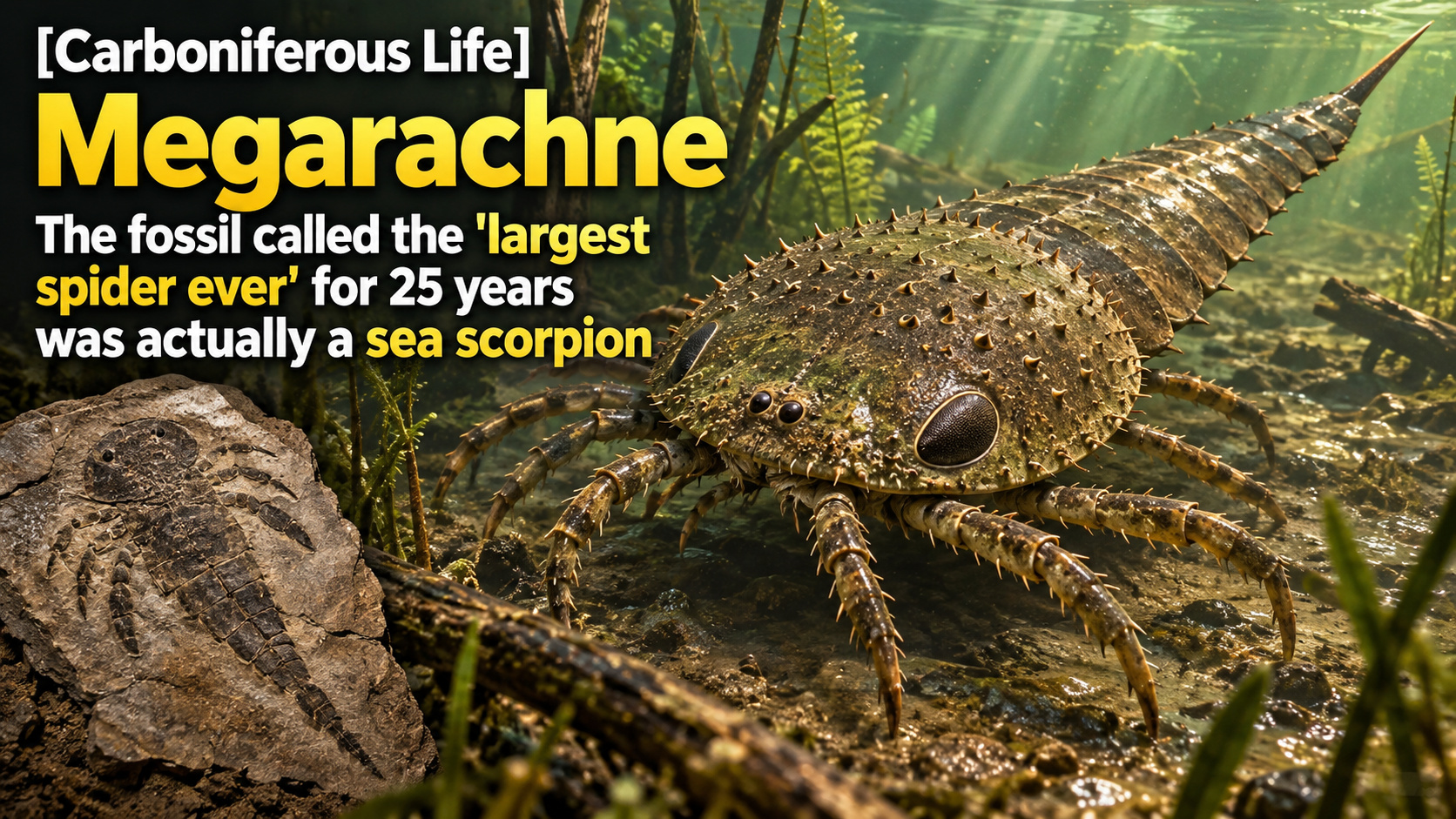
Megarachne was a sea scorpion that lived in the lakes and wetlands of South America near the end of the Carboniferous. It was described in 1980 as the largest spider that ever lived, and plaster casts of the fossil went on display in museums around the world. A new study in 2005 showed that it was a sea scorpion, not a spider.
Appearance and Way of Life
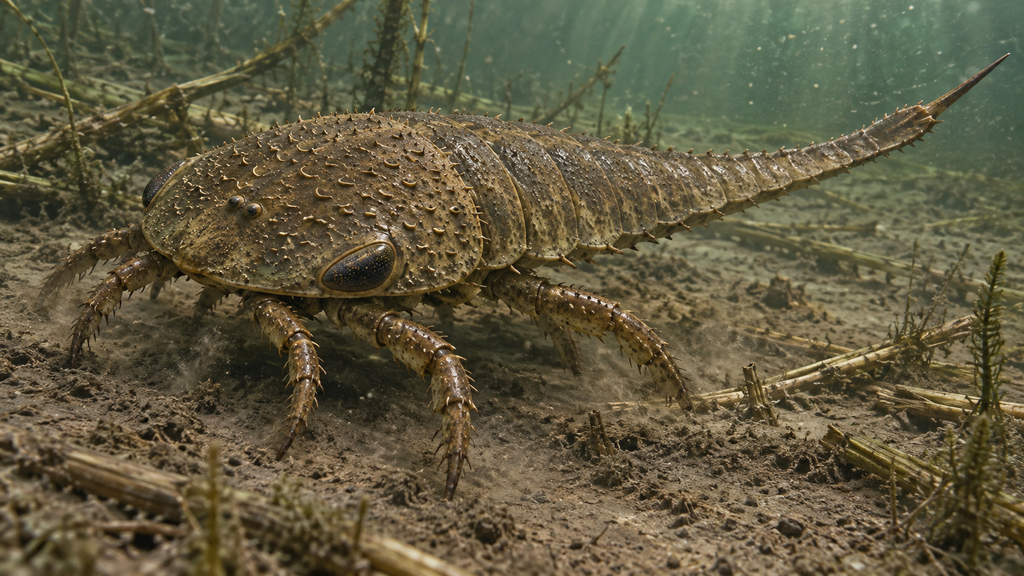
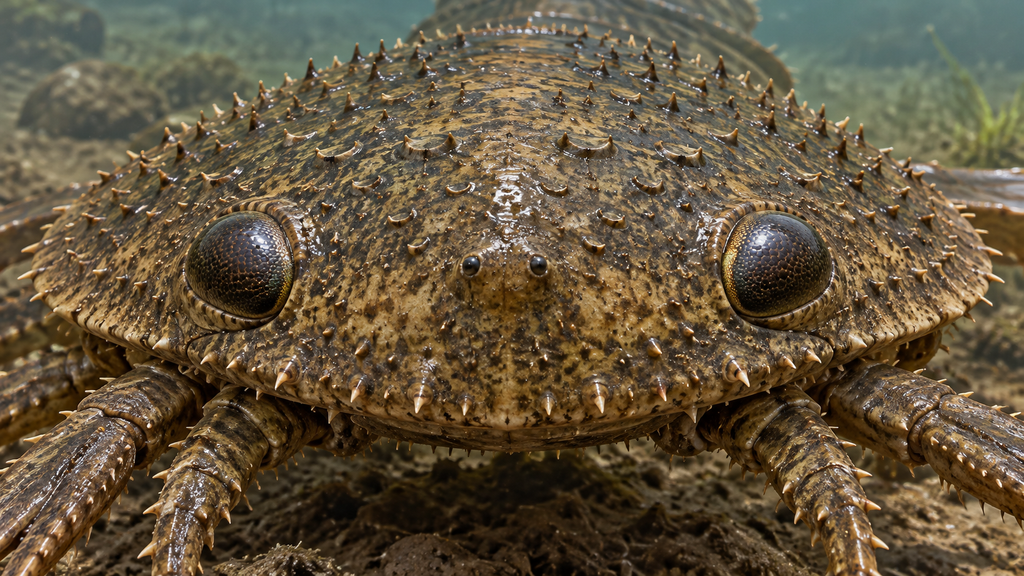
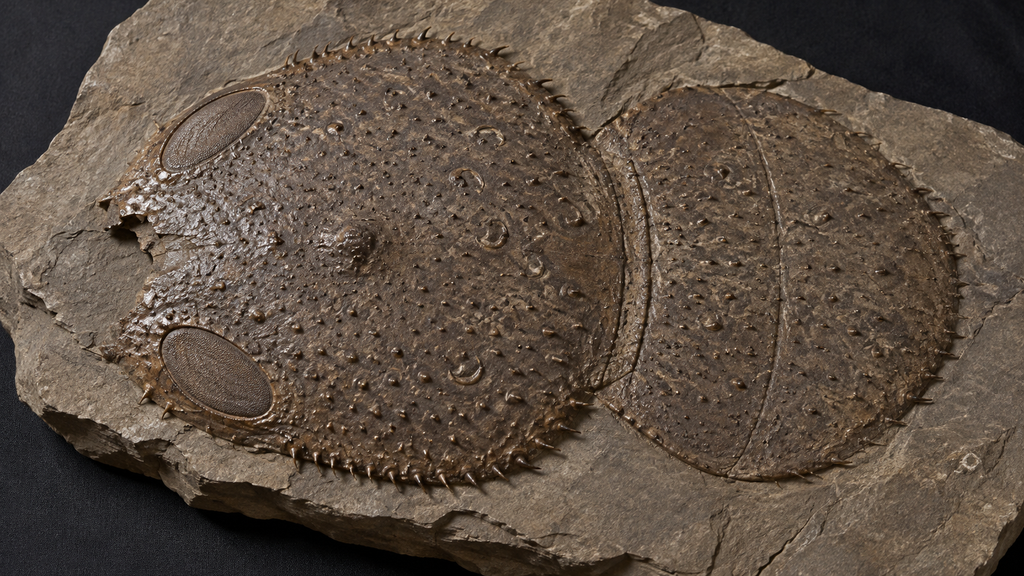
The front of Megarachne‘s body was covered by a broad, rounded carapace, followed by a body made of overlapping plates. The surface of the carapace is crowded with tiny spines and small raised crescent-shaped bumps. This kind of ornament is typical of sea scorpions and is not found on spiders. A low bump in the middle of the carapace carries a small pair of eyes, and a large kidney-shaped eye sits on either side.
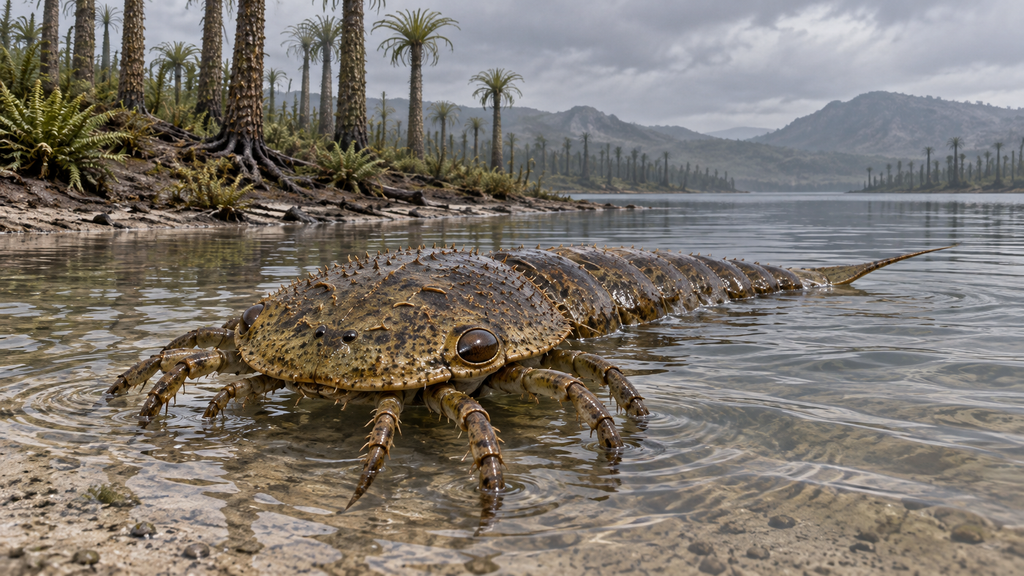
The fossils mainly preserve the carapace and body plates seen from above, and the legs as a whole are unknown. The tail and legs in the main image are filled in from close relatives. Sea scorpions fall into two broad groups: slender swimmers, and walkers that moved along the sea floor or lake bed on their legs. Megarachne belongs to the walkers and is thought to have lived on the bottom like its relatives Woodwardopterus and Hibbertopterus.
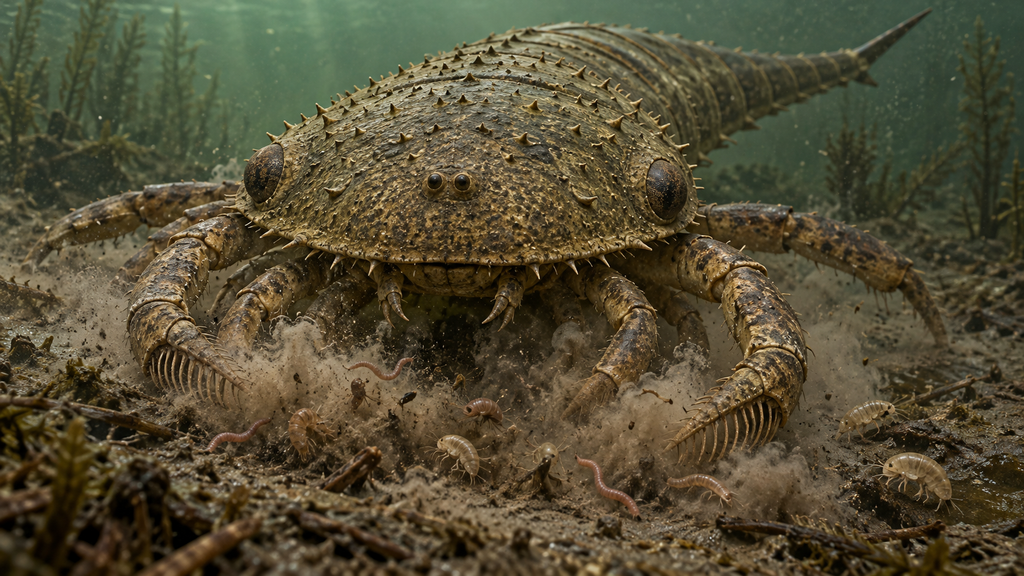
The legs of those relatives carry blade-like structures and rows of comb-like spines. The 2005 paper suggests that Megarachne may likewise have raked the mud of the lake bed with its legs and sieved out small animals living in it. Paul Selden of the University of Manchester, the paper’s first author, said that if you had to compare it with a living animal, you would choose a large crab or lobster, not a spider.
Despite the name “sea scorpion,” the rocks that hold Megarachne were laid down in rivers and lakes, not in the sea. The same rocks have yielded insect wings, fossils of lycopsids and seed ferns, and Gondwanarachne, a trigonotarbid, an extinct arachnid group related to spiders. South America was then part of the southern supercontinent Gondwana, and ice sheets covered the regions closer to the South Pole.
Among sea scorpions, Megarachne was not especially large. The Devonian Jaekelopterus is estimated to have reached around 2.5 m.
Twenty-Five Years as the Largest Spider
Megarachne was described by the Argentine paleontologist Mario Hünicken. In his 1980 paper he identified the fossil as a giant mygalomorph spider, the group that includes tarantulas. He estimated a body length of 33.9 cm and a leg span of about 50 cm, well beyond the roughly 30 cm leg span of the Goliath birdeater, one of the largest living spiders. That made it the largest spider ever known.
The identification rested on the shape of the carapace, the position of the bump bearing the eyes, a projection at the front of the carapace read as a pair of chelicerae (the fanged mouthparts of a spider), and a round structure at the back read as the abdomen. Because most of the fossil was buried in rock, Hünicken also took X-rays and interpreted the curved lines in them as fangs, a sternum and the bases of the legs. A reconstruction of a giant spider followed, and plaster casts of the fossil were eagerly acquired by museums around the world for their displays.
Some arachnologists raised doubts in 1989 and 1990. The ornament on the carapace did not look like a spider’s, a suture ran across the carapace, the front edge of the supposed chelicerae was shaped like a spade, and none of the features that define spiders could be seen in the fossil. Checking, however, was difficult: the original specimen had been deposited in a bank vault, where other researchers could not easily study it.
The holotype was later moved to the Museum of Paleontology at the National University of Córdoba, and a second specimen turned up at the same site and in the same rock layer. Selden studied both together with the Argentine arachnologist José Corronca and with Hünicken himself, and the three published their results in 2005 in Biology Letters, a journal of the Royal Society.
Their conclusion was that Megarachne was a sea scorpion, not a spider. Its eyes were a small central pair and a large pair at the sides, not a spider’s cluster of small eyes. The projection taken for chelicerae was part of the carapace with broken edges, and the surface ornament ran across it without a break. The supposed abdomen was the second plate on the back of the body. The curved lines in the X-rays that looked like fangs and a sternum were fractures along boundaries between thicker and thinner rock, and said nothing about the animal’s anatomy. The spines and crescent-shaped bumps on the carapace matched those of Woodwardopterus from the Carboniferous of Scotland, and the paper placed the two in the same family.
Under the rules of zoological naming, the first name given to an animal stays even when its identity turns out to be different. So Megarachne, the “great spider,” keeps its name and is now treated as a sea scorpion. The paper describes it as the most complete sea scorpion yet found in the Carboniferous rocks of South America. The title of largest spider went back to the living Goliath birdeater.
Related products
You can find books and products related to this article on Amazon.
If you buy through the links above, this blog may earn a commission.
Sources
Selden, P. A., Corronca, J. A. & Hünicken, M. A. (2005). The true identity of the supposed giant fossil spider Megarachne. Biology Letters 1(1), 44–48. https://doi.org/10.1098/rsbl.2004.0272
Hünicken, M. A. (1980). A giant fossil spider (Megarachne servinei) from Bajo de Véliz, Upper Carboniferous, Argentina. Boletín de la Academia Nacional de Ciencias, Córdoba 53, 317–341.
ScienceDaily (University of Manchester news release). Biggest Spider In The World – NOT! (23 February 2005). https://www.sciencedaily.com/releases/2005/02/050222192426.htm

コメント